
20% of all world oil passes through a 33km-wide corridor between Iran and Oman. If that corridor closes, your gasoline triples, cooking gas disappears, and the global economy collapses within weeks. In March 2026, this is happening. And unlike previous oil crises — 1973, 1979, 1990 — this one involves the most dangerous combination yet: active war with precision weapons, retaliation against civilian gas infrastructure, and the largest naval concentration in the Gulf since the Iraq War.
The Strait of Hormuz: The World's Funnel
| Data | Value |
|---|---|
| Width | 33 km (21 miles) |
| Navigable depth | 2 lanes of 3 km each |
| Oil throughput | ~21 million barrels/day |
| % of world oil | ~20-25% |
| Liquefied natural gas | ~25% of world LNG |
| Dependent countries | Japan, South Korea, China, India, Europe |
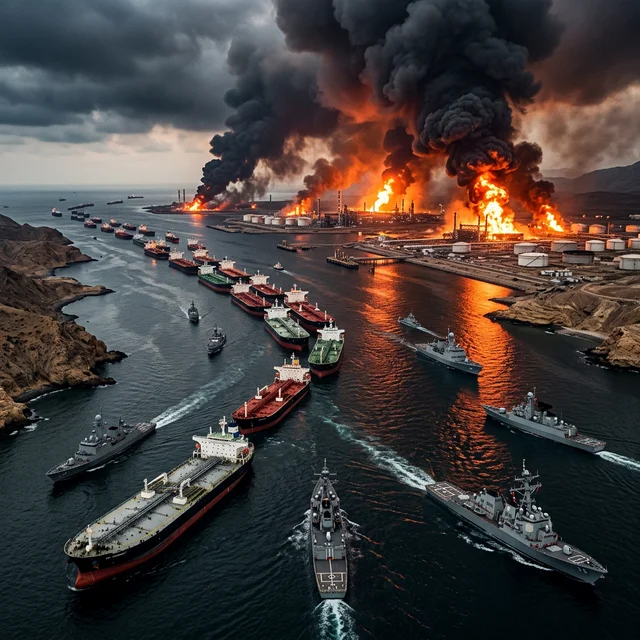
The Strait of Hormuz is perhaps the most strategic point on Earth. At just 33 km wide at its narrowest, it connects the Persian Gulf to the Gulf of Oman and from there to the world's oceans. The actual navigable channel is even narrower: two 3km "lanes" — one inbound, one outbound — separated by a 3km buffer. Through this chokepoint pass between 15 and 21 million barrels of oil per day, plus a colossal share of the world's LNG.
To put it in perspective: if Hormuz closes for one week, the global economy loses $147 billion in trade value. If it closes for one month, recession is inevitable in 80% of G20 economies.
Crisis Timeline (Feb-Mar 2026)
| Date | Event |
|---|---|
| Late Feb | US and Israel launch massive strikes against Iran (Op. Roaring Lion) |
| Mar 1 | Iran retaliates with missiles and drones against UAE |
| Mar 2 | Iran attacks Qatar gas facilities — production halted |
| Mar 3 | European gas price surges 45% |
| Mar 3 | Iran announces Strait of Hormuz blockade |
| Mar 3-4 | Strait navigation virtually paralyzed |
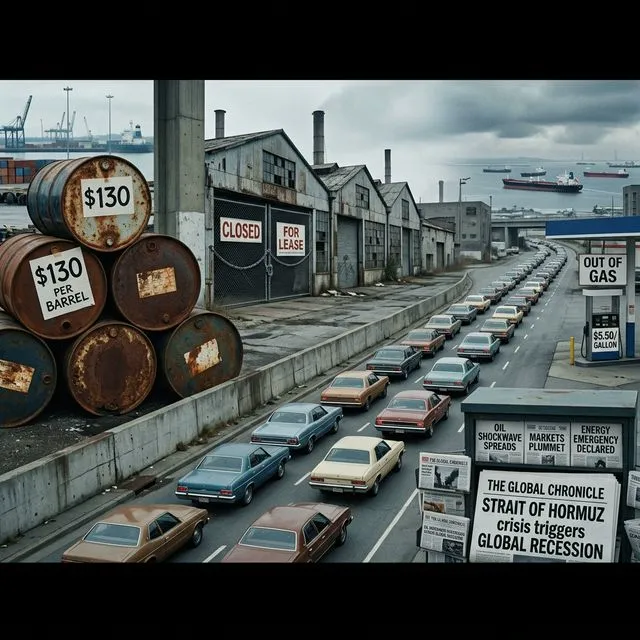
| Mar 4 | Oil surpasses $150/barrel, heading toward $200 |
How We Got Here
The escalation followed a predictable pattern analysts had been warning about for years. After months of tension over Iran's nuclear program, the US-Israeli decision to launch Operation Roaring Lion — a series of surgical strikes against Iranian nuclear and military facilities — crossed the red line Tehran had always warned would result in a Strait blockade. Iran kept its promise. And went further: by attacking Qatar (historically neutral), it signaled that no Gulf state would be safe.
Immediate Global Impact
Oil Price Scenarios
| Scenario | Estimated Price | Impact |
|---|---|---|
| Pre-crisis | $75-85/barrel | Normal |
| Partial blockade | $150-180/barrel | Moderate recession |
| Full blockade | $200-300/barrel | Economic collapse |
| Prolonged conflict | $300+/barrel | Global depression |
At the Gas Pump
| Item | Current Price (US) | Full Blockade Scenario |
|---|---|---|
| Gasoline | $3.50/gallon | $8-10/gallon |
| Diesel | $4.00/gallon | $9-12/gallon |
| Heating oil | $3.80/gallon | $8-11/gallon |
| Airline tickets | Varies | +80-120% |
| Food prices | Normal index | +30-50% (transport) |
Supply Chain Cascade Effect
The impact goes far beyond pump prices. Global interdependence means Hormuz closure triggers cascading effects:
- Chemical sector: 40% of global petrochemicals use Gulf feedstock — plastics, fertilizers, and medicines at risk
- Agriculture: Petroleum-based fertilizers spike, threatening world crops. Wheat rises 25% in the first week
- Industry: Factories dependent on resins, polymers, and petrochemical compounds slow or halt
- Aviation: Jet fuel triples, forcing airlines to cancel flights and reduce routes
- Maritime freight: Lloyd's insurance for Gulf vessels surges 400%, making routes economically unviable
Who Loses Most?
| Country/Region | Hormuz Dependency | Risk |
|---|---|---|
| Japan | ~80% of oil imports | 🔴 Critical |
| South Korea | ~70% | 🔴 Critical |
| India | ~60% | 🔴 High |
| China | ~40% | 🟡 High |
| Europe | ~30% (Qatar gas) | 🟡 High |
| USA | Nearly self-sufficient | 🟢 Low (but price rises) |
The American Paradox
The US is virtually oil self-sufficient since the shale oil revolution. But this doesn't protect it: oil is a global commodity, and its price is set by international markets. When Hormuz closes, the barrel price rises for EVERYONE — including Americans who produce their own oil. American producers profit; American consumers pay.
Military Response
Naval Forces in the Strait (Mar 2026)
| Country | Assets | Objective |
|---|---|---|
| USA | 2 carrier groups | Ensure navigation |
| UK | Frigates + minesweepers | Ship protection |
| France | 1 frigate + submarine | NATO support |
| Iran | Fast boats + naval mines | Blockade |
| China | Destroyers in region | Protect Chinese vessels |
The Naval Mine Threat
Iran possesses an estimated arsenal of 5,000 to 10,000 naval mines. Scattering mines across the Strait — an operation that can be done in hours — would make navigation impossible for weeks, even after a ceasefire. Mine clearance (minesweeping) is one of the slowest and most dangerous naval operations. In the 1991 Gulf War, the US Navy took months to clear a fraction of the Gulf.
Historical Lessons: Previous Oil Crises
| Crisis | Year | Cause | Price Impact | Duration |
|---|---|---|---|---|
| OPEC Embargo | 1973 | Yom Kippur War | +300% | 6 months |
| Iranian Revolution | 1979 | Shah's fall | +150% | 12 months |
| Kuwait Invasion | 1990 | Saddam Hussein | +130% | 4 months |
| Hormuz 2026 | 2026 | US/Israel vs Iran | +200%+ | Ongoing |
The 1973 crisis caused gas station lines in the US for months and accelerated the search for fuel-efficient cars. 1979 generated the decade's second global recession. 1990 was quickly contained by American military intervention. The 2026 crisis combines elements of all three — and is potentially worse, because it involves direct attacks on a neutral producer (Qatar) and naval mines that can persist for months.
Qatar: The Forgotten Victim
Qatar, until weeks ago one of the world's wealthiest nations per capita, saw its LNG facilities attacked by Iran.
| Impact | Data |
|---|---|
| Gas production | Halted |
| European gas price | +45% in 24 hours |
| LNG contracts affected | Japan, Korea, Europe |
| Qatar revenue | In collapse |
| Estimated reconstruction | $30-50 billion |
| Time to restore | 6-18 months |
The attack on Qatar is perhaps the crisis's most significant event. The country is the world's largest LNG exporter and supplies gas to Europe, Japan, and South Korea. By attacking it, Iran demonstrated that even countries "protected" by American bases (US CENTCOM is headquartered in Qatar) are not immune.
The Energy Transition Accelerated
Every oil crisis in history has accelerated investment in alternatives. This one will be no different:
| Effect | Timeline |
|---|---|
| Solar/wind: Investment triples in Hormuz-dependent countries | 6-12 months |
| Electric vehicles: Sales explode as gasoline triples | Immediate |
| Green hydrogen: Previously "unviable" projects receive emergency funding | 12-24 months |
| Nuclear: Debate reopened in Germany, Italy, and Australia | 6-18 months |
| Strategic reserves: Countries build larger oil stockpiles | 12-36 months |
Possible Scenarios
| Scenario | Probability | Outcome |
|---|---|---|
| Diplomatic de-escalation | 20% | Oil returns to $100 within weeks |
| Contained conflict | 40% | Oil $150-180 for months |
| Regional escalation | 30% | Global recession, $200+/barrel |
| Nuclear conflict | 10% | Civilizational catastrophe |
China's Role
China depends on 40% of its oil from the Gulf but is also Iran's main trading partner. Beijing is in a delicate position: publicly condemning American strikes while privately negotiating with Tehran to reopen the Strait. Analysts suggest China is the only actor with sufficient leverage over Iran to force de-escalation — but the price will be steep: American concessions on Taiwan.
Conclusion: 33 Km That Control the World
The Strait of Hormuz is modern civilization's most vulnerable point. A 33km corridor controls 20% of the world's oil. When it closes, everything stops: factories, planes, food trucks, power generators.
History teaches that every oil crisis eventually ends — but not without leaving scars. The 1973 crisis redesigned energy geopolitics for 50 years. The 2026 crisis may be the event that finally breaks the world's dependence on fossil fuels.
Or it may be the event that breaks the world economy first.
And now it's closing.


