458 bodies recovered in Bucha — some with hands tied behind their backs and bullets in the head. Up to 600 people killed under the rubble of a theater where the word "CHILDREN" had been painted on the ground, visible from satellite. 58 civilians massacred at a train station while trying to flee — including 7 children — by a missile bearing the inscription "FOR THE CHILDREN." These are the three massacres that defined the nature of Russia's war against Ukraine: not a military operation, but a systematic campaign of terror against civilians. This article reconstructs, minute by minute, the horrors of Bucha, Mariupol, and Kramatorsk — based on reports from the UN, Amnesty International, Human Rights Watch, the International Criminal Court, and award-winning journalism.
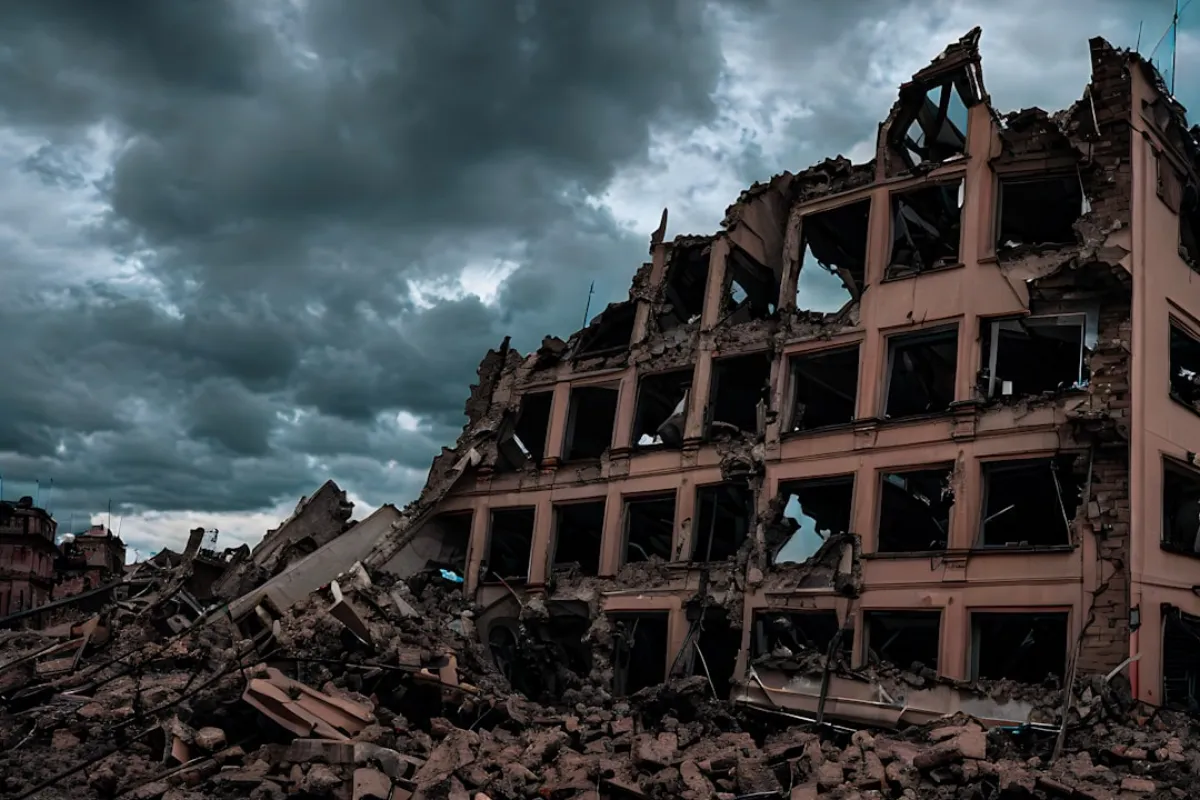
Bucha: The Horror in the Streets of a Kyiv Suburb
The Occupation
Bucha was a peaceful bedroom community, just 30 kilometers northwest of Kyiv. With around 37,000 inhabitants before the war, it was known for its parks, tree-lined streets, and family atmosphere. Everything changed on February 26, 2022, just two days after the Russian invasion, when troops of the Russian Federation occupied the city.
The occupation lasted 33 days — from February 26 to March 30, 2022. During this period, the city was completely cut off from the outside world. No electricity, no water, no communications. Residents who couldn't flee in time were trapped in their basements, unaware of what was happening on the surface.
The 33 Days of Terror
What happened in Bucha during those 33 days was reconstructed by investigators from the UN, Amnesty International, and investigative journalism teams, including an award-winning investigation by the New York Times that identified the responsible Russian military unit: the 234th Guards Air Assault Regiment.
| Date | Event |
|---|---|
| 02/26/2022 | Russian troops occupy Bucha |
| 03/04/2022 | First reports of executions of unarmed civilians |
| 03/05/2022 | Russian snipers open fire on civilians without apparent reason |
| 03/06/2022 | Shelling intensified; residents seek shelter in basements |
| 03/12/2022 | Full Russian control. Residents bury 67 people in a mass grave near a church |
| 03/29/2022 | Ukrainian forces regain control |
| 03/30-31/2022 | Russian troops withdraw |
| 04/01/2022 | First images of the horrors emerge |
| 04/03/2022 | Mayor Anatoly Fedoruk announces 280 people buried in mass graves |
What the World Saw
When cameras entered Bucha in April 2022, the images shocked the world. Bodies of civilians lay in the streets — in civilian clothing, some on bicycles, others fallen on the sidewalk as if they had simply been walking when they were shot. The evidence of summary executions was unequivocal.
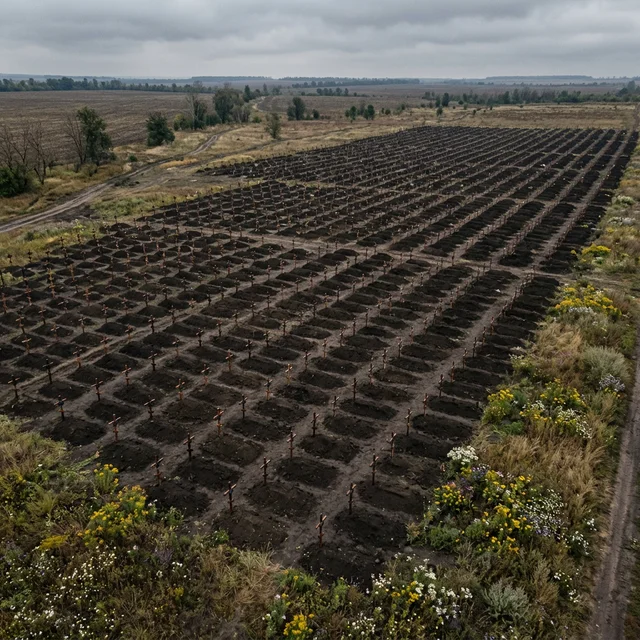
The Numbers of Bucha
| Data | Value |
|---|---|
| Bodies recovered | 458 |
| Children among victims | 9 (under 18) |
| Killed with weapons | 419 of 458 bodies |
| With hands tied | Dozens of victims found with restraints |
| Men and boys | 88% of summary executions |
| Executions documented by UN | 73 confirmed + 105 under investigation |
| Buried in mass graves | Hundreds |
The details are terrifying. Many victims were found with hands tied behind their backs and bullets in the back of the head — a classic indicator of summary execution. Others had gunshot wounds to the knees, suggesting torture before execution. Snipers shot civilians who were simply walking down the street, without any military justification.
Sexual violence against women and girls was also documented by the UN and Amnesty International, adding yet another layer of horror to what was already a catalog of atrocities.
The New York Times Investigation
One of the most important investigations into Bucha was conducted by the New York Times, which used phone records, captured documents, interviews with survivors, and video analysis to identify the Russian military unit responsible for most of the killings: the 234th Guards Air Assault Regiment.
Amnesty International also found evidence of highly specialized ammunition at the scene — a type of projectile used exclusively by specific Russian military units, reinforcing the identification of those responsible.
Russia's Response
Russia denied all accusations, calling the images from Bucha a "heinous provocation by Ukrainian radicals." Moscow claimed that all civilians were alive when Russian troops withdrew on March 30. However, satellite images from Maxar Technologies proved that many bodies had been in the streets weeks before the Russian withdrawal — destroying Moscow's narrative.
Mariupol: The Theater Where "CHILDREN" Meant Nothing
The Besieged City
If Bucha was the symbol of summary executions, Mariupol became the symbol of medieval siege in the 21st century. The port city in southeastern Ukraine, with 431,000 inhabitants before the war, was subjected to a brutal siege lasting nearly three months (February to May 2022).
The siege cut off all supplies — food, water, electricity, medicine. Residents were forced to melt snow to drink, burn furniture for warmth, and bury the dead in backyards because it was impossible to reach cemeteries.
The Theater: Refuge of the Innocent
The Donetsk Regional Academic Drama Theater, in the center of Mariupol, became one of the city's main civilian shelters. Hundreds of women, children, and elderly sheltered inside — on the stage, in the wings, in dressing rooms, in hallways.
To ensure the building was identifiable from the air as a civilian shelter, residents painted on the ground around the theater, in giant letters visible from satellite, the word in Russian: "ДЕТИ" — "CHILDREN."
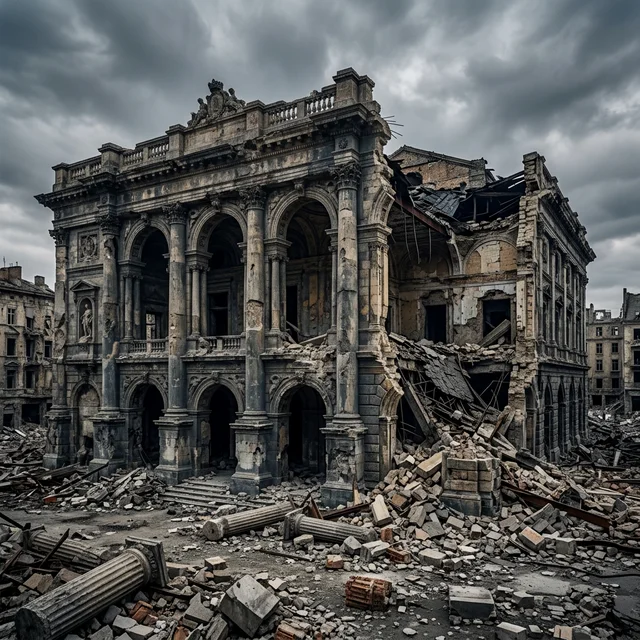
The Attack: March 16, 2022
On the morning of March 16, 2022, the Russian Air Force dropped what Amnesty International identified as two 500 kg bombs on the theater. The building collapsed on hundreds of civilians.
| Attack Data | Detail |
|---|---|
| Date | March 16, 2022 |
| Type of attack | Aerial bombing (Russian fighters) |
| Munitions | Two 500 kg bombs |
| Sheltering civilians | Hundreds (estimates range from 500 to 1,200) |
| Estimated dead (City Council) | ~300 |
| Estimated dead (AP) | Up to 600 |
| Confirmed dead (Amnesty) | At least 12 (+ "likely many more") |
| Word "CHILDREN" visible | Yes — confirmed by satellite imagery |
Amnesty International conducted an exhaustive investigation and concluded the attack constituted a war crime, stating that Russian military forces deliberately targeted the theater despite knowing hundreds of civilians were sheltering there. The fact that the word "CHILDREN" was written in a manner visible from space makes it impossible to claim ignorance.
Survivors
Some survivors emerged from the theater's basement, which partially withstood the impact. One mother recounted pulling her young daughter from the rubble. But many — perhaps most — were never found. The theater's rubble became their tomb.
The Complete Destruction of Mariupol
The theater bombing was just one episode of the broader siege. When Russian forces finally conquered Mariupol in May 2022:
- 90% of residential buildings were damaged or destroyed
- The population fell from 431,000 to less than 100,000
- Estimates of civilians killed during the siege range from 22,000 to 25,000
- The last pocket of resistance was the Azovstal Steel Plant, where soldiers and civilians held out until May 20
Kramatorsk: The "For the Children" Missile
The Interrupted Evacuation
If Bucha was summary executions and Mariupol was siege, Kramatorsk was the calculated precision of an attack on those who were fleeing. On April 8, 2022, between 1,000 and 4,000 civilians — predominantly women, children, and elderly — were gathered at the Kramatorsk railway station in eastern Ukraine. They were waiting for evacuation trains to escape the intensifying shelling in the Donbas region.
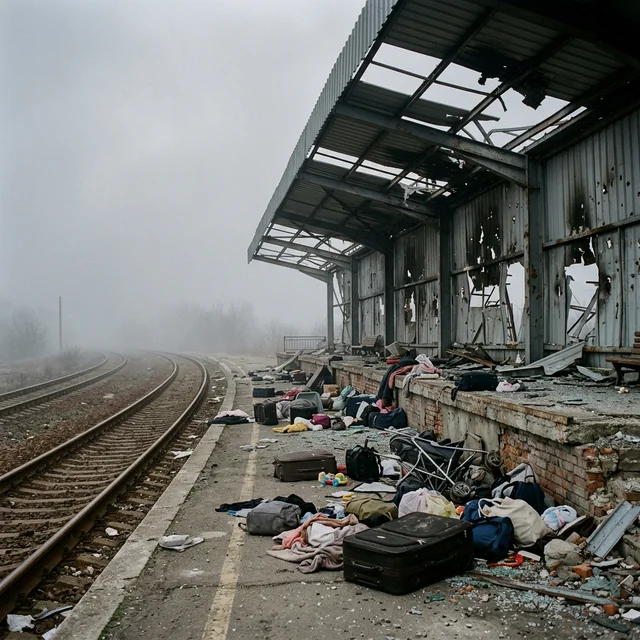
The Attack
At 10:30 AM, a Tochka-U short-range ballistic missile struck the station. The explosion was devastating — cluster munitions scattered shrapnel for hundreds of meters, cutting down lives on the crowded platform.
| Data | Value |
|---|---|
| Date and time | April 8, 2022, ~10:30 AM |
| Missile type | Tochka-U (SS-21 Scarab) |
| Dead | 58+ civilians (Human Rights Watch) |
| Children killed | 7 (including 2 who died in hospital) |
| Injured | 109-150+ people |
| Children injured | 34 |
| Civilians at station | 1,000 to 4,000 |
| Typical injuries | Amputations, shrapnel, burns |
The Macabre Inscription
What made the Kramatorsk attack particularly shocking — beyond targeting a civilian evacuation station — was the inscription on the missile's body: in Russian, "ЗА ДЕТЕЙ" — "FOR THE CHILDREN" — a message that transforms the attack from an act of war into a declaration of hatred.
Human Rights Watch documented the attack and concluded that all 58+ dead were civilians — there were no legitimate military targets at the station. The attack was classified as a probable war crime.
Russia and the Missile
Russia initially denied the attack, but evidence showed that Russian forces were the only ones operating Tochka-U missiles in the region at that time. Independent investigations confirmed the Russian origin of the missile.
Patterns of Horror: Comparative Analysis
The three massacres, although different in method, reveal a systematic pattern of attacks on civilians:
| Aspect | Bucha | Mariupol (Theater) | Kramatorsk |
|---|---|---|---|
| Date | Feb-Mar 2022 | 03/16/2022 | 04/08/2022 |
| Method | Summary executions | Aerial bombing | Ballistic missile |
| Target | Civilians in homes | Marked civilian shelter | Evacuation station |
| Dead | 458 recovered | 300-600 estimated | 58+ confirmed |
| Children | 9 under 18 | Dozens (uncounted) | 7 killed + 34 injured |
| War crime | Confirmed (UN/Amnesty) | Confirmed (Amnesty) | Probable (HRW) |
| Russian unit identified | 234th Regiment (NYT) | Russian Air Force | Russian ground forces |
| Russian response | "Ukrainian provocation" | Denies responsibility | Denies responsibility |
The pattern is clear: deliberate attacks on unprotected civilian populations, using methods ranging from the brutal intimacy of a point-blank execution to the technological coldness of a ballistic missile launched from dozens of kilometers away.
The International Response: Justice or Impunity?
The Arrest Warrant Against Putin
In March 2023, the International Criminal Court (ICC) issued an arrest warrant against President Vladimir Putin — not for Bucha, Mariupol, or Kramatorsk directly, but for the illegal deportation of Ukrainian children to Russia. Russia's Commissioner for Children's Rights, Maria Lvova-Belova, was also indicted.
Ongoing Investigations
| Body | Action |
|---|---|
| ICC | Warrant against Putin. Ongoing investigations into war crimes |
| UN (OHCHR) | Documented hundreds of civilian deaths. Detailed reports on Bucha |
| Amnesty International | Complete investigation into Mariupol theater. War crime confirmed |
| Human Rights Watch | Documented Kramatorsk. At least 58 civilians killed |
| Ukraine Prosecutor General | Over 120,000 war crime incidents registered through 2026 |
| EU Special Team | Technical assistance to Ukrainian investigation |
The Question of Impunity
The great challenge of international justice is that the ICC has no police force of its own. Putin can only be arrested if he sets foot in one of the 123 ICC member countries. Furthermore, Russia does not recognize the court's jurisdiction.
The precedent, however, is powerful: Slobodan Milošević (Serbia), Charles Taylor (Liberia), and Omar al-Bashir (Sudan) — all were eventually brought to trial, even when it seemed impossible. Justice may be slow, but it has a long memory.
Survivors: Voices That Cannot Be Silenced
Testimonies from Bucha
A resident of Bucha recounted that Russian soldiers entered her home, killed her husband in front of her children, and then forced her to cook for them while the body remained on the kitchen floor. Cases like this were documented by dozens of international organizations.
Testimonies from Mariupol
A mother who survived the theater bombing recounted: "My daughter was under the rubble. I could hear her crying. It took hours to get her out." Many other mothers never found their children.
Testimonies from Kramatorsk
Survivors at the station described the scene as an "impossible nightmare" — families with suitcases and toys in hand, children clutching teddy bears, and then the deafening sound of the missile followed by the absolute silence of shock, broken only by the screams of the wounded.
Why These Massacres Matter
Bucha, Mariupol, and Kramatorsk are not just names on maps or numbers in tables. They are documented proof that, in the 21st century, a permanent member of the UN Security Council — with veto power — can conduct a systematic campaign of terror against civilians and, to a large extent, escape the consequences.
These massacres matter because:
- They set precedents: If left unpunished, they send the message that any nuclear power can attack civilians without consequences
- They are documented like never before: thanks to satellites, cell phones, journalistic investigations, and human rights organizations, there has never been so much evidence of war crimes
- They test the international justice system: the warrant against Putin is historic, but its execution is the real test
- They affect generations: the children who survived carry trauma that will last decades
- They define the nature of the war: this is not a conflict between armies — it is a war against civilians
Massacre Timeline
| Date | Location | Event | Dead |
|---|---|---|---|
| 02/26/2022 | Bucha | Start of Russian occupation | — |
| 03/04/2022 | Bucha | First reports of civilian executions | Dozens |
| 03/16/2022 | Mariupol | Theater bombing with "CHILDREN" on ground | 300-600 |
| 03/29/2022 | Bucha | Ukrainian forces retake the city | — |
| 04/01/2022 | Bucha | World sees first images | 458 total |
| 04/08/2022 | Kramatorsk | Tochka-U missile hits crowded station | 58+ |
| 05/20/2022 | Mariupol | Last defenders of Azovstal surrender | — |
| 03/2023 | The Hague | ICC issues arrest warrant for Putin | — |
Conclusion: The Scenes Nobody Should Ever Forget
To forget Bucha, Mariupol, and Kramatorsk would be to betray the memory of the dead and abandon the survivors. Every body found with bound hands in Bucha, every piece of rubble under which a family was buried in Mariupol, every suitcase abandoned on the Kramatorsk platform is testimony that humanity, when it falls silent in the face of barbarism, becomes complicit.
The war in Ukraine has already accumulated more than 12,000 confirmed civilian deaths by the UN, including more than 600 children. The actual number is certainly much higher. Each of these numbers was a person, with a name, a family, dreams. And the massacres of Bucha, Mariupol, and Kramatorsk are the moments when this war revealed its darkest face.
May these names — Bucha, Mariupol, Kramatorsk — never be forgotten. May the preserved evidence lead to justice. And may the world, when it looks back, not need to ask: "why did we do nothing?"
Editorial Note: This article is based on official reports from the UN (OHCHR), Amnesty International, Human Rights Watch, the International Criminal Court (ICC), investigations by the New York Times and Associated Press, and verified journalistic documentation from multiple sources. Images used are illustrative and AI-generated to represent the events described.
Read Also
- Ukraine War: The Numbers the World Ignores
- 20 Little-Known Facts About World War II
- Lulinha and the INSS Scandal: Full Investigation
Frequently Asked Questions
How many people died in Bucha?
458 bodies were recovered in Bucha, including 9 children. Of these, 419 were killed with firearms, many with signs of summary execution — hands tied and bullets in the back of the head. The UN confirmed 73 extrajudicial killings and is investigating 105 more cases.
What happened at the Mariupol Theater?
On March 16, 2022, the Russian Air Force bombed the Mariupol Drama Theater with two 500 kg bombs. Hundreds of civilians, including many children, were sheltering inside. The word "CHILDREN" was painted on the ground around it in giant letters visible from satellite. Estimates range from 300 to 600 dead.
Why did the Kramatorsk attack shock the world?
Because a Tochka-U missile hit a railway station packed with evacuating civilians — women, children, and elderly. 58+ people died, including 7 children. The missile bore the macabre inscription "FOR THE CHILDREN" — a declaration of hatred written on the weapon itself.
Can Putin be arrested for war crimes?
The ICC issued an arrest warrant for Putin in March 2023. However, the court has no police force of its own. Putin can only be arrested if he travels to one of the 123 ICC member countries. Russia does not recognize the court's jurisdiction.
Which organizations documented these massacres?
UN (OHCHR), Amnesty International, Human Rights Watch, International Criminal Court (ICC), New York Times, Associated Press, among others. Amnesty International classified the Mariupol theater bombing as a war crime. The UN documented hundreds of civilian deaths in Bucha.
Sources: UN/OHCHR, Amnesty International, Human Rights Watch, International Criminal Court, New York Times, Associated Press, Maxar Technologies, Ukraine Prosecutor General's Office, Save the Children, Kyiv Independent, The Guardian, CBS News, Radio Free Europe. Data updated through February 2026.