A missile traveling at Mach 10 — so fast that no current defense system can intercept it. Bombs that consume all ambient oxygen, vaporizing human bodies. Fiber-optic guided drones that are impossible to jam electronically. Munitions that scatter hundreds of bomblets across a football field, killing indiscriminately. And hovering above it all, the largest nuclear arsenal on the planet — 5,580 warheads ready to turn civilization to ash. This is the arsenal of the apocalypse being tested, refined, and used daily on the Ukrainian battlefield. This article is a complete and terrifying guide to the weapons defining 21st-century warfare.
Hypersonic Missiles: The Speed That Kills
The Oreshnik — The "Hazelnut" That Causes Earthquakes
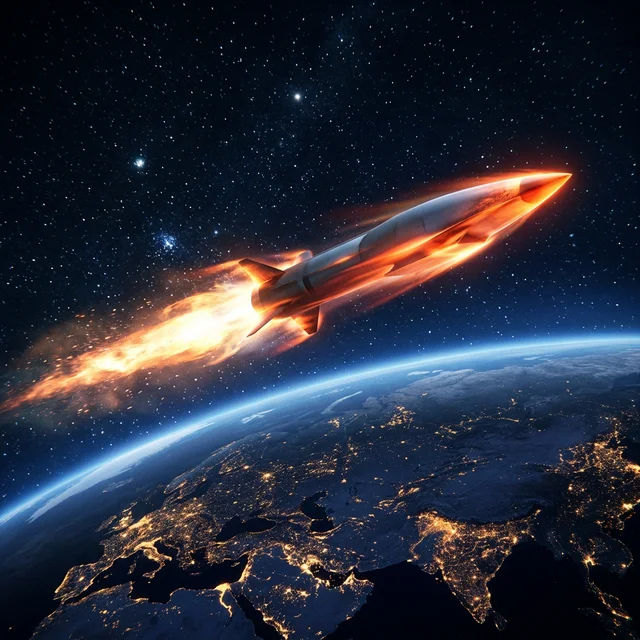
In November 2024, Russia introduced a weapon to the battlefield that changed the global strategic calculus: the Oreshnik ballistic missile (whose name, ironically, means "hazelnut" in Russian). First used against a military factory in Dnipro, the Oreshnik is what military analysts call a "game changer" — a weapon that redefines the rules.
| Specification | Data |
|---|---|
| Type | Intermediate-range ballistic missile |
| Speed | Mach 5 to Mach 10 (6,174 to 12,348 km/h) |
| Capability | Nuclear or conventional |
| Interceptable? | No — no current defense system can stop it |
| First combat use | November 2024, Dnipro |
| Second major strike | January 2026, western Ukraine (near Polish border) |
| Putin's statement | "Even with a conventional warhead, its destructive power is comparable to a nuclear weapon" |
What makes the Oreshnik so terrifying isn't just its speed — it's the impossibility of interception. Traveling at over 12,000 km/h, the missile reaches its target before any defense system can calculate its trajectory.
The Zirkon — Supersonic Death from the Sea
The 3M22 Zirkon is Russia's anti-ship hypersonic cruise missile, capable of reaching speeds of Mach 8 (over 9,800 km/h). In February 2026, Russia used four Zirkon missiles in a single salvo against Ukraine — demonstrating saturation capability.
Iskander-M — Putin's Bastion
The Iskander-M is the short-range tactical ballistic missile that has become the backbone of Russian strike forces. With a range of up to 500 km and both conventional and nuclear capability, the Iskander-M is used in strikes against Ukrainian civilian and military infrastructure almost daily.
The Drone Revolution: The Robot War
If hypersonic missiles are weapons of terror, drones are weapons of revolution. The war in Ukraine has completely transformed the role of unmanned aerial vehicles in modern warfare, creating a new paradigm where $1,000 machines destroy $10 million tanks.
FPV Drones — First Person, Last Breath
FPV drones (First Person View) are the conflict's most impactful innovation. Small, cheap, extremely agile, and operated by a pilot who sees in real-time through a camera on the drone, they have become the primary weapon on both sides.
| Data | Value |
|---|---|
| Annual production (Ukraine) | Target of 1 million drones (2024) |
| Annual production (Russia) | Target of 1.4 million drones (2024) |
| % targets destroyed by drones (2024) | 69% of troops, 75% of vehicles |
| % targets destroyed (end 2025) | Over 80% of all enemy targets |
| Average cost | $500 to $5,000 |
Fiber-Optic Drones — Impossible to Block
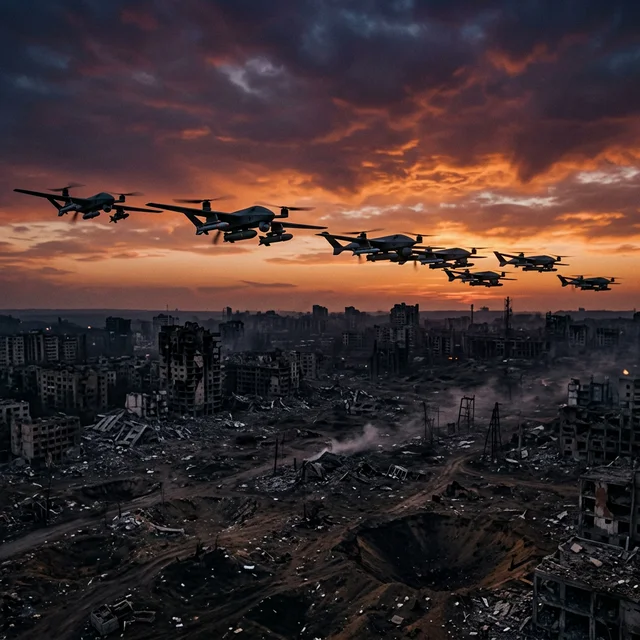
The most frightening evolution in drone warfare emerged in August 2024: fiber-optic guided drones. Unlike conventional drones that communicate via radio (and can be jammed by electronic warfare), these drones are controlled by a physical fiber-optic cable. Result: they are impossible to jam electronically.
Long-Range Strike Drones
Ukraine developed long-range strike drones capable of hitting targets deep inside Russian territory — including air bases, ammunition depots, and industrial facilities. Attacks on Russian air bases housing nuclear-capable aircraft (June 2025) raised tensions to their highest level since the war began.
Flamingo — Ukraine's Cruise Missile
In response to Russia's arsenal, Ukraine is developing the Flamingo, a surface-to-surface cruise missile with a reported range of 3,000 km. Already used in deep strikes inside Russia, the Flamingo represents Ukraine's strategic retaliation capability.
Thermobaric Bombs: The Vacuum of Death
How They Work
Thermobaric bombs — also known as vacuum bombs or fuel-air explosives — are perhaps the most devastating conventional weapons in use on the Ukrainian battlefield.
- Dispersal: The bomb releases an aerosol cloud of fuel
- Mixing: The fuel mixes with atmospheric air
- Ignition: The mixture detonates, creating a prolonged shockwave and extreme temperatures
- Vacuum: The explosion consumes all available oxygen, creating a brutal vacuum
| Effect | Consequence |
|---|---|
| Temperature | Can exceed 3,000°C |
| Shockwave | More prolonged than conventional explosives |
| Vacuum | Consumes all oxygen — kills by asphyxiation those not killed by the blast |
| Effect on buildings | Penetrates crevices, corridors, and bunkers — nowhere to hide |
| On human bodies | Can vaporize bodies in the central blast zone |
Cluster Munitions: Death That Never Ends
Cluster munitions are bombs or projectiles that open mid-air and scatter hundreds of smaller bomblets across a wide area. Banned by 123 countries under the 2008 Convention, but neither Russia, Ukraine, nor the United States are signatories. The darkest legacy: 10-40% of bomblets fail to explode, becoming de facto landmines that will continue killing civilians — especially children — for decades.
Depleted Uranium: The Radioactive Controversy
Both the UK and US supplied depleted uranium armor-piercing rounds to Ukraine. Russia condemned this as a "criminal act," falsely claiming DU has a "nuclear component." Scientists debate long-term health and environmental risks, but DU munitions are not nuclear weapons.
ATACMS and Storm Shadow: Global Reach
ATACMS (US) with 300 km range and Storm Shadow (UK) with up to 560 km range gave Ukraine the ability to strike deep into Russian-held territory and Russia itself. In November 2024, the US lifted restrictions allowing ATACMS use against targets inside Russia.
The Nuclear Threat: The Elephant in the Room
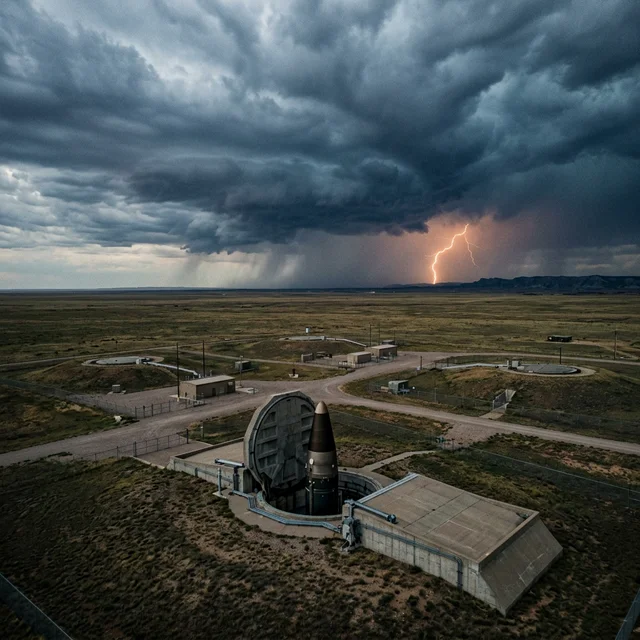
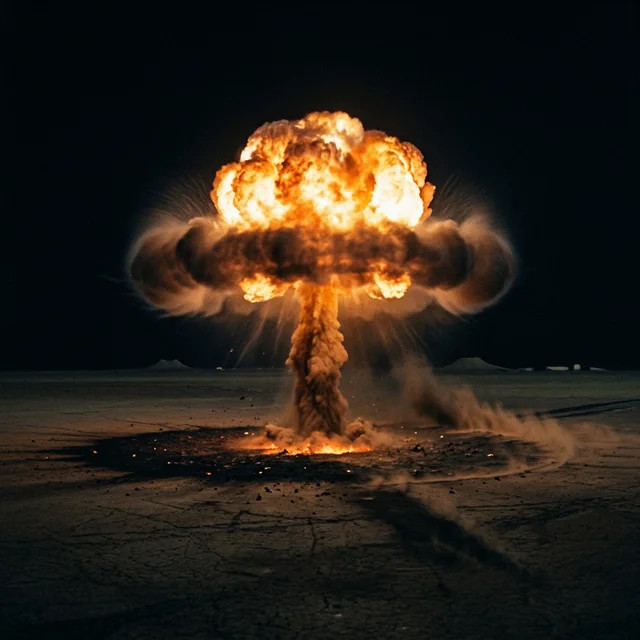
Russia possesses the world's largest nuclear arsenal: ~5,580 total warheads, including ~1,674 deployed strategic warheads and ~1,558 tactical warheads. Since the invasion began, Russia has practiced nuclear blackmail — using the threat of nuclear weapons to deter the West.
Nuclear escalation timeline:
- February 2022: Putin places nuclear forces on "special alert"
- September 2024: Russia changes nuclear doctrine
- 2024: Tactical nuclear weapons positioned in Belarus
- November 2024: Nuclear-capable Oreshnik used conventionally
- January 2026: Second Oreshnik strike — near NATO border
Experts map three scenarios: demonstrative detonation (most likely), tactical use against military concentrations, and strategic attack on a city (apocalypse scenario).
Conclusion: The Abyss Watches Us
Every weapon described in this article exists. Each is being used — or stands ready to be used — on the Ukrainian battlefield. From $1,000 drones that hunt individual soldiers to the 5,580 nuclear warheads that could extinguish human civilization, the arsenal of the apocalypse is not fiction — it's the shopping catalog of the world's armies.
Friedrich Nietzsche wrote: "Whoever fights monsters should see to it that in the process he does not become a monster. And if you gaze long enough into an abyss, the abyss will gaze back into you." The nuclear abyss watches us. The question is: are we looking back?
Editorial Note: This article is informational and based on reports from international organizations (UN, Amnesty International, Human Rights Watch), research center analyses (CSIS, Carnegie, Brookings, Atlantic Council, RUSI), and verified reporting (Kyiv Independent, Defense News, PBS). Technical specifications are from public, open sources. Images are illustrative and AI-generated.
Read Also
- Bucha, Mariupol, Kramatorsk: The Scenes Nobody Should Forget
- Ukraine War: The Numbers the World Ignores
- 20 Little-Known Facts About World War II
Frequently Asked Questions
What is the Oreshnik missile?
The Oreshnik is a hypersonic intermediate-range ballistic missile capable of speeds from Mach 5 to Mach 10. First used in combat in November 2024. No current defense system can intercept it. Putin stated its conventional destructive power is comparable to a nuclear weapon.
What are thermobaric bombs?
Thermobaric bombs (or "vacuum bombs") disperse a fuel cloud in the air and detonate it — creating temperatures above 3,000°C and consuming all ambient oxygen. Russia uses them extensively. The ICC is investigating whether this constitutes a war crime.
Why are fiber-optic drones so dangerous?
Because they cannot be electronically jammed. Controlled by a physical cable, there is no signal to block. They appeared at scale in August 2024 and transformed the battlefield.
Can Putin use nuclear weapons?
Putin has the world's largest nuclear arsenal (5,580 warheads). Russia's nuclear doctrine was changed in September 2024 to envision nuclear use against "critical threats to sovereignty." Experts consider the possibility small but real.
Sources: CSIS, Carnegie Endowment, Brookings Institution, Atlantic Council, RUSI, Kyiv Independent, Defense News, UN, Amnesty International, Human Rights Watch, PBS, Al Jazeera, The Guardian. Data updated through February 2026.