For decades, humanity has looked to the stars and dreamed of reaching neighboring solar systems within a single human lifetime. The vast distances of interstellar space make traditional chemical rockets entirely impractical for such ambitious journeys. Theoretical physicists and engineers have long proposed laser-pushed solar sails as the ultimate solution for deep space exploration. These ultra-lightweight probes would ride powerful beams of light, theoretically reaching a significant fraction of the speed of light. However, recent scientific breakthroughs have revealed an unexpected hurdle.
Theoretical physicists have discovered a hidden cosmic barrier that fundamentally limits how fast these sails can travel. As the sail accelerates toward relativistic speeds, it encounters a phenomenon known as quantum photon scattering drag. This drag effect becomes overwhelmingly powerful at roughly 75 percent of the speed of light, acting as an invisible brake. Consequently, placing a fundamental speed limit on laser propulsion interstellar probes changes our entire understanding of cosmic navigation. This discovery is reshaping the blueprints of projects aiming for Alpha Centauri and beyond.
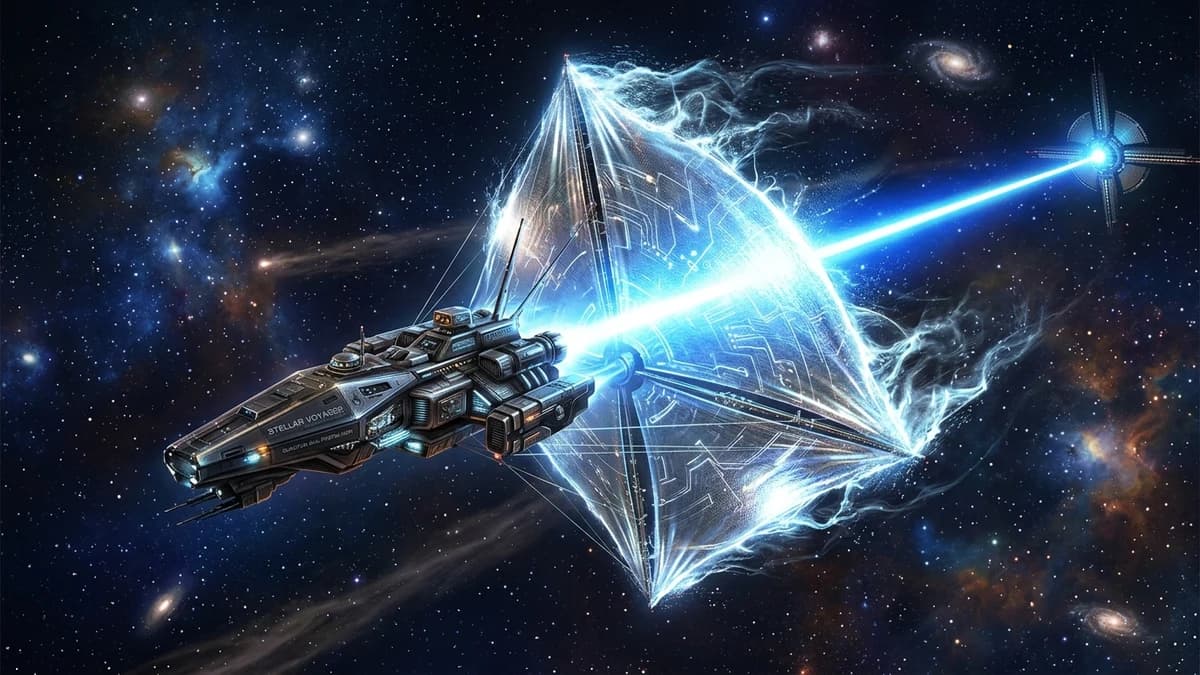
The concept of a solar sail is elegant in its simplicity and profound in its potential. Instead of carrying heavy chemical fuel, a spacecraft relies on the momentum of light particles, or photons, to generate thrust. When photons strike the highly reflective surface of the sail, they bounce off, transferring their momentum to the probe. By leaving the heavy energy source on Earth or in orbit, the spacecraft's mass is kept astonishingly low. This allows a powerful, focused laser array to accelerate a tiny probe to unprecedented velocities.
In theory, a continuously powered laser beam could push a gram-sized spacecraft to 20 percent of the speed of light in just a few minutes. This is the foundational idea behind initiatives like Breakthrough Starshot, which aims to visit our nearest stellar neighbor, Proxima Centauri. At these speeds, a journey that would take conventional rockets tens of thousands of years can be reduced to just over twenty years. The mechanics of this propulsion system represent a paradigm shift in aerospace engineering. It replaces the tyranny of the rocket equation with the boundless potential of directed energy.
However, the universe is rarely as straightforward as our mathematical models initially suggest. The interstellar medium, the space between stars, is not a perfect vacuum. It is filled with trace amounts of gas, dust, and a pervasive sea of cosmic microwave background radiation. As a solar sail accelerates to relativistic speeds, the very fabric of this medium begins to push back. The interaction between the sail and the scattered photons in the environment creates a profound resistive force.
This is where the concept of quantum photon scattering drag comes into play. From the perspective of a spacecraft traveling at 75 percent of the speed of light, the low-energy photons of the interstellar medium are blue-shifted. This means their apparent energy and frequency increase dramatically, causing them to strike the sail with immense force. The forward-facing pressure from this radiation eventually equals the thrust provided by the pushing laser from behind. This creates an insurmountable equilibrium point, setting an absolute speed limit for any laser-driven interstellar craft.
Understanding this cosmic barrier requires a deep dive into quantum electrodynamics and relativistic physics. When a photon from the pushing laser strikes the sail, it imparts a specific quantum of momentum. However, because the sail is moving incredibly fast, the incoming laser photons are red-shifted from the sail's frame of reference. This red-shift diminishes the effectiveness of the laser, providing less thrust as the velocity increases. Concurrently, the blue-shifted photons from the interstellar medium strike the front of the sail, exerting a counteracting pressure.
Furthermore, quantum mechanical interactions at the surface of the sail material complicate the picture. As blue-shifted photons collide with the atomic lattice of the sail, they can cause electron excitation and even ionization. This not only generates drag but also threatens to heat the ultra-thin material to catastrophic temperatures. Managing this thermal load while battling photon drag presents an unprecedented challenge for materials scientists. The interplay of these relativistic and quantum effects defines the newly discovered 75 percent speed of light boundary.
The implications for ambitious projects like Breakthrough Starshot are profound and far-reaching. Originally, engineers hoped that continuous laser pushing could incrementally inch probes closer to the speed of light. The revelation of photon scattering drag means that expectations must be fundamentally recalibrated. While 75 percent of light speed is still incredibly fast, it represents a hard ceiling that cannot be bypassed by simply adding more laser power. If you increase the laser power, the thermal load increases, but the relativistic drag eventually counters the thrust anyway.
This speed limit forces mission planners to optimize for entirely new variables in deep space transit. Instead of focusing solely on maximum velocity, engineers must design sails that can minimize interactions with the interstellar medium. Advanced metamaterials are being theorized to selectively reflect the pushing laser while allowing blue-shifted cosmic photons to pass through harmlessly. This delicate balance of optical properties will dictate the success or failure of humanity's first interstellar voyage.
Comparing Propulsion Systems for Interstellar Travel
To fully appreciate the impact of this discovery, we must compare laser solar sails with other proposed methods of interstellar travel. The table below illustrates the stark differences in maximum theoretical speeds, dominant drag forces, and estimated travel times to Alpha Centauri. It highlights why solar sails remain the most viable option despite the newly discovered speed limit.
| Propulsion Type | Max Theoretical Speed | Primary Source of Drag/Limitation | Time to Alpha Centauri (4.37 ly) |
|---|---|---|---|
| Chemical Rocket | < 0.1% c | Fuel mass ratio (Rocket Equation) | > 50,000 years |
| Nuclear Fusion | 10% to 15% c | Fuel containment and system mass | 30 to 45 years |
| Laser Solar Sail | ~75% c | Quantum photon scattering drag | 6 to 10 years |
As the table shows, chemical rockets are entirely unsuited for journeys beyond our solar system due to their massive fuel requirements. Nuclear fusion offers a significant improvement, potentially reaching speeds that would allow a probe to reach Alpha Centauri in a few decades. However, fusion propulsion still requires the spacecraft to carry its own heavy fuel, limiting its ultimate velocity. Laser-pushed solar sails bypass the fuel problem entirely, making them uniquely capable of reaching relativistic speeds. The 75 percent light speed limit, while a constraint, still leaves them as the undisputed champion of interstellar transit.
The challenge now shifts from pure propulsion to advanced materials science and thermal management. The sail must be incredibly thin, on the order of a few hundred atoms thick, to maintain a low mass. At the same time, it must be highly reflective to the specific wavelength of the pushing laser to maximize thrust. Finding a material that meets these criteria while surviving the harsh environment of interstellar space is a monumental task. The intense heat generated by photon collisions and cosmic dust impacts requires unprecedented durability.
Recent research has focused on materials like graphene, molybdenum disulfide, and engineered photonic crystals. These substances offer remarkable strength-to-weight ratios and tunable optical properties. By precisely engineering the nanostructure of the sail, scientists hope to create a material that reflects the pushing laser but is transparent to the blue-shifted cosmic background. This would mitigate the effects of photon scattering drag, allowing the craft to safely approach the theoretical speed limit. The future of interstellar travel depends entirely on these microscopic material innovations.
Despite the discovery of this hidden cosmic barrier, the dream of interstellar exploration remains vigorously alive. The 75 percent speed of light limit is not a defeat, but rather a crucial piece of the navigational puzzle. By understanding the true constraints of our universe, we can design more robust and realistic spacecraft. This breakthrough in theoretical physics prevents us from investing billions in mission profiles that would inevitably fail. It guides our focus toward achievable milestones and realistic engineering solutions.
The journey to the stars will test the limits of human ingenuity and international cooperation. It requires a sustained, multigenerational effort spanning physics, engineering, and materials science. As we refine our understanding of quantum mechanics and relativistic effects, our blueprints for the future become sharper and more defined. The photon scattering drag is just another wind to be navigated in the vast ocean of the cosmos. Our solar sails will eventually catch the laser light, carrying the legacy of Earth into the deep unknown.
Frequently Asked Questions
What exactly is quantum photon scattering drag?
Quantum photon scattering drag is a resistive force encountered by objects traveling at relativistic speeds through space. As a solar sail accelerates, the low-energy photons in the interstellar medium appear blue-shifted from the sail's perspective, drastically increasing their relative energy. When these high-energy photons collide with the front of the sail, they exert a profound backward pressure. This pressure acts as an invisible brake, countering the thrust from the pushing laser. Ultimately, it creates a fundamental speed limit that prevents the spacecraft from accelerating indefinitely.
Why can't we overcome this speed limit by just using a more powerful laser?
Using a more powerful laser cannot overcome this speed limit due to the laws of relativity and thermodynamics. As the spacecraft approaches the 75 percent light speed barrier, the incoming laser photons from Earth become severely red-shifted and lose their pushing effectiveness. Simultaneously, the counteracting drag from the blue-shifted interstellar photons increases exponentially. If you increase the laser power to fight this, the sail will absorb more energy than it can radiate away. This excessive heat would quickly vaporize the ultra-thin sail material, destroying the spacecraft entirely.
How does this discovery affect the Breakthrough Starshot initiative?
This discovery provides a realistic framework and upper boundary for the Breakthrough Starshot initiative's mission planning. Previously, calculations suggested that higher velocities might be achievable with continuous laser acceleration over longer distances. The confirmation of the photon drag limit forces engineers to optimize their designs for survival and thermal management at a maximum of 75 percent light speed. While it caps the top speed, reaching even 20 percent of light speed remains an extraordinary achievement. It ensures the project focuses on achievable physics rather than impossible trajectories.
External References
- arXiv: https://arxiv.org/
- ScienceDaily: https://www.sciencedaily.com/
- The Astrophysical Journal: https://iopscience.iop.org/journal/0004-637X