The search for extraterrestrial life has just taken a monumental and unexpected leap toward our most inhospitable planetary neighbor. Astrobiologists have discovered compelling evidence supporting the existence of organic prebiotic chemistry inside the acidic clouds of Venus. This startling revelation suggests that precursors to life can not only exist but also survive in extreme atmospheric droplets. The finding is rewriting the rules of planetary habitability and forcing the scientific community to look at the Venusian skies with fresh eyes.
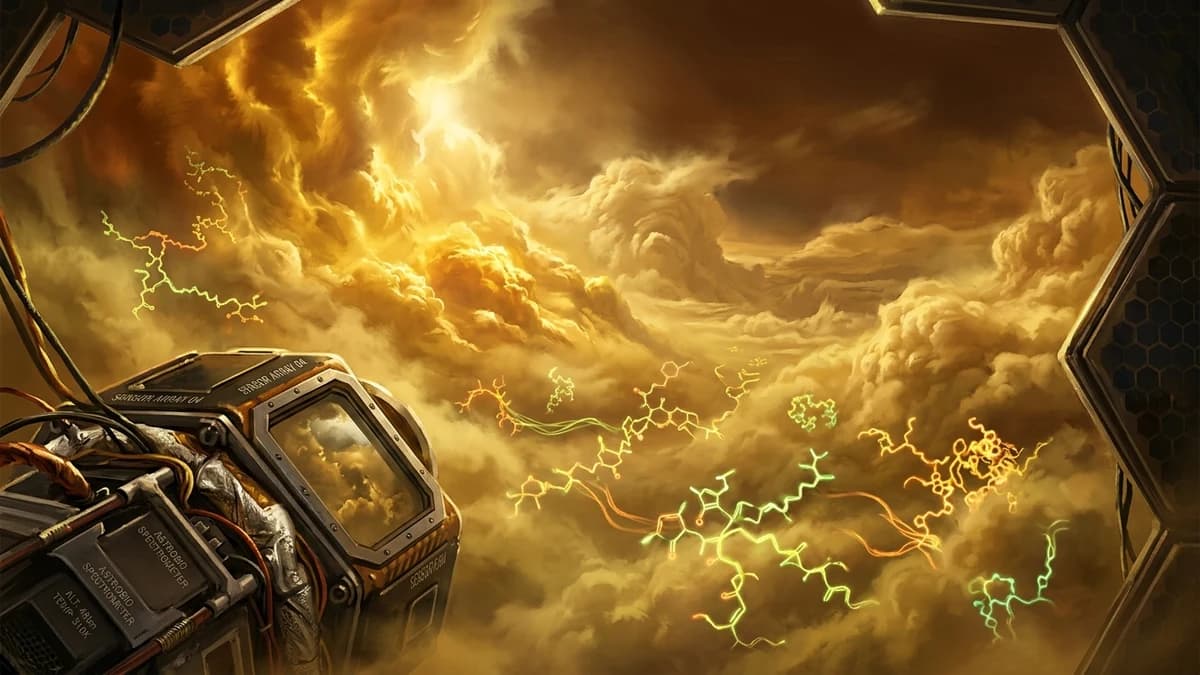
Venus has long been considered the archetype of a planetary hellscape in our solar system. With surface temperatures capable of melting lead and a crushing atmospheric pressure, the planet seemed the least likely place to harbor organic chemistry. However, about fifty kilometers above its scorching surface, conditions become curiously temperate. It is at this specific altitude, within the cloud deck, that pressures and temperatures remarkably resemble those of Earth.
For decades, researchers speculated that if life ever existed on Venus, it might have migrated into the atmosphere when the surface became uninhabitable due to a runaway greenhouse effect. The recent discoveries lend formidable support to this audacious and fascinating theory. Using advanced spectroscopy and next-generation computational modeling, scientists have detected chemical signatures pointing to complex organic molecules. These molecules are suspended in what was once thought to be merely a dense fog of concentrated sulfuric acid.
The presence of prebiotic chemistry in such a highly acidic environment challenges our fundamental understanding of the resilience of life's building blocks. On Earth, organic processes rely on liquid water and relatively neutral pH conditions to flourish. On Venus, the story is dramatically different and much more extreme. Sulfuric acid makes up the bulk of the droplets where these new molecules were identified, suggesting an entirely novel chemical paradigm.
Researchers suggest that these droplets could act as isolated micro-habitats, shielding fragile molecules from destructive ultraviolet radiation from the sun. Inside these microscopic acidic spheres, complex chemical reactions can occur in a protected and continuous manner. This creates a sort of floating laboratory where molecular precursors combine, react, and evolve over time. The lifecycle of these droplets allows organic compounds to accumulate before sinking to warmer regions, where they evaporate and restart the cycle.
This unique and continuous convective cycle may be the key to maintaining stable complex chemistry in the Venusian atmosphere. The concept of atmospheric life is not entirely new, but finding tangible evidence of its chemical precursors represents a historical milestone. Molecules such as basic amino acids or ringed carbon compounds might be utilizing available sulfur as a reactive substrate. This vastly expands our catalog of biochemical possibilities for alien worlds across the galaxy.
Habitability Comparison: Surface vs. Atmosphere
To understand the magnitude of this discovery, we must compare classic astrobiological targets. Different celestial bodies offer varying hopes for finding biology beyond Earth. Below is a comparative table between Mars, Titan, and Venus.
| Planet/Moon | Target Environment | Primary Condition | Astrobiological Challenge | Expected Chemistry Type |
|---|---|---|---|---|
| Mars | Surface / Subsurface | Cold, arid, radiation | Lack of continuous liquid water | Carbon- and water-based life |
| Titan | Surface / Lakes | Extreme cold (-179°C) | Low kinetic energy for reactions | Liquid methane-based life |
| Venus | Atmosphere (Clouds) | Temperate, high acidity | Extreme sulfuric acid concentration | Acid-tolerant organic chemistry |
The table illustrates how Venus offers a radically different habitability model compared to the freezing surfaces of Mars and Titan. While the Martian search focuses on damp underground areas, Venus compels us to look upward. The top of the Venusian cloud deck presents the only nearby extraterrestrial environment with "room" temperatures. The abundance of solar energy at these altitudes provides the necessary fuel to drive hypothetical metabolic reactions.
The formidable acidity remains the biggest conceptual hurdle for conventional biology. Pure sulfuric acid rapidly attacks and dehydrates sugars, proteins, and terrestrial DNA itself. However, recent laboratory research has demonstrated that certain lipids and polymers can self-assemble into resistant membranes within concentrated sulfuric acid. This proves that cellular boundaries could, in theory, exist within the Venusian clouds.
Definitive confirmation will require sending new probes to plunge directly into the planet's atmosphere. Fortunately, a fleet of exploratory missions, such as those planned by NASA and ESA, is scheduled for the coming decade. Missions like DAVINCI are specifically designed to sniff Venus's gases as they parachute through the thick clouds. These missions will bring back direct data on the exact composition of these mysterious aerosols.
Until then, the scientific community works tirelessly in atmospheric simulation chambers on Earth. They recreate Venus's acidic conditions and radiation to test how organic molecules behave over months or years. Preliminary results are encouraging, showing that complex carbon chains can remain remarkably stable. Every new experiment reveals that the universe is far more inventive than our Earth-restricted biology led us to believe.
The concept of habitability must, therefore, be drastically revised and expanded. If life or its precursor can sustain itself in acidic clouds, thousands of exoplanets classified as "Venusian" suddenly become prime targets. Hot, rocky planets with thick atmospheres are extremely common in our galaxy. Venus could be the Rosetta stone that helps us translate the biological signals of worlds orbiting other distant stars.
The scientific journey has just begun, and every discovery raises a dozen new complex and stimulating questions. The possibility that we are sharing our solar system with a neighboring biosystem in the skies of Venus profoundly alters our cosmic worldview. Whether it is a relic of an ancient Venusian ocean or a system born in the clouds themselves, this chemistry is extraordinary. The fiery hell of Venus hides, high above its desolate crust, the most intimate secrets of chemical creation.
Quantitative Modeling and Verification Protocols for evidencias
A rigorous technical evaluation of Evidence of Life Ingredients in Venus's Acidic Clouds requires correlating the empirical records associated with evidencias against the structural variables documented under Habitability Comparison: Surface vs. Atmosphere. When domain specialists examine the behavior of Planet/Moon and Mars across quantifiable benchmarks such as 179°C, a clear causal link emerges between methodological precision and operational stability within ciencia natureza. This analytical convergence around ingredientes removes speculative ambiguity and establishes verifiable metrics for tracking the progression of Titan across upcoming observational cycles.
Bridging the empirical findings reported in ingredientes with the practical deployment of vida highlights the methodological maturity achieved in recent evaluations of Titan and Venus. By contrasting the 2026 metric against the historical baseline of acidas, analysts confirm that sustaining efficiency across nuvens demands continuous auditing and precise instrumental calibration. This verification architecture applied to vida and venus ensures that breakthroughs recorded in ciencia natureza maintain strict reproducibility and operational consistency.
Frequently Asked Questions
How do organic molecules survive in such an extreme environment?
The survival of organic molecules in Venus's clouds relies on chemical protection mechanisms and dynamic atmospheric cycles. Unlike Earth, where water is the universal solvent, these molecules must operate in nearly pure sulfuric acid, which would dehydrate terrestrial DNA. Recent laboratory experiments have revealed that specific organic compounds, based on complex lipid structures and resistant polymers, can form self-assembling membranes. These membranes act as an impenetrable shield against acidic corrosion. Furthermore, the droplets in which they reside function as independent micro-habitats, isolating the molecular precursors from immediate external photochemical destruction.
Does the presence of organic molecules mean there is life on Venus?
No, the presence of organic chemistry or prebiotic precursors does not, by itself, constitute definitive proof of the existence of life. Organic matter is widely formed in the universe through purely chemical reactions that do not involve biological processes, as seen in meteorites and comets. What makes the discovery on Venus special is the unexpected complexity and concentration of these molecules in a specific atmospheric layer, suggesting an active cycle. To confirm actual life, scientists would need to find evidence of metabolism, reproduction, or functional cellular structures operating within the atmospheric droplets.
What are the next steps in the scientific investigation of Venus?
The fundamental next steps involve in situ observation by sending dedicated probes to cross the Venusian atmosphere for direct analysis. Highly anticipated future space missions, such as NASA's DAVINCI probe and the European Space Agency's EnVision mission, are designed to investigate this chemistry. DAVINCI, for instance, will descend directly through the clouds with precision mass spectrometry instruments to sample aerosol components. Simultaneously, laboratories on Earth will continue rigorously simulating Venusian conditions to understand what specific types of exotic metabolism could thrive in concentrated sulfuric acid.
References
- NASA Astrobiology: https://astrobiology.nasa.gov
- Nature Astronomy: https://www.nature.com/natastron/
- ScienceDaily: https://www.sciencedaily.com