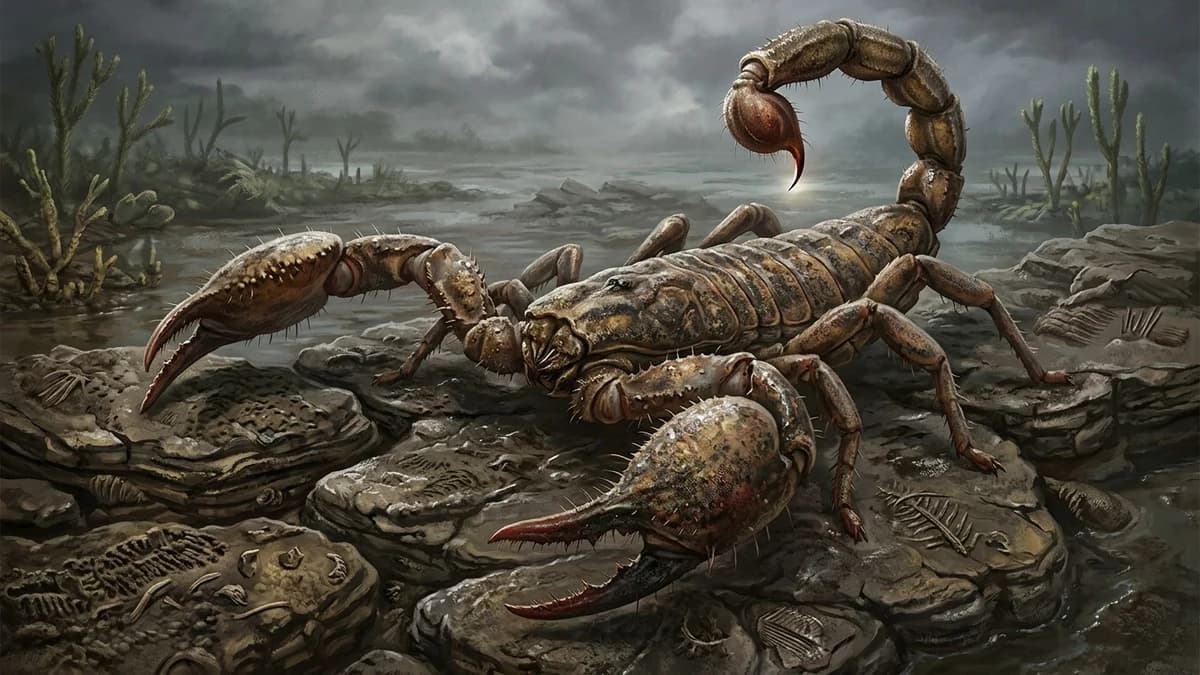
Global paleontology has just witnessed one of the most fascinating and transformative discoveries of the twenty-first century. Researchers identified Praearcturus gigas, a colossal scorpion that dominated primitive environments approximately 415 million years ago. This unprecedented event completely redefines our fundamental understanding of the early evolution of large terrestrial arthropods.
With an impressive length reaching up to one entire meter, this formidable predator walked upon the Earth during the Silurian period. Its very existence challenges many previous theories regarding the exact moment when living beings began achieving truly gigantic proportions. Until now, it was widely believed that such massive dimensions emerged much later in the evolutionary geological timescale.
The absolute relevance of this monumental discovery lies in the structural complexity and gigantism achieved long before dense forests appeared. It was traditionally believed that insects and arthropods only grew so large due to a massive oxygen increase during the Carboniferous period. However, the incredible Praearcturus gigas definitively proves that distinctly different evolutionary mechanisms were already actively operating millions of years earlier.
The Context of the Silurian Period
The ancient Silurian period was an era of immense geological, climatic, and biological transformations across our entire primitive planet. Landmasses were just beginning to be bravely colonized by the first vascular plants, which subtly altered the atmosphere's chemical composition. The vast oceans hosted a flourishing, diverse biodiversity, but continental areas and coastal margins remained extremely inhospitable environments.
It was exactly within these ecological transition zones that Praearcturus gigas found its perfectly ideal habitat and successfully prospered. The incredibly humid shorelines and coastal swamps offered the perfect structural refuge and an abundance of small, vulnerable prey. This formidable, armored creature quickly became one of the absolute top apex predators within these strange, emerging ecosystems.
The global climate was considerably and noticeably warmer than it is today, featuring elevated sea levels that created vast, shallow seas. These uniquely challenging environmental conditions strongly promoted radical evolutionary innovations among courageous species daring to venture outside the aquatic realm. Our giant scorpion was undoubtedly an absolute, pioneering force in this complex, dangerous transition from marine to terrestrial life.
This specific geological era clearly marked the beginning of an invisible yet incredibly relentless biological arms race among competing species. Prey animals aggressively developed increasingly thicker armors and evasive behavioral patterns, while predators constantly refined their sheer size and hunting tools. The outstanding gigantism of Praearcturus gigas was a direct, brutal, and effective response to these intense, uncompromising selective environmental pressures.
Anatomy and Physiology of the Predator
Upon meticulously analyzing the recovered ancient fossils, brilliant scientists were entirely perplexed by this creature's astonishing anatomical perfection. The Praearcturus gigas possessed incredibly robust pincers, specifically designed to completely crush exoskeletons and rapidly immobilize any unfortunate, wandering adversary. Its entire elongated body was thoroughly protected by a remarkably thick, impact-resistant chitinous carapace of unparalleled durability and strength.
The distinct structure of its formidable telson, the notorious stinger located at the tail's extremity, suggests highly developed venom glands. This potent, toxic venom would have been unequivocally lethal to practically any contemporary organism sharing its harsh, prehistoric habitat. The highly articulated tail essentially allowed lightning-fast, precise, and deadly strikes in a fraction of a second, guaranteeing constant hunting success.
Its specialized locomotor appendages clearly reveal that the massive animal possessed surprising agility despite its formidable size and heavy weight. It is widely believed that it could easily perform incredibly swift dashes to successfully ambush completely unsuspecting prey passing through its territory. This lethal combination of sheer brute force, heavily armored protection, and deadly agility made it the supreme, undisputed nightmare of coastal margins.
The specialized respiratory adaptations of this colossal arthropod provide vital, fascinating clues regarding its ability to survive comfortably on dry land. Stunningly preserved fossils clearly indicate the undeniable presence of specialized book lung structures, strictly essential for breathing outside purely aquatic environments. This fascinating, undeniable anatomical detail confirms that the difficult evolutionary transition to terrestrial life was already in a highly advanced stage.
Interestingly, its highly developed compound eyes effectively provided an impressive three-hundred-and-sixty-degree vision, absolutely crucial for locating prey and detecting environmental threats. This sharp visual perception seamlessly worked in perfect conjunction with highly sensitive sensory bristles strategically scattered along its multiple legs. Together, these combined senses turned the giant prehistoric scorpion into a perfectly tuned, deadly killing machine in tune with its surroundings.
Profound Evolutionary Impact
The spectacular revelation of Praearcturus gigas strongly forces the global scientific community to rewrite fundamental chapters of our planet's natural history. Previously, the notorious eurypterids, also commonly known as giant sea scorpions, were widely considered the only large arthropod predators of that primordial era. However, this magnificent new species brilliantly demonstrates that the lineage of true terrestrial scorpions was already actively experiencing parallel gigantism.
This truly impressive evolutionary convergence strongly indicates that a greatly oversized body size offered significant advantages in various emerging ecological niches. By strategically occupying predatory niches in completely muddy, coastal areas, the creature successfully avoided competing directly with strictly marine predators. This clever strategic ecological isolation fundamentally allowed an incredibly rapid, highly successful, and varied morphological diversification over millions of years.
The notable absence of larger terrestrial vertebrate predators during the ancient Silurian period left the evolutionary path completely clear for invertebrate dominance. The Praearcturus gigas boldly assumed the undisputed, bloody throne of these muddy ecosystems, brutally and efficiently regulating smaller prey populations. Its undeniable existence emphatically highlights the incredible, almost magical adaptive capacity of primitive terrestrial biology facing completely unchartered territories.
Curious scientists are now actively seeking concrete answers regarding what precisely led to the eventual, tragic extinction of this formidable giant. Drastic, sudden climatic changes, significant alterations in sea levels, or the eventual rise of advanced vertebrate competitors might have been absolute determinants. Regardless of the actual cause, its powerful genetic and morphological legacy strongly resonates to this day in its much smaller modern relatives.
The meticulous, dedicated study of this specific fossil also actively sheds brilliant light on the atmospheric oxygen rates of that distant time. Although these rates were absolutely not as high as in the later Carboniferous, they must have been entirely sufficient to sustain giant physiology. This fact has happily triggered incredibly passionate new academic debates regarding paleoclimatology and early Earth's initial, fragile atmospheric composition.
Comparative Species Table
Below, we proudly present a highly detailed, informative table that meticulously contrasts the main physical and temporal characteristics of these formidable creatures.
| Characteristic | Modern Scorpions | Praearcturus gigas | Sea Scorpions (Eurypterids) |
|---|---|---|---|
| Average Length | 5 to 20 centimeters | 100 centimeters (1 meter) | Up to 250 centimeters (2.5 meters) |
| Primary Habitat | Deserts, Forests, Terrestrial | Coastal Margins, Swamps, Semi-terrestrial | Oceans, Shallow Seas, Estuaries |
| Existence Period | Holocene (Present Day) | Silurian (415 million years ago) | Ordovician to Permian periods |
| Primary Diet | Insects, Small Vertebrates | Primitive invertebrates, small early fishes | Primitive fishes, trilobites, cephalopods |
| Predatory Mechanism | Lethal venom and small pincers | Extreme brute force and probable potent venom | Colossal crushing pincers and sharp claws |
| Respiratory System | Book lungs (strictly terrestrial) | Book lungs and primitive residual gills | Purely aquatic functional gills |
This insightful table clearly and undeniably demonstrates how Praearcturus gigas occupies a fascinating, totally unique intermediate position in vast evolutionary history. It beautifully combines the advanced terrestrial anatomical adaptations of modern scorpions with the colossal physical scale of primitive, terrifying marine sea scorpions.
The Importance of Found Fossils
The truly miraculous preservation of these magnificent ancient specimens provides a beautifully silent, yet incredibly eloquent testimony of past environmental conditions. The muddy, wet sediments of ancient riverbanks perfectly encapsulated the creature, strictly protecting its fragile carapace from the destructive action of scavengers. This incredibly rapid, oxygen-free burial fundamentally prevented common, destructive bacterial decomposition, thereby flawlessly safeguarding surprising, intricate anatomical details.
With the tremendous assistance of modern computerized tomographies, brilliant paleontologists successfully managed to accurately reconstruct the arthropod in three spectacular dimensions. The high-resolution scans amazingly revealed even the delicate internal structure of the primitive digestive tract, highlighting its highly specialized metabolism. This truly unprecedented level of immaculate detail finally allowed dedicated researchers to comprehend its predatory feeding habits with absolute, crystalline clarity.
The initial, monumental discovery wonderfully occurred in a remote, frequently neglected commercial quarry, which heavily highlights the continuous importance of active field exploration. Persistent, dedicated paleontological expeditions consistently continue to reveal incredibly well-guarded natural secrets safely hidden right beneath our very own feet, challenging paradigms. Each entirely new fossil carefully excavated acts as an absolutely crucial puzzle piece in the immense, complicated puzzle of global evolutionary biology.
Leading experts strongly believe that countless other truly notable specimens patiently await their eventual, glorious discovery within the Silurian period rock layers. Advanced, modernized excavation technology and incredibly precise chemical analysis tools are exponentially accelerating the rapid pace of these monumental, historic revelations. The exciting future of modern paleontology definitely promises to bring even more shocking surprises regarding the forgotten giants that once ruled our world.
This extraordinary, groundbreaking discovery also beautifully serves as a profound inspiration for the entirely new generation of biological and geological science students. The remote, ancient past of our home planet continuously remains a totally fascinating laboratory of extreme wonders and relentless, brutal evolutionary innovations. Actively learning about terrifying monsters of the past teaches us incredibly valuable lessons regarding resilience, adaptation, and the biosphere's constant transformations.
Territorial Behavior and Hunting
Based purely on the complex biomechanics of its legs and massive claws, scientists deduce that Praearcturus gigas was an absolute ambush predator. It most likely carefully hid itself under damp, sticky mud or primitive, rotting vegetation, patiently awaiting the approach of highly unfortunate victims. This deadly tactic heavily required enormous patience and a finely tuned sensory system perfectly adapted to the constantly shifting coastal environment.
When an unsuspecting prey foolishly found itself within reach, the giant scorpion unleashed a sudden, explosive attack, trapping it in formidable pincers. The sheer crushing force forcefully generated by these chitinous structures would be perfectly capable of easily shattering the hard carapaces of smaller contemporary arthropods. Immobilization was almost always instantaneous, rapidly followed by a thoroughly neutralizing venom injection precisely delivered through its incredibly long, deadly telson.
Intense intraspecific competition also heavily and undeniably shaped the violent behavioral patterns and physical development of these absolutely enormous arthropods. Fossilized male specimens frequently and clearly exhibited deep battle marks and permanent scars, strongly suggesting intense territorial disputes or bloody fights for sexual partners. These primordial, brutal battles among heavily armed titans certainly offered spectacular, terrifying shows of sheer savagery in a world devoid of birdsong.
The actual geographical distribution of these remarkable creatures continuously remains a great, enduring mystery that deeply intrigues renowned researchers from global universities. It is absolutely not known for sure if they possessed a truly global reach or were strictly restricted to very specific, highly isolated continental microclimates. However, the impressive size of their claws and rigid carapaces strongly suggests that short-distance migrations would be perfectly possible and biologically necessary.
Carefully observing the distant past through this brand new, sharp lens focused entirely on Praearcturus gigas immensely magnifies our admiration for the natural world. Instead of a totally barren and completely lifeless world, the Silurian coastlines possessed margins inhabited by fierce beasts of frightening, majestic proportions. This complex, terrifying trophic web successfully established the fundamental, biological foundations for all subsequent, rich terrestrial ecosystems throughout Earth's long history.
Additional extensive field excavations strongly promise to bring even more shocking, incredible revelations about the mysterious lifestyle of these truly formidable creatures. Ambitious researchers actively plan to cleverly utilize advanced artificial intelligence to accurately map highly promising fossil sites in various unexplored sedimentary rock formations. This massive, multidisciplinary collective effort will undoubtedly unite several diverse generations of passionate paleontologists around the globe in a completely unprecedented, historic manner. Generous governmental funding directly dedicated to these crucial field missions has recently seen a significant, highly welcomed increase thanks to widespread, positive publicity.
Comparative biology and modern genetic disciplines vastly help scientists clarify exactly how certain key physical traits successfully resisted the merciless, continuous test of deep time. Although the truly terrifying one-meter giants absolutely no longer exist, their fundamental bodily blueprint has continued to silently prosper in scorching modern deserts. The incredible, ongoing, and indisputable success of the tough scorpion lineage undeniably proves the extreme, raw effectiveness of its organic design and structural defenses. Relentless evolution has repeatedly, consistently demonstrated that highly simple, physically strong, and deadly adaptations frequently outperform far more complex, metabolically expensive, and unnecessary evolutionary transformations.
Educational scientific documentaries are already aggressively beginning to prepare incredibly high-quality, stunning computer animations to visually illustrate the brutal grandeur of the prehistoric predator. Actually seeing the creature in full, glorious digital motion, entirely dominating ancient muddy beaches, brings the general public much closer to true natural wonder. These modern, highly innovative educational tools will definitely inspire countless curious children to eagerly pursue and passionately embrace complex careers in the rigorous natural sciences. After all, complex terrestrial geological history is easily the most dramatic, totally thrilling, and phenomenally epic tale ever written by time itself.
The gigantic, truly frightening legacy of Praearcturus gigas will undoubtedly continue being studied and passionately debated in university halls for long, intense decades. It acts as living, unquestionable scientific proof that wild nature constantly, tirelessly tests unimaginable physical limits during its absolutely wonderful, completely endless organic cycles. Truly understanding this incredibly ancient, deeply violent, and wonderfully strange past offers very humble, surprisingly wise, and profoundly enlightening perspectives regarding our own fragile humanity's future. We are, at the very end of the day, merely recent visitors and amazed temporary passengers wandering on a vast planet filled with infinite hidden mysteries.
Frequently Asked Questions
What is the true difference between Praearcturus gigas and modern day scorpions?
The Praearcturus gigas differed substantially from completely modern scorpions, mainly due to its colossal, terrifying size and highly unique coastal adaptations. While modern scorpions currently do not exceed twenty centimeters and typically inhabit arid or forest zones, this prehistoric creature reached one full meter. It actively and successfully prospered in muddy shorelines during the Silurian period, exhibiting a complex amphibious respiratory system distinct from modern animals. Its massive, crushing claws and its highly effective coastal ambush hunting method clearly demonstrate a predatory strategy adapted to a primordial world. These distinct physical evidences strongly suggest an extremely robust biology designed specifically to perfectly dominate a brutal, hostile, and competitive coastal ecosystem.
Why did arthropods grow so incredibly large in the ancient Silurian period?
During the ancient, fascinating Silurian period, absolute gigantism among certain arthropods was heavily driven by the widespread absence of competing vertebrate predators. This formidable, unprecedented ecological vacuum beautifully allowed terrestrial and semi-terrestrial invertebrates to exponentially expand their sizes without the strong evolutionary pressure of constant flight. Furthermore, the abundantly warm climatic conditions and the incredibly rich availability of easy prey in swampy zones vastly favored extraordinary bodily growth spurts. Although early atmospheric oxygen levels were not as high as in the later Carboniferous, they adequately supported highly advanced metabolisms and giant carapaces. The complete lack of direct competition fundamentally transformed the primordial coasts into a truly productive, safe haven for the proliferation of armored titans.
How did paleontologists correctly determine the exact size of this frightening predator?
The precise determination of measurements and exact size of this terrifying predator was made possible through rigorous, careful analyses of immaculately preserved fossil records. Dedicated paleontologists meticulously measured individual leg segments, fully intact pincers, and extensive dorsal carapace fragments carefully extracted from protective, ancient rocky matrices. Utilizing highly advanced knowledge of comparative anatomy, brilliant researchers meticulously extrapolated the total proportions using modern scorpions and ancient eurypterids as reference models. Modern digital modeling tools and highly detailed three-dimensional tomographies provided incredibly robust and highly secure confirmations regarding the animal's unbelievable skeletal dimensions. The final, verified result scientifically validated and thoroughly proved the impressive length of one meter, completely surprising the international academic community involved.
Scientific References
- Journal of Paleontology. "Evolution of large arthropods during marine and continental biological transitions in the Early Silurian period."
- ScienceDaily. "Spectacular discovery of a one-meter giant scorpion shakes the timeline of global invertebrate evolution and biology."
- Natural History Museum. "Fossil records and biomechanical modeling of giant arthropods reveal deadly hunting tactics of the extinct predator Praearcturus gigas."