In less than a week, the world went from diplomatic tension to the precipice of mass destruction. What began with Operation Roaring Lion — coordinated US and Israeli strikes on Iran on February 28, 2026 — escalated into an unprecedented Iranian retaliation against six Persian Gulf countries, with over 700 projectiles launched. Iran's Supreme Leader, Ayatollah Ali Khamenei, was killed. The country declared 40 days of mourning. And now, an Interim Leadership Council governs a nation that is wounded, furious, and armed with long-range ballistic missiles.
This article is not news coverage. It's an advanced scenario analysis — including what happens if dialogue fails, who might interfere, and what the worst imaginable scenario looks like: a war that could literally redraw the map of the world or, at its darkest extreme, threaten the existence of civilization as we know it.
Part I: The Current Scenario — Where We Stand Now
The Catastrophe Timeline
To understand the gravity of this moment, we need to reconstruct the sequence of events that brought us here:
| Date | Event | Impact |
|---|---|---|
| 2024-2025 | Israeli strikes weaken Iranian defenses and nuclear program | Iran loses robust response capability |
| Late 2025 | Massive anti-regime protests in Iran | Violent repression, internal instability |
| Jan-Feb 2026 | Nuclear tensions reach critical point | US and Israel plan military action |
| 02/28/2026 | Operation Roaring Lion — US and Israel attack Iran | Nuclear facilities destroyed, military leaders killed, Khamenei killed |
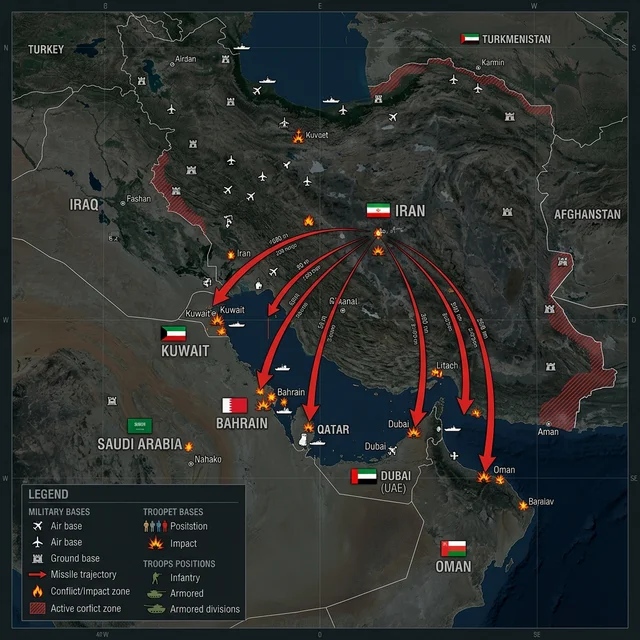
| 03/01/2026 | Iranian retaliation — 708 projectiles against 6 Gulf countries | 3 dead, 58 injured in UAE, Burj Al Arab damaged, airports closed |
| 03/01/2026 | Hezbollah launches missiles at northern Israel | Israel bombs Lebanon |
| 03/01-02/2026 | 3 US F-15 jets crash in Kuwait (friendly fire) | 4 American service members killed |
| 03/02/2026 | Iran declares "total war" | Interim Leadership Council takes over |
The Toll So Far
The numbers are devastating — and still growing:
| Indicator | Number |
|---|---|
| Dead in Iran (Red Crescent) | 555+ |
| Dead at girls' school in Minab | 150-180 |
| Injured in Iran | 747+ |
| Dead in UAE | 3 |
| Injured in UAE | 58 |
| US military killed | 4 |
| Countries directly hit | 9+ |
| Projectiles launched by Iran | 708 |
| Flights canceled globally | Thousands |
| Oil price (Brent) | $135+ per barrel |
The Death of Khamenei: The Point of No Return
The death of Ayatollah Ali Khamenei, Iran's Supreme Leader since 1989, is possibly the most significant event in Middle Eastern geopolitics since the 1979 Iranian Revolution. Khamenei wasn't just a political leader — he was the spiritual guide of 88 million Iranians and the guarantor of the theocratic system that has governed the country for over four decades.
His elimination in an Israeli airstrike in Tehran had immediate consequences:
- Power vacuum: An Interim Leadership Council was formed, but its legitimacy is contested internally
- Radicalization: More radical factions within the Islamic Revolutionary Guard Corps (IRGC) gained influence
- Mourning as weapon: The 40 days of declared mourning serve as both tribute and a period of military and social mobilization
- Martyrdom narrative: Khamenei dead becomes more powerful as a symbol than he was as a living leader — fueling the desire for revenge
History teaches us that eliminating leaders rarely ends conflicts. In most cases, it intensifies them.
The Activated Proxy Network
Iran doesn't fight alone. Over decades, Tehran built a network of armed allies — often called the "Axis of Resistance" — now in full activity:
| Proxy | Location | Capability | March 2026 Status |
|---|---|---|---|
| Hezbollah | Lebanon | 150,000+ missiles, experienced ground forces | Launching missiles at northern Israel |
| Houthis | Yemen | Drones, anti-ship missiles, Red Sea control | Attacking commercial shipping |
| Iraqi militias | Iraq | Rockets, drones, territorial control | Threatening American bases |
| Syrian militias | Syria | Ground forces, artillery | Mobilizing on Israel border (Golan) |
| Hamas | Gaza/West Bank | Urban guerrilla, tunnels | Partially destroyed but active cells |
The result is that Israel faces the possibility of a war on five simultaneous fronts. No army in the world, however sophisticated, is prepared to sustain a defensive war on five fronts for a prolonged period.
Part II: The No-Dialogue Scenario — When Diplomacy Dies
Why Dialogue Is Failing
There are structural reasons why negotiation attempts are failing:
1. Asymmetry of objectives:
- US/Israel: Want Iran's denuclearization and regime change
- Iran: Wants regime survival, withdrawal of American bases, and recognition as a regional power
- These objectives are mutually exclusive — there is no negotiation zone
2. Decapitated leadership:
- With Khamenei dead, there is no clear authority in Iran with the power to negotiate and make concessions
- The Interim Council is fragile and dominated by military hawks from the IRGC
3. Commitment escalation:
- Both sides have invested too much — politically, militarily, and emotionally — to back down without being seen as "defeated"
4. Domestic pressure:
- In the US, the administration faces pressure to show "results"
- In Iran, the population — even those who were anti-regime — united against the external enemy
What Happens When There Is No Dialogue
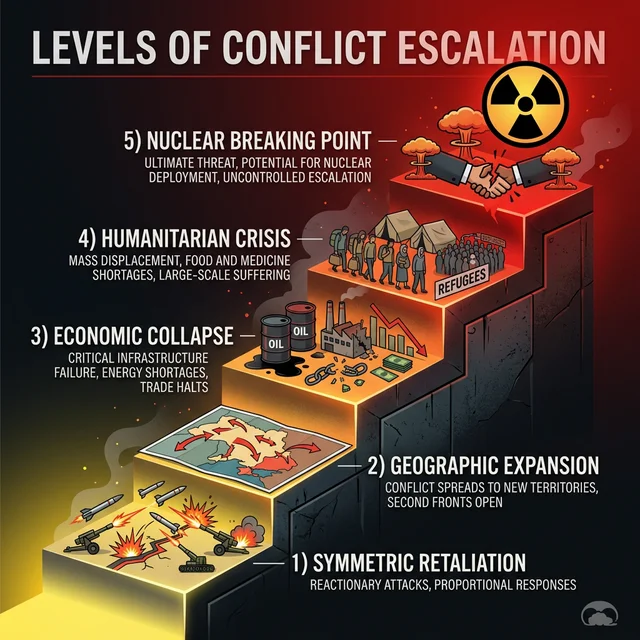
Without dialogue, conflicts follow a predictable escalation documented by game theory and military history:
Phase 1 — Symmetric Retaliation (Week 1-2):
Each side responds to the previous attack with proportional or slightly superior force. The cycle self-feeds.
Phase 2 — Geographic Expansion (Week 2-4):
Proxies enter fully. Hezbollah opens a total front in northern Israel. Houthis intensify Red Sea attacks. The conflict becomes a regional war with multiple actors.
Phase 3 — Economic Collapse (Month 1-2):
The Strait of Hormuz is effectively blocked. Oil reaches $200+. Insurers refuse to cover ships. The global economy enters recession.
Phase 4 — Humanitarian Crisis (Month 2-6):
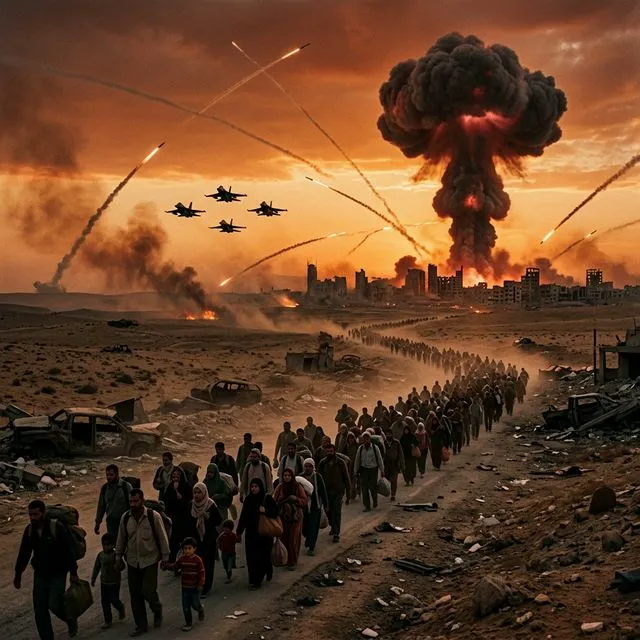
Civilians on both sides pay the price. Iranian infrastructure is systematically destroyed. Refugees flee en masse. Famine and epidemics emerge in conflict zones.
Phase 5 — Nuclear Breaking Point (Month 3+):
If Iran perceives it's losing the conventional war and the regime faces existential risk, the temptation to use residual nuclear capability — or a "dirty bomb" — becomes real. Simultaneously, Israel may consider using its nuclear weapons as a last resort if its defenses are overwhelmed on multiple fronts.
Part III: Interference from Other Countries — Who Enters the Game
No modern war remains bilateral. The US-Israel-Iran conflict already involves, directly or indirectly, dozens of nations. Here is the map of alliances, interests, and possible interference:
China: The Dragon's Dilemma
China is simultaneously Iran's main oil buyer (90% of exports go to Beijing) and a power that vitally depends on the Strait of Hormuz (5 million barrels/day transit through the strait toward China).
China's dilemma is brutal:
- Supporting Iran publicly risks confrontation with the US
- Allowing Hormuz closure collapses its own economy (50% of Chinese oil transits through the strait)
- Remaining neutral loses influence and credibility as an alternative superpower
Likely scenario: China pressures Iran behind the scenes NOT to close the Strait of Hormuz, while offering diplomatic support at the UN and possibly indirect military support.
Russia: The Strategic Opportunist
Russia, already engaged in the Ukraine war, sees the Middle East conflict as a golden opportunity to divide US attention and resources.
Russian interests:
- High oil prices benefit the Russian economy
- A distracted US in the Middle East = less pressure on Ukraine
- Strengthening of the Russia-China-Iran axis against the West
Likely scenario: Russia provides intelligence, missile technology, and possibly S-400 air defense systems to Iran. No direct military intervention, but intense logistical and diplomatic support.
Turkey: The Ambiguous Mediator
Turkey occupies a unique position: NATO member but with relatively functional relations with Iran and Russia.
Likely scenario: Turkey positions itself as a reluctant mediator, offering a communication channel between Iran and the West, while reinforcing borders.
Europe: The Reluctant Ally
European allies initially distanced themselves from the decision to attack Iran. But geopolitical reality pulled them back.
| Country | Position | Action |
|---|---|---|
| France | Initial distance, then logistic support | Sent frigates to Persian Gulf |
| Germany | Active diplomacy for ceasefire | UN mediation, IRGC sanctions |
| UK | Alignment with US (Five Eyes) | Participation in suppressing Iranian retaliation |
| Italy | Energy concerns (gas) | Negotiating alternative LNG routes |
| Spain | Anti-war position | Blocking NATO bases on Spanish soil |
Europe faces an existential energy dilemma: if the Strait of Hormuz closes and Qatari gas stops flowing, European gas prices could triple to $100/MWh — destroying the continent's industrial competitiveness.
Part IV: The Terror Machine — The Worst-Case Scenario
⚠️ WARNING: This section describes hypothetical extreme scenarios based on analyses from think tanks, academics, and military strategists. The goal is to inform, not alarmism.
Apocalyptic Scenario: How a Total War Unfolds
Imagine we're in June 2026. Dialogue failed. Escalation followed all phases.
Week 1-4: Total Regional War
Hezbollah launches 30,000 missiles in 24 hours against Israel — a capability military analysts confirm exists. The Iron Dome system is overwhelmed. Israeli cities suffer direct impacts. Israel responds with massive bombardments of Lebanon.
Simultaneously:
- Houthis sink an oil tanker in the Red Sea
- Iraqi militias attack the Green Zone in Baghdad
- Pro-Iran Syrian forces advance on the Golan Heights
Month 2: Strait of Hormuz Closed
Iran plants thousands of naval mines in the Strait. Iranian Kilo-class submarines sink a commercial vessel. Navigation is impossible.
Immediate consequences:
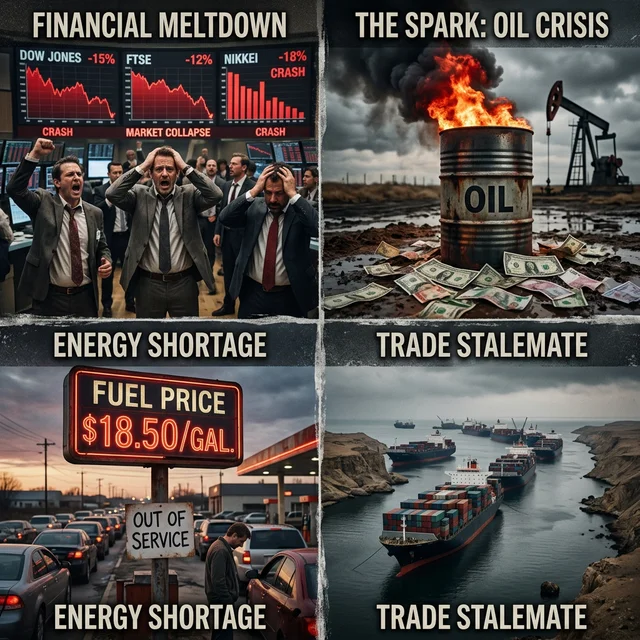
- 20 million barrels of oil/day removed from the global market
- Brent crude exceeds $200/barrel
- Gas in the US reaches $8-10/gallon
- Global inflation spikes to 15-20%
- Global recession is inevitable — world GDP falls 3-5%
Month 3-4: Supply Chain Collapse
Factories in China, Japan, and South Korea stop due to energy shortages. Semiconductors disappear. The global automotive industry halts. Food prices rise 40-60%.
| Country | Hormuz Dependency | Estimated Impact |
|---|---|---|
| China | 50% of oil | GDP falls 3-4%, factories stopped |
| Japan | 80% of oil | Energy rationing, severe recession |
| South Korea | 75% of oil | Samsung, Hyundai halt production |
| India | 60% of oil | Food crisis, 25%+ inflation |
| Europe | 15% oil, 25% LNG | Gas triples, deindustrialization |
| Brazil | Indirect impact via prices | Fuel R$15-20/L, 15%+ inflation |
The Nuclear Ghost: The Scenario Nobody Wants to Name
This is the darkest point of the analysis. Two nations with nuclear capability are directly involved:
Israel: Possesses 80-90 nuclear warheads. "Samson Option" doctrine — nuclear weapons use as a last resort if the state's existence is threatened.
Pakistan: Possesses ~170 nuclear warheads. Internal instability creates risk of losing control of the arsenal.
Consequences of a nuclear detonation, even tactical:
- 50,000-150,000 immediate deaths
- Radioactive cloud covers Lebanon, Syria, northern Israel
- Water and soil contamination for decades
- Exodus of millions
- Nuclear precedent broken: first time since Nagasaki (1945)
Part V: The Possible Scenarios — From Best to Worst
Summary Table: The 5 Scenarios
| Scenario | Probability | Estimated Deaths | Economic Impact | Duration |
|---|---|---|---|---|
| A: De-escalation | 20% | 1,000-5,000 | $500B-1T | 1-3 months |
| B: Attrition | 35% | 10,000-50,000 | $2-5T | 6-18 months |
| C: Regional War | 25% | 100,000-500,000 | $10-20T | 1-3 years |
| D: Tactical Nuclear | 10% | 200,000-1,000,000 | $30-50T | 2-5 years |
| E: Systemic Collapse | 5% | 1,000,000+ | Incalculable | 5-10 years |
🔴 Note: Even the "best" scenarios (A and B) involve thousands of deaths and hundreds of billions in economic damage. There is no "good" scenario — only degrees of catastrophe.
Part VI: What Could Prevent the Worst
Despite the darkness of these scenarios, factors could prevent the most catastrophic outcomes:
1. The China Factor
China has the greatest leverage over Iran. If Beijing clearly communicates to Tehran that closing Hormuz is a red line, Iran will likely back down on that specific point.
2. Domestic Pressure in the US
American public opinion — historically tired of Middle East wars after Iraq and Afghanistan — may force a course change.
3. Military Exhaustion
Iran's missile arsenal is not infinite. In a prolonged attrition scenario, Iran's retaliation capability progressively decreases, creating a window for negotiation.
4. Neutral Power Mediation
The UN, Turkey, India, Oman, and even the Vatican could offer backchannel communication allowing both sides to back down without publicly losing face.
5. Nuclear Reality Check
If the world gets close enough to nuclear weapons use, pure existential terror may force a retreat — as happened during the Cuban Missile Crisis in 1962.
Conclusion: The Doomsday Clock Has Advanced
The Doomsday Clock of the Bulletin of the Atomic Scientists was already at 90 seconds to midnight before this crisis — the closest to catastrophe in all of history.
With the Middle East war, Khamenei's death, Iran's massive retaliation, and the nuclear specter looming, we are in uncharted territory.
Humanity has stood at the edge of the abyss before and retreated. But every time we play with fire, the chances of getting burned increase. The Middle East of March 2026 is not just another crisis — it's a survival test for the global order we've built since 1945.
The question isn't "can this get worse?" — it's "how much are we willing to let it worsen before acting?"
This article will be updated as new developments are confirmed.
Read Also
- US-Israel Attack on Iran: Operation Roaring Lion
- Iran Attacks Dubai and the Persian Gulf: The Retaliation That Shocked the World
- World War III: Possible Scenarios
- Arsenal of Apocalypse: The Most Devastating Weapons
References and Sources
- The Guardian — Iran retaliatory attacks on Gulf states (March 2026)
- Al Jazeera — Middle East crisis: Full timeline of escalation
- Council on Foreign Relations — War with Iran: Scenarios and implications
- Atlantic Council — US-Israel strikes on Iran: Analysis
- Chatham House — The Strait of Hormuz chokepoint analysis
- UK Parliament — Iran conflict briefing (March 2026)
- UNESCO — School bombing in Minab condemnation
- Reuters — Oil prices surge above $135 on Gulf crisis
- Washington Post — Iran death toll and humanitarian impact
- Wikipedia — 2026 United States–Iran conflict
- Bulletin of the Atomic Scientists — Doomsday Clock