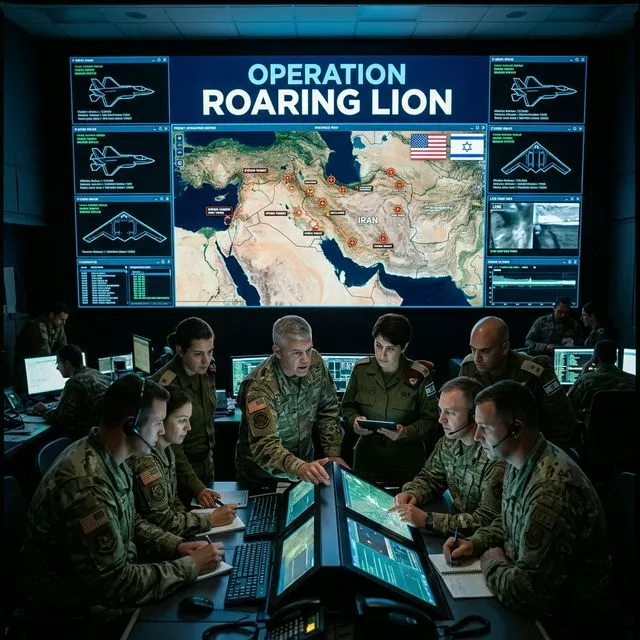
In the early hours of February 28, 2026, the world woke up to news that had been feared as a geopolitical nightmare scenario for decades: the United States and Israel launched a joint military attack against Iran. The operation, codenamed "Roaring Lion" by Israel and "Epic Fury" by the US Department of Defense, struck targets in multiple Iranian cities and triggered a chain of retaliations that plunged the entire Middle East — and the world — into a crisis of historic proportions.
This article presents the known facts based on verifiable sources from multiple international news agencies. It is a journalistic record of an event that is still unfolding as you read — and that may define the global balance of power for decades to come.
Timeline: How We Got Here
To understand the magnitude of what happened on February 28, 2026, we need to look back weeks and months to understand the escalation that led to the breaking point.
The Escalation (January-February 2026)
The path to the attack was paved by a series of events that, in retrospect, clearly signaled military intent:
| Date | Event |
|---|---|
| January 2026 | Iran faces massive anti-regime protests. HRANA estimates 7,000 dead in crackdown |
| January 27 | US deploys two carrier strike groups to the Middle East |
| February 6 | Indirect nuclear negotiations between Iran and US in Muscat, Oman — no progress |
| February 13 | Trump declares regime change in Iran would be "the best thing that could happen" |
| February 14 | US officials indicate armed forces are preparing for sustained operations against Iran |
| February 24 | In State of the Union address, Trump accuses Iran of resuming nuclear weapons efforts |
| February 28 | Launch of Operation Roaring Lion / Epic Fury |
The pattern is clear: each statement and military movement was a piece on a geopolitical chessboard that had been in preparation for months. The question was not "if" there would be an attack, but "when."
The Nuclear Context
At the core of the conflict lies Iran's nuclear program. While Iran has historically insisted its program is for peaceful purposes, the US and Israel argue that intelligence evidence demonstrates military intentions.
The 2015 Nuclear Deal (JCPOA), from which the US withdrew in 2018 under Trump's first term, was seen as the primary diplomatic instrument for containing Iranian nuclear ambition. With the collapse of that agreement and Iran's subsequent acceleration of uranium enrichment (reaching 60% levels, technically close to weapons-grade), the space for diplomacy shrank dramatically.
Israeli intelligence, particularly Mossad, had been monitoring Iranian nuclear facilities for years. Covert operations — including the assassination of Iranian nuclear scientists and cyberattacks like the famous Stuxnet virus — were already part of the "shadow war" arsenal between the two countries.
The Attack: February 28, 2026
The First Minutes
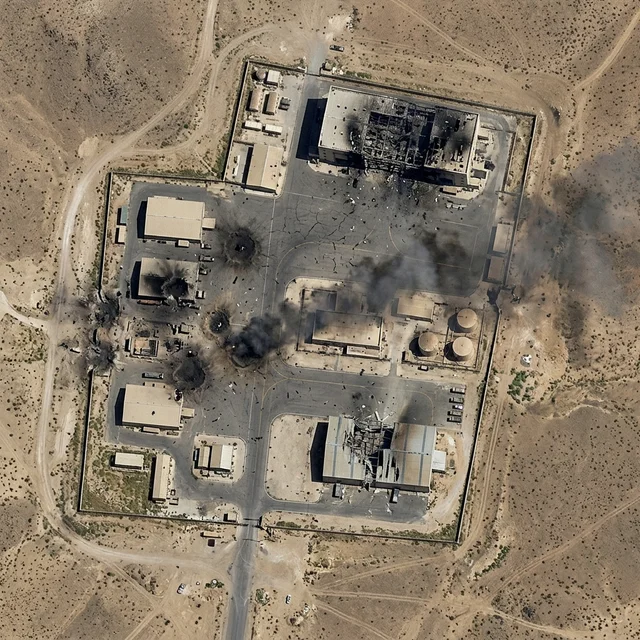
The first explosions were reported by residents of Tehran, Isfahan, Qom, Karaj, and Kermanshah in the early morning hours local time. Satellite imagery subsequently confirmed heavy damage to multiple facilities.
Initial targets included:
- Supreme Leader Ali Khamenei's residential compound in a Tehran district — satellite images showed extensive damage
- Presidential Palace — directly hit
- National Security Council — destroyed
- Nuclear facilities at Natanz and Isfahan
- IRGC military bases (Islamic Revolutionary Guard Corps) across multiple provinces
Official Communications
Donald Trump (US President): Confirmed American participation via Truth Social, calling Iran a country needing "regime change" and calling on IRGC members to surrender in exchange for immunity. In a subsequent address, he urged the Iranian people to "take over" their government.
Israel Katz (Israeli Defense Minister): Confirmed the Israeli attack, classifying it as a "preemptive attack" to "remove threats to the State of Israel."
Pete Hegseth (US Secretary of Defense): Identified the operation's objectives as: dismantling Iran's nuclear and missile programs, destroying Iranian naval capability, and facilitating regime change.
The First Hours
Initial reports indicated that Supreme Leader Ali Khamenei became unreachable after the first attacks. Ali Shamkhani, Secretary of the Supreme National Security Council, was reported dead. However, Iran's Foreign Minister later stated that both Khamenei and President Masoud Pezeshkian were alive.
Iranian media reported 201 dead and 747 wounded in the US-Israeli attacks. One of the most serious incidents was a strike on a girls' school in Minab, Hormozgan province, which killed at least 51 people, according to the Associated Press.
Iranian Retaliation
Missiles Across the Persian Gulf
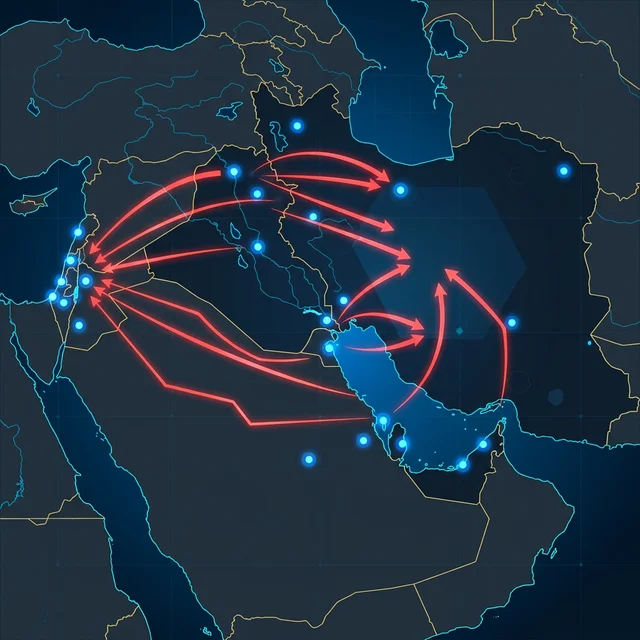
Iran's response came swift and violent. Dozens of ballistic missiles were launched in multiple directions simultaneously, hitting an impressively wide geographic area:
| Target | Type | Reported Outcome |
|---|---|---|
| Israel | Ballistic missiles | Strikes confirmed on Israeli territory |
| US bases in Jordan | Missiles | Impacts reported |
| US bases in Syria | Missiles | Explosions confirmed |
| Bases in Kuwait | Missiles | Impacts confirmed |
| Bahrain (US 5th Fleet HQ) | Missiles | US Embassy closed |
| Qatar | Missiles | Explosions reported |
| Saudi Arabia | Missiles | Attacks confirmed |
| UAE (Dubai and Abu Dhabi) | Missiles | UAE announced interception; 1 death from debris |
The scale of Iranian retaliation surprised many analysts. In previous conflicts, such as the retaliation for the assassination of General Qasem Soleimani in 2020, Iran had opted for limited, symbolic attacks. This time, the response was massive and multi-directional.
Regional Impact
The crisis had immediate effects across the entire region:
- Airspaces closed — Commercial flights suspended across vast areas of the Middle East
- Air India and IndiGo canceled flights to the region
- India issued advisory for citizens in Israel to exercise extreme caution
- Financial markets in freefall — oil surged above $120 per barrel
- US Embassies across the region in lockdown
- Iraqi military base housing pro-Iran group Kata'ib Hezbollah was also hit, with at least 2 dead
Geopolitical Analysis: What's at Stake
Declared Objectives
The United States and Israel declared three main objectives for the operation:
- Eliminate Iran's nuclear program — destroy uranium enrichment facilities, centrifuges and research infrastructure
- Destroy missile capability — neutralize Iran's ballistic missile arsenal, the primary vehicle for regional power projection
- Promote regime change — creating conditions for an internal collapse of the theocratic government
Historically, airstrikes alone are rarely sufficient to achieve regime change. This raises fundamental questions about the existence of plans for a ground phase of the operation.
International Reactions
The international community was deeply divided:
- Global leaders called for de-escalation — UN, EU, and China issued immediate ceasefire appeals
- Russia condemned the attacks as "illegal aggression"
- Saudi Arabia — ambiguous position; quietly supported neutralization of the Iranian threat but fears regional instability
- China — condemned the attacks and called for diplomatic resolution
- Brazil — convened emergency meeting of the UN Security Council
The Gulf Countries' Dilemma
The UAE, Bahrain, Kuwait, and Qatar find themselves in an impossible position: they are US allies hosting American military bases, but they are geographic neighbors of Iran and vulnerable to its retaliatory capacity. The Iranian missiles that hit Dubai and Abu Dhabi demonstrate this vulnerability in brutal fashion.
Historical Precedents
Operation Opera (1981)
Israel has precedents for preemptive strikes against nuclear programs. On June 7, 1981, Israeli F-16 fighter jets destroyed the Osirak nuclear reactor in Iraq, which was under construction with French assistance. The operation, executed in less than 2 minutes, significantly delayed Iraq's nuclear program.
Operation Orchard (2007)
In September 2007, Israel destroyed a Syrian nuclear reactor under construction in the Deir ez-Zor region. The operation remained officially unconfirmed by Israel for more than a decade.
The Soleimani Strike (2020)
The assassination of Qasem Soleimani by an American drone in January 2020 at Baghdad Airport was the highest point of direct US-Iran confrontation before today. Iranian retaliation was limited — strikes on American bases in Iraq that resulted in traumatic brain injuries in dozens of American soldiers.
The current operation represents a monumental escalation compared to all these precedents.
Implications for the Future
Possible Scenarios
International security analysts consider multiple evolution scenarios:
Scenario 1: Controlled Escalation
The US and Israel achieve their military objectives, Iran absorbs the impact without escalating to total war, and eventually a new order emerges through international negotiations.
Scenario 2: Prolonged Regional War
Iran activates its proxy network (Hezbollah in Lebanon, Houthis in Yemen, militias in Iraq and Syria) for a prolonged war of attrition against American and Israeli interests.
Scenario 3: Humanitarian Crisis
The destruction of Iranian infrastructure leads to a massive humanitarian crisis, displacement, and instability that spreads across the region.
Scenario 4: Nuclear Escalation
If Iran possesses undetected nuclear capability, or if the operation fails to completely destroy the program, the situation could escalate to an unprecedented level.
Global Economic Impact
The attack has already had an immediate impact on global markets:
- Oil — The Strait of Hormuz, through which 20% of the world's oil passes, is in the direct conflict zone
- Financial markets — Global stock exchanges in steep decline
- Shipping insurance — Premiums surged for vessels in the region
- Commercial aviation — Massive flight cancellations affecting millions of passengers
The Human Factor
Amid strategic calculations and military statistics, it is essential to remember that behind every number are human lives. The 51 dead at the school in Minab were children and teenagers. The families in Dubai and Abu Dhabi who heard explosions in their city skies lived through moments of genuine terror.
Wars are rarely as "surgical" as their planners promise. Military technology has advanced enormously since the first modern wars, but civilians continue to pay a disproportionate price. The responsibility to minimize civilian harm falls on all sides of any conflict — and will be judged by history.
The Iranian Diaspora
Millions of Iranians live outside Iran — in the US, Europe, Canada, Australia, and throughout the Middle East. For them, today's events represent an emotionally devastating situation: many oppose the theocratic regime but fear for the well-being of family members who remain in the country. Iranian social media exploded with panic messages, information searches, and appeals for safety.
The Role of Information and Misinformation
In a conflict of this magnitude, information warfare is as important as conventional warfare. In the first hours after the attack, social media was flooded with:
- Real videos of explosions in Iranian cities
- Fake videos recycled from previous conflicts (Syria, Ukraine)
- Contradictory claims about targeted sites and victims
- War propaganda from both sides
- Deepfakes supposedly showing Iranian leaders
Verifying information in conflict contexts is extremely difficult. The sources used in this article — The Guardian, PBS, CBS News, Associated Press, CFR — are organizations with proven track records of factual journalism, although all are subject to limitations in active war scenarios.
Conclusion: A World in Change
The February 28, 2026 attack on Iran is not just a military event — it is a geopolitical inflection point. Regardless of its immediate results, it will alter the power dynamics in the Middle East, test international alliances, and redefine the limits of what regional and global powers are willing to tolerate.
History will judge us not only by what was done on this date, but by what we do in the weeks, months, and years that follow. The path to peace is never simple, but the alternative — an endless cycle of violence and retaliation — is infinitely worse.
This article will be updated as new verifiable information becomes available.
References and Sources
- The Guardian — US and Israel launch joint attack on Iran
- PBS — Operation Epic Fury: What We Know
- CBS News — Iran retaliates with missiles across Gulf
- Council on Foreign Relations — Iran Crisis Tracker
- Gulf News — Missiles hit Dubai and Abu Dhabi
- Al Jazeera — Iran nuclear crisis timeline
- Wikipedia — 2026 Iran–United States Crisis
- Associated Press — Civilian casualties in southern Iran