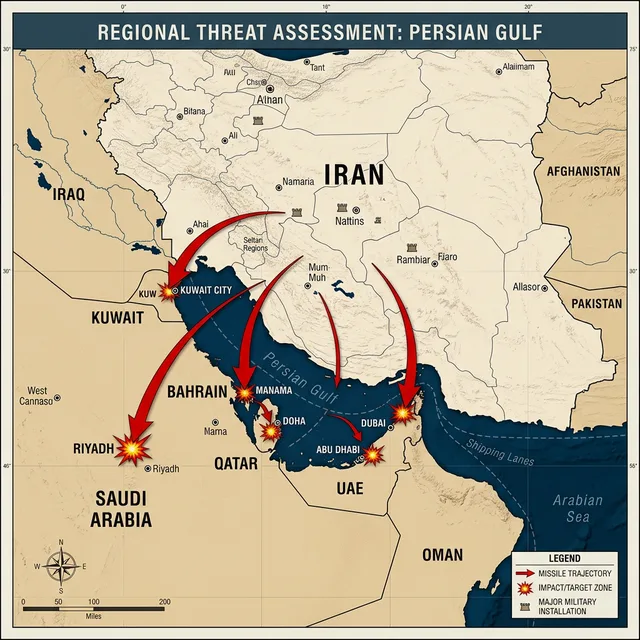
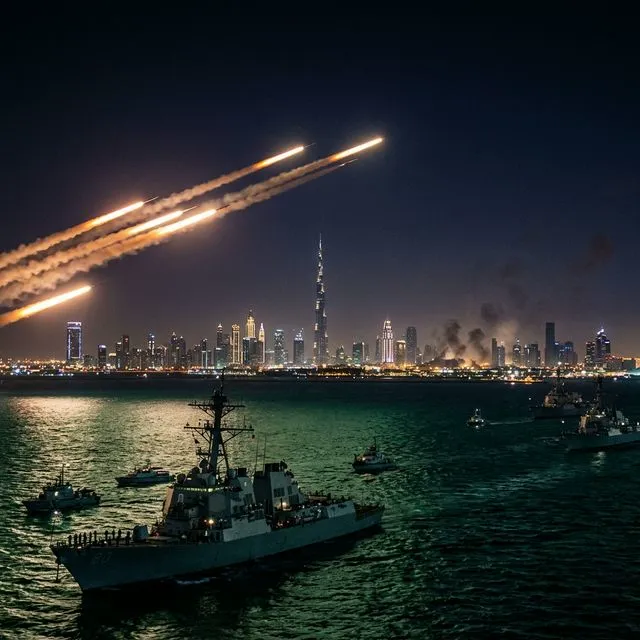
Less than 48 hours after the devastating US and Israeli strikes on Iranian territory — the so-called Operation Roaring Lion — Iran responded with one of the largest missile and drone offensives ever recorded in modern military history. The target: not just Israel, but the entire Persian Gulf. Dubai, Abu Dhabi, Bahrain, Kuwait, Qatar and Saudi Arabia were hit simultaneously in a show of force that caught even military analysts off guard with its scale and coordination.
This article documents, based on verified sources from multiple international agencies, the details of the Iranian retaliation, the damage caused, the victims and the consequences that are redrawing the geopolitical map of the Middle East — and the world.
The Numbers: An Unprecedented Offensive
The scale of the Iranian attack is hard to grasp without putting it in perspective. According to official data compiled by defense agencies, international media and governments of the targeted countries:
| Arsenal Used | Quantity |
|---|---|
| Ballistic missiles | 165 |
| Cruise missiles | 2 |
| Drones (unmanned aerial vehicles) | 541 |
| Total projectiles | 708 |
For comparison, Iran's retaliation against Israel in April 2024 — considered historic at the time — involved around 300 drones and missiles. The March 2026 attack was more than double in volume and incomparably broader in geographic reach, hitting six countries simultaneously.
Timeline of the First Hours
The attacks began in the early hours of March 1, 2026, local Gulf time, just two days after Operation Roaring Lion:
| Time (GMT+4) | Event |
|---|---|
| 01:15 | First missile launches detected from Iranian territory |
| 01:25 | UAE and Bahrain defense systems activated |
| 01:35 | First impact reported in Bahrain — international airport hit by drone |
| 01:42 | Explosions in Dubai — near airport and Jebel Ali port |
| 01:50 | Explosions in Riyadh, Saudi Arabia — American military bases targeted |
| 02:00 | Explosions in Kuwait City — airport and military base |
| 02:15 | Qatar intercepts missiles — debris causes fire in industrial area |
| 02:30 | Abu Dhabi reports multiple impacts — Zayed airport and Al-Salam naval base |
| 03:00 | UAE confirms: majority of projectiles intercepted; 3 fatalities, 58 injured |
Dubai: The Symbol of Vulnerability
Burj Al Arab and Palm Jumeirah Damaged
Among the images that circled the globe in the first hours, few were as shocking as those showing smoke rising near the iconic Burj Al Arab hotel, one of the most recognizable landmarks on the planet. Although the hotel itself didn't suffer catastrophic structural damage, the surrounding area was hit by debris from intercepted missiles.
Palm Jumeirah — the famous palm-shaped artificial island — also suffered damage. Debris from intercepted drones fell on residential areas, injuring at least two people. For millions of tourists and residents who associate Dubai with unshakeable luxury and security, the images of smoke over the Palm were a profound psychological shock.
Dubai International Airport (DXB)
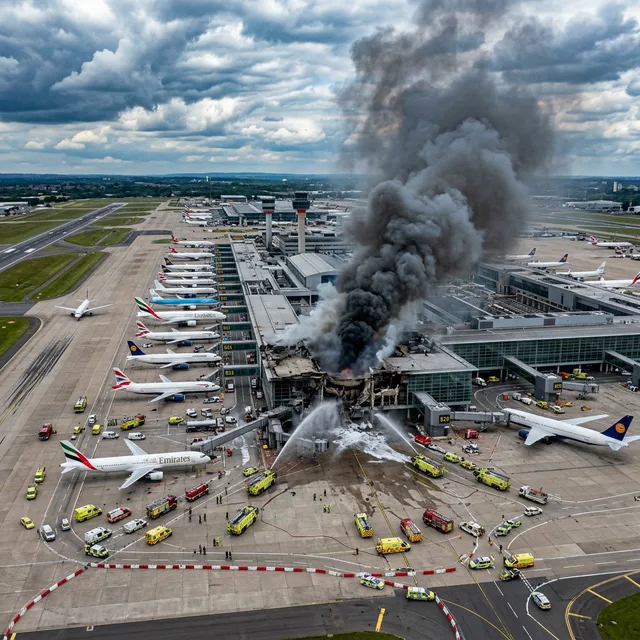
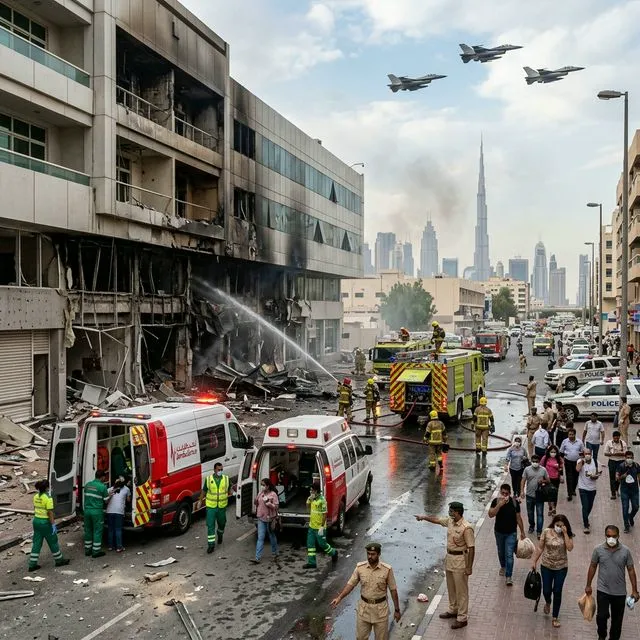
The busiest airport in the Middle East — and one of the busiest in the world, with over 85 million passengers per year — was directly affected. Although air defenses intercepted most projectiles aimed at airport infrastructure, debris from interceptions caused damage to auxiliary facilities.
All flights were immediately suspended. Air India canceled 50 international flights. Malaysia Airlines suspended routes to Doha, Jeddah and Medina. Emirates and Etihad halted operations for hours. Hundreds of thousands of passengers were stranded at airports around the world.
Jebel Ali Port: Fire at the Logistical Heart
Jebel Ali port, the largest artificial port in the world and the biggest commercial hub between Europe and Asia, suffered a significant fire caused by debris from an intercepted missile. Although the fire was contained within hours, the disruption to port operations has economic implications far beyond Dubai — global supply chains depend on this infrastructure.
The UAE Toll
The UAE Ministry of Defense issued an official statement detailing:
- 165 ballistic missiles detected in UAE airspace
- 2 cruise missiles also intercepted
- 541 drones monitored and mostly neutralized
- 3 fatalities: citizens of Pakistan, Nepal and Bangladesh — expatriate workers, cruel irony of a conflict that kills those who are most vulnerable
- 58 injured on Emirati territory
In Abu Dhabi, Zayed International Airport was directly hit. The Al-Salam naval base suffered a warehouse fire from drone attacks. The complex housing the Israeli embassy in Abu Dhabi sustained minor damage from intercepted drone debris — a symbolic target with a clear message.
Bahrain: The US 5th Fleet in the Crosshairs
The small island kingdom of Bahrain, home to the headquarters of the US Navy's 5th Fleet, was one of the priority targets of the Iranian retaliation. The international airport was hit by drones, suffering minor damage. But the real target was the American naval base.
Facilities linked to the 5th Fleet were struck by missiles. The US embassy in Manama ordered staff to evacuate nearby hotels after one was hit by debris. Naval patrols in the region were immediately reinforced.
Bahrain's position — just 200 km from the Iranian coast across the Persian Gulf — makes the country extraordinarily vulnerable. With a population of just 1.5 million, Bahrain lacks the strategic depth and advanced defense systems of the UAE or Saudi Arabia.
Kuwait, Qatar, Saudi Arabia and Oman
Kuwait
Kuwait International Airport was targeted, with explosions reported in the vicinity. American military bases on Kuwaiti soil were also hit. Kuwait suspended all commercial flights indefinitely.
Qatar
Qatar intercepted missile attacks, but debris from a neutralized missile caused a minor fire in an industrial zone near Doha. Injuries were reported but no confirmed fatalities.
Saudi Arabia
Explosions were reported in Riyadh, the capital. Iranian missiles primarily targeted American military bases in Saudi territory. The Saudi government didn't release complete damage data, maintaining a diplomatic silence that reveals the complexity of its position.
Oman
The port of Duqm, a strategic installation in southeastern Oman, was targeted by Iranian drones. Oman, historically neutral in Iran-West disputes — and the country that hosted the last nuclear negotiation attempts — saw its neutrality shattered in minutes.
Defense Systems: What Worked and What Didn't
The Iranian retaliation put the world's most sophisticated anti-missile defense systems to the test. Gulf countries operate a combination of:
- THAAD (Terminal High Altitude Area Defense) — American high-altitude interception system
- Patriot PAC-3 — Medium-altitude anti-missile system
- NASAMS — Norwegian-American short-range air defense system
Interception Rate
According to preliminary military reports, interception rates varied significantly:
| Country | Primary System | Estimated Interception Rate |
|---|---|---|
| UAE | THAAD + Patriot | ~92% |
| Bahrain | Patriot (US support) | ~80% |
| Saudi Arabia | Patriot PAC-3 | ~85% |
| Kuwait | Patriot (US support) | ~78% |
| Qatar | Patriot PAC-3 + NASAMS | ~90% |
| Oman | Limited systems | ~60% |
The brutal lesson is that even with interception rates above 85%, the sheer quantity of projectiles — over 700 — means dozens penetrate defenses. And a single ballistic missile can cause catastrophic destruction.
Economic Impact: Oil and Market Chaos
Strait of Hormuz: The World's Bottleneck
The Strait of Hormuz, a maritime passage just 33 km wide between Iran and Oman, is the most strategic corridor in global energy trade. Through it flow daily:
- 20% of all oil consumed worldwide
- 25% of all global liquefied natural gas (LNG)
- Tankers carrying up to 21 million barrels per day
With Iranian missiles flying over these waters, oil and LNG tankers suspended crossings. Maritime insurers raised premiums to unprecedented levels.
Financial Markets in Collapse
Market response was immediate and violent:
- Oil (Brent): surged above $135 per barrel — highest since the 2022 energy crisis
- Gold: jumped 8% in a single session, reaching new all-time high
- Global stock markets: S&P 500 fell 4.2%, Nikkei lost 5.1%, DAX dropped 3.8%
- Dollar: strengthened against all major currencies (flight to safety)
- Aviation sector: Emirates Group and Qatar Airways stocks fell over 15%
International Reactions
The Organisation of Islamic Cooperation (OIC) issued a strong condemnation of the Iranian attacks against Saudi Arabia, UAE, Bahrain, Qatar, Kuwait and Jordan. The UN Secretary-General called for an immediate ceasefire and convened an emergency Security Council meeting. Singapore expressed "deep regret" over the failure of negotiations.
In Karachi, Pakistan, protests erupted near the American consulate, resulting in casualties. Pro-Iran demonstrations broke out in Baghdad, Beirut and Sanaa. Meanwhile, Iranian diaspora communities organized peace vigils.
Why Were the Gulf Countries Attacked?
American Bases
The UAE, Bahrain, Kuwait, Qatar and Saudi Arabia host American military bases. The US Navy's 5th Fleet operates from Bahrain. Al Udeid Air Base in Qatar is the largest American military hub in the Middle East.
From the Iranian perspective, these bases were used to plan and execute Operation Roaring Lion. Attacking them means attacking enemy military infrastructure, not the host country — though the distinction is negligible when missiles fall on cities.
Strategic Message
Iran sent a triple message:
- To the US: "There is no safe place for your forces in this region"
- To US allies in the Gulf: "There is a cost to hosting American bases"
- To the world: "We can paralyze the global economy by closing the Strait of Hormuz"
What to Expect Now: Scenarios
Scenario 1: Negotiated De-escalation (25% probability)
Diplomatic intervention led by China, the UN and neutral powers. The mutual destruction achieved may create a "window of exhaustion" where both sides accept negotiations.
Scenario 2: Controlled Escalation (40% probability)
The US and allies attack Iranian military targets again, Iran retaliates at similar scale. A cycle of strikes and retaliations establishes itself, but neither side crosses the line of ground invasion or nuclear weapons use.
Scenario 3: Total Regional War (25% probability)
Iran's proxy network — Hezbollah in Lebanon, Houthis in Yemen, militias in Syria and Iraq — enters the conflict fully. Multiple fronts open simultaneously.
Scenario 4: Strait of Hormuz Closure (10% probability)
Iran blocks the Strait with naval mines and submarines. Oil prices exceed $200. The global economy enters recession.
The Human Cost
Behind the numbers and strategic analyses are human beings whose lives were destroyed or irreversibly altered. The three dead in the UAE were expatriate workers — Pakistani, Nepalese and Bangladeshi — people who left their countries seeking a better life and met death in a war that wasn't theirs.
The 58 injured include children, elderly people and ordinary workers. The thousands stranded at airports face agonizing uncertainty. Dubai residents who heard explosions above their heads at 2 AM experienced moments of terror that will leave lasting psychological scars.
Connection to Operation Roaring Lion
This article is a direct continuation of coverage of Operation Roaring Lion, which details the initial US and Israeli attack on Iran on February 28, 2026. Read it for the complete timeline, historical precedents and the nuclear context that led to the breaking point.
Conclusion: The World Changed — Again
The Iranian retaliation against Dubai and the Persian Gulf is not just another chapter of Middle Eastern tension. It's a demonstration that in the world of 2026, regional conflicts don't stay contained. When missiles fall on Dubai — a city that symbolizes globalization, prosperity and the future — the message is clear: no one is isolated.
This article will be updated as new developments are confirmed by reliable sources.
References and Sources
- The Guardian — Iran retaliatory attacks on Gulf states
- Arab News — UAE reports 3 dead, 58 injured in Iranian strikes
- CBS News — Iran launches missiles at Dubai, Bahrain, Saudi Arabia
- Al Jazeera — Gulf states under fire: Iran's retaliatory offensive
- The Independent — Burj Al Arab, Palm Jumeirah damaged
- The Straits Times — Jebel Ali port fire after missile debris
- Iran International — Iran launches 700+ projectiles at Gulf states
- Reuters — Oil prices spike above $135 on Gulf crisis
- Wikipedia — 2026 Iran–Gulf States conflict