Particle physics has just witnessed an unprecedented breakthrough thanks to researchers at the Thomas Jefferson National Accelerator Facility. In a monumental experiment, scientists managed to identify two exotic subatomic structures that challenge traditional models of matter. These structures belong to the so-called XYZ states, a category of particles that does not fit into conventional rules. The discovery promises to revolutionize our understanding of how quarks and gluons interact within the universe.
The Standard Model of particle physics describes the fundamental building blocks of all visible matter. In this model, quarks are elementary particles that bind together to form hadrons, such as protons and neutrons. Traditionally, we have known that hadrons come in two primary forms: baryons, composed of three quarks, and mesons, composed of a quark-antiquark pair. However, nature always finds ways to surprise the scientific community with much more complex configurations and arrangements.
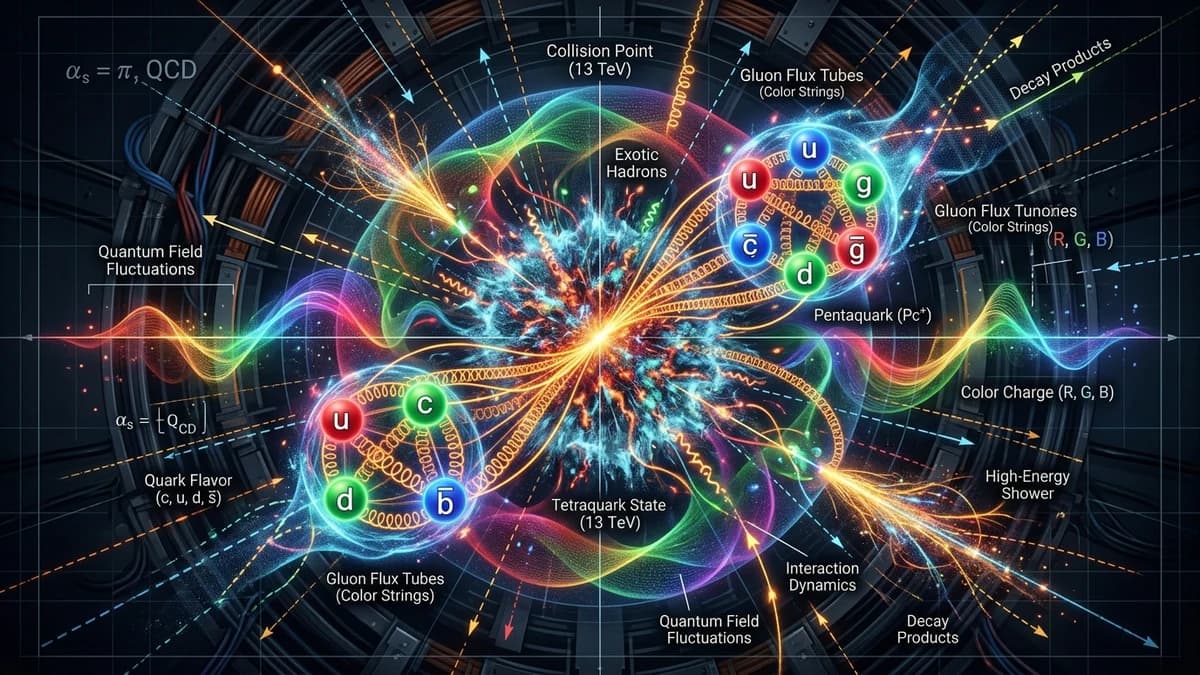
For decades, theoretical physicists have suggested the possibility of exotic arrangements containing four or even five quarks, known as tetraquarks and pentaquarks. These formations, collectively called exotic XYZ states, have been extremely difficult to detect in experimental environments. The strong nuclear force, which holds the quarks together, is mediated by particles called gluons, creating a dynamic and highly chaotic environment. Understanding the exact mathematical rules governing these intricate interactions has been one of modern physics' greatest challenges.
The Thomas Jefferson National Accelerator Facility, also known widely as Jefferson Lab, features cutting-edge technologies designed specifically to probe the atomic nucleus. Its primary accelerator, the Continuous Electron Beam Accelerator Facility (CEBAF), fires continuous beams of electrons at fixed targets with surgical precision. When these high-energy electrons strike atomic nuclei, they interact with the internal structures, revealing the deepest secrets of matter. It was precisely this high-energy environment that made the new and fascinating discovery possible.
While analyzing the vast datasets generated by the collisions, physicists observed clear anomalies indicating the presence of new subatomic resonances. These resonances are the ephemeral signatures of particles that exist for mere fractions of a second before rapidly decaying into lighter, stable particles. The two newly identified structures demonstrated masses and decay patterns that do not correspond to any known, conventional meson or baryon. They align perfectly with the long-standing theoretical predictions for the mysterious XYZ states.
The first of the discovered structures appears to be a very strong candidate for a tetraquark containing heavy quarks, possibly involving the charm quark. The presence of heavy quarks provides slightly greater stability to the overall structure, allowing it to be detected with rigorous statistical significance. The experimental data displayed exceptional clarity, easily reaching the five-sigma mark, which is the gold standard for confirming a discovery in particle physics. This unprecedented level of precision almost completely eliminates the possibility of a random statistical fluctuation.
The second exotic structure revealed an even more intriguing pattern, strongly suggesting the presence of a pentaquark or a tightly bound hadronic molecule. Differentiating between a compact five-quark particle and a molecular state formed by two adjacent hadrons is an incredibly complex experimental task. Researchers utilized advanced supercomputer simulations based on Lattice Quantum Chromodynamics (Lattice QCD) to thoroughly compare the experimental results with the reigning theory. The simulations indicate that the strong force allows for far more diverse quark configurations than initially thought by scientists.
Comparison of Hadronic Structures
To fully grasp the massive magnitude of this discovery, it is essential to contrast these exotic states with ordinary, everyday matter. The table below details the crucial differences between conventional hadrons and the newly observed XYZ states.
| Characteristic | Conventional Hadrons (Baryons/Mesons) | Exotic XYZ States (Tetra/Pentaquarks) |
|---|---|---|
| Typical Composition | 3 quarks (Baryons) or quark-antiquark pair (Mesons) | 4 quarks (Tetraquarks) or 5 quarks (Pentaquarks) |
| Stability | Highly stable (protons) or highly predictable decay | Extremely unstable, exhibiting ultrafast decay rates |
| Binding Mechanism | Conventional strong force and simple gluon exchange | Complex gluon dynamics and possible molecular bonds |
| Detection Difficulty | Relatively easy to observe in standard accelerators | Requires high-intensity beams and sophisticated analysis |
| Cosmological Importance | Form the solid foundation of all visible atomic matter | May exist deep within high-density neutron stars |
Quantum chromodynamics (QCD) is the mathematical theory that describes the strong force, one of the four fundamental forces of nature. Unlike gravity or electromagnetism, the strong force does not diminish in intensity as the constituent quarks move further apart from one another. Instead, it acts like a stretching rubber band, accumulating immense energy until it abruptly snaps and creates new particle pairs. This unique phenomenon, known as color confinement, completely prevents single quarks from being observed in isolation in nature.
The groundbreaking discoveries at Jefferson Lab offer a natural laboratory to rigorously test the limits of color confinement and the non-linear equations of QCD. When four or five quarks bind together, the internal dynamics of the resulting particle become incredibly rich, involving multiple simultaneous gluon interactions. Studying these highly complex particles helps theoreticians continually refine their approximations and improve the computational methods used in Lattice QCD. Over time, this meticulous work could lead to a much more accurate unified theory regarding matter formation in the early universe.
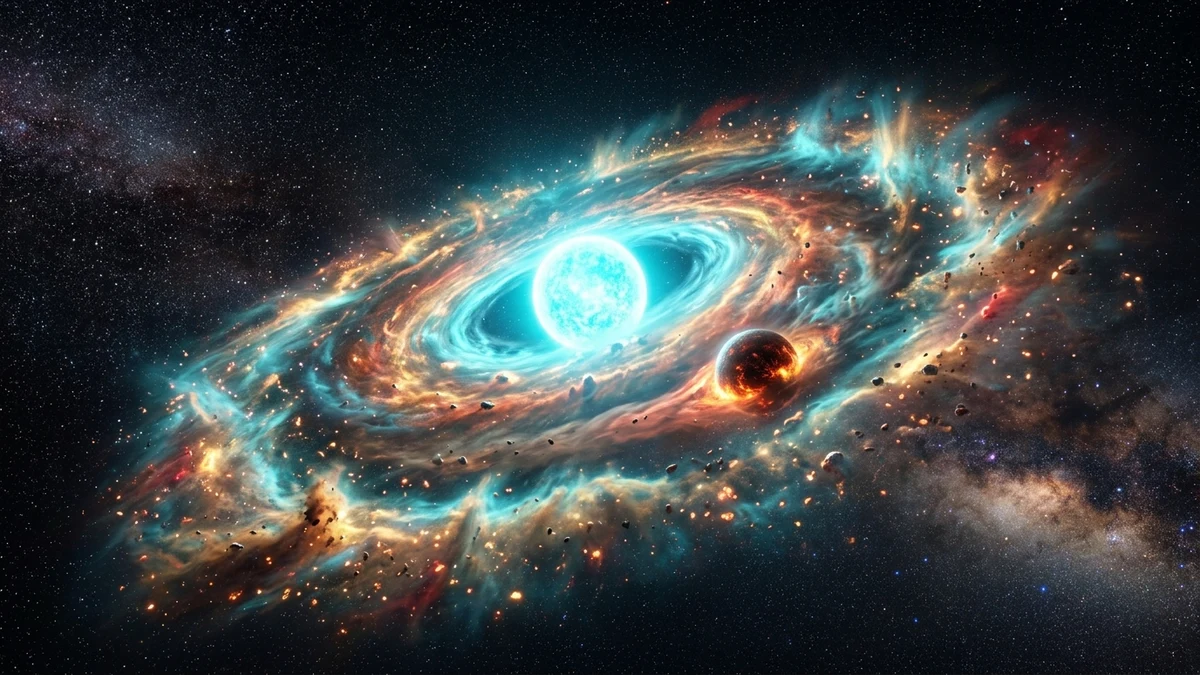
The paramount importance of this research extends far beyond terrestrial laboratories, reaching into the most extreme environments of the cosmos. In the dark heart of neutron stars, matter is crushed to unimaginably high densities, far surpassing anything found in ordinary atomic nuclei. Under such extreme gravitational pressures, individual neutrons may dissolve entirely, creating a degenerate state commonly known as quark matter. The precise properties of these exotic stars depend directly on the rules of quantum chromodynamics and XYZ state formation.
If tetraquarks and pentaquarks can consistently form and remain stable in these intense stellar environments, the equation of state for neutron stars must be rewritten. This would fundamentally affect our cosmological predictions regarding the maximum size, mass limits, and cooling rates of these dead stars. Furthermore, the gravitational wave signatures generated by colliding neutron stars would contain subtle traces of this exotic internal composition. Therefore, the experimental discoveries made right here on Earth have direct, profound implications for gravitational wave astronomy and modern astrophysics.
Physicists are continuing to work tirelessly to carefully analyze the remaining data from the latest experimental campaign conducted at CEBAF. Future scheduled upgrades to the accelerator facility plan to further increase the energy and intensity of the electron beam, opening new horizons. Every new exotic particle found serves as a crucial missing piece in a vast cosmic puzzle that refuses to be solved easily. Jefferson Lab's ongoing commitment to absolute experimental excellence guarantees that many more surprises await us in the realm of the infinitely small.
Ultimately, the successful identification of these two exotic subatomic structures marks a literal golden era for nuclear and particle physics. They not only validate complex mathematical predictions but also push physicists to think well beyond the established boundaries of the Standard Model. The wonderfully exotic nature of matter reveals that the universe is fundamentally more complex and marvelous than simple arrangements of protons and neutrons. With increasingly sophisticated experimental tools and brilliant minds focused on the problem, the domain of quantum chromodynamics will soon unveil its final secrets.
Frequently Asked Questions
What exactly are the exotic XYZ states in particle physics?
The exotic XYZ states are extremely rare subatomic particles that do not follow the classical hadron formation rules of the Standard Model. While ordinary particles contain two or three quarks, XYZ states can contain four (tetraquarks) or five (pentaquarks) quarks within their unique structure. They were assigned generic letters like X, Y, and Z because, initially, their exact properties, behaviors, and compositions were entirely unknown to scientists. The discovery and careful study of these exotic particles help validate the complex theory of quantum chromodynamics under extreme physical conditions.
How does Jefferson Lab manage to detect these exotic structures?
The Thomas Jefferson National Accelerator Facility utilizes the CEBAF accelerator, which fires continuous electron beams with extreme energy and precision against fixed targets. When these fast electrons collide with atomic nuclei, the immense released energy can temporarily create brand new, highly unstable particles like the XYZ states. Because these structures decay in minuscule fractions of a second, scientists utilize colossal detectors and highly complex algorithms to track the resulting decay products. By deeply analyzing the trajectory and energy of the resulting particles, physicists can accurately reconstruct the mass and properties of the original particle.
What is the profound impact of this discovery on our understanding of the universe?
Accurately identifying new exotic states allows scientists to better understand the strong nuclear force, the fundamental interaction that keeps atomic nuclei bound together. This has colossal and far-reaching implications for astrophysics, especially in the study of the incredibly dense cores of neutron stars and early universe matter. If exotic particles can reliably exist in these extreme cosmic conditions, our current models regarding stellar evolution and gravitational wave emissions must be significantly adjusted. Essentially, these remarkable discoveries on a subatomic scale help continuously shape our macroscopic view of how the vast cosmos operates.