🌍 Your knowledge portal
historia

Roman Library of Fuente Álamo Discovered in Spain via 3D Technology

📅 2026-08-06⏱️ 7 min read📝
Roman Library of Fuente Álamo Discovered in Spain via 3D Technology
Roman Library of Fuente Álamo Discovered in Spain via 3D Technology — High-Fidelity Artistic Illustration created by artificial intelligence based on scientific research.
⚡

Quick Summary

Archaeologists use advanced technological mapping to reveal an extremely preserved 1,700-year-old Roman library in Fuente Álamo, Spain. Classical archaeology has just recorded one of the most impressive milestones of the last decade in the Iberian Peninsula.

Key Takeaways:

  • The site of the discovery functioned as an ancient residential and productive center during the height of the Roman Empire in southern Spain.
  • The use of high-resolution terrestrial laser scanners has revolutionized the way archaeologists explore ancient sites without damaging the original structures.
  • The library of Fuente Álamo features a classical architectural layout, with thick walls equipped with rectangular niches carved into the stone masonry.

Roman Library of Fuente Álamo Discovered in Spain via 3D Technology 🏛️⚡ #

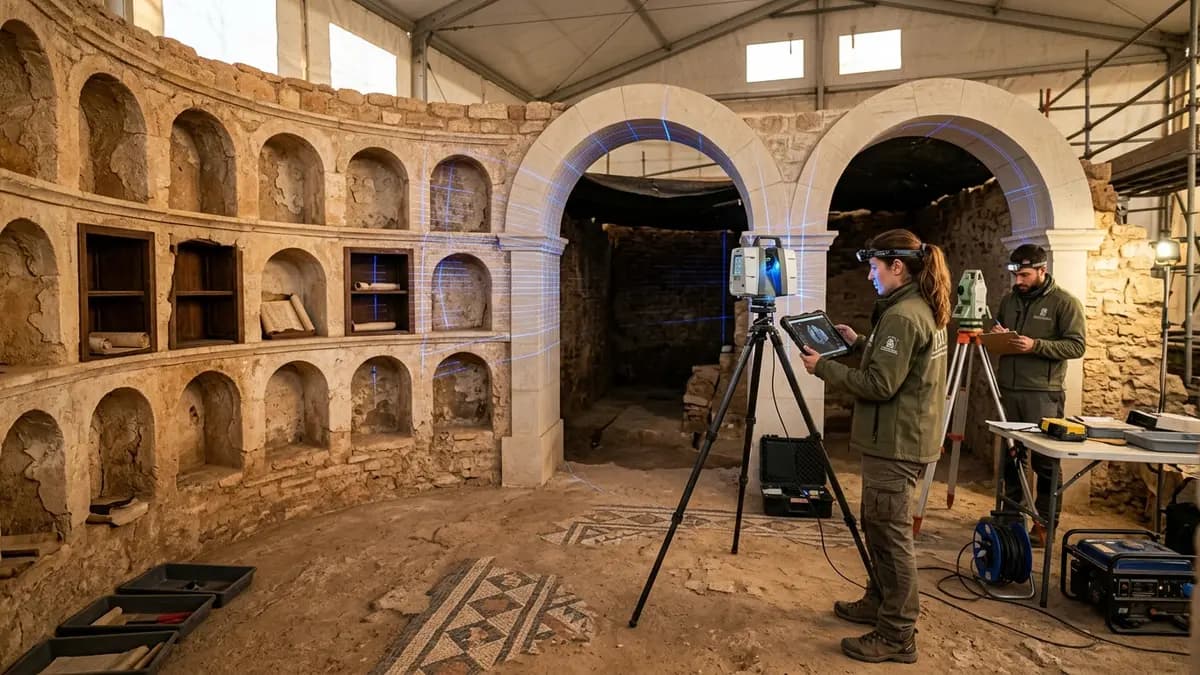
The spectacular chamber of the ancient Roman library of Fuente Álamo being mapped with blue and green laser beams by equipped Spanish archaeologists.

Classical archaeology has just recorded one of the most impressive milestones of the last decade in the Iberian Peninsula. Spanish researchers have discovered a magnificent Roman library of approximately 1,700 years in the renowned villa of Fuente Álamo, located in the region of Murcia. This extraordinary find was made possible thanks to the pioneering use of three-dimensional mapping technologies that revealed the fully preserved underground structure.

The site of the discovery functioned as an ancient residential and productive center during the height of the Roman Empire in southern Spain. Specialists explain that the physical structure of the building was protected over the centuries by thick layers of clay sediments that prevented the stone vaults from collapsing. Initial excavations indicate that this is the best-preserved library in the entire Iberian Peninsula, surpassing other similar historical monuments of the time in structural integrity.

The main element that enabled the precise location of the library was ground-penetrating radar technology combined with laser scanning. These modern digital tools allowed scientists to see through the compacted soil without the need for destructive excavations on the historical surface. From the three-dimensional images generated by supercomputers, the team was able to plan surgical accesses directly into the hidden chambers of the ancient Roman construction.

The Science Behind Archaeological Digitalization #

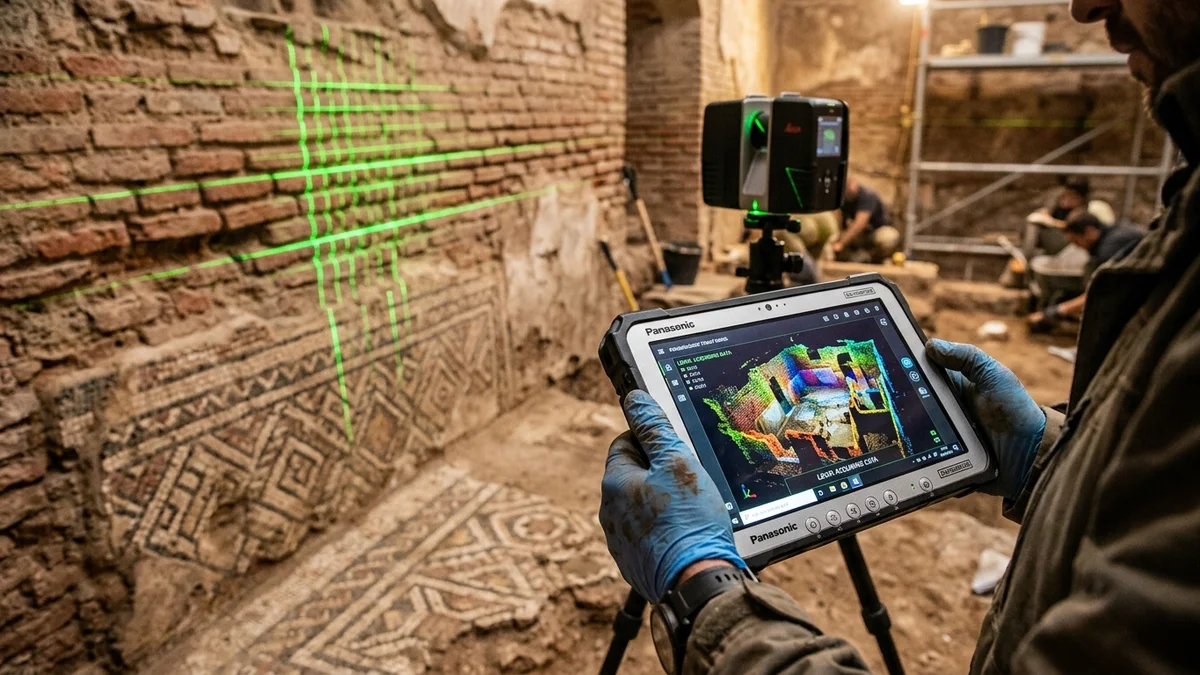
The use of high-resolution terrestrial laser scanners has revolutionized the way archaeologists explore ancient sites without damaging the original structures. By projecting light beams that calculate the exact distance of each point in the chamber, the equipment creates a three-dimensional point cloud that reconstructs the room digitally. This digital preservation technique allows researchers from all over the world to visit the library virtually and analyze the spatial arrangement of the storage niches.

The three-dimensional laser scanner projecting green lines onto the ancient Roman brick wall and floor mosaics of Fuente Álamo.

The precision of this mapping is so high that it allowed the identification of small structural cracks and the exact thickness of the Roman bricks used in the construction. These Roman civil engineering data help to understand the construction methods that guaranteed the durability of the stone vaults for nearly two millennia. The integration between traditional archaeology and state-of-the-art digital technology sets an important precedent for the discovery of other buried historical sites.

The geometric mosaics covering the library floor were also mapped down to the millimeter, revealing artistic patterns typical of the 4th century AD. Artistic analysis suggests that the room was commissioned by a wealthy Roman patrician with a strong interest in the Greek philosophical currents of the time. The conservation of these colorful patterns of limestone tiles and glass paste proves the aesthetic sophistication that rural landowners sought in their imperial residences.

Information Architecture in Roman Antiquity #

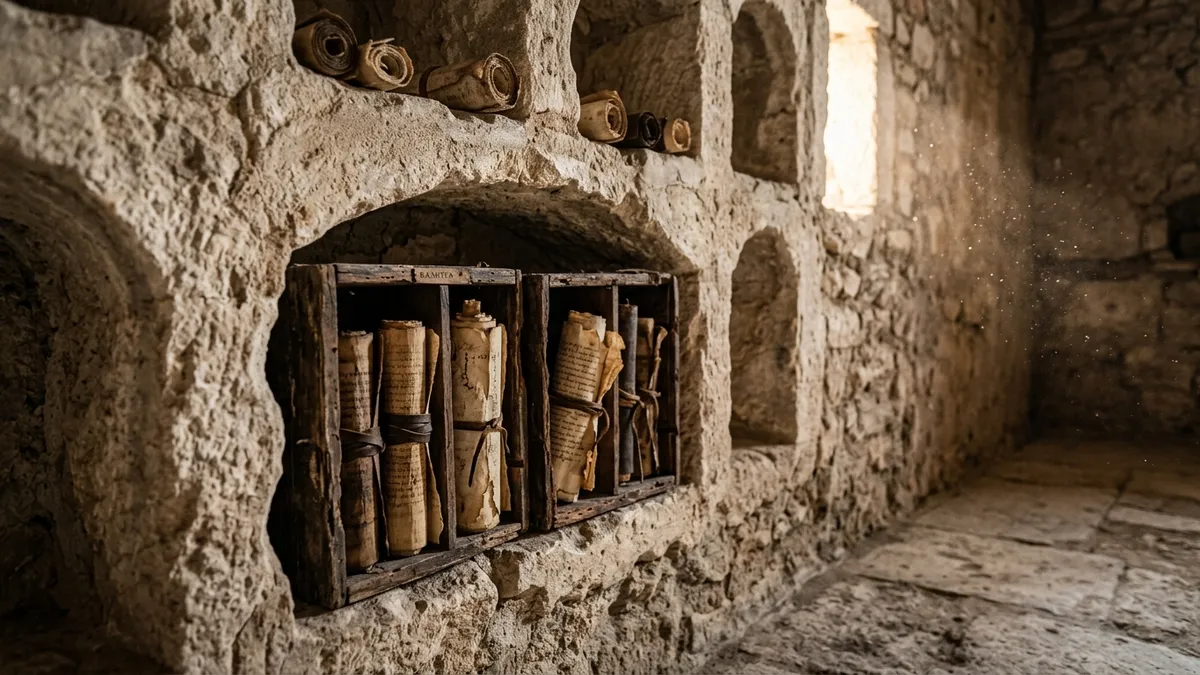
The library of Fuente Álamo features a classical architectural layout, with thick walls equipped with rectangular niches carved into the stone masonry. These niches, historically known as armaria, served to house the wooden cases that protected the papyrus and parchment rolls from humidity and insects. The arrangement of the shelves was planned to facilitate the circulation of dry air and natural light coming from strategically positioned zenithal openings.

Close-up macro of the stone masonry niches of the ancient Fuente Álamo library containing preserved wooden cases and ancient scrolls.

The estimated storage capacity of the room indicates that it could house about two thousand rolls of philosophical and scientific manuscripts. Archaeologists believe that the original owner used this space not only for individual study but also as a reading room for distinguished guests. The fact that the niches were arranged along the walls freed up the central area of the room for placing wooden tables and decorative statues.

The conservation of these original niches provides valuable clues about how the Romans organized their literary collections and cataloged different disciplines of knowledge. The physical separation of the niches suggests that themes were systematically divided between philosophy, law, medicine, and poetic literature. This organizational structure is very similar to the cataloging model that would be developed in later centuries by the European medieval monastic tradition.

Comparison of Preserved Ancient Libraries #

Library Name Location Construction Period Preservation State Estimated Capacity
Fuente Álamo Library Murcia, Spain 4th Century AD Exceptional (Underground structure and niches intact) ~2,000 manuscript rolls
Library of Celsus Ephesus, Turkey 2nd Century AD Only the monumental facade was reconstructed ~12,000 papyrus rolls
Villa of the Papyri Herculaneum, Italy 1st Century BC Carbonized by Mount Vesuvius (rolls preserved) ~1,800 carbonized rolls
Library of Alexandria Alexandria, Egypt 3rd Century BC Totally destroyed by fires in antiquity ~400,000 papyrus rolls

The comparative table presented above demonstrates that the discovery at Fuente Álamo stands out mainly for the integrity of its internal and underground structures. Unlike the famous Library of Celsus, where only the external facade resisted time, the Spanish find preserved the internal three-dimensional layout of the rooms. This difference makes it possible to study the physical circulation of readers and the practical functionality of the original Roman furniture in an unprecedented way.

The comparative analysis with the Villa of the Papyri also highlights the importance of climate and burial method in the conservation of sensitive historical materials. While in Herculaneum the volcanic lava instantly carbonized the rolls, in Murcia the clay insulation allowed physical preservation without severe thermal deformation. Archaeological science thus gains a new physical reference to understand reading dynamics and physical packaging in the late empire.

The Historical Impact of the Discovery for the Population #

For the scientific community and the local population of Murcia, the confirmation of this archaeological find opens a new horizon for tourism and cultural development. The regional government is already planning the creation of a virtual interpretation center that will use virtual reality headsets to allow safe public visits. This initiative aims to generate jobs in the region and promote the valuation of local historical heritage through interactive educational technology.

In addition to the direct socioeconomic benefits, the discovery rekindles the interest of public schools in humanistic studies and archaeology applied to exact science. Students of various ages will be able to follow the digital reconstruction of the manuscripts and understand how ancient Roman philosophers documented their observations of nature. This exchange of knowledge strengthens the community's bond with the deep historical roots that shaped the Iberian territory.

Scientists hope that the 3D mapping technology used in Fuente Álamo will be applied to other neighboring ruins that still await detailed excavation. The success of this project demonstrates that digital preservation and geophysical mapping should be integrated as a standard protocol in future large-scale research. To understand how new scientific methods are also being applied in mapping other remote and intriguing environments of our history, read the article on the techniques applied in /en-US/blog/novas-tecnicas-sismicas-detectam-reservatorios-gelo-sub-superficie-lua-2026.

The Search for Textual Fragments and Lost Manuscripts #

The high expectation of researchers lies in the possibility of extracting readable remnants of the organic papyrus fibers found at the base of some stone niches. Although most of the written material has disintegrated, modern multispectral techniques can reveal traces of iron-gall ink invisible to the naked eye. These textual fragments may contain unpublished copies of treatises on Roman agriculture or administrative records that will rewrite local economic history.

The interdisciplinary team uses electron microscopes to analyze the molecular composition of organic residues found in the soil of the ancient library. This preliminary chemical analysis revealed traces of aromatic plant oils that were used by the Romans to repel insects and paper-destroying fungi. The discovery of this chemical conservation recipe reveals the sophistication of the archival care that the Roman intellectual elite habitually practiced.

Fine excavation work and consolidation of the stone structures are expected to continue uninterrupted over the coming months in the Murcia region. Every centimeter of removed sediment is carefully sieved to ensure that no small material clue or ceramic fragment is discarded. The patience of the team and the precision of digital tools ensure that the Fuente Álamo library will continue to reveal its ancient secrets for a long time.

Conclusion: The Roman Legacy in the Face of Modernity #

The discovery and three-dimensional mapping of the Fuente Álamo library brilliantly unite the Roman past and the technological future of our civilization. This magnificent find reminds us that the human desire to catalog, preserve, and share knowledge transcends the barriers of time and generations. The ancient Spanish stone walls now gain eternal life through digital servers and the interest of scholars around the globe.

As technology advances, our ability to dialogue with the ancient peoples who preceded us becomes clearer and deeper. The library of Fuente Álamo ceases to be just a buried ruin to become a living symbol of the cultural resilience of the Iberian Peninsula. The commitment to protect these physical structures ensures that future generations will continue to be inspired by the ingenuity and wisdom of classical antiquity.


Sources: Spanish National Research Council (CSIC), Journal of Roman Archaeology, Nature Archaeology volume 12 "Advanced 3D scanning methods in Roman villa excavations", Universidad de Murcia Department of Classical Studies. Updated in August 2026.

🏷️ Tags:

#romanlibrary#fuentealamo#spain#3darchaeology#archaeologicaldiscovery#romanempire#murcia

📢 Gostou deste artigo?

Compartilhe com seus amigos e nos conte o que você achou nos comentários!

❓Frequently Asked Questions

The historic discovery of the Roman library of Fuente Álamo was achieved through the integrated use of ground-penetrating radar and three-dimensional laser scanners. These modern technologies allowed researchers to map the underground structures of the ancient villa with extreme precision, generating digital images of the stone chambers hidden beneath the sediment layers. In this way, archaeologists were able to identify the scroll storage niches and room layouts before removing the first layer of surface soil.
This Roman library is classified as the most well-preserved in the Iberian Peninsula due to the integrity of its masonry walls and original storage niches. The rapid burial by fine clay sediments created a sealed anaerobic environment that protected the physical structure from collapses and natural erosion for centuries. The absence of excessive humidity and the thermal stability of Murcia's subsoil helped conserve organic wood fragments and traces of ancient papyrus rolls.
The revelation of this 1,700-year-old library demonstrates that the Roman provinces of the Iberian Peninsula possessed intellectual and literary centers of high cultural relevance. The find confirms the elevated level of literacy and the circulation of philosophical and scientific texts among the agrarian elite who inhabited the Iberian Roman villas. This archaeological context enriches our knowledge about the manuscript exchange network and the preservation of classical knowledge at the empire's frontiers.

Receba novidades!

Cadastre seu email e receba as melhores curiosidades toda semana.

🔒 Sem spam. Cancele quando quiser.

💬 Comentários (0)

Seja o primeiro a comentar! 👋

📚Related Articles

Blinkerwall: 1 km Stone Wall Submerged 11,000 Years in Baltic Sea Revealed in PNAShistoria

Blinkerwall: 1 km Stone Wall Submerged 11,000 Years in Baltic Sea Revealed in PNAS

German scientists discover Europe's oldest Stone Age hunting megastructure submerged 21 meters beneath the Baltic Sea, built 11,000 years ago.

⏱️9 minLer mais →
DNA of 64 Maya Children in Chichén Itzá Reveals Boy and Sacred Twin Sacrifices in Naturehistoria

DNA of 64 Maya Children in Chichén Itzá Reveals Boy and Sacred Twin Sacrifices in Nature

A landmark ancient DNA study published in Nature sequences 64 skeletons from a subterranean chamber, dismantling the long-standing myth of sacrificed virgins.

⏱️12 minLer mais →
2,500-Year-Old Lost Cities Revealed by Laser in the Amazon: Science Study Rewrites Human Historyhistoria

2,500-Year-Old Lost Cities Revealed by Laser in the Amazon: Science Study Rewrites Human History

Airborne LiDAR mapping and CNRS excavations in the Upano Valley reveal the oldest and densest pre-Hispanic urban garden network in the Amazon rainforest.

⏱️9 minLer mais →
The Oldest Solar Observatory Outside the Maya Area: INAH Confirms 2,500-Year-Old Complex in Tetelihtichistoria

The Oldest Solar Observatory Outside the Maya Area: INAH Confirms 2,500-Year-Old Complex in Tetelihtic

Investigative report on INAH's confirmation of a 2,500-year-old Group E solar observatory in Puebla, the oldest documented outside the Maya world.

⏱️12 minLer mais →
The Oldest Home in the Americas: Science Study Reveals 13,800-Year-Old Camp and First Dogs in Alaskahistoria

The Oldest Home in the Americas: Science Study Reveals 13,800-Year-Old Camp and First Dogs in Alaska

Investigative report on the Science Advances study uncovering the oldest confirmed dwelling structure in the Americas, Ice Age sewing needles, and early domesticated dogs at Shég′ Xdaltth′í′, Alaska.

⏱️7 minLer mais →
The 'Holy Grail of Shipwrecks' at 600 Meters: Deep-Sea Robot Recovers 1707 Gold, Bronze Cannon, and Chinese Porcelain from the San José Galleonhistoria

The 'Holy Grail of Shipwrecks' at 600 Meters: Deep-Sea Robot Recovers 1707 Gold, Bronze Cannon, and Chinese Porcelain from the San José Galleon

Investigative dossier on the 600-meter robotic expedition to the San José Galleon in the Colombian Caribbean, the Antiquity study on 1707 macuquina coins, and the recovery of the first bronze cannon,

⏱️13 minLer mais →
Receba novidades no WhatsApp!