The universe has always harbored fascinating mysteries that challenge our understanding of classical physics. One of these impressive phenomena is vacuum birefringence, a concept deeply rooted in quantum mechanics. It is a spectacular effect where empty space itself behaves like an optical prism under specific physical conditions.
Our modern understanding of the vacuum reveals that it is not an absolute nothingness devoid of any substance or energy. On the contrary, quantum theory describes the vacuum as a seething sea of virtual particles and antiparticles. These subatomic entities spontaneously arise from vacuum energy and disappear in microscopic fractions of a second, maintaining equilibrium.
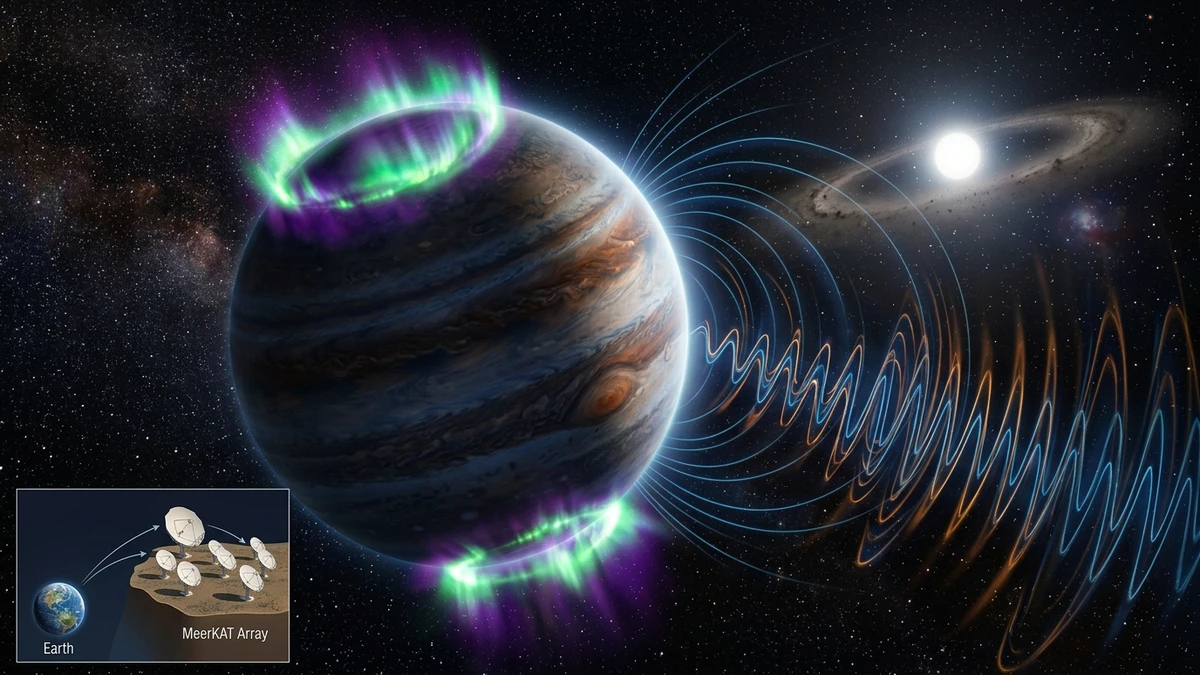
When we apply incredibly intense magnetic fields to this region, the dynamics of the vacuum undergo dramatic alterations. The sea of virtual particles interacts with the external magnetic field, altering the electromagnetic properties of space itself. As a result, the light that traverses this medium experiences changes in its propagation velocity and polarization state.
Birefringence occurs when light is split into two beams due to differences in the refractive index. In nature, we observe this macroscopically in certain crystals like calcite, which naturally split passing light. However, observing this phenomenon occurring in pure space vacuum requires energies that we cannot easily replicate in terrestrial laboratories.
The Pioneering Prediction of Heisenberg and Euler
In 1936, the renowned physicists Werner Heisenberg and Hans Heinrich Euler published theoretical works that would change our view of the vacuum. They utilized the early formulation of quantum electrodynamics (QED) to describe the behavior of empty space under intense fields. Their equations demonstrated mathematically that exceedingly strong electric and magnetic fields could modify the polarization properties of the vacuum.
At that time, humanity's technological capability was far below what was necessary to prove such a theory experimentally. The magnetic fields required for the effect to be measurable were orders of magnitude higher than what we knew. Therefore, vacuum birefringence remained an elegant mathematical prediction for several decades, eagerly awaiting empirical validation.
Heisenberg and Euler proposed that the interaction of light with virtual particles would create a dependency on the polarization direction. This means that photons polarized parallel to the magnetic field would travel at slightly different speeds than perpendicularly polarized photons. This minuscule difference would be enough to generate a measurable effect if the light traversed a considerable distance in this magnetic medium.
Their brilliant work established the theoretical foundations for the subsequent development of modern Quantum Electrodynamics. QED has become one of the most successful and precise theories in the entire landscape of modern physics. It not only explained birefringence but also predicted anomalies in the electron's magnetic moment and the famous Casimir Effect.
The Cosmic Laboratory: Magnetar RX J1856.5-3754
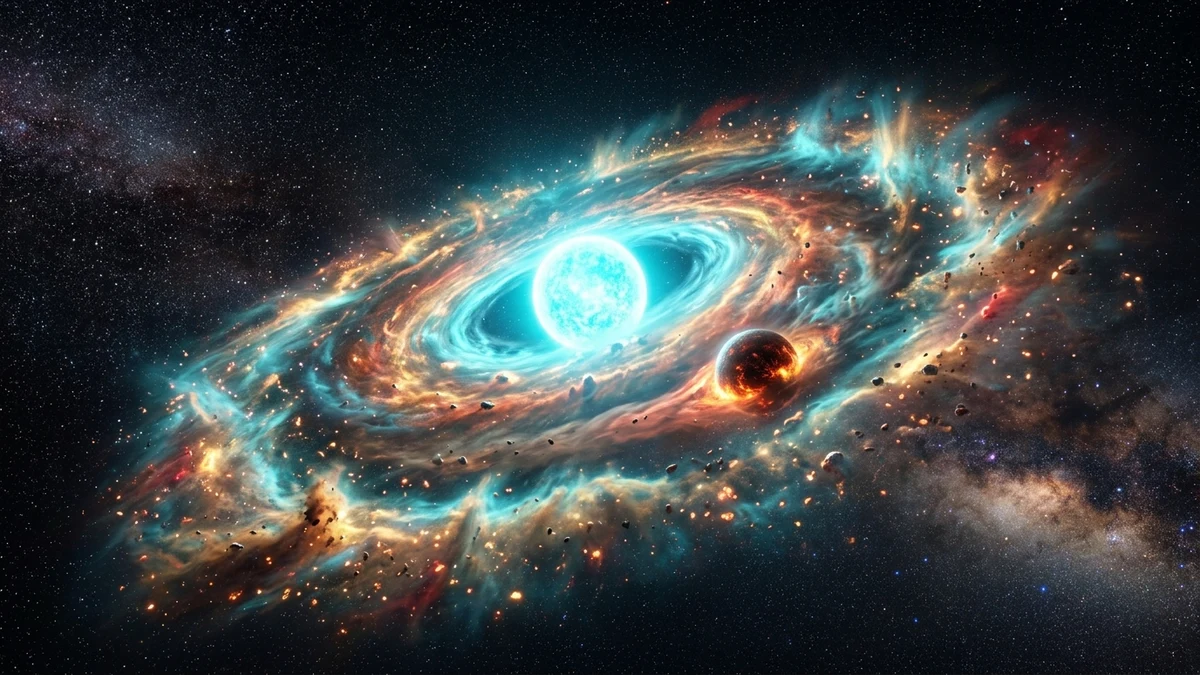
To observe vacuum birefringence in practice, scientists needed to find the most magnetic environments in the universe. This is where neutron stars come into play, specifically an extreme class known in astrophysics as magnetars. These stars are the incredibly dense remnants of massive supernovae that collapsed under their own gravity after exhausting their nuclear fuel.
The magnetar RX J1856.5-3754 became the ideal target for astronomical observations aiming to confirm the quantum effect. Located approximately 400 light-years from Earth, it is one of the closest neutron stars to our solar system. Its magnetic field is astonishing, being trillions of times stronger than the magnetic field that protects the Earth.
With magnetic fields reaching magnitudes of 10^14 Gauss, the region around this magnetar deforms the very essence of the vacuum. This extreme environment transforms empty space into a virtual prismatic crystal on a massive cosmic scale. The thermal light emitted by the hot surface of the neutron star must traverse this formidable magnetic field before reaching our telescopes.
Astronomers utilized the Very Large Telescope (VLT) from the European Southern Observatory (ESO) in Chile for this monumental undertaking. Equipped with instruments of ultra-high precision, the telescope managed to detect and measure the linear polarization of the magnetar's visible light. The observed degree of polarization, in the range of 16%, successfully confirmed that the light was undergoing the effects predicted by QED.
Understanding the Physics of Vacuum Birefringence
In practical terms, vacuum birefringence means that space becomes optically anisotropic in the presence of strong fields. Light is essentially an electromagnetic wave, composed of oscillating electric and magnetic fields that propagate through space. When these waves encounter an extremely powerful external magnetic field, the quantum fluctuations of the vacuum react to the wave's passage.
The effect can be visualized as light subtly fracturing into different polarization components along its journey. The component of light polarized in one direction travels slightly faster than the component polarized orthogonally. This phase shift accumulated along the trajectory of the light produces a detectable change in the final state of polarization.
A common analogy is to think of the quantumly perturbed vacuum as a stretched piece of transparent adhesive tape. The tension creates a preferential directionality for the propagation of light through the material, altering its optical properties. In the case of magnetars, the "tension" is the unimaginably strong magnetic field generated by the ultra-dense rotating matter.
The implications of understanding this phenomenon are vast for particle physics and for broad cosmology. It provides a direct window for testing the behavior of matter and energy in the most extreme conditions conceivable. Furthermore, it reassures the validity of Quantum Electrodynamics in strong-field regimes, where the theory had not been rigorously tested before.
Comparison Table: Physical Fields and Polarization Effects
Below we present a comparative table detailing different polarization and refraction effects caused by distinct physical phenomena in the universe.
| Physical Effect | Causative Agent | Propagation Medium | Nature of Optical Modification |
|---|---|---|---|
| Classical Refraction | Density difference in the material | Transparent materials (water, glass) | Change in the speed of light dependent on the refractive index of the macroscopic physical material. |
| Classical Birefringence | Anisotropic crystalline structure | Mineral crystals (calcite, quartz) | Splitting of a light ray into two rays due to two different refractive indices within the solid crystal. |
| Vacuum Birefringence (QED) | Extreme magnetic or electric fields | Quantum vacuum space | Polarization dependent on the photon's direction interacting with virtual particles of the magnetized vacuum. |
| Gravitational Lensing | Extreme mass deforming spacetime | Curved spacetime (galaxies, black holes) | Curvature of light's trajectory and possible polarization alteration (subtle gravitational Faraday effect). |
| Classical Faraday Effect | Moderate magnetic field | Interstellar plasmas, magnetic gases | Rotation of the plane of polarization of light as it passes through a material medium under a magnetic field. |
The Impact of Quantum Electrodynamics on Observations
The confirmation of vacuum birefringence crowns Quantum Electrodynamics (QED) as one of the supreme theories of human intellect. QED perfectly describes how light and matter interact at fundamental levels through the continuous exchange of photons. The success in predicting the polarizing effects in magnetars shows that the mathematical formalism remains robust even in ultra-intense fields.
The ability to measure optical polarization in such faint targets in the night sky represents a formidable technological achievement. The VLT had to overcome enormous technical challenges, including the removal of instrumental polarization and Earth's atmospheric interference. This level of precision inaugurates a new era in astronomical optical polarimetry, extending our senses to the very limits of the cosmos.
Future observations utilizing the next generation of telescopes, such as the Extremely Large Telescope (ELT), will expand these measurements. Researchers plan to observe the X-ray emission of magnetars, where the effects of vacuum birefringence should be even more pronounced. Satellites equipped with X-ray polarimeters are already being designed to explore this quantum signature at higher energies.
Studying the vacuum under strong magnetic fields is not limited solely to pure observational astrophysics. Terrestrial ultra-high-intensity laser facilities are currently attempting to replicate these quantum effects directly in the laboratory. The success in measuring the QED effect from magnetars guides the development of new, groundbreaking experiments back on Earth.
Exploring the Boundaries of Known Physics
The profound study of magnetars constantly challenges our conceptions about the fundamental states of baryonic matter. These compact celestial bodies gather the mass of an average Sun into a sphere roughly the size of a small city. This absurd density and rapid rotation generate massive internal electrical currents, sustaining colossal magnetic fields over millennia.
The environment near a magnetar not only induces vacuum birefringence but also affects the very shape of atoms. The magnetic field is so overwhelming that it compresses electron clouds into thin cylinders along the magnetic field lines. The chemical physics in such environments would be completely alien, featuring reactions and bonds impossible under normal conditions.
To fully comprehend the propagation of light near these neutron stars, we must also consider the effects of general relativity. The immense gravity of the magnetar intensely bends spacetime around it, creating lensing effects that also affect photon trajectories. The combined interaction of Einstein's general relativity and quantum electrodynamics produces entirely unique observational signatures.
Therefore, the success in measuring the polarization of the magnetar RX J1856.5-3754 is a victory for theoretical and observational science. The unification of quantum mechanics with large-scale macroscopic astronomical observation demonstrates the underlying harmony of universal laws. Each new observation brings us a little closer to understanding the delicate energetic balance that governs the vacuum itself.
Frequently Asked Questions
What exactly does it mean for the vacuum to be birefringent and how does it differ from a completely empty space?
Vacuum birefringence refers to the phenomenon where apparently empty space acquires optical properties similar to those of certain crystals when exposed to an extreme magnetic field. Unlike the classical view that the vacuum is the absolute absence of matter and fields, quantum physics demonstrates that it is filled with fluctuations of virtual particles and antiparticles. When a formidable magnetic field, like that of a magnetar, interacts with this virtual sea, the space begins to affect the light passing through it, splitting and altering the speed of photons depending on the direction of their original polarization.
Why did scientists use the magnetar RX J1856.5-3754 instead of conducting the experiment right here on Earth?
For vacuum birefringence to reach a level that we can accurately measure with our current technology, magnetic fields of unimaginable intensities are absolutely required. The magnetar RX J1856.5-3754 possesses a magnetic field that is trillions of times greater than Earth's, reaching magnitudes that we simply cannot reproduce continuously in any advanced terrestrial laboratory. Thus, neutron stars function as perfect cosmic laboratories, naturally providing the extreme physical conditions demanded to empirically validate the complex predictions initially proposed by Heisenberg and Euler based on Quantum Electrodynamics.
What role does Quantum Electrodynamics (QED) play in predicting this complex phenomenon of modern astrophysics?
Quantum Electrodynamics is the fundamental theoretical framework that mathematically describes how light and matter interact at the subatomic and quantum level. It was crucial for predicting the phenomenon, as it provides the detailed equations for how elementary particles respond to underlying electromagnetic fields. Heisenberg and Euler used early principles of this theory in the 1930s to show that photons undergo scattering through momentary interaction with the vacuum's virtual particles. Without QED, modern scientists would not have a mathematical model to predict the tiny phase shifts and resulting polarization of light radiated by the magnetar RX J1856.5-3754.
References
- Nature - "Polarized light from a magnetar confirms quantum vacuum birefringence effect." Accessed on August 27, 2026. Available at: https://www.nature.com
- European Space Agency (ESA) - "VLT observations of neutron star reveal quantum effects in strong magnetic fields." Accessed on August 27, 2026. Available at: https://www.esa.int
- ScienceDaily - "Quantum effect of vacuum birefringence verified in extreme magnetic star." Accessed on August 27, 2026. Available at: https://www.sciencedaily.com