First Waste-Heat-Driven Elastocaloric Solid-State Cooling System Developed
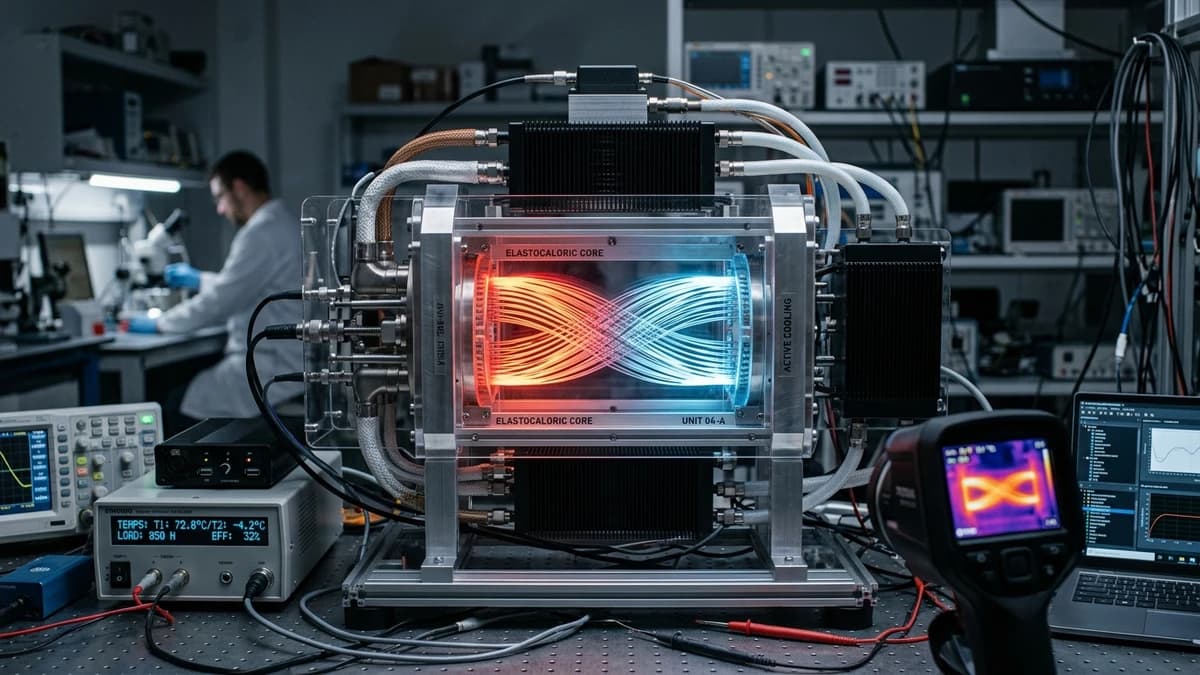
Materials scientists and thermal engineers from Saarland University in Germany, in collaboration with the Technical University of Denmark (DTU) and the University of Maryland, demonstrated in September 2026 the continuous operation of the first solid-state elastocaloric refrigeration system powered entirely by low-grade industrial waste heat (operating between 60°C and 90°C). The thermodynamic machine operates without external electric drivetrains, heavy mechanical compressors, or synthetic chemical refrigerants, utilizing superelastic wire bundles crafted from specialized nickel-titanium-copper ($Ni_{45}Ti_{50}Cu_5$) shape-memory alloys. The experimental device achieves a continuous operational cooling temperature span ($\Delta T$) reaching 28 degrees Celsius while operating at 65% of the theoretical Carnot efficiency limit, converting discarded thermal exhaust from artificial intelligence data centers into carbon-neutral refrigeration.
This breakthrough establishes a new operating paradigm for residential, commercial, and industrial environmental climate control — an industrial sector that currently consumes more than 20% of all electrical power generated globally while remaining tethered to vapor-compression thermodynamic cycles invented in the nineteenth century. Recognized by both the United States Department of Energy (DOE) and the International Energy Agency (IEA) as the most commercially promising non-vapor-compression technology for achieving global net-zero targets, elastocaloric refrigeration demonstrates that solid-state metallic materials can outperform traditional volatile phase-change chemical fluids across both energy efficiency and environmental durability metrics.
Thermodynamics of the Elastocaloric Effect: The Martensitic Phase Transition
The foundational operational mechanism of the elastocaloric cycle resides in the reversible crystallographic transformations of metallic shape-memory alloys. In an unstressed resting state at ambient temperature, the alloy resides in a highly ordered, high-symmetry parent phase known as austenite, characterized by a body-centered cubic (B2) crystal lattice. When external uniaxial mechanical tensile force is applied across bundles of cold-drawn metallic wires, the atomic structure undergoes a diffusionless, reversible first-order structural shift into martensite, which possesses a lower-symmetry monoclinic (B19') lattice.