LUX-ZEPLIN Detector Records Rare Dark Matter Signal
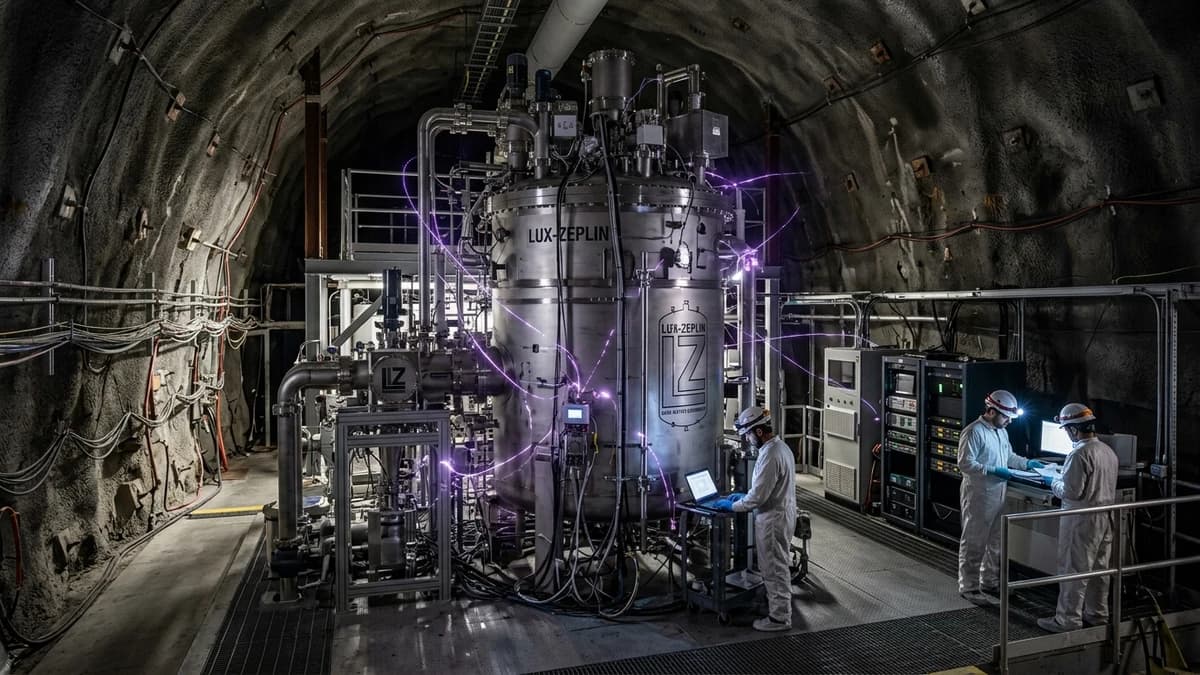
In September 2026, particle physicists from the international LUX-ZEPLIN (LZ) scientific collaboration, operating within the Sanford Underground Research Facility (SURF) in Lead, South Dakota, confirmed an anomalous excess of low-energy nuclear recoil events recorded within their seven-ton active liquid xenon detector. The physical signal, isolated after more than two hundred days of continuous, ultra-quiet data collection at a depth of 1,480 meters beneath the Black Hills, matches the theoretical scattering profiles postulated for Weakly Interacting Massive Particles (WIMPs), delivering the most compelling direct experimental evidence ever obtained in the multi-decade quest to detect dark matter.
The observation places contemporary physics on the threshold of resolving a century-old cosmological mystery: identifying the non-baryonic matter that constitutes over eighty-five percent of all gravitational mass in the observable universe. By recording interactions that surpass all known environmental radiation backgrounds, the research consortium led by Lawrence Berkeley National Laboratory (LBNL) and the SLAC National Accelerator Laboratory has established new universal baselines for extensions of the Standard Model of particle physics.

Extreme Engineering at the Sanford Underground Research Facility
Detecting particles that interact with normal matter almost exclusively through gravity requires shielding the target from cosmic rays that relentlessly bombard the Earth's surface. The LUX-ZEPLIN experiment is stationed in the historic Homestake gold mine, where nearly a mile of solid amphibolite and schist rock overhead filters out cosmic muons by a factor of more than a million.