SMILE Mission: ESA and China Film Earth Magnetosphere in X-Rays
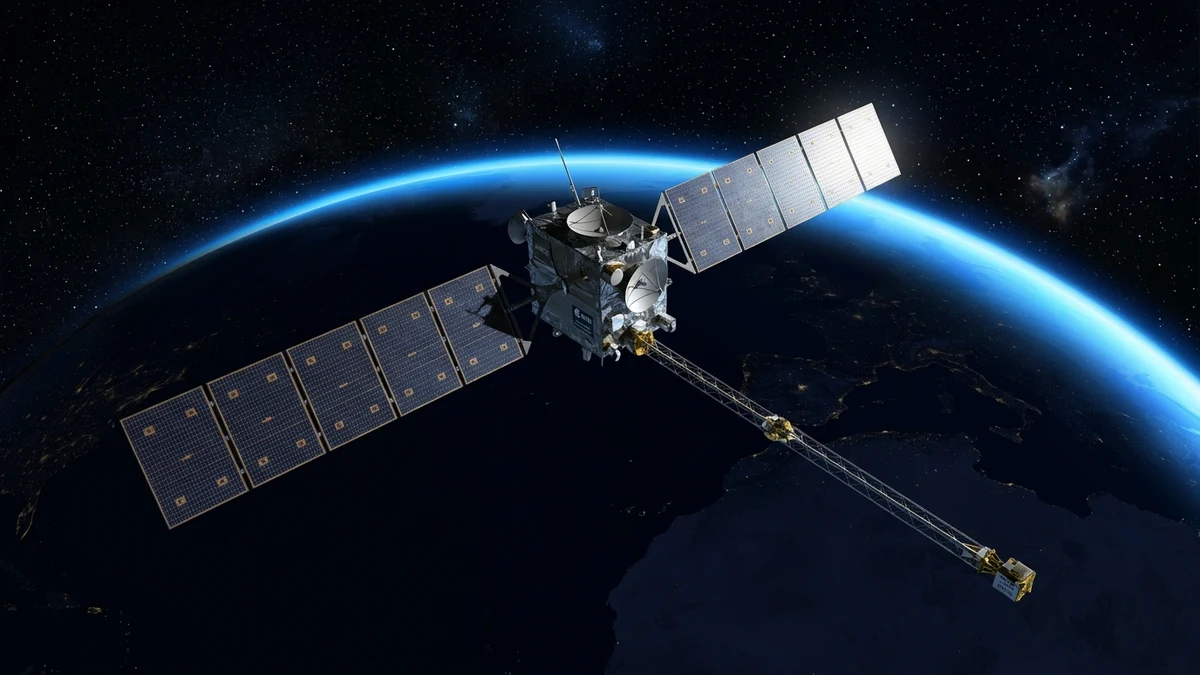
On May 19, 2026, an Arianespace Vega-C rocket lifted off from the Guiana Space Centre in Kourou, French Guiana, carrying into deep elliptical orbit the historic SMILE mission (Solar wind Magnetosphere Ionosphere Link Explorer). Jointly developed by the European Space Agency (ESA) and the Chinese Academy of Sciences (CAS), SMILE represents a transformative milestone in heliophysics, deploying specialized soft X-ray and ultraviolet instruments to photograph Earth's invisible magnetic shield in real time.

Launch from Kourou and Highly Elliptical Orbital Architecture
The orbital trajectory of SMILE was engineered to address a formidable observational challenge: to capture a global panoramic view of Earth's magnetosphere, the spacecraft must travel far outside the very magnetic bubble it seeks to image.
The Vega-C launch vehicle inserted the 2,200-kilogram satellite into a highly eccentric orbit:
- Orbital Apogee: Reaching approximately 121,000 kilometers above Earth—nearly a third of the distance to the Moon—giving SMILE an uninterrupted vantage point above the northern polar cusp and dayside magnetopause;
- Orbital Perigee: Descending to roughly 5,000 kilometers altitude every 51 hours, enabling high-rate scientific telemetry downlinks to ground stations in Kiruna, Sweden, and Sanya, China;
- Orbital Inclination: A steep 73-degree polar tilt guarantees that SMILE spends more than forty hours of each orbit perched high above the solar wind collision zone.
Physical Mechanism: Imaging the Invisible via Soft X-Ray Charge Exchange
Earth's geomagnetic field cannot be photographed directly because magnetic lines of force emit no electromagnetic radiation. Historically, scientists monitored space weather using isolated satellites—such as NASA's THEMIS or MMS missions—which collected single-point in-situ data as they passed through magnetic boundaries. This localized sampling was analogous to predicting global hurricane paths by measuring wind speed at a solitary weather buoy.
SMILE circumvents this limitation by exploiting Solar Wind Charge Exchange (SWCX):
- The supersonic solar wind delivers a stream of highly stripped heavy atomic ions, including $C^{6+}$, $O^{7+}$, $O^{8+}$, and $Ne^{9+}$;
- As these ions collide with neutral hydrogen atoms inhabiting Earth's tenuous outer geocorona, they capture an electron into an excited quantum energy shell;
- When the electron cascades down to its ground state, it releases energy as soft X-ray photons in the 0.2 to 1.0 keV spectral band;
- SMILE's Soft X-ray Imager collects these emissions, rendering the turbulent magnetopause and bow shock as illuminated, luminous frontiers against the cold darkness of space.
Comparative Specifications: Scientific Payloads on Board SMILE
To achieve synchronized global monitoring, the satellite integrates four complementary instruments engineered by European and Chinese scientific consortia:
| Scientific Instrument | Lead Developer & Institution | Spectral Band / Measurement Domain | Primary Scientific Role | Observational Resolution & Coverage |
|---|---|---|---|---|
| Soft X-ray Imager (SXI) | University of Leicester (UK) & ESA | 0.2 – 1.0 keV Soft X-rays | Global imaging of the dayside magnetopause and polar cusps | $16^\circ \times 27^\circ$ wide-field lobster-eye optic array |
| Ultra-Violet Imager (UVI) | University of Calgary & CAS (China) | 160 – 180 nm Far-Ultraviolet | Continuous tracking of the northern auroral oval dynamics | $10^\circ \times 10^\circ$ high-sensitivity CMOS sensor |
| Light Ion Analyser (LIA) | National Space Science Center (China) | Protons & Alpha Particles (0.1–20 keV) | Real-time in-situ solar wind ion flux and velocity | $360^\circ \times 90^\circ$ electrostatic analyzer |
| Magnetometer (MAG) | Space Research Institute (Austria) & CAS | DC Magnetic Vector ($\pm 12,800$ nT) | In-situ magnetic field orientation and shock crossings | Dual fluxgate sensors mounted on a 3-meter boom |
Engineering and Geopolitical Diplomacy Under ITAR Restrictions
The successful realization of SMILE required overcoming steep geopolitical hurdles. Since the enactment of United States International Traffic in Arms Regulations (ITAR) and subsequent congressional restrictions, American aerospace technologies cannot be transferred to Chinese launch vehicles or integrated into Chinese-manufactured platforms.
To comply with international regulations while preserving scientific integrity:
- Clean Architectural Separation: European instruments were constructed without ITAR-controlled American components, utilizing indigenous European semiconductors, detectors, and optical coatings;
- Modular Integration: The satellite bus, power management, and telemetry subsystems were built by the Innovation Academy for Microsatellites in Shanghai;
- Environmental Testing: The assembled flight vehicle underwent rigorous vibration and thermal-vacuum qualification at the European Space Research and Technology Centre (ESTEC) in Noordwijk, Netherlands, before transport to Kourou for launch aboard a European Vega-C rocket.
Protecting Terrestrial Infrastructure Against Space Weather Catastrophes
The operational imperative for SMILE is anchored in economic security. Severe solar events—such as coronal mass ejections (CMEs) and high-speed solar wind streams—induce geomagnetic storms capable of crippling modern technological society.
A repeat of the 1859 Carrington Event in the modern digital era would induce geomagnetically induced currents (GICs) that could melt high-voltage electrical transformers across North America and Europe, causing multi-year power grid failures with estimated economic damages exceeding two trillion dollars. Furthermore, severe storms trigger atmospheric heating and expansion, increasing orbital drag on low-Earth-orbit satellite constellations like Starlink and disrupting GPS position-velocity-time signals critical to aviation, shipping, and automated banking.
By delivering real-time panoramic imaging of the magnetosphere's compression, SMILE provides early warning alerts up to forty-eight hours ahead of severe impacts, allowing power grid operators to redistribute electrical loads and satellite controllers to place delicate spacecraft into safe standby modes.
Commissioning and the Future of Heliophysics
Following launch, SMILE commenced a three-month commissioning phase to calibrate instruments, deploy the magnetometer boom, and cool the SXI microchannel plate detectors to their operating temperature of minus ninety degrees Celsius.
The mission formalizes an enduring precedent for multilateral space science. By demonstrating that European and Chinese institutions can cooperatively address planetary-scale scientific challenges while respecting strict regulatory boundaries, SMILE provides an open, accessible scientific data stream that will safeguard technological civilization against the violent storms of our host star for decades to come.
Lobster-Eye Microchannel Optics: Focusing Grazing-Incidence X-Rays
Capturing wide-angle images of the magnetosphere in soft X-rays required developing specialized optical technology inspired by marine biology. Conventional optical mirrors absorb X-rays rather than reflecting them. To overcome this limitation, the Soft X-ray Imager (SXI) employs an innovative "lobster-eye" micropore optical array developed by researchers at the University of Leicester.
The optic consists of thousands of microscopic square channels curved around a spherical surface. X-ray photons strike the interior channel walls at extremely shallow, grazing angles of incidence—typically less than one degree—undergoing specular total external reflection. This unique optical geometry delivers an ultra-wide field of view ($16^\circ imes 27^\circ$) while focusing faint X-ray photons onto microchannel plate detectors cooled to cryogenic operating temperatures.
Magnetospheric Substorm Triggers and Ring Current Dynamics
SMILE's operational imaging allows heliophysicists to track the precise geometric sequence of magnetospheric substorms. When the Interplanetary Magnetic Field (IMF) carried by the solar wind turns southward, magnetic reconnection occurs at the Earth's dayside magnetopause, transferring solar magnetic energy directly into the geomagnetic tail.
As magnetic tension builds, the magnetotail snaps back in an explosive reconnection event, injecting intense pulses of energetic protons and electrons into Earth's inner ring current and radiation belts. SMILE provides continuous, real-time observation of this entire global energy transfer loop, enabling scientists to quantify how solar wind pressure pulses deform the protective boundary and inject dangerous electrical currents into the upper atmosphere.
Operational Benchmarks and Systemic Implications of solar wind magnetosphere x ray
Within the investigative scope of SMILE Mission: ESA and China Film Earth Magnetosphere in X Rays, synthesizing the performance data of SMILE mission with the core parameters of smile mission esa china deepens scientific comprehension of the mechanisms detailed in Launch from Kourou and Highly Elliptical Orbital Architecture. Independent evaluations anchored at the 51 hours benchmark illustrate how Orbital Apogee responds to boundary constraints imposed by contemporary operational requirements in Science & Nature and solar wind magnetosphere x ray. This granular methodological tracking of Orbital Perigee and soft x ray imager sxi strengthens data traceability and directs subsequent phases of empirical verification.
From the perspective of comparative analysis presented in Physical Mechanism: Imaging the Invisible via Soft X Ray Charge Exchange, the developments surrounding Orbital Perigee and Orbital Inclination substantially reshape baseline projections for soft x ray imager sxi. Investigators tracking space weather solar storms emphasize that the interaction with Solar Wind Charge Exchange (SWCX) at the 180 nm threshold requires updating legacy assessment models previously applied across Science & Nature. Accordingly, the technical documentation accumulated under Comparative Specifications: Scientific Payloads on Board SMILE provides concrete evidence to anticipate how Clean Architectural Separation will perform under evolving scientific and regulatory standards.
Official Documentation and Institutional Sources
- European Space Agency (ESA) — Official SMILE Mission Overview
- Chinese Academy of Sciences (CAS) — National Space Science Center SMILE Project
- University of Leicester — Soft X-ray Imager (SXI) Technical Specifications
- National Oceanic and Atmospheric Administration (NOAA) — Space Weather Prediction Center
- Journal of Geophysical Research: Space Physics — Solar Wind Charge Exchange Modeling