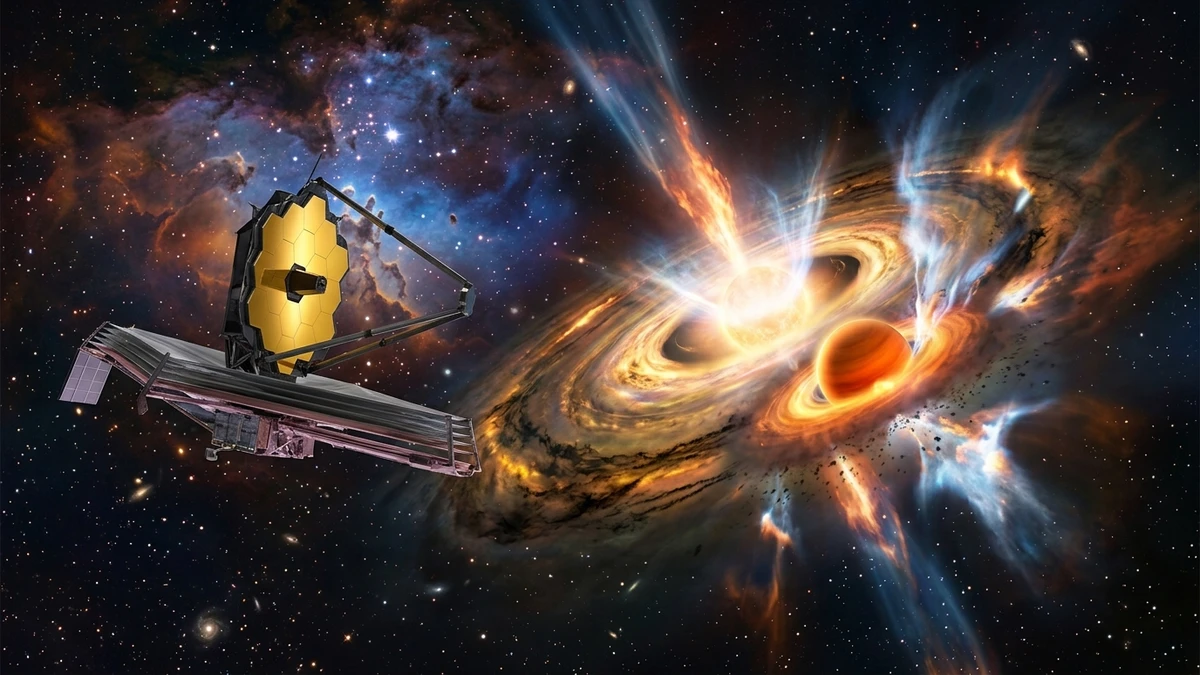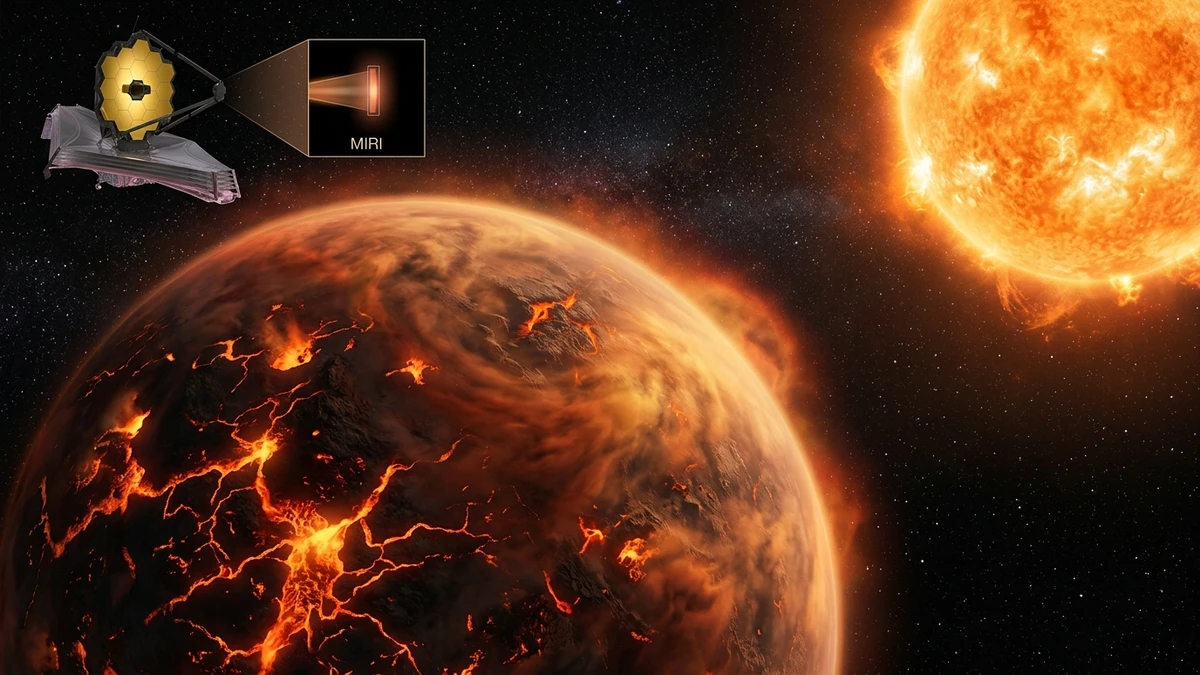
The James Webb Space Telescope has detected a retained atmosphere on the ultra-hot exoplanet HD 3167 b, a rocky lava world located 154 light-years from Earth in the constellation Pisces. Observations conducted with the Mid-Infrared Instrument measured thermal emission from the planet's dayside during secondary eclipse, revealing temperatures significantly cooler than expected for airless bodies. The presence of this atmospheric envelope demonstrates that rocky exoplanets in ultra-short-period orbits can preserve gases even under intense radiation from their host stars.
The discovery of exoplanet HD 3167 b challenges classic theories regarding the evolution and erosion of planetary atmospheres in extreme stellar environments. Planets orbiting so close to their host stars experience overwhelming stellar winds that should have stripped away any volatile layer over billions of years. New spectroscopic data acquired by international astronomy teams indicate that active volcanic processes or silicate outgassing continuously replenish this atmospheric reservoir.
With an orbital period of just 0.96 Earth days, the exoplanet completes a full revolution around its K-dwarf star in less than 24 hours. This extreme proximity causes the world's surface to remain in a partially molten state, creating permanent magma oceans across the hemisphere facing the central star. The space telescope captured the exact moment when direct stellar illumination was occulted, allowing researchers to isolate the infrared radiation emitted exclusively by the planetary atmosphere.
The Physics of Lava Worlds and James Webb Space Telescope Measurements
Thermal measurements performed by the MIRI instrument revealed efficient heat redistribution from the dayside to the nightside of the exoplanet. On airless rocky worlds, illuminated temperatures reach extreme theoretical peaks calculated purely from direct stellar flux. The presence of an atmosphere acts as a global thermal regulator, transporting scorching winds of vaporized silicates and carbon dioxide across the entire planetary sphere.
Analysis of the mid-infrared data revealed that exoplanet HD 3167 b possesses the coolest dayside temperature ever recorded for a lava world with a confirmed atmosphere. This unprecedented physical parameter provides the first empirical evidence that dense super-Earths can retain volatile elements under harsh ultraviolet radiation. The detailed scientific study was published in the peer-reviewed astrophysics journal The Astrophysical Journal Letters following rigorous evaluation.
Astronomers utilized the secondary eclipse photometry technique to measure the total decrease in infrared brightness when the exoplanet passes behind its host star. By subtracting pure stellar light from the combined system, the team isolated the exact thermal signature emitted by the dayside hemisphere. This delicate optical procedure demanded the unprecedented precision of the space observatory's gold-coated beryllium primary mirrors.
| Astronomical Parameter | Observed Value | Unit / Reference |
|---|---|---|
| System Distance | 154 | Light-years from Earth |
| Orbital Period | 0.96 | Earth days (~23 hours) |
| Host Star Type | Orange Dwarf (K-type) | Constellation Pisces |
| Detection Instrument | MIRI (Mid-Infrared) | James Webb Space Telescope |
| Exoplanet Classification | Rocky Lava Super-Earth | High Bulk Density |
| Heating Mechanism | Tidal Locking | Permanent Dayside Magma |
Atmospheric Retention Mechanisms and Volcanic Outgassing
Preserving an atmosphere on this exoplanet requires continuous internal sources capable of replenishing gaseous mass lost to outer space. Silicate volcanism and evaporation from the molten crust generate an exotic biogeochemical cycle dominated by mineral vapors and sulfur compounds. These heavy gaseous species possess high molecular weights, hindering their thermal escape under continuous stellar particle bombardment.
The gravity of super-Earth HD 3167 b plays a decisive role in retaining the gaseous layer against stellar wind drag forces. Being significantly more massive than Earth, its deep gravitational potential well requires greater kinetic energy for gas atoms to escape into interstellar space. The combination of high planetary mass and constant rocky outgassing ensures the long-term stability of this exotic atmospheric blanket.
Comparisons with other ultra-hot exoplanets observed by the orbital observatory highlight the immense structural diversity of exoplanetary systems. While some Neptune-sized worlds completely lose their primordial hydrogen envelopes, rocky super-Earths can sustain magma-driven secondary atmospheres. This evolving theoretical model transforms scientists' understanding of primordial habitability and the geology of extreme exoplanets.
Spectroscopic Modeling and Implications for Modern Astrophysics
Thermal emission spectroscopy captured by the observatory enabled researchers to map the dominant chemical components comprising the atmospheric layer. The absence of deep water absorption features suggests a composition dominated by carbon monoxide, sulfur dioxide, and vaporized rock particles. These heavy chemical species form reflective mineral clouds in the upper atmosphere that scatter incoming stellar radiation.
Computational models developed by international astrophysicists indicate that planetary winds transport heat at supersonic speeds across the terminator region. This extreme atmospheric circulation dramatically reduces thermal contrast between the illuminated hemisphere and the perpetual shadow zone. Ongoing observations scheduled for future operational cycles of the telescope will further characterize the vertical structure of this gaseous layer.
Studying exoplanets like HD 3167 b provides valuable insights into the early formation stages of Earth and other rocky planets in our Solar System. During the Hadean Eon, Earth experienced a similar global magma ocean phase where initial outgassing shaped its early atmosphere. Understanding these distant worlds allows scientists to reconstruct the fundamental geological processes that preceded the emergence of habitable environments.
Frequently Asked Questions About Exoplanet HD 3167 b
Can exoplanet HD 3167 b support life as we know it?
Exoplanet HD 3167 b cannot support life as we know it due to its extreme surface temperatures and a global environment dominated by molten magma oceans. The planet orbits its host star in less than 24 Earth hours, receiving an overwhelming influx of high-energy ultraviolet and X-ray radiation. Its exotic gaseous envelope consists of vaporized rock minerals, sulfur dioxide, and heavy toxic compounds that completely preclude the presence of liquid water and the synthesis of complex organic molecules required for biological systems.
How did the James Webb Space Telescope confirm the existence of the exoplanetary atmosphere?
The James Webb Space Telescope used its specialized Mid-Infrared Instrument MIRI to measure thermal radiation emitted by the exoplanet during secondary eclipse. By recording the precise drop in total infrared brightness as the world passed directly behind its host star, astronomers successfully isolated the thermal emission from the dayside hemisphere. The measured temperature proved to be significantly lower than theoretical predictions for an airless bare rock, empirically demonstrating that a thick atmosphere is actively redistributing heat to the nightside hemisphere.
What is the scientific significance of finding an atmosphere on an ultra-hot lava planet?
Confirming an atmosphere on this ultra-hot world challenges previous astrophysics models that predicted the complete thermal erosion of gaseous layers on short-period rocky exoplanets exposed to harsh stellar winds. Retaining gases on exoplanet HD 3167 b proves that massive super-Earths possess sufficient planetary gravity and ongoing volcanic activity to continuously regenerate secondary gaseous envelopes over deep geological time. This landmark finding significantly expands scientific understanding regarding volatile element retention, exoplanetary atmospheric evolution, and atmospheric stability under extreme stellar radiation environments.