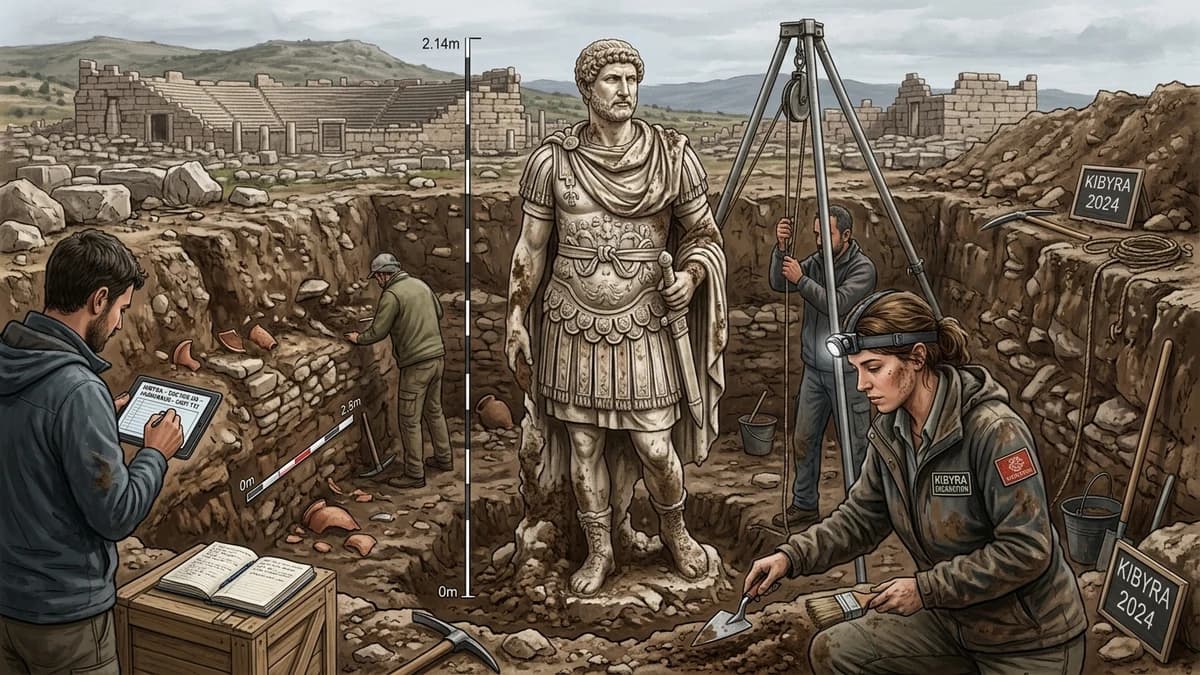
The overall preservation of the statue, despite having been found in various fragments, is nothing short of remarkable. The fact that the statue survived ancient earthquakes, potential looting, and the natural wear of time over nearly two millennia is considered a small archaeological miracle. Experts theorize that the statue was toppled and buried during a natural disaster, which paradoxically helped protect it from further destruction.
Emperor Hadrian governed the vast Roman Empire from 117 to 138 AD, a pivotal period frequently characterized as an era of relative peace and prosperity. He is widely remembered for his deep love of Greek culture and for his relentless travels across the extensive provinces of the empire. Unlike many of his predecessors, Hadrian spent significantly more time traveling and inspecting than residing centrally in Rome.
His extensive tour through Asia Minor was marked by the active construction of aqueducts, magnificent bridges, thermal baths, and temples, boosting local infrastructure and economies. The imposing statue found in Kibyra was likely commissioned to celebrate one of his grand visits to the city or in profound gratitude for some granted imperial favor. Such grand monuments were a common way for local elites to express their loyalty and secure the continuous benevolence of the emperor.
Hadrian's reign was also fundamental for the strategic consolidation of the empire's borders, with Hadrian's Wall in Britannia being his most famous military project. However, in the wealthy East, his strategy was much more focused on shrewd diplomacy and grand cultural patronage rather than aggressive military conquest. The military imagery of the statue in Kibyra therefore serves as a potent reminder of his supreme authority, even within a context of peace.
The military armor, commonly known as a "lorica," worn by the statue of Hadrian is replete with intricate and highly symbolic motifs. On the breastplate, one can observe fine reliefs representing diverse deities, mythical creatures, and glorious trophies captured from defeated enemies. These elements were not merely decorative embellishments but effectively transmitted specific messages regarding the emperor's role as a divine protector and undefeated conqueror.
In particular, the presence of the Gorgon Medusa centrally placed on the armor served as a powerful apotropaic talisman, intended to ward off evil and the enemies of Rome. Other elaborate reliefs frequently associate the emperor with martial gods like Mars or deities of wisdom such as Minerva, continuously reinforcing his legitimacy and governmental wisdom. The exquisite quality of these reliefs attests to the enormous wealth commissioned by the city's proud administration.
This specific iconography was standardized across the empire, ensuring that any citizen, regardless of the language they spoke, intuitively understood the message of Roman dominance. The undeniable fact that such an elaborate representation was found in Kibyra deeply underlines the commercial and political importance of the city in antiquity. The statue functions as a comprehensive compendium in stone of Roman imperial ideology.
The fortunate discovery of a statue of Empress Sabina alongside that of Hadrian is of immense historical and sociological importance. Sabina played a crucial role in imperial propaganda, being frequently and respectfully depicted as the ultimate epitome of Roman virtues like modesty and devotion. Statues of the entire imperial family served to project undeniable stability and continuous dynastic strength.
She frequently accompanied her husband on his long and arduous travels, which effectively made her a familiar figure in many remote provinces, including Asia Minor. The presence of her statue in Kibyra strongly suggests that the city wanted to honor not just the ruler, but the whole institution of the reigning dynasty. This accurately reflects the highly complex political game and sophisticated public relations that provincial cities maintained with central Rome.
In addition to the central imperial figures, the archaeologists also recovered fragments of two other sculptures that have not yet been fully identified. It is widely believed that they may represent local patron deities of the city or exceptionally important figures of the provincial elite. The continuous academic analysis of these additional pieces will certainly shed much more light on the original sculptural complex.
The excavation of the statues was a painstaking process that required extreme patience and unparalleled scientific precision. The dedicated team in Kibyra spent long months carefully removing dense layers of packed earth and historical debris that covered the ancient artifacts. Small handheld tools, fine brushes, and gentle air jets were utilized to meticulously prevent any scratches or damage to the highly sensitive marble surface.
Each recovered fragment was meticulously cataloged, professionally photographed, and accurately mapped in a three-dimensional coordinate system before being lifted from the ground. This scientific documentation is essential to completely understand the site's stratigraphy and the exact historical context in which the statues were deposited. The physical work at the site is frequently just the beginning of a remarkably long scientific process of deep analysis.
Interdisciplinary collaboration has been the absolute key to the massive success of this recent excavation effort. Highly skilled archaeologists, conservators, geologists, and experienced art historians work closely together to correctly interpret the physical evidence found. The joint effort guarantees that every possible piece of data is extracted before the fragile objects are eventually moved to a secure laboratory.
Below is a detailed comparative table outlining the characteristics of notable statues and monuments associated with some of the most celebrated Roman emperors, highlighting the Kibyra discovery within the broader context of imperial history.
| Emperor |
Relevant Monument/Statue |
Height/Dimension |
Original Discovery Location |
State of Preservation |
Primary Material |
| Hadrian |
Armored Statue of Kibyra |
2.14 m |
Kibyra, Turkey |
Fragmented, nearly complete |
White Marble |
| Augustus |
Augustus of Prima Porta |
2.08 m |
Villa of Livia, Italy |
Complete |
Parian Marble |
| Marcus Aurelius |
Equestrian Statue |
4.24 m |
Capitoline Hill, Rome |
Complete, oxidized |
Gilded Bronze |
| Constantine |
Colossus of Constantine |
~12 m (estimated) |
Basilica of Maxentius, Rome |
Fragments only (head, hands, feet) |
Marble and Bronze |
The comparative analysis clearly reveals that the magnificent Kibyra statue, due to its size and exceptional details, easily rivals the greatest imperial monuments ever discovered in the Mediterranean basin.
Asia Minor was undeniably one of the most brilliant jewels in the crown of the Roman Empire, and major discoveries like this one in Kibyra forcefully reinforce the magnitude of the Roman presence. The region was remarkably economically prosperous and culturally rich, acting as a vital bridge between eastern Greek traditions and practical Latin pragmatism. Monumental structures so luxurious are direct reflections of this incredibly successful cultural synthesis.
The ancient inscriptions found near the direct site of the discovery are currently being translated and promise to reveal specific names of local patrons and the exact civic purpose behind the erection of the statues. Oftentimes, these historical texts provide critical information regarding the local tax system, regional civic festivals, and complex political alliances. This undeniably makes the archaeological site not just a mine of art, but also of highly valuable ancient administrative data.
This discovery significantly strengthens modern Turkey's global profile as one of the world's leading centers for serious research in classical antiquities. The immense abundance of well-preserved Roman sites in the country continuously attracts a massive global academic interest that incessantly reveals the fascinating secrets of antiquity. The Kibyra find is a truly monumental testament to this deeply shared human heritage.
Immediately following their safe extraction, the statues were carefully transferred to specialized modern facilities for thorough cleaning and expert conservation. Professional conservators utilize mild chemical solvents and precise laser tools to safely remove centuries of hard incrustations and calcification from the ancient marble. The primary goal is to safely reveal the intricate carved details and any remaining trace of original pigmentation that might have surprisingly survived the passing of time.
Digital reconstruction also plays a fundamentally critical role, significantly helping experts to accurately visualize how the broken statues should be correctly reassembled. Utilizing advanced 3D modeling, the team can virtually test the perfect fit of the pieces before ever attempting to restore them physically, which greatly minimizes the risk of damage. This highly virtual process significantly accelerates the complex conservation decisions.
Eventually, the colossal statue of Hadrian and the other accompanying pieces will be structurally consolidated using stainless steel pins and highly specialized clear resins. The preservation aims not only to ensure the robust structural stability of the heavy sculptures but also to keep them completely authentic without hiding the natural cracks that tell their long history. The final stunning result will be permanently exhibited in a rigorously climate-controlled environment.
The thrilling announcement of the discovery of Emperor Hadrian's statue in Kibyra immediately generated a massive wave of enthusiasm within the booming cultural tourism sector. International travel agencies and dedicated tour operators are already actively preparing historical packages focused tightly on the ancient western Anatolian route. It is widely expected that Kibyra will receive a highly significant increase in the number of annual visitors in the coming years.
Local governmental authorities are working rapidly and efficiently to massively improve the touristic infrastructure surrounding the expansive archaeological site. This development includes the swift construction of brand-new visitor centers, significantly better access roads, and modernized regional museums designed to accommodate the newly restored statues. Such substantial financial investments will easily generate new jobs and inject much-needed capital into the local economy.
Finally, the incredible discovery highlights the overriding importance of fiercely protecting global cultural heritage against illegal looting and the illicit antiquities trade. The government of Turkey, working closely together with various international organizations, strongly emphasizes that maintaining these ancient artifacts in their original historical contexts is essential. This incredible archaeological discovery serves as a truly remarkable victory in the continuous noble mission to properly celebrate and fiercely protect our shared world heritage.
The magnificent ancient city of Kibyra was a highly formidable urban center, famously known for its immense economic strength deeply focused on advanced metallurgy, extremely high-quality pottery, and the famously traditional breeding of exquisite horses. Geographically, the large city strategically dominated the crucial intersection of several highly important commercial trade routes throughout ancient Asia Minor, which directly provided it with exceptional wealth and enormous diplomatic relevance. At the absolute height of the Roman imperial period, Kibyra continuously enjoyed exceptionally strong political connections with the central capital, greatly facilitating the massive construction of grand stadiums, beautiful theaters, and massive public complexes filled with exquisite art that loudly symbolized imperial power in the eastern region.
The extremely careful restoration of the magnificent imperial sculptures effectively utilizes cutting-edge multidisciplinary scientific approaches, heavily encompassing three-dimensional laser scanning, non-invasive chemical elemental analysis, and advanced marble stabilization primarily through highly specialized synthetic resins. Initially, all the carefully removed pieces undergo an incredibly rigorous cleaning process utilizing specialized solvents and ultrasonic scalpels inside strictly climate-controlled laboratories to perfectly preserve the microscopic details of the ancient sculpture. Furthermore, the complex physical reconstructions are completely simulated beforehand utilizing incredibly accurate computer 3D models to absolutely ensure that the new structural supports perfectly adapt without placing any undue or dangerous pressure on the original ancient cracks of the marble stone.
The highly detailed representations of powerful emperors in luxurious military attire served primarily as incredibly powerful tools of profound ideological propaganda and a strong guarantee of absolute dynastic supremacy before the vast provincial citizens. Even during the highly prosperous and historically peaceful reign of Emperor Hadrian, the intricate iconography constantly praised the unwavering virtue, the absolute heroic strength, and the continuous divine protection offered generously by the supreme authority of the vast empire. The incredibly intricate reliefs meticulously carved into the armor featuring highly mystical symbols strongly guaranteed to all local inhabitants that the powerful state remained incredibly strong, the mighty Roman leaders completely dominated the global world order, and the region's socioeconomic stability remained perfectly safe.
- Archaeology Magazine. "Discovering Imperial Roman Legacies in Western Anatolia." Archaeology Magazine, August 2026.
- HeritageDaily. "Giant Emperor Hadrian Statue Unearthed in Ancient Kibyra." HeritageDaily, Archaeology News, 2026.
- Ministry of Culture and Tourism of the Republic of Turkey. "Official Excavation Reports: The Kibyra Dig Site." Turkish Ministry of Culture, 2026.