FRB 20250316A: Super Radio Burst Mapped
On March 16, 2025, radio detectors on Earth recorded an electromagnetic pulse so bright that automated systems initially discarded it, assuming it was local terrestrial interference. This monumental burst of energy, cataloged as FRB 20250316A, traveled 130 million light-years through the cosmos before hitting our planet. Now, in July 2026, scientists are celebrating the definitive mapping of its exact origin in the spiral galaxy NGC 4141, a milestone that redefines the boundaries of observational astrophysics.
The detection was quickly nicknamed "RBFLOAT," short for the "Radio Brightest Flash of All Time," since its intrinsic luminosity far surpassed any fast radio burst previously cataloged. In a mere fraction of a millisecond, this cosmic event released the amount of energy that our Sun produces over tens of thousands of years. The discovery of this extreme phenomenon provides a critical window for researchers to decode the physics governing the most violent environments in the universe.
What Happened
The CHIME/FRB consortium recently published their detailed analysis of the explosion in The Astrophysical Journal Letters, confirming its location with record-breaking precision. Using auxiliary external antennas known as "outriggers," astronomers successfully triangulated the signal's origin down to an unprecedented scale of just 13 parsecs in diameter. This level of precision is mathematically equivalent to identifying a single lit light bulb on the surface of the Moon from our vantage point on Earth.
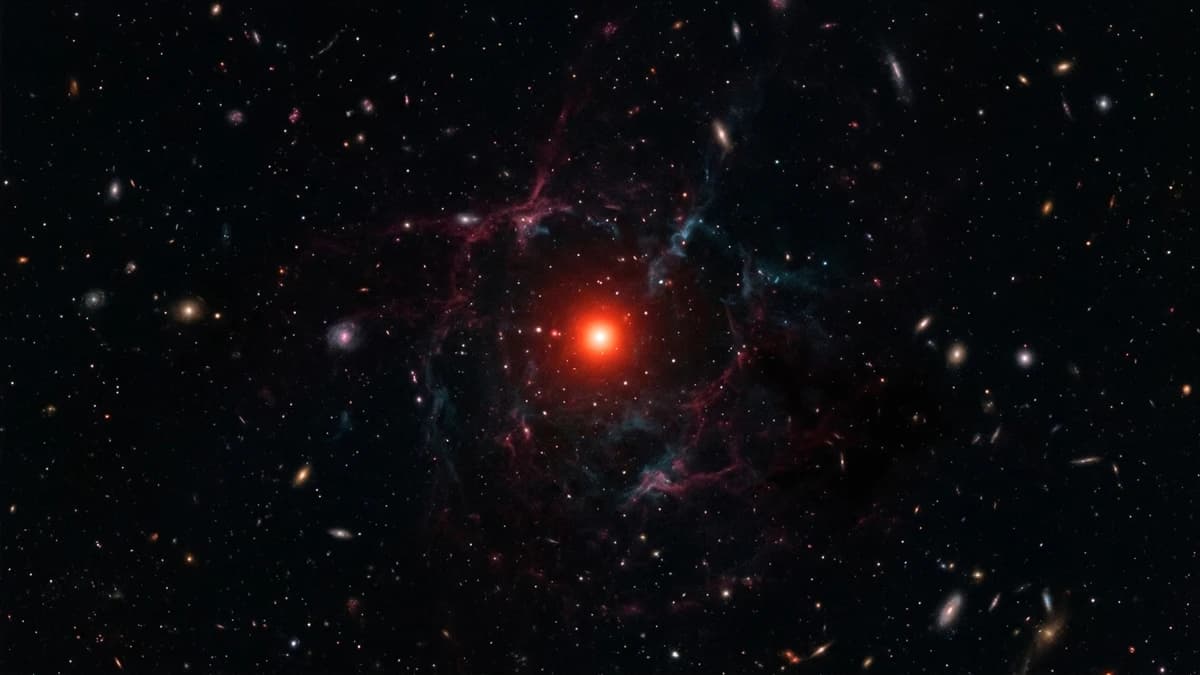
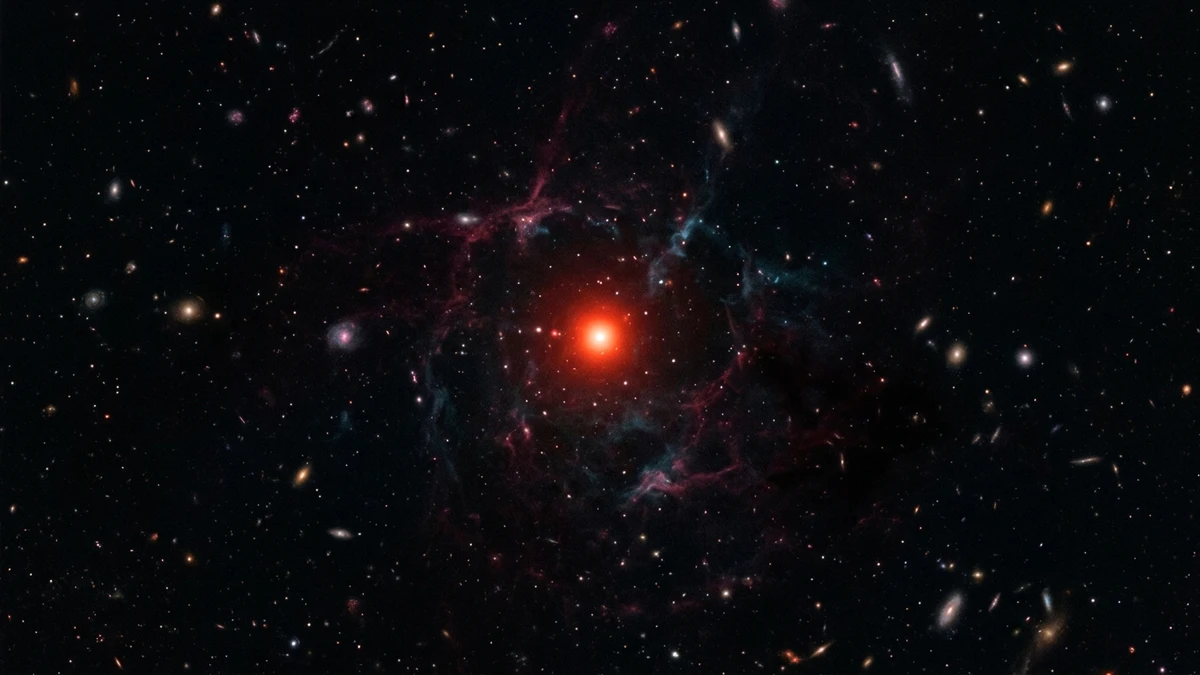
The signal was classified as a "one-off" fast radio burst, meaning it has not repeated since its initial detection in 2025. Immediately after the triangulation, a global network of ground-based and space-based telescopes focused on the coordinates to capture any remaining electromagnetic signatures. The James Webb Space Telescope (JWST) played a central role in this follow-up campaign, revealing a highly active stellar nursery in the outer spiral arm of the host galaxy NGC 4141.
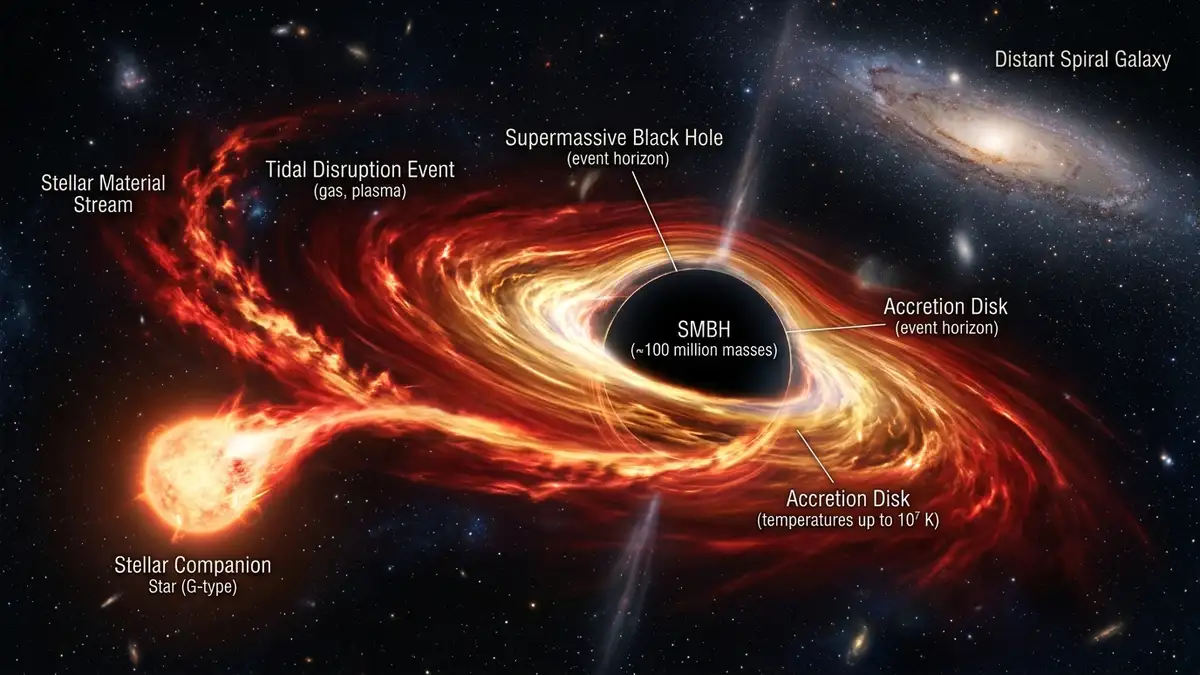
The complete absence of persistent emissions following the burst deeply intrigued researchers who monitored the region in the subsequent months. No supernova remnants or persistent radio sources were detected, which imposes strict boundaries on theories explaining the engine behind these events. This subsequent radio silence remains a fundamental piece of the puzzle in understanding the physical nature of non-repeating fast radio bursts.
Context and History
Fast radio bursts were first discovered in 2007 and have since remained one of the greatest enigmas of contemporary astronomy due to their brevity and intense energy. While some sources repeat their emissions sporadically, the vast majority send a single pulse and fall completely silent. This behavioral distinction resembles the mystery surrounding the mysterious radio signal that recently intrigued the global astrophysical community.
The spiral galaxy NGC 4141, located within the Ursa Major constellation, had already been monitored in various surveys of nearby galaxies. However, it had never shown any unusual electromagnetic activity until the historic event of March 16, 2025. The successful association of the burst with this specific galaxy was only possible due to the rapid maturation of interferometry techniques.
Before the implementation of CHIME's outrigger array, astronomers struggled to determine the exact point of origin for most FRBs. Most bursts could only be localized to vast regions of the sky containing thousands of potential host galaxies, making detailed studies impossible. The successful mapping of FRB 20250316A to a region of just 45 light-years within NGC 4141 marks a definitive transition into high-precision astrophysics.
Impact on the Population
For the average citizen, investigating explosions that occurred millions of light-years away might seem like an academic exercise with no practical application. However, developing the technologies required to capture and process these faint cosmic signals yields direct benefits for Earth's technological infrastructure. The demand to analyze massive volumes of raw data in real-time drives significant advances in distributed computing and high-speed network signal processing.
For instance, the space interferometry techniques refined for this mapping are actively applied to improve the accuracy of global positioning systems (GPS) and satellite communications. Additionally, studying how electromagnetic waves behave in extreme cosmic plasma environments helps scientists refine nuclear fusion models on Earth. The pursuit of decoding the cosmos thus acts as a silent but powerful catalyst for everyday technological innovation.
Furthermore, sharing these scientific discoveries plays a vital cultural role by actively countering pseudoscience and sensationalized rumors about mysterious alien signals. By providing solid, evidence-based physical explanations, scientists educate the public and inspire new generations to pursue careers in science, technology, engineering, and mathematics (STEM). This scientific literacy forms the very foundation for long-term technical and economic development worldwide.
| Aspect | Before | After | Impact |
|---|---|---|---|
| Localization Precision | Several thousand parsecs | Only 13 parsecs (record) | Identification of the exact stellar nursery of the cosmic explosion. |
| Processing Time | Weeks of manual analysis | Automated real-time triangulation | Immediate response for ground and space telescopes. |
| Source Identification | Ambiguous galaxy association | Confirmed host galaxy | Elimination of conspiracy theories about artificial signals. |
| Terrestrial Applications | Analog and slow VLBI networks | Ultra-precise synchronization algorithms | Direct improvements in geolocation and satellite systems. |
What Those Involved Say
Project leaders enthusiastically celebrated the validation of the new auxiliary outrigger antenna array. Dr. Victoria Kaspi, an astrophysicist at McGill University and a key member of the CHIME collaboration, highlighted the instrumentation milestone. She stated that mapping such a bright event represents the culmination of years of hard work by engineers developing real-time detection systems.
In turn, astrophysicists working with the James Webb Space Telescope emphasized their surprise at finding the source in a young outer spiral arm. Dr. Patrick Boyle, lead researcher for the follow-up infrared observations, commented that the absence of a persistent radio source challenges classic assumptions about giant magnetars. This landscape of new scientific frontiers is just as exciting as the search for liquid water and the subsurface ocean on Mars revealed recently.
Independent researchers praised the transparency of the dataset and the robustness of the calibration method employed by the team. The global scientific community agrees that the success of FRB 20250316A sets a high new standard for future publications of transient space events. This event demonstrates how open collaboration between observatories worldwide is indispensable for unraveling the deepest mysteries of the universe.
Next Steps
The CHIME/FRB team plans to expand its network of outrigger antennas to new strategic locations across the Americas throughout the remainder of 2026. This expansion will cover a much larger portion of the sky with high angular resolution, significantly increasing the detection rate of fast radio bursts. The gathered data will help construct a comprehensive statistical library detailing the physical properties of these fleeting transients.
Simultaneously, the James Webb Space Telescope will continue to monitor the coordinates of FRB 20250316A in NGC 4141 to detect potential thermal evolution signatures. Supercomputing models will be utilized to simulate exotic stellar collisions that might reproduce the extreme luminosity characteristics observed in this event. These theoretical studies will be crucial in confirming or ruling out binary merger progenitor models.
The collaboration also plans to share the custom detection algorithms developed for this project with other branches of applied data science. The expectation is that these advanced tools will optimize noise filtering in commercial mobile networks and communications satellite systems. In this manner, astronomical technology continues to feed back into the progress of terrestrial communications in a practical and direct way.
Closing
The exact localization of FRB 20250316A in the galaxy NGC 4141 represents a major triumph for international cooperation and applied technology. Mapping this energetic colossus proves that human ingenuity can bridge cosmic abysses to decipher the most extreme physics in the universe. This milestone solves a mystery from 2025 while illuminating new paths that science will continue to explore.
Studying phenomena like fast radio bursts teaches us that the cosmos is far from silent, static, or empty. Each electromagnetic pulse captured is an open invitation to expand our understanding of matter, gravity, and time itself. As we refine our lenses to peer deeper into the universe, we find that every answer reveals even more fascinating questions about our own existence.