
Water on Mars: The Underground Ocean That Could Redefine the Search for Extraterrestrial Life
Date: March 13, 2026
Reading time: 28 minutes
Emoji: 💧
In one of the most monumental discoveries in the history of space exploration, scientists have confirmed the existence of a vast underground ocean of liquid water beneath the Martian crust. The reservoir, detected by radar data from the MARSIS instrument aboard the European Space Agency's Mars Express probe, contains enough water to cover the entire surface of the planet with an ocean approximately 1.5 kilometers deep. The scale is staggering to comprehend: we are talking about more water than in all of North America's Great Lakes combined — multiplied by over a hundred. This is not merely a geological curiosity. It is a revolution that completely redraws our understanding of Mars, the potential for life in the Solar System, and the future of human colonization beyond Earth. In this article, we dive deep into the science, the evidence, the implications, and the heated debates this discovery has sparked in the corridors of NASA, ESA, SpaceX, and every astrobiology laboratory on the planet.
The Discovery: How We Found Water Beneath Mars
The MARSIS Instrument and Radar Technique
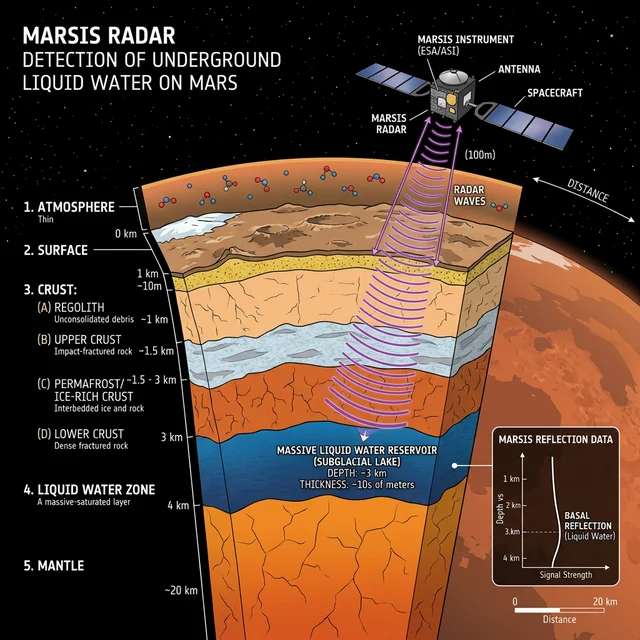
The discovery was made possible by MARSIS (Mars Advanced Radar for Subsurface and Ionosphere Sounding), a ground-penetrating radar instrument aboard the Mars Express spacecraft, operated by the European Space Agency (ESA). Operating since 2003, MARSIS emits low-frequency radio pulses that penetrate deep into the Martian crust — up to 5 kilometers — and analyzes reflected signals to reveal the planet's subsurface structure.
The principle is elegantly simple: when radio waves encounter an interface between two materials with different electrical properties — such as dry rock and liquid water — part of the signal is reflected back. The intensity and characteristics of this reflection reveal the nature of the material. In the case of Mars, researchers identified exceptionally bright and extensive reflections emanating from a depth between 11.5 and 20 kilometers — exactly the pattern expected from liquid saturating fractured porous rock.
The Numbers That Changed Everything
| Data Point | Value |
|---|---|
| Reservoir depth | 11.5 — 20 km below the surface |
| Estimated water volume | Enough to cover Mars with an ocean ~1.5 km deep |
| Comparison with Earth | Equivalent to ~2× Earth's ocean volume distributed in porous rock |
| Detection instrument | MARSIS (Mars Express, ESA) |
| Data collection period | 2003 — 2025 (22 years) |
| Area covered by analysis | Nearly the entire Martian surface |
| Estimated temperature at depth | -10°C to +20°C (depending on geothermal gradient) |
| Water state | Liquid (possibly high salinity maintaining low freezing point) |
The team led by Professor Vashan Wright of the Scripps Institution of Oceanography at the University of California, San Diego, analyzed data accumulated over more than two decades of MARSIS operation. By processing radar reflections covering virtually the entire surface of Mars, the pattern was unmistakable: the mid-crust of Mars, in a band between 11.5 and 20 km, exhibited significantly elevated dielectric permittivity — consistent with liquid water filling fractures and pores in the rock.
Where Did This Water Come From? Mars's Hydrological History
A Planet That Was Once Blue
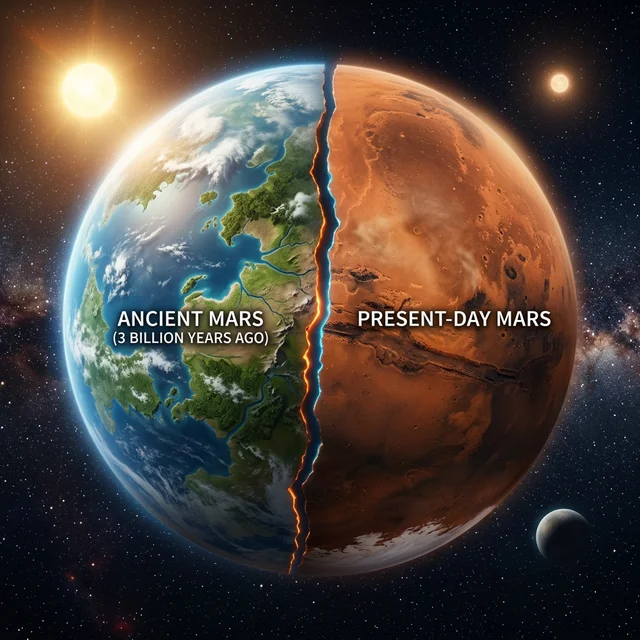
Approximately 3 to 4 billion years ago, Mars was a radically different world from the frozen desert we know today. The planet possessed a thick atmosphere rich in carbon dioxide, temperatures that permitted the existence of liquid water on the surface, and — according to geological evidence accumulated over decades — oceans, lakes, and extensive river systems.
The transition of Mars from a potentially habitable planet to the current apocalyptic desert is one of the great narratives of planetary science. The main theory accepted by the scientific community involves a cascade of interconnected events that occurred over hundreds of millions of years:
Loss of the global magnetic field: About 4 billion years ago, Mars's internal dynamo — the mechanism that generated its global magnetic field — ceased to function. Without a magnetic shield, the planet's atmosphere was directly exposed to the solar wind, which gradually eroded it into space over hundreds of millions of years.
Reduction in atmospheric pressure: As the atmosphere became increasingly rarefied, surface pressure dropped below water's triple point — the minimum pressure level necessary for liquid water to exist stably on the surface. Below this threshold, surface water either sublimes directly into gas or freezes. This is the physical limit that transformed Mars from a world with oceans into a cryogenic desert.
Water migration underground: Part of the water evaporated and was lost to space along with the atmosphere. But a very significant portion — we now know probably a majority — infiltrated the planet's crust, migrating to ever-deeper layers where pressure and temperature conditions allow its existence as a liquid.
The Perseverance Evidence
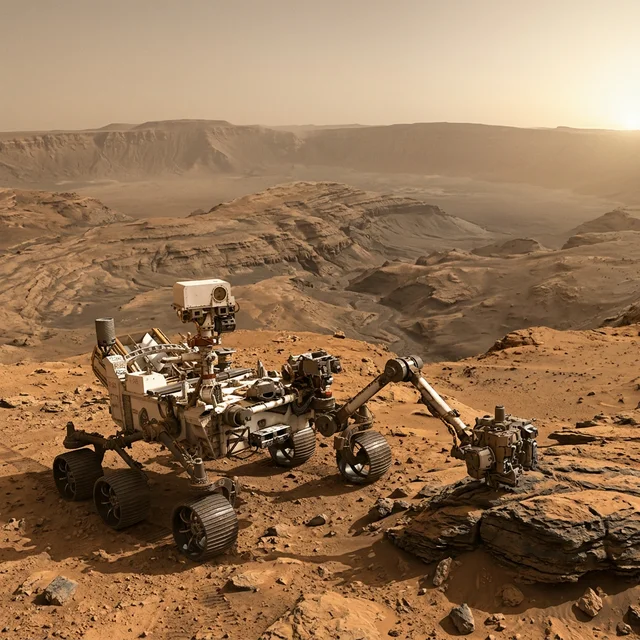
The MARSIS data does not exist in isolation. Multiple missions had already accumulated converging evidence that Mars harbors significant quantities of water:
Perseverance (NASA, 2021–present): Operating in Jezero Crater — an ancient Martian lake with a preserved river delta — the rover identified hydrated minerals, carbonates, and water-altered olivine in rock samples. The SHERLOC instrument detected organic matter in several samples, although the origin (biological or abiological) remains undetermined.
Curiosity (NASA, 2012–present): In Mount Sharp, within Gale Crater, Curiosity documented extensive sedimentary layers that could only have formed in a long-duration aqueous environment — a lake or lake system that persisted for millions of years. The SAM instrument detected seasonal variations of methane in the atmosphere, intriguing scientists.
Mars Reconnaissance Orbiter (NASA): The SHARAD radar and HiRISE imager documented extensive evidence of subsurface ice in Mars's mid and high latitudes. Pure ice deposits measuring kilometers thick were identified in the polar caps and in underground geological formations called "Mid-Latitude Massive Ice Bodies." These structures alone contain enough ice to cover all of Mars with a layer more than 5 meters thick.
InSight (NASA, 2018–2022): The SEIS seismometer detected hundreds of marsquakes, enabling the first detailed reconstruction of Mars's internal structure. The seismic data is crucial: they reveal low-velocity zones in the deep crust consistent with fluid-saturated material — corroborating the MARSIS findings.
Implications for the Search for Life
What It Means for Astrobiology
The discovery of an underground ocean on Mars not only resurrects but exponentially amplifies the possibility that Mars harbors — or has harbored — forms of life. On Earth, wherever we find liquid water, we find life. Without exception. From hydrothermal vents at the bottom of the ocean at 4,000 meters depth to lakes trapped beneath kilometers of Antarctic ice, from saturated rocks kilometers deep in South African gold mines to acid pools with nearly zero pH in Yellowstone's thermal springs — terrestrial life has colonized every niche where liquid water exists.
On Earth, extremophile organisms called lithoautotrophs survive and thrive at depths of 5 or more kilometers below the surface, completely independent of sunlight. These microbes obtain energy from chemical reactions between water and rock minerals — a process called hydrogen oxidation or serpentinization. If similar geological processes occur in the deep Martian subsurface — and all evidence suggests they do — then the essential conditions for life may exist there right now.
The Salinity Factor
A critical aspect of the discovery is the salinity question. For water to remain liquid at the extremely low temperatures prevailing in the deep Martian crust (potentially between -20°C and -60°C in the shallower portions of the reservoir), it is highly likely to contain elevated concentrations of dissolved salts — primarily perchlorates and chlorides of calcium, magnesium, and sodium.
Perchlorates are particularly interesting because they are extremely efficient at depressing water's freezing point. A saturated solution of calcium perchlorate can remain liquid at temperatures as low as -70°C. Curiosity and the Phoenix Lander have already detected abundant perchlorates in the shallow Martian soil, making their abundant presence at depth plausible.
But there is a fascinating paradox: on Earth, high salinity and perchlorates are generally toxic to most organisms. However, over recent decades, microbiologists have discovered numerous species of halophiles (salt-loving organisms) and perchlorate-reducers that thrive in extreme saline conditions and even use perchlorate as an electron acceptor in their metabolism. This means that even a Martian brine loaded with perchlorates is not necessarily a death sentence for life — in fact, it could be an energy source.
| Factor | Earth (deep subsurface) | Mars (estimated) |
|---|---|---|
| Water depth | 0–5 km | 11.5–20 km |
| Temperature | 20°C–150°C | -10°C–20°C (estimated) |
| Salinity | Variable | High (perchlorates, chlorides) |
| Energy source | Serpentinization, radiolysis | Serpentinization (likely) |
| Life confirmed? | Yes (lithoautotrophic bacteria) | Unknown |
| Estimated pH | 4–9 | 3–8 (estimated) |
Impact on Human Colonization of Mars
The Resource That Changes Everything
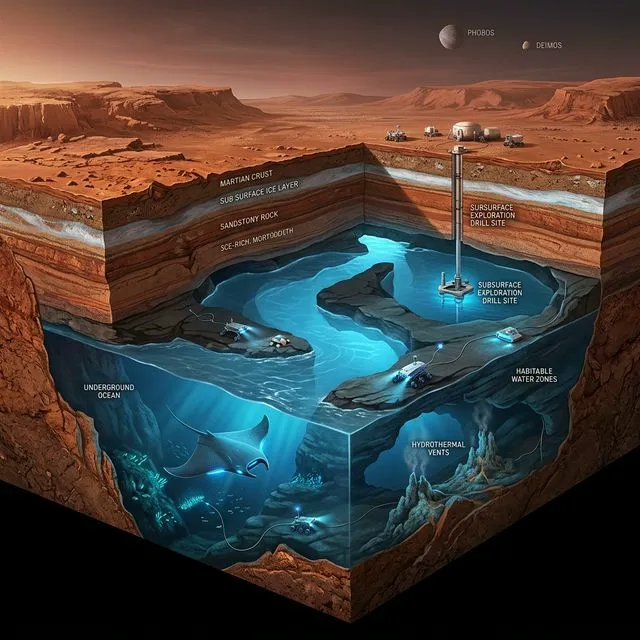
Water is often called "the most important resource in space" — and with good reason. For a future Martian colony, access to liquid water would mean not only hydration supplies and food production, but also rocket fuel manufacturing (through electrolysis of water into hydrogen and oxygen), radiation protection (water shields are extremely effective against cosmic rays), and sustaining closed-loop life support systems.
Until now, colonization plans — including those from SpaceX, NASA, and the Chinese and Indian programs — relied on two water sources: surface ice at the poles and extraction of water molecules from regolith (Martian soil), an energy-intensive and low-yield process. The discovery of a global underground ocean dramatically transforms this equation:
- Abundance: Virtually unlimited volume for human scales — we no longer need to worry about "having enough water"
- Liquid state: Unlike polar ice, liquid water requires significantly less energy to extract and process
- Global distribution: The reservoir is not concentrated at the poles — it spans the entire crust, allowing greater flexibility in choosing settlement locations
- Depth: The great depth (11.5–20 km) is the main challenge; deep drilling on Mars will require technology that does not yet exist at space scale
Drilling Challenges
Despite justified optimism, it is essential to recognize that accessing water at more than 11 kilometers depth represents an extraordinary engineering challenge — even by terrestrial standards, where the deepest drilling record is the Kola Superdeep Borehole in Russia, which reached 12.2 km after 20 years of work. Transporting and operating drilling equipment of that magnitude on the Martian surface, months away from Earth by travel, with different gravity and no local infrastructure, is a feat that will likely require decades of technological development.
However, water in more accessible forms — ice at shallower depths, shallow aquifers, more superficial lateral brines — likely exists in far greater abundance than previously thought. The deep ocean discovery suggests an active and extensive underground hydrological system, with infiltration and fluid migration through fractures and permeability zones that could bring water to more accessible depths in many locations.
The Scientific Debate: Not Everyone Agrees
Objections and Alternative Interpretations
As with every major scientific discovery, the interpretation of MARSIS data is not universally accepted without reservations. Several researchers have raised legitimate questions and alternative interpretations:
Conductive clay: Professor Jeff Plaut of NASA's JPL argued that certain ion-rich clay minerals can also produce radar reflections similar to those of liquid water. Smectitic clays saturated with metallic ions (especially iron clays) can exhibit sufficiently high electrical permittivity to mimic the water signal.
Geothermal gradient question: Mars is geologically far less active than Earth. Its geothermal gradient — the rate of heating with depth — is significantly lower. Some models suggest that at 12 km depth, the temperature could still be below -20°C, requiring extreme salt concentrations to keep water liquid.
Instrument resolution: MARSIS operates with limited vertical resolution (hundreds of meters). This means the technique cannot distinguish between a large continuous body of water and multiple small deposits scattered throughout the rock.
Absence of correlated seismic activity: If an extensive underground ocean exists, some researchers would expect to observe specific seismic attenuation patterns in InSight data — and this evidence is ambiguous in available data.
What This Means for You
Practical and Everyday Impact
For the non-scientific public, the discovery of liquid water on Mars may seem distant and abstract. But its ramifications are profound and multifaceted, affecting everything from the global economy to philosophical and existential questions:
Accelerated space race: Confirmation of abundant water resources on Mars will intensify competition among the US, China, India, the European Union, and the private sector (SpaceX, Blue Origin) to establish permanent presence. First to arrive gains access to this resource.
Investment and technology: New companies and technologies for deep drilling, autonomous robotics, and closed-loop life support systems will receive massive investments. NASA announced in February 2026 that it is accelerating the Artemis Moon-to-Mars program timeline.
Philosophical implications: If life — even microbial — is found in Mars's underground water, it will be the greatest discovery in human history. It would mean life is not a unique accident of Earth but a potentially universal natural phenomenon. The ramifications for religion, philosophy, ethics, and politics would be immeasurable.
Water as strategic resource: In international space law, treaties like the 1967 Outer Space Treaty prohibit "national appropriation" of celestial bodies. But resource exploitation is a legal gray area already generating diplomatic conflicts in 2026.
Future Scenario Analysis: 2030–2050
Scenario 1: Biological Confirmation (Optimistic)
A robotic drilling mission (possible by 2035) collects subsurface water samples and identifies biosignatures — complex organic molecules or living microorganisms. Mars is officially declared a "living planet," triggering an unprecedented scientific and cultural revolution. Investments in space exploration triple within 5 years.
Scenario 2: Sterile but Abundant Water (Pragmatic)
The water exists but is sterile — chemically too hostile for life. Nevertheless, it represents a crucial resource for colonization. SpaceX and NASA establish a permanent base between 2040-2045, using mid-latitude ice as the primary resource while developing deep drilling technology.
Scenario 3: Reinterpreted Data (Conservative)
Subsequent research demonstrates that the radar reflections are caused by conductive minerals, not liquid water. Mars returns to "possibly dry at depth" status. Colonization remains viable but dependent exclusively on polar ice, limiting settlement locations and exponentially increasing logistics costs.
Conclusion: The Red Planet Holds Blue Secrets
The discovery of a potential underground ocean on Mars is one that redefines eras. If confirmed by future missions, it transforms Mars from a sterile and hostile neighbor into a world with water resources potentially greater than Earth's — hidden beneath a thin shell of red dust and ancient stone.
The search for life on Mars — which began as science fiction in H.G. Wells's novels and became real science with the Viking probes in the 1970s — has just gained the most powerful fuel imaginable: confirmation that the most essential ingredient for life as we know it exists in extraordinary abundance, waiting to be explored.
As the research team themselves stated: "If Mars has liquid water in oceanic proportions, we're not just talking about a resource — we're talking about a habitat. And if Mars is a habitat, the question changes from 'is there life out there?' to 'what kind is it?'"
The answer may lie only a few kilometers beneath the red soil of the fourth planet from the Sun.
Sources and References
- NASA — Mars Exploration Program — Active Mars data and missions
- ESA — Mars Express Mission — MARSIS instrument and orbital data
- Scripps Institution of Oceanography — UCSD — Vashan Wright's research team
- Nature — MARSIS subsurface water analysis — Scientific publication of the discovery
- USGS — Astrogeology Science Center — Planetary geology
- SpaceX — Mars Program — Colonization plans


