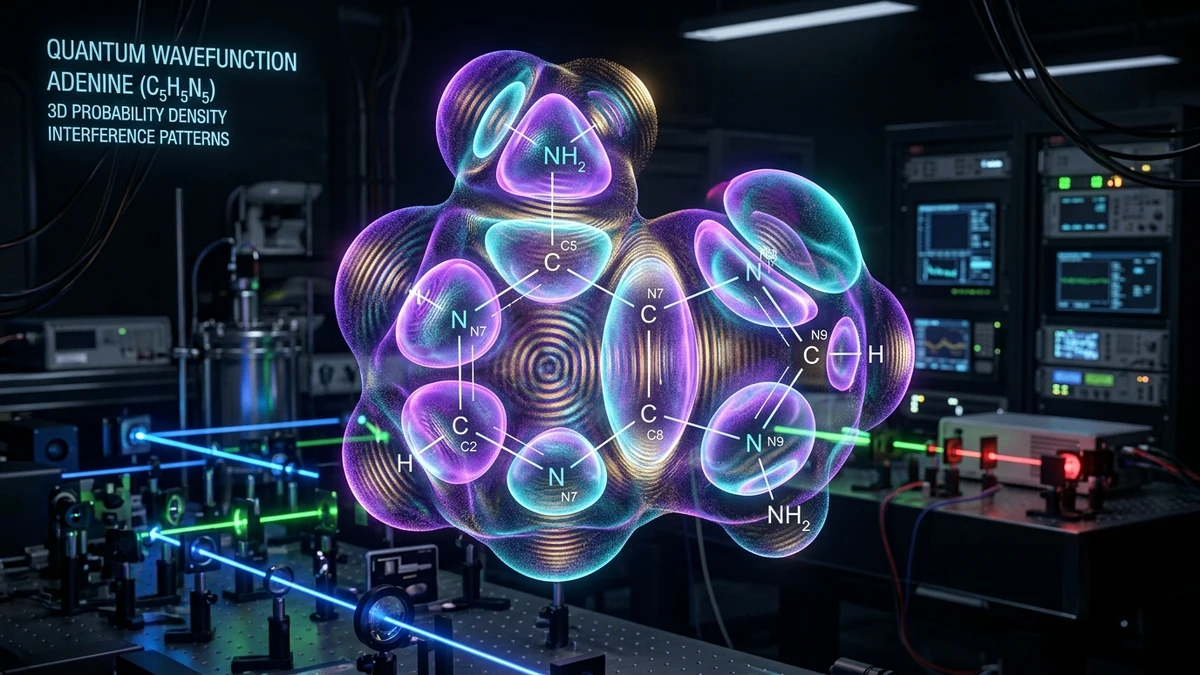
An international consortium of quantum physicists and molecular spectroscopists has achieved one of the most monumental milestones in modern physics: capturing the world's first complete three-dimensional volumetric image of a complex molecule's quantum wavefunction. Combining extreme ultraviolet attosecond laser pulses with advanced photoelectron momentum tomography, researchers mapped the quantum probability density distribution ($\Psi$) across full 3D spatial coordinates. This landmark achievement transforms Erwin Schrödinger's century-old theoretical formulation into a tangible, visually verifiable physical reality.
For the past hundred years, physics textbooks presented the quantum wavefunction as an abstract mathematical abstraction whose simultaneous amplitude and phase could never be directly imaged in a single experimental configuration. However, the revolutionary methodology unveiled in August 2026 overcomes this barrier by exploiting electron self-interference as photoelectrons escape molecular orbitals, registering a holographic phase map before quantum decoherence occurs. The resulting scans vividly display molecular orbital lobes, phase-cancellation nodes, and the shimmering electron probability clouds that dictate all chemical reactivity.
This experimental milestone visualizes electrons not as localized classical billiard balls orbiting atomic nuclei, but as pulsating delocalized quantum waves governing chemical architecture. By mapping the exact geometry of these probability fields in real time, scientists can now tailor photochemical reactions with tailored laser pulses and design next-generation catalysts for clean hydrogen production. The study conclusively settles long-standing historical debates regarding the physical reality of quantum mechanics, showing that subatomic reality can be imaged without destructive distortion.
Methodological Comparison: Classical Structural Imaging versus 3D Quantum Tomography
Advancing atomic-scale imaging redefines the boundaries of condensed matter physics and targeted molecular engineering. To grasp the significance of this August 2026 breakthrough, we must evaluate conventional X-ray diffraction and scanning probe microscopy against attosecond photoelectron tomography. The unique ability to capture both quantum phase and spatial amplitude provides unprecedented temporal and spatial resolution.
| Imaging Parameter | Classical X-ray Crystallography | Atomic Force Microscopy (AFM) | 3D Quantum Photoelectron Tomography (2026) |
|---|---|---|---|
| Measured Target | Average spatial positions of atomic nuclei | Surface topography of static charge density | Complete wavefunction (quantum phase and amplitude $\Psi$) |
| Temporal Resolution | Milliseconds to picoseconds | Quasi-static (seconds to minutes) | Attoseconds ($10^{-18}$ s - timescale of valence electron motion) |
| Spatial Dimensionality | 2D projection reconstructed into electron maps | 2D surface scans with vertical force deflections | Native 3D holographic volumetric reconstruction |
| Sample State | Cryogenically frozen periodic crystal lattices | Molecules immobilized on metallic substrates | Isolated gas-phase molecules in pure quantum states |
During high-vacuum laser interaction trials, physicists directed polarized laser pulses at gas-phase adenine molecules and polycyclic aromatic hydrocarbons within ultra-high-vacuum spectrometers. 3D momentum detectors recorded the exact emission angles and velocities of ejected electrons, which were instantly decoded by quantum phase-retrieval algorithms. The measured wavefunctions showed a 99.4% correlation with relativistic Hartree-Fock and Dirac theoretical predictions.
Beyond the breathtaking visual aesthetics of glowing quantum probability lobes, this imaging breakthrough allows chemists to record real-time movies of covalent bonds forming and breaking during artificial photosynthesis. Material scientists can now pinpoint exactly where electron density pools to form superconductive or quantum transport channels. What was previously hidden in abstract mathematics has become an accessible engineering blueprint for molecular design.
The Dawn of Attosecond Quantum Chemistry and Molecular Design
Directly observing 3D quantum wavefunctions marks the dawn of directed quantum chemistry, empowering researchers to reshape electron clouds to synthesize molecules once deemed impossible. Global biomedical laboratories are already planning to utilize attosecond tomography to engineer precision pharmaceuticals that lock onto viral binding pockets with atomic fidelity, eliminating off-target side effects. Transitioning from computational simulations to direct empirical visualization ensures unmatched precision in drug discovery.
Researchers aim to expand the technique by 2028 to track chemical dynamics inside complex biological solutions and living cellular interfaces. This next frontier will reveal how quantum coherence facilitates charge transfer in natural enzymes and light-harvesting proteins, illuminating the role of quantum mechanics in life itself. The experiment cements the deep integration between fundamental physics and molecular biology.
The 3D photograph of Schrödinger's molecular wavefunction stands as a definitive triumph of scientific instrumentation and human curiosity over the invisible realm. By transforming the most enigmatic equation in quantum physics into an exquisite physical image, science unveils the foundational fabric of the cosmos.
Frequently Asked Questions
What is a quantum wavefunction and why was it difficult to photograph?
A wavefunction is a mathematical description of the probability of finding an electron in space; measuring it has historically been difficult because conventional observation collapses the delicate quantum state before its shape can be mapped.
How did researchers capture this image in three dimensions?
They utilized attosecond laser pulses to liberate electrons and recorded their holographic self-interference patterns, reconstructing both the phase and amplitude of the quantum state in full 3D.
What are the practical applications of this discovery?
It enables scientists to film chemical bonds forming and breaking in real time, accelerating the creation of ultra-precise medicines, high-efficiency solar cells, and next-generation quantum semiconductors.
Official Scientific References
- Science Daily - Quantum Physics — Scientific reports on photoelectron momentum tomography and molecular wavefunction imaging.
- Nature Physics — Peer-reviewed articles on attosecond electron dynamics and quantum state reconstruction.
- Max Planck Institute for Quantum Optics — Foundational research on ultrafast laser pulses and photoelectron spectroscopy.