A monumental and highly consequential scientific discovery has profoundly shaken the underlying foundations of modern astrophysics and observational cosmology worldwide. Dedicated international scientists have successfully detected a lingering low-frequency gravitational wave background, frequently and affectionately referred to as the primordial cosmic hum. This remarkably constant, subtle, and almost totally imperceptible cosmic vibration continuously permeates the entire dimensional fabric of our vastly known and observable universe.
Prominent astronomers firmly and passionately believe that this specific background noise can directly unlock the greatest, most profound scientific secrets dating back from the absolute dawn of time. Entirely unlike the violently short waves directly generated by sporadic and explosive stellar collisions, these specific fluctuations are exceedingly slow and truly colossal in spatial scale. They consistently possess phenomenal temporal periods that actively endure and span for multiple consecutive years or even last for entire, uninterrupted decades to finish a single oscillatory cycle.
The invisible space-time continuum is continuously and relentlessly stretched and forcefully squeezed by these formidably powerful, low-frequency gravitational energy waves. For many long and controversial years, the true, fundamental astronomical origin of this continuous gravitational signal robustly remained a highly debated and contentious topic within academic astronomy circles. However, exciting new advanced theoretical research investigations are finally beginning to explicitly point toward a truly revolutionary and intellectually captivating cosmological explanation that challenges existing orthodoxies.
The Origin of the Space-Time Hum
A fundamentally groundbreaking and comprehensive theoretical study originating from the esteemed Colgate University, officially published in the prestigious Physical Review D scientific journal, boldly proposes an intriguing cosmic origin. The brilliantly dedicated researchers courageously suggest that these mysterious lingering waves are essentially distant echoing remnants originating from the universe's absolute first supermassive black holes. Crucially and fundamentally, these ancient, unimaginable cosmic giants might have initially evolved directly from highly exotic, purely hypothetical celestial objects widely known as dark stars.
Theoretical dark stars represent a highly radical, profoundly transformative, and entirely novel concept deeply rooted within both particle physics and theoretical stellar astrophysics. Markedly different from all the brightly burning common stars observed today, they absolutely would not be primarily powered by standard nuclear hydrogen fusion within their dense cores. Instead, their incredibly intense, primary, and sustaining source of fiery energy would be the continuous, highly destructive, subatomic annihilation of trapped dark matter particles.
In the extremely young, embryonic primordial universe, the gravitational concentration and density of this mysterious, invisible dark matter was incredibly high, dynamic, and exceptionally active. This deeply elusive and mysterious substance vigorously clumped and gathered within the dense, dark inner cores of the universe's first forming protogalaxies during their initial stages. Immense, swirling primordial clouds consisting purely of early hydrogen and helium gases inevitably collapsed spiraling inward, drawn relentlessly toward these incredibly potent, invisible gravitational dark matter halos.
The Birth of Dark Stars
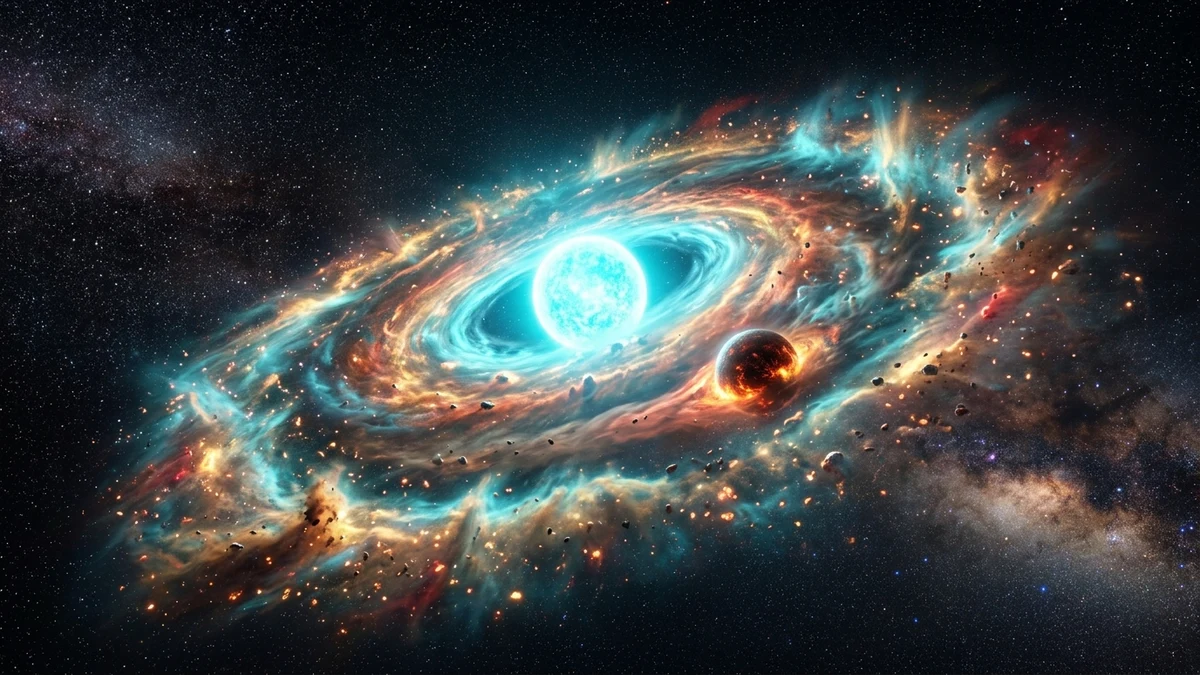
During this profoundly violent, early gaseous primordial collapse, the countless unseen trapped particles of dark matter ferociously collided and aggressively annihilated each other in a continuous explosive manner. This incredibly dramatic and unending annihilation process successfully generated a colossal, almost incomprehensible quantity of outward-radiating, fierce thermal heat energy pushing strongly against gravity. This tremendous internal outward-pushing thermal pressure actively and efficiently prevented the massive collapsing gas cloud from quickly forming into a typical, conventionally ordinary main-sequence star.
Directly due to this incredibly unique, wildly exotic, and incredibly potent central heat source, the theorized early dark stars could continuously grow massively and indefinitely without any immediate catastrophic collapse. They simply never ever attained the extreme, crushing nuclear densities desperately required to successfully initiate the ignition of standard, traditional stellar nuclear fusion. Consequently, they could continuously and aggressively accumulate vast amounts of surrounding gas, eventually achieving astonishing masses totaling millions of times the entire mass of our own Sun.
They shined incredibly and intensely brightly across the empty void of space, but their spectacular luminosity primarily originated from burning dark matter annihilation, completely bypassing normal nuclear reactions. Eventually, after thousands of millennia had passed, the gigantic central supply of dark matter nestled within the star's monstrously huge core finally became totally and completely exhausted. Entirely bereft of this absolutely vital and essential internal thermal energetic support, the unbelievably massive celestial object finally and inevitably succumbed fatally to its own crushing, overwhelming gravitational force.
The Formation of Supermassive Black Holes
The absolute, total, and catastrophic gravitational collapse of an entirely exhausted dark star would directly and immediately spawn a monumentally gigantic black hole. This highly ingenious theoretical cosmological process elegantly and beautifully resolves one of the absolute greatest and most stubbornly persistent unsolved mysteries currently plaguing modern observational astronomy. It concisely and admirably explains precisely how unbelievably massive supermassive black holes seemingly formed so incredibly, inexplicably fast within an extremely young and early universe.
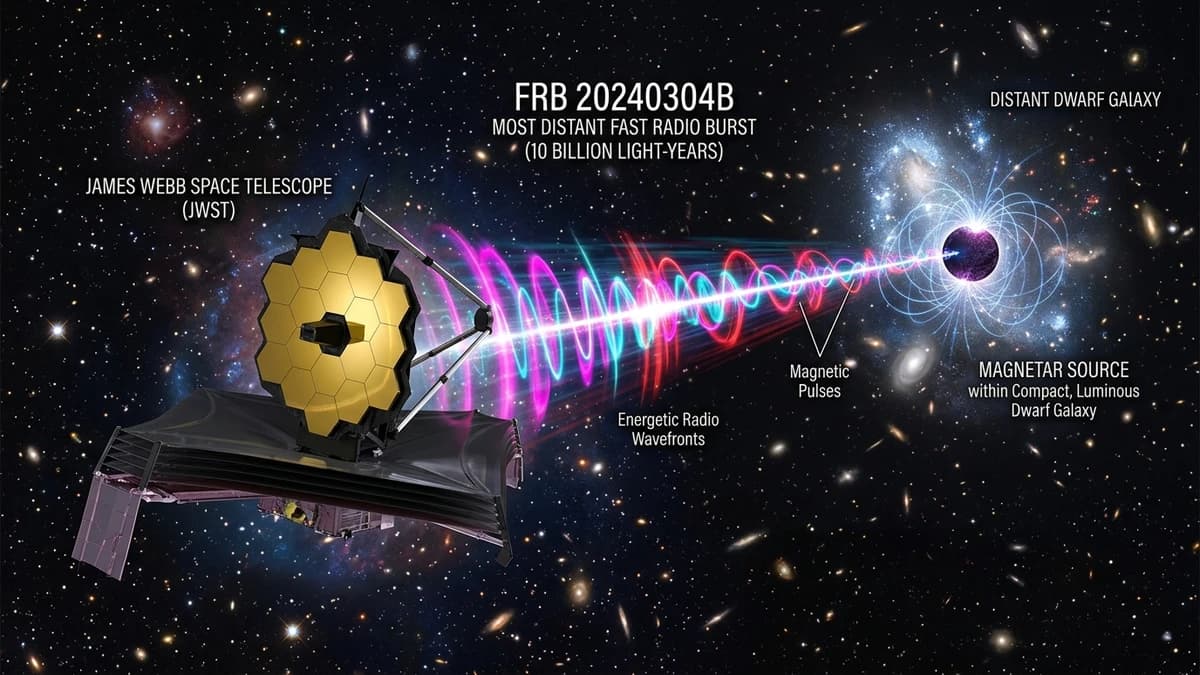
Standard, universally accepted astrophysical models dictating ordinary stellar evolution repeatedly and desperately struggle to adequately explain the astonishingly early emergence of such immensely massive early black holes. The spectacularly powerful and highly advanced James Webb Space Telescope has inexplicably and repeatedly discovered entirely too many of these formidable cosmic giants existing at unexpectedly and prematurely early cosmic epochs. The uniquely distinct evolutionary pathway provided by massive dark stars perfectly, timely, and elegantly furnishes the crucially monstrous, gigantic cosmic seeds that are theoretically and fundamentally required.
As the earliest primitive galaxies violently merged together, their respective central supermassive black holes also mortally orbited each other in a deadly gravitational dance. These incredibly destructive, spiraling, and violent cosmic collisions between authentic primordial giants vigorously generated extraordinarily intense, massive gravitational ripples permeating throughout the entirety of the space-time fabric. It is precisely this chaotic, collective, and monumental chorus comprised entirely of ancient titanic galactic mergers that actively composes today's highly intriguing, measurable cosmic gravitational echo.
Cosmic Signal Comparison Table
| Feature | Cosmic Microwave Background (CMB) | Stochastic Gravitational Wave Background (SGWB) | Pulsar Timing Array (PTA) Signals |
|---|---|---|---|
| Wave Nature | Primordial electromagnetic radiation consisting of ancient photons. | Invisible, continuous fluctuations deeply embedded within the space-time fabric. | Minuscule, precisely measured variations within the arrival time of radio pulses. |
| Origin Epoch | Approximately 380,000 years immediately succeeding the Big Bang. | Ranging from the initial early universe to very recent galaxy collisions. | Continuous, regular radiative emissions momentarily affected by massive passing waves. |
| Revealed Information | Crucial initial thermodynamic temperature and basic density conditions. | Colossal mass dynamics, galactic mergers, and primitive cosmic physics. | Confirmed, undeniable presence of vast supermassive binary black hole systems. |
| Detection Method | Highly advanced, sensitive telescopes and dedicated orbital microwave satellites. | Sophisticated, complex laser interferometers located both on Earth and in space. | Powerful, enormous radio telescopes constantly monitoring spinning neutron stars. |
| Typical Frequency | Gigahertz range located in the upper band of the electromagnetic spectrum. | Hertz down to millihertz representing medium frequency spatial gravitational waves. | Nanohertz representing extremely, unfathomably low-frequency spatial gravitational ripples. |
The Pulsar Detection Method
But exactly how do highly experienced modern astronomers successfully manage to effectively "hear" this extremely low-frequency cosmic hum from their scientific installations situated directly on Earth? The brilliantly elegant methodological answer essentially and fundamentally resides entirely within a vast, complex galactic network comprising highly precise natural chronometers officially called Pulsar Timing Arrays. Highly magnetic pulsars are incredibly dense, ultra-fast spinning neutron stars that continuously emit intensely bright, precisely targeted beams of electromagnetic radiation across the farthest celestial reaches.
Tirelessly acting as astoundingly reliable, sweeping cosmic lighthouses, they radiate their energetic pulses with a truly remarkable, unwavering regularity that directly and fiercely rivals humanity's absolute best atomic clocks. When profoundly crushing, incredibly massive gravitational waves smoothly travel and fluidly traverse across our sprawling home galaxy, they subtly and undeniably warp the entire intervening intergalactic space. This invisible process imperceptibly alters and temporarily compresses the actual, established physical distance constantly separating the Earth from these distant, brilliantly scintillating cosmic pulsars.
Consequently, and quite inevitably, extremely minuscule, highly microscopic temporal delays or alternatively, subtle, unexpected advancements routinely occur modifying the exact arrival times of the emitted radio pulses. By meticulously, concurrently, and flawlessly monitoring dozens of carefully selected pulsars in an absolutely simultaneous fashion spanning several consecutive decades, brilliant scientists can finally isolate the signal patiently. This monumental, highly collaborative, and truly tireless astronomical global effort has finally and unequivocally revealed the unquestionable signature of the immense stochastic spatial gravitational background.
Profound Implications for Dark Matter
The bold, highly visionary theoretical connection established between the newly detected cosmic echo and the exotic, hypothetical dark stars certainly carries undeniable, deeply transformative scientific implications. This extraordinary, paradigm-shifting astronomical discovery could potentially provide the highly coveted, absolute first incisive observational probe unlocking the deeply elusive core properties defining dark matter. Historically and continuously extending right up until the present day, silent dark matter has only been theoretically inferred indirectly through observing its severe, undeniable gravitational effects.
If the highly elegant, intensely innovative astrophysical dark star hypothesis is eventually confirmed definitively, it will absolutely prove categorically that mysterious dark matter actively interacts. The violently constant, furious subatomic destruction and active annihilation of these completely unknown particles routinely offers abundant, crucially vital clues regarding the hidden mass and true nature. This unprecedented revelation would certainly immensely help to significantly constrain and refine the highly exhaustive, mathematically complex theoretical models that constantly and incessantly attempt to describe it rigorously.
Theoretical particle physicists could audaciously and enthusiastically utilize the highly valuable empirical data extracted from these gravitational waves to analytically calculate ancient, historical annihilation rates. This monumental leap would beautifully and seamlessly unite traditional, empirical observational cosmology with highly sophisticated, advanced quantum physics functioning on an ambitiously vast, entirely unprecedented universal scale. Our current, distinctly limited scientific comprehension of the murky, shadowy dark universe would progressively transition sharply from purely abstract mathematical speculations directly into severe, highly decisive empirical testing.
The Future Horizon of Observational Cosmology
Humanity is, entirely without a shadow of a doubt, currently entering boldly and fearlessly into a completely new and extremely thrilling golden era regarding revolutionary gravitational astronomy. Hardworking, extremely laborious ground-based observatories have already masterfully and undeniably established the solid empirical foundation, but the audaciously planned future space observatories solemnly promise to irreversibly transform the entire field. Fabulous, highly ingenious engineering projects such as the esteemed Laser Interferometer Space Antenna will spectacularly elevate our crucially important stellar observation capabilities directly into outer space.
This strategic maneuver will successfully and surgically remove entirely all the highly bothersome, constantly intrusive planetary seismic interference plaguing Earth, thus allowing and guaranteeing unprecedented, astonishingly precise spatial measurements unimaginable currently. Extremely ambitious scientists passionately aim to entirely map the diffuse, deeply mysterious low-frequency gravitational background with an incredibly dizzying, absolutely astonishing visual clarity totally unprecedented today. Very soon, we will be technologically empowered to flawlessly isolate and expertly separate the highly intrusive, noisy modern collision data directly from the true, profoundly gentle primordial cosmic hum.
Overcoming Instrumental Calibration Challenges
To successfully and completely unravel these sublime, deeply hidden cosmic wonders, intrepid scientists stubbornly and persistently confront truly formidable, highly complex technological challenges that are incredibly difficult to successfully resolve. The highly valuable, actively sought authentic signal comprising the deeply elusive cosmic echo is exceptionally weak, rendered almost entirely invisible by the loudly incessant, overwhelming local galactic noises. Severe, highly unpredictable local electromagnetic environmental interferences combined with constant, chaotic spatial fluctuations can easily and thoroughly conceal or completely mask the highly fragile, intensely sought spatial anomalies.
The colossally sized, incredibly potent terrestrial radio telescopes currently utilized constantly demand uninterrupted, astonishingly rigorous calibrations possessing an unparalleled, extreme precision required to successfully filter out such incredibly massive unwanted distortions. Highly sophisticated, extremely modern software platforms powered heavily by robust, highly analytical artificial intelligence algorithms are commonly and extensively employed to unmask anomalies in a purely surgical manner. This highly meticulous, fiercely methodical, and strictly mathematical decantation of the immensely vast, chaotic ocean containing raw data firmly and permanently consolidates the irreproachable foundation supporting the officially collected astronomical results.
Frequently Asked Questions
What exactly is the cosmic gravitational echo?
The fascinating phenomenon widely known as the cosmic gravitational echo, frequently and formally designated in a highly technical manner as the Stochastic Gravitational Wave Background (SGWB), is notably a completely invisible, continuous hum that uninterruptedly fills the entirety of the known universe. Entirely and completely different from the extremely fast, sporadic, and localized gravitational waves violently generated by dramatic, unique, and temporally short astronomical events, such as the devastatingly rapid and highly fatal collision between two massive stellar black holes, this remarkably persistent cosmic echo is, in fact, a faint, constant cosmic murmur. It is physically constituted and beautifully forged by the highly chaotic, permanent, and continuous superposition of millions upon millions of low-frequency waves originating from immensely colossal galaxy collisions occurring steadily throughout the entire, incredibly lengthy stellar history of the cosmos. Tenacious, highly dedicated scientists manage to detect this fantastic, minuscule vibration by exactly measuring how the dimensional fabric comprising space-time smoothly curves, actively utilizing incredibly rigorous, extensive, and massive networks of distantly located stellar pulsars.
How do theoretical dark stars differ from normal stars like our Sun?
The highly fascinating and deeply intriguing dark stars are definitively and essentially formidable, incredibly dense, purely hypothetical astrophysical objects that obligatorily would have existed in a totally exclusive manner only during the highly tumultuous, incredibly violent initial early phases of our rapidly expanding young universe. While incredibly common, ordinary celestial stars actively observed today, much like our very own familiar, brilliantly glowing Sun, tirelessly and constantly generate their vital energy by continuously fusing together extremely light gaseous hydrogen atoms deeply within their incredibly hot interiors, the highly exotic early dark stars would actively survive in a radically contrasting, entirely different manner. They would be perpetually, intensely, and ferociously heated entirely by means of the violent, subatomic microscopic annihilation occurring between completely unknown, forcefully colliding dark matter particles trapped brutally within their colossal, unfathomably massive core by immense gravitational forces, thereby ultimately granting them an astonishing, truly gigantic physical size.
What precise role do pulsars play in detecting these elusive waves?
The brilliantly scintillating, incredibly dense pulsars are exceptionally fast, exceptionally dense, highly magnetic residual neutron stars that actively rotate dizzily and thus periodically emit extremely potent, highly regular luminous radiation beams that perfectly mimic the highly reliable, sweeping behavior characteristically seen in coastal lighthouses. Operating exactly in this highly dependable manner, they flawlessly function as completely irreplaceable, perfectly tuned, highly precise cosmic astronomical chronometers applied directly and fundamentally to continuously feed crucial, highly accurate timing information into the powerful, incredibly massive Stellar Timing Arrays technically designated as PTAs. When finally, the incredibly smooth, low-frequency gravitational waves seamlessly pass completely unharmed through the incredibly distant, vast sidereal vacuum actively separating the solitary Earth and these highly magnetic, brilliantly shining pulsars, they slightly and almost imperceptibly distort the fundamental dimensional fabric actively traversed by the sweeping radiation rays using astonishing natural mathematical magic. By exhaustively, metrically, and milimetrically studying these highly microscopic chronological timing variations successfully registered globally around the entire world utilizing countless, massive annual datasets, specialized experts can finally accurately calculate the immense force and precise origin of this breathtakingly impressive cosmic symphony.
References
- NASA (https://www.nasa.gov)
- Physical Review D (https://journals.aps.org/prd)
- ScienceDaily (https://www.sciencedaily.com)