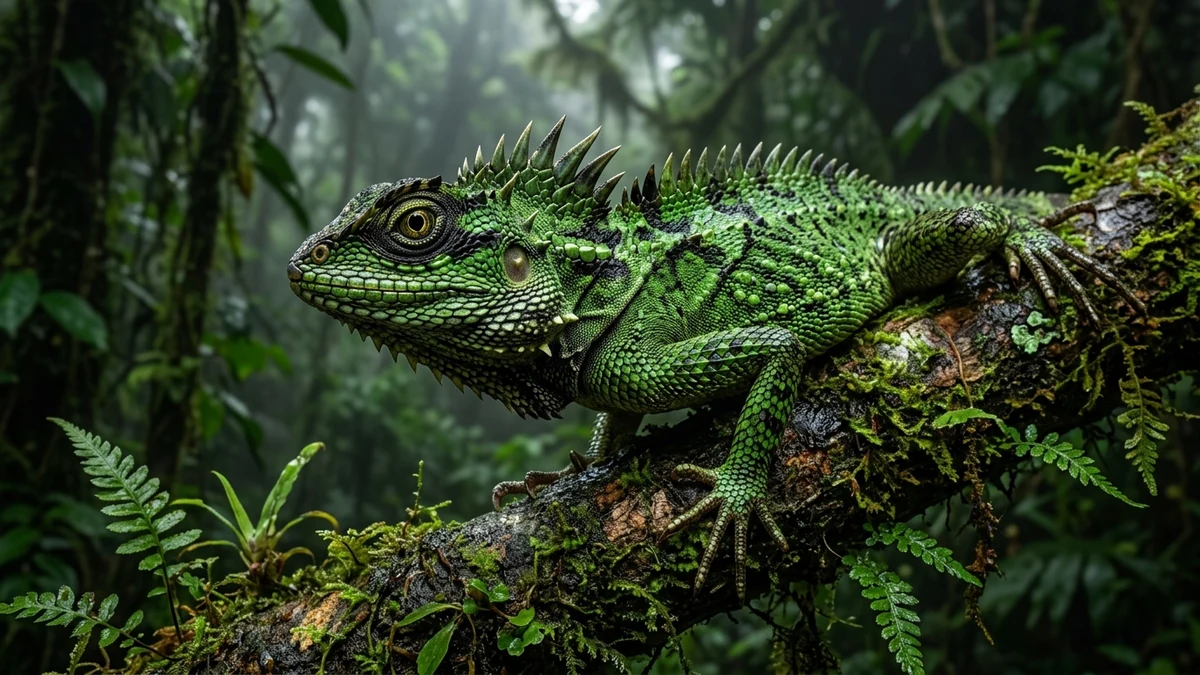
An international expedition of evolutionary biologists and herpetologists announced in August 2026 the remarkable discovery of a new prehistoric-looking reptile species inhabiting isolated high-altitude cloud forests in Southeast Asia: the horned mountain dragon (Acanthosaura syrax). Characterized by an imposing spiky dorsal crest evoking Jurassic armor, prominent dagger-like supraorbital horns, and piercing golden irises, this extraordinary creature survived undisturbed for millions of years in a misty, closed-canopy ecosystem. The formal species description follows comprehensive morphological and genomic phylogenetic analyses validating its deep evolutionary divergence.
Belonging to the agamid lizard family Agamidae, the newly described reptile exhibits a suite of specialized anatomical adaptations for canopy arboreality. Acanthosaura syrax possesses dynamic cryptic camouflage that flawlessly mirrors the textures and colors of ancient mosses, lichens, and wet tree bark, rendering it nearly undetectable to predators and prey in the cloud forest canopy. Unlike lowland agamid species, this mountain specialist evolved reinforced hooked talons and a rigid prehensile tail that anchor its body against fierce high-altitude winds.
Phylogenetic sequencing revealed that the lineage of Acanthosaura syrax diverged from its closest relatives over twelve million years ago during the Miocene epoch, when regional tectonic uplift fragmented continuous lowland rainforests into isolated mountain-top "sky islands." The species eluded discovery by modern biologists due to the extreme inaccessibility of its rocky montane habitat and its strictly crepuscular ambush-hunting behavior. The finding underscores the critical ecological value of protecting undisturbed biological refugia across tropical biomes.
Biological Comparison: Species Profiles within the Horned Dragon Genus (Acanthosaura)
The evolutionary taxonomy of high-altitude cloud forest reptiles reveals striking morphological specializations driven by millions of years of allopatric speciation. To understand the diagnostic traits that distinguish Acanthosaura syrax described in August 2026 from its known Asian congeners, we must analyze its osteological and behavioral characteristics. Variations in horn morphology and dorsal spines reflect unique environmental selection pressures at high elevations.
| Biological Characteristic | Green-Horned Dragon (Acanthosaura capra) | Boulenger's Mountain Dragon (Acanthosaura crucigera) | Newly Discovered Horned Dragon (Acanthosaura syrax 2026) |
|---|---|---|---|
| Supraorbital Horns | Short, conical horns above orbit | Slender spines curving backward | Elongated dagger-like horns with reinforced serrated base |
| Camouflage Patterns | Uniform emerald green with brown marbling | Dark crossbands over dorsal surface | Complex moss-and-lichen cryptic patterning with gold iridescence |
| Elevational Niche | Lowland dipterocarp forest (100 to 600 m) | Mid-elevation evergreen forest (600 to 1,000 m) | Pristine montane cloud forest (1,200 to 1,800 m) |
| Foraging Strategy | Active forager along lower tree trunks | Generalist arboreal forager with quick escape | Motionless ambush predator in high canopy with erectile crest |
During canopy survey missions that documented the type specimens, researchers deployed high-resolution thermal imaging and canopy climbing gear to observe the species within its natural micro-environment. Male dragons display an expandable, brightly colored gular pouch deployed during territorial confrontations and courtship displays, accompanied by the rapid erection of the serrated nuchal crest. The species feeds primarily on armored tree-dwelling beetles, nocturnal moths, and giant orb-weaver spiders.
Beyond its captivating mythological appearance reminiscent of miniature dragons, Acanthosaura syrax serves as an indispensable ecological bioindicator of forest health. Being exquisitely sensitive to microclimatic temperature fluctuations and ambient humidity shifts, its long-term survival is bound to the preservation of intact primary cloud forest against climate change.
Rainforest Conservation and Next-Generation Field Expeditions
Formal recognition of the new species has catalyzed immediate initiatives by environmental authorities and international conservation NGOs to establish a protected biological reserve encompassing the isolated montane valleys where populations were mapped. The geographic isolation that shielded Acanthosaura syrax for millions of years also makes it vulnerable to habitat fragmentation, illegal deforestation, and exotic wildlife poaching. Regional wildlife rangers have deployed acoustic monitoring grids and drone patrols to safeguard the habitat.
Herpetologists are preparing follow-up field expeditions to neighboring unexplored peaks to ascertain population ranges and collect environmental DNA (eDNA) from montane stream networks. Biologists hypothesize that the surrounding cloud forest canopy harbors numerous undescribed amphibians, insects, and small vertebrates that evolved in parallel under the same permanent mist.
The discovery of Acanthosaura syrax celebrates Earth's boundless biodiversity and reminds us that our planet still shelters magnificent creatures worthy of legend. Protecting these living marvels is a vital responsibility to preserve our shared global biological heritage.
Frequently Asked Questions
What is Acanthosaura syrax and where was it found?
It is a newly described reptile in the agamid family, commonly referred to as the horned mountain dragon, discovered in isolated high-altitude cloud forests of Southeast Asia.
Why is it called a 'horned dragon'?
Because it features prominent dagger-like horn projections above its eyes and a sharp, serrated dorsal crest that gives it the appearance of a miniature prehistoric dragon.
What is the scientific significance of this discovery?
The species represents an ancient evolutionary lineage isolated for over 12 million years and serves as a vital bioindicator for the ecological health of high-elevation rainforests.
Official Scientific References
- Zootaxa - International Journal of Zoological Taxonomy — Formal taxonomic description and morphological diagnosis of the new agamid species.
- IUCN Red List of Threatened Species — Conservation status assessments and distribution mapping for montane reptiles.
- World Wildlife Fund (WWF) — Greater Mekong biodiversity surveys and high-altitude species discovery briefings.