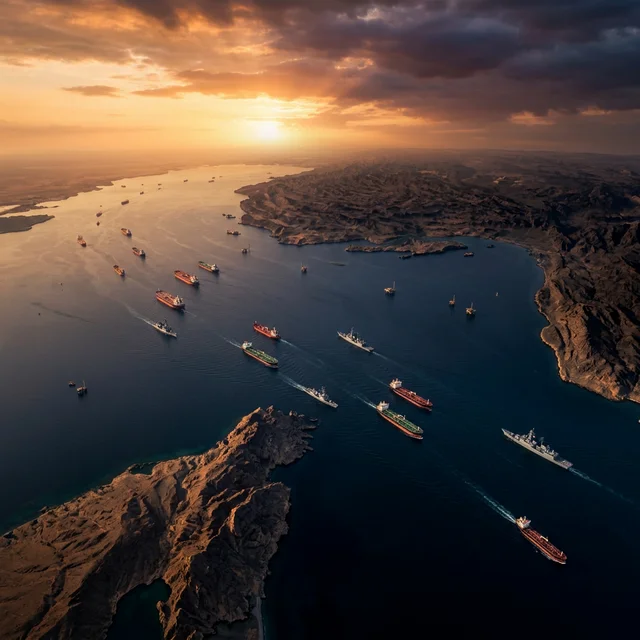
Twenty million barrels of crude oil transit daily through the Strait of Hormuz—a maritime corridor measuring just fifty-four kilometers across at its narrowest point between the Islamic Republic of Iran and the Musandam Peninsula of Oman. This vital geographic bottleneck regulates roughly one-fifth of the world’s total petroleum supply and over a quarter of global liquefied natural gas (LNG) commerce. With military hostilities escalating rapidly between the United States, Israel, and Iran in early 2026, the potential closure of this waterway has emerged as a severe macroeconomic hazard, threatening to trigger the sharpest global inflationary recession since the 1970s.
Benchmark Brent crude prices surged past 35 per barrel in early trading, while international energy analysts and investment banks caution that sustained naval interdiction could drive crude toward 00 per barrel. Rising petroleum costs quickly spill over into petrochemical feedstocks, fertilizer production, agricultural freight, and maritime logistics. The crisis exposes a profound structural paradox in the modern global economy: despite decades of international dialogue regarding decarbonization and energy diversification, global manufacturing and food distribution networks remain critically dependent on a vulnerable sea lane flanked by heavily fortified coastal batteries.
The threat of maritime disruption along the Persian Gulf triggers immediate financial shocks across international currency exchanges, equity markets, and sovereign bond yields. Central banks worldwide, already navigating stubborn domestic inflation, face the complex dilemma of raising interest rates to combat energy-driven price surges or lowering rates to cushion contracting economic activity.
The Maritime Chokepoint: Quantitative Scale of Hormuz Transit
The physical and logistical parameters of the Strait of Hormuz demonstrate why no other maritime conduit matches its strategic significance for international commerce.
The baseline operational metrics reflect the massive economic volume concentrated along this maritime passage:
- Passage Width: 54 km overall width, featuring dual inward and outward navigation channels measuring only 3.2 km each, separated by a 3.2 km buffer zone.
- Daily Petroleum Flow: 20.5 to 21.0 million barrels per day of crude and refined petroleum products.
- Share of Global Petroleum Consumption: Approximately 20% of worldwide liquids demand.
- Liquefied Natural Gas (LNG) Volume: Approximately 25% of global LNG trade, led by Qatari exports.
- Dependent Exporting Nations: Saudi Arabia, Iraq, Kuwait, United Arab Emirates, Qatar, Iran, and Oman.
- Daily Economic Transit Value: Exceeding .8 billion per day under current spot pricing.
- Vessel Transit Volume: An average of 85 to 95 commercial supertankers and gas carriers transiting daily.
The geographic configuration leaves Persian Gulf exporters with limited operational alternatives. The entire sovereign economies of Kuwait and Qatar depend unconditionally on open transit through the strait. Iraq routes more than ninety percent of its state oil revenues through southern terminals at Basra, while the United Arab Emirates and Saudi Arabia possess only partial overland bypass conduits.
Market Reaction: Spiking Energy Benchmarks and Financial Turmoil
The threat of naval confrontation in the Gulf produced an immediate reprisal across international commodities markets and shipping insurance syndicates.
The following comparative table tracks the escalation of key energy benchmarks and retail consumer indicators during early 2026:
| Energy Commodity / Benchmark | Pre-Crisis Baseline (Feb 2026) | Current Market Price (Mar 2026) | Net Percentage Surge | Immediate Consumer & Industrial Impact |
|---|---|---|---|---|
| Brent Crude Oil | 2.00 / barrel | 36.50 / barrel | +66.4% | Escalates jet fuel, maritime bunker, and diesel refining |
| WTI Crude Oil (US) | 7.80 / barrel | 29.20 / barrel | +66.1% | Drives average retail gasoline above .80 per gallon |
| Asian LNG Benchmark (JKM) | 2.10 / MMBtu | 8.40 / MMBtu | +134.7% | Increases electric utility tariffs across Japan and Korea |
| European Natural Gas (TTF) | €32.50 / MWh | €74.80 / MWh | +130.1% | Forces curtailment of ammonia and fertilizer synthesis |
| Marine Hull War Risk Insurance | 0.05% of vessel value | 1.85% of vessel value | +3,600% | Causes tanker operators to divert voyages or anchor |
Concurrently, international capital markets experienced significant volatility. The Dow Jones Industrial Average dropped twelve percent within two weeks, while Japanese equity indices dropped fifteen percent due to Tokyo's heavy dependence on imported Middle Eastern crude. Maritime underwriters based at Lloyd's of London designated the entire Persian Gulf an active exclusion zone, refusing standard commercial war risk coverage and stranding hundreds of bulk vessels in international waters.
Historical Comparison of Global Oil Shocks
To contextualize the macroeconomic danger posed by the 2026 escalation, economists contrast the current crisis with previous energy disruptions over the past half-century.
The table below contrasts the causes, magnitude, and systemic outcomes of historical oil crises with the current standoff:
| Historical Energy Shock | Year of Inception | Primary Geopolitical Trigger | Peak Price Escalation Factor | Macroeconomic and Systemic Consequence |
|---|---|---|---|---|
| First Arab Oil Embargo | 1973 | OAPEC embargo following Yom Kippur War | 4.0x ( to 2 / barrel) | Global stagflation, fuel rationing, and systemic recession |
| Iranian Revolution | 1979 | Collapse of Pahlavi dynasty and labor strikes | 2.5x (4 to 5 / barrel) | Severe industrial inflation and double-digit central bank rates |
| First Gulf War | 1990 | Iraqi military invasion of Kuwait | 2.0x (0 to 0 / barrel) | Brief multi-quarter international economic contraction |
| Commodity Super-Cycle Peak | 2008 | Speculative financial flows and emerging demand | 1.8x (0 to 47 / barrel) | Accelerated the onset of the Great Financial Crisis |
| European Energy Crisis | 2022 | Russian invasion of Ukraine & pipeline halts | 1.7x (5 to 30 / barrel) | European industrial slowdown and global LNG price spikes |
| Strait of Hormuz Confrontation | 2026 | Direct military conflict between US, Israel, and Iran | 1.7x to 2.5x (2 to 36+ / barrel) | Ongoing systemic threat of worldwide stagflation |
The 2026 crisis carries greater systemic risk than 1973 because the international economy is now deeply financialized, reliant on just-in-time supply chains, and dependent on a globalized market for liquefied natural gas that did not exist during twentieth-century conflicts.
Macroeconomic Scenarios: Projections for the Global Economy
Macroeconomic modeling by leading multilateral research institutions maps four distinct trajectories for the remainder of 2026:
Scenario 1: Sustained Risk Premium Without Formal Blockade (Probability: 40%)
The strait remains physically open, but commercial shipping contends with prohibitive war-risk insurance premiums and localized naval harassment.
- Projected Crude Price: 15 to 45 per barrel.
- Global GDP Impact: Reduction of 0.6% to 1.1% in global growth.
- Inflationary Effect: Addition of 2.0 to 2.5 percentage points to baseline headline inflation.
Scenario 2: Intermittent Harassment and Partial Interdiction (Probability: 30%)
Iran utilizes drone swarms, fast-attack naval craft, and localized naval mining to restrict commercial tanker transit by 40% to 60%.
- Projected Crude Price: 50 to 90 per barrel.
- Global GDP Impact: Contraction of 2.2% to 3.0% across major economies.
- Recessionary Outcome: Confirmed technical recessions in Western Europe, Japan, and South Korea.
Scenario 3: Total Naval Blockade and Infrastructure Destruction (Probability: 15%)
Extensive acoustic sea mining, coastal anti-ship cruise missile strikes, and sabotage of regional oil export terminals halt commercial navigation through Hormuz completely.
- Projected Crude Price: Exceeding 00 to 50 per barrel.
- Global GDP Impact: Severe contraction between 5.0% and 7.5%, comparable to the 2008 financial crash.
- Recessionary Outcome: Worldwide economic contraction, mass industrial closures, and emergency fuel rationing.
Scenario 4: Rapid Diplomatic De-escalation (Probability: 15%)
Multilateral negotiations facilitated by regional mediators establish naval security corridors and a temporary cessation of hostilities.
- Projected Crude Price: Retreat toward 0 to 05 per barrel within three months.
- Global GDP Impact: Minor friction with 0.2% reduction in annualized growth.
Global Vulnerability: The Asymmetric Burden on Asia and Europe
The economic fallout of a Hormuz closure is distributed unevenly across international trading blocs:
- Japan and South Korea: Highly exposed developed nations. Japan imports eighty percent of its petroleum and thirty percent of its LNG through Hormuz; South Korea imports seventy-five percent of its oil. Prolonged interdiction would force immediate national energy rationing.
- China: Confronts a delicate strategic position. Beijing imports half of its domestic oil consumption through Hormuz and purchases ninety percent of Iranian crude exports. While maintaining strategic petroleum reserves sufficient for ninety days, an extended disruption would severely compress industrial factory output.
- Western Europe: Having decoupled from Russian pipeline gas following 2022, European utilities rely on Qatari LNG shipments to sustain electrical generation. An interruption would send electricity costs soaring, accelerating European deindustrialization.
- The United States: Benefiting from domestic shale production, North America is partially insulated from crude physical shortages. However, because petroleum is a fungible global commodity, domestic gasoline and diesel prices rise in step with global benchmarks, creating acute political and consumer challenges.
Structural Lessons for the Future of Energy Security
The 2026 crisis exposes dangerous strategic neglect in international infrastructure planning. A 00 trillion global economy cannot safely rely on a single narrow maritime corridor vulnerable to regional conflict.
Long-term economic resilience requires four structural shifts:
- Expanding Overland Bypass Infrastructure: Accelerating pipeline networks like Saudi Arabia’s East-West pipeline and the UAE's Habshan-Fujairah link to route crude directly to Red Sea and Gulf of Oman terminals.
- Re-evaluating Strategic Reserves: Extending mandatory state reserves from ninety days of net imports to one hundred eighty days, reflecting the reality of protracted geopolitical crises.
- Accelerating Decarbonization and Electrification: Expanding domestic renewables, grid battery storage, and advanced nuclear power to reduce structural dependence on imported hydrocarbons.
- Institutional Conflict De-escalation: Prioritizing diplomatic conflict resolution frameworks to preserve maritime freedom of navigation under international maritime law.
Until the global economy diversifies its energy systems and transit routes, the Strait of Hormuz will remain a volatile geopolitical chokepoint, where localized military confrontations can disrupt livelihoods across the globe within hours.
Institutional Sources and Official References
- United States Energy Information Administration (EIA) — World Oil Transit Chokepoints Analysis
- International Energy Agency (IEA) — Oil Market Report and Strategic Stockpiles Review
- Reuters Financial Markets — Real-Time Energy Commodity Pricing and Tanker Tracking
- Bloomberg Energy Intelligence — Global Supply Chain and Petroleum Analytics
- Chatham House International Affairs — Maritime Security and Geopolitics in the Persian Gulf