How Were the Egyptian Pyramids Built? Science Finally Has Answers 🏛️
For 4,500 years, the pyramids of Egypt have defied our understanding. How did a civilization without cranes, complex pulleys, functional wheels, or iron tools manage to erect the most monumental structures of antiquity?
Generations of pseudo-historians attributed the construction to aliens, lost civilizations, or mysterious technology. But over the last two decades, revolutionary archaeological discoveries — including operational papyri found in 2013, worker villages excavated at Giza, and engineering experiments replicating ancient techniques — have finally revealed how it was really done.
The truth is more impressive than any conspiracy theory. It didn't require magic. It required genius.
📐 The Numbers That Impress
The Great Pyramid of Giza (Pyramid of Khufu)
| Dimension | Value |
|---|---|
| Original height | 146.5 meters (48-story building) |
| Current height (without capstone) | 138.5 meters |
| Base (each side) | 230.4 meters |
| Base area | 53,000 m² (~8 football fields) |
| Volume | 2.6 million m³ |
| Estimated total weight | 6 million tons |
| Number of blocks | ~2.3 million |
| Average weight per block | 2.5 tons |
| Heaviest blocks (granite) | Up to 80 tons |
| Construction time | ~20 years |
Precision That Defies Explanation
The Great Pyramid's precision rivals modern construction:
- Alignment with true north: error of only 3 arcminutes (0.05°) — for comparison, most modern buildings have greater error
- Difference between the 4 base sides: less than 20 cm across 230 meters — precision of 0.008%
- Base leveling: variation of only 2.1 cm across the entire platform — a virtual lake
- Block fitting: some fit with 0.5 mm precision — you can't slide a sheet of paper between them
How did they achieve this with copper instruments and ropes? That's the question that kept generations of researchers awake at night.
❌ Myth Busted: It Was NOT Aliens
Before explaining how it was done, let's eliminate the most popular and most wrong theory:
Concrete evidence of human authorship:
- Quarries identified with copper tool marks — we can see exactly where each block was extracted
- Wadi al-Jarf Papyri (discovered in 2013): operational diaries of Merer, a supervisor who transported limestone blocks to Giza. They are the oldest administrative documents ever found — literally the construction "logbook"
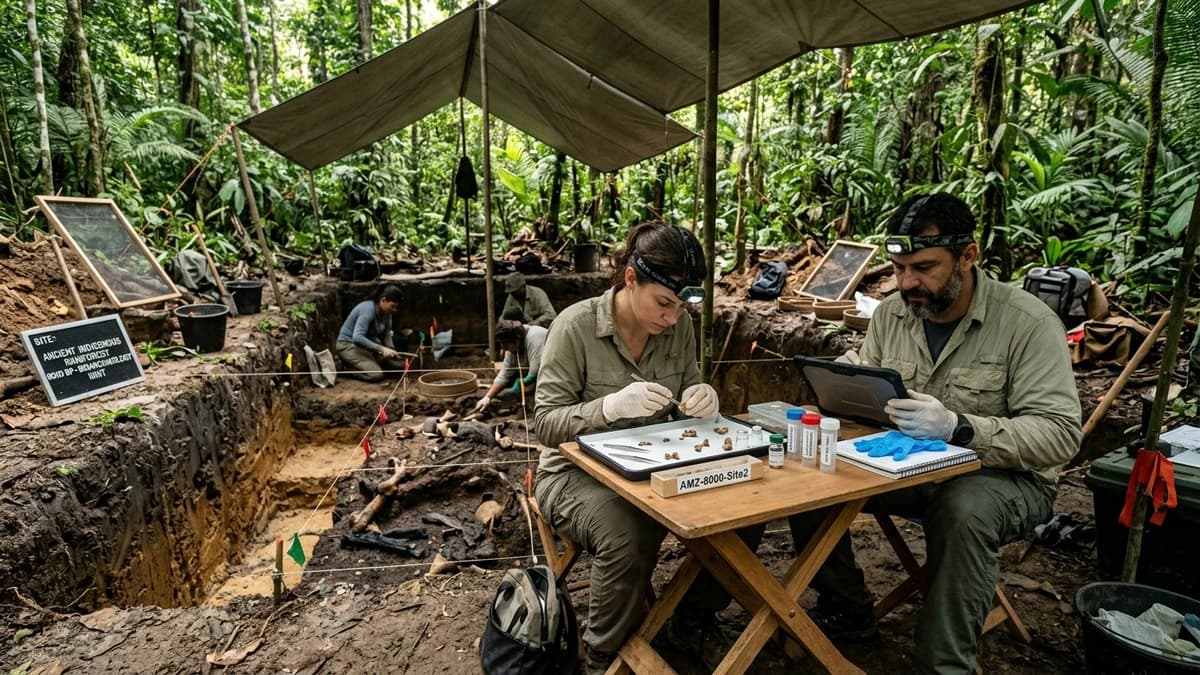
- Worker village excavated by Mark Lehner: bakeries, breweries, dormitories, a hospital, and even a cemetery. Bone analysis shows well-nourished workers
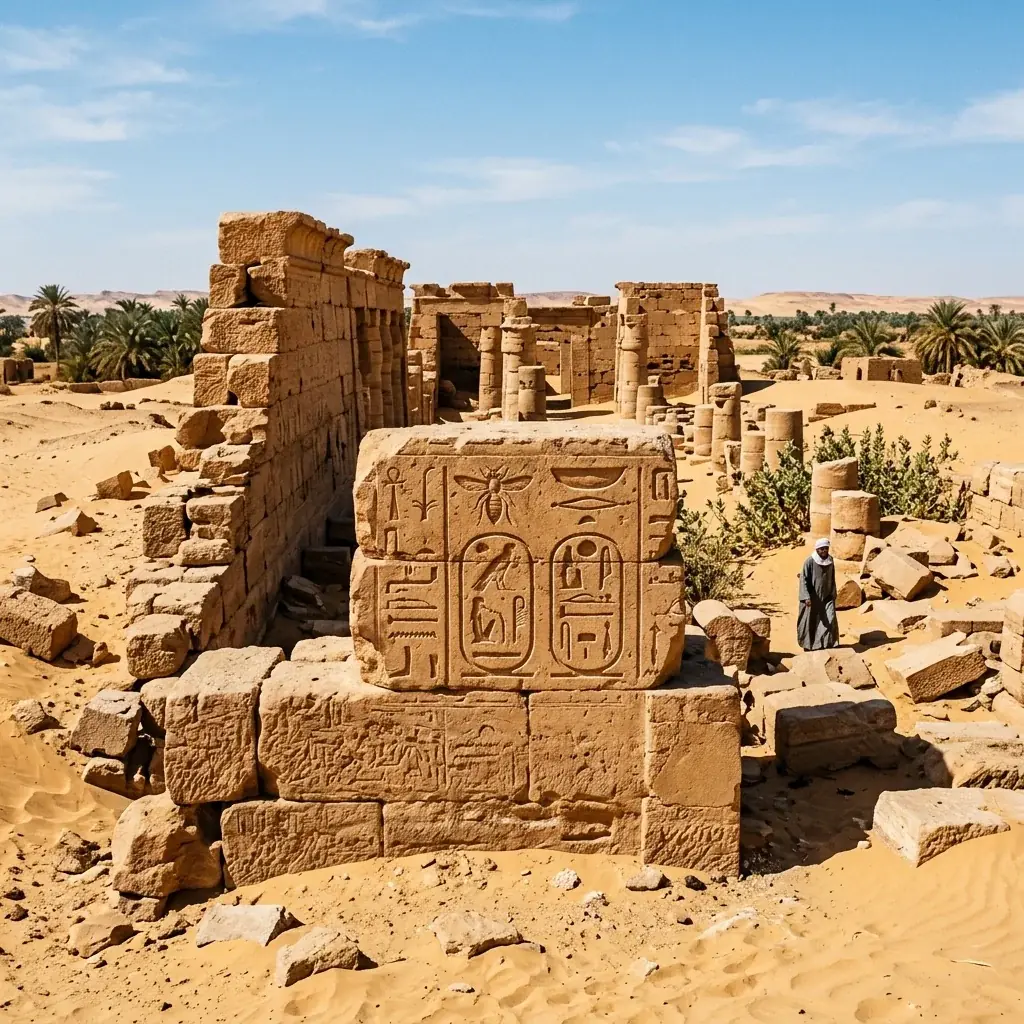
- Graffiti on the stones: Teams left their names written on blocks — "Friends of Khufu," "The Drunkards of Menkaure" (yes, really)
- Preserved tools: Copper chisels, dolerite hammers, saws, and ropes found on site
- Construction ramps found in unfinished pyramids (such as at Meidum and the pyramid of Sahure)
The Egyptians didn't need extraterrestrial technology. They had something better: brilliant engineering, military-grade organization, and abundant labor.
⛏️ Step 1: Block Extraction
Limestone (90% of blocks)
Most blocks came from quarries less than 1 km from the pyramid — a crucial detail that makes the logistics far more feasible than "transporting stones hundreds of km."
Extraction technique (experimentally proven):
- Marking: They drew the block outline on the bedrock using ropes and pigments
- Channels: They carved channels of ~10 cm around the block using copper chisels and dolerite hammers (stone harder than granite)
- Wooden wedges: They inserted dry wooden wedges into the channels
- Water: They repeatedly soaked the wedges
- Expansion: The wood gradually swelled, exerting colossal pressure — until the rock split perfectly along the desired line
Modern experiments: Denys Stocks' team (University of Manchester) replicated this technique and extracted 2.5-ton blocks in 2-3 days using only period-appropriate tools.
Granite (Internal Chambers)
The enormous granite blocks for the internal chambers (including the King's Chamber, with slabs up to 80 tons) came from Aswan — 800 km to the south. There weren't many blocks (~80), but each weighed dozens of tons.
Transport: Specially built barges navigated the Nile during the annual flood (June-September), when the river level rose up to 8 meters — transforming the desert into a network of navigable canals that reached much closer to the pyramids.
2024 Discovery: Researchers using satellite imagery identified an extinct branch of the Nile that passed much closer to the Giza pyramids than the current river — the "Khufu branch." This solves the mystery of how heavy blocks were brought to the construction site without crossing kilometers of desert.
🏗️ Step 2: Moving the Blocks
The 2014 Discovery: Sleds and Wet Sand
In 2014, physicists at the University of Amsterdam (Daniel Bonn and team) solved a centuries-old mystery — inspired by an Egyptian painting from 1880 BC showing workers pouring water in front of a sled carrying a statue.
What they discovered:
- Dry sand piles up in front of the sled, creating resistance
- With 4-5% moisture, the sand forms a rigid surface that reduces friction by half
- Result: a 2.5-ton block can be pulled by just 10-12 men on wet sand (vs 20-24 on dry sand)
The science: Water creates "capillary bridges" between sand grains, forming a semi-rigid surface. It's the same principle that makes wet beach sand firmer than dry sand.
Experimental Tests
Lehner's team built replicas of Egyptian sleds and tested:
- Dry sand: friction coefficient = 0.5
- Sand with 4-5% water: coefficient = 0.25 (half!)
- With wooden rollers: even more efficient on hard surfaces
🔺 Step 3: Elevation — How Did They Raise the Blocks?
This is the most debated question. How do you place a 2.5-ton block at 146 meters high?
Most Accepted Theory: Spiral Ramp (Jean-Pierre Houdin)
French architect Jean-Pierre Houdin proposed in 2007 a theory that gained enormous credibility:
First phase (lower 1/3): A straight external ramp with a 7-8° incline carried blocks up to ~40 meters. For the base, where blocks are larger and heavier, this straight ramp was efficient. After completion, it was dismantled and reabsorbed into the pyramid.
Second phase (upper 2/3): An internal spiral ramp — embedded within the structure itself, spiraling upward at ~7° incline. This ramp allowed blocks to be taken to the top without the need for a gigantic external ramp.
Evidence:
- Microgravimetry scans of Khufu's pyramid in 1986 detected a spiral of lower density inside the structure — exactly where the ramp would be
- Houdin's calculations show the internal ramp is structurally viable and explains the perfect geometric shape
- In unfinished pyramids (like Meidum), ramp remnants were actually found
For Giant Blocks (80 tons)
The King's Chamber granite blocks represent a special challenge. Weighing up to 80 tons, they couldn't simply be pulled up ramps. The likely solution:
- Counterweight system: Workers on descending ramps pulled downward using their own weight as a counterweight to raise the block via another path
- Hundreds of coordinated workers: Evidence suggests teams of 200-400 men working in synchronization
- Animal fat lubrication on contact surfaces
👷 The Workforce: They Were NOT Slaves
One of the greatest historical corrections of the 20th century was the discovery that the pyramids were not built by slaves. The idea of slavery came from Herodotus (who visited Egypt 2,000 years after construction and didn't speak Egyptian) and was perpetuated by Hollywood.
The Evidence
Worker village (excavated by Mark Lehner, 1988-present):
- Organized dormitories for thousands of people
- Industrial bakeries producing hundreds of loaves daily
- Breweries (beer was part of the salary)
- Hospital/infirmary with evidence of fracture treatment — healed bones indicate injured workers received medical care
- Cemetery with respectable tombs — slaves would not have received dignified burial
Bone analysis:
- Workers had a protein-rich diet (beef — 21 oxen/day, lamb, fish)
- They ate better than the average Egyptian population
- Evidence of treated and healed fractures — they received medical attention
- Arthritis and joint wear consistent with heavy labor, but no signs of abuse
Organization:
- Permanent team: ~4,000 specialized workers (masons, engineers, carpenters) who lived at Giza year-round
- Temporary workforce: 20,000-30,000 farmers during the Nile flood (3-4 months/year) — when they couldn't cultivate flooded fields. It was considered religious and patriotic service
- Team system: Divided into teams with competitive names. They competed to see who could move the most blocks per day — leaving rivalry graffiti on blocks that we still find today
🧭 Astronomical Precision: How Did They Achieve It?
Alignment with True North
Without a compass (invented ~2,000 years later), how did they align the pyramid with an error of only 0.05°?
Probable method (demonstrated by Dr. Kate Spence, Cambridge):
- On a starry night, they observed two circumpolar stars (Kochab and Mizar)
- When the two stars aligned vertically, a straight line between them and the observer pointed to exact true north
- They marked the direction on the ground using a plumb line
- They repeated on multiple nights to confirm
The method works: Spence's calculations show that the resulting error (~3 arcminutes) corresponds exactly to the error found in the pyramid.
Perfect Base Leveling
How did they level a 53,000 m² platform with a variation of only 2.1 cm?
Probable technique: water level. Channels carved around the perimeter were filled with water. The water surface creates a natural perfect level. They marked the water height on the channel walls and then leveled the rock to that mark.
❓ Mysteries That Still Persist
Despite all the progress, some enigmas remain:
Secret chambers: In 2017, the ScanPyramids project (using cosmic rays — muons) detected a large void approximately 30 meters long inside the Great Pyramid, above the Grand Gallery. It has never been accessed. What's inside is unknown.
The "air shafts": Two narrow shafts exit the King's Chamber pointing toward specific stars (Thuban and Al Nitak in Orion's Belt). Are they ventilation? Symbolic passages for the pharaoh's soul? One shaft was explored by robot in 2002 and found a "door" with copper handles — what lies behind remains a mystery.
The Sphinx: Geological studies suggest that the Sphinx's erosion may be caused by rainwater — which would date it to ~7,000-9,000 BC, millennia before the pyramids. The hypothesis is controversial but has not been refuted.
Diorite vases: Vases found at Saqqara made of diorite (stone harder than steel) with 1 mm thick walls and perfectly hollow interiors. With the available copper tools, how? The best hypothesis: copper drills with quartz sand as abrasive, spinning patiently for hundreds of hours.
Conclusion: Human Genius, Not Extraterrestrial
The pyramids were built by thousands of skilled, well-fed workers organized like a military operation — using simple copper and stone tools, ingenious friction-reduction techniques, the Nile as a natural highway, and mathematical and astronomical precision that still impresses modern engineers.
They didn't need supernatural help. They needed something more impressive: human intelligence applied with patience, organization, and monumental scale.
The next time someone says "it must have been aliens," remember: the Egyptians competed between teams to see who moved the most stones, wrote rivalry graffiti on blocks, drank beer as part of their salary, and left detailed administrative records on papyrus. That's not alien work — it's human work at its most extraordinary.
Frequently Asked Questions
How were the pyramids actually built?
The most accepted theory involves a combination of ramps, sledges, and organized labor. Workers quarried limestone blocks (averaging 2.5 tons) and transported them on wooden sledges, wetting the sand to reduce friction by 50%. Internal and external ramps were used to raise blocks to higher levels. The Great Pyramid required about 2.3 million blocks over approximately 20 years. Recent discoveries of a ramp system at Hatnub quarry (2018) provided direct evidence of how heavy stones were moved uphill.
Were the pyramids built by slaves?
No. Archaeological evidence strongly suggests the pyramids were built by paid skilled laborers and seasonal workers, not slaves. Excavations near the pyramids revealed workers' villages with bakeries, breweries, and medical facilities. Workers received good nutrition (beef, bread, beer) and medical care. Graffiti found inside the pyramids shows team names and pride in their work. The slave narrative was popularized by Herodotus (who visited 2,000 years after construction) and Hollywood films.
What was inside the pyramids?
The Great Pyramid contains three known chambers: the King's Chamber (with an empty granite sarcophagus), the Queen's Chamber, and an unfinished subterranean chamber. Narrow shafts extend from the chambers, possibly for ventilation or astronomical alignment. In 2017, muon scanning revealed a previously unknown large void above the Grand Gallery. Most pyramids were looted in antiquity, so their original contents (treasures, mummies, offerings) are largely unknown. Only a few intact burial chambers have been found in lesser pyramids.
Could we build a pyramid today?
Yes, but it would be extremely expensive. Engineers estimate the Great Pyramid would cost $5-10 billion to replicate with modern technology. With cranes, trucks, and modern materials, construction could be completed in 3-5 years instead of 20. However, replicating the precision of the original (base is level to within 2.1 cm across 230 meters) would still be challenging. The real question isn't whether we could build one, but why we would — the pyramids served a specific cultural and religious purpose that doesn't exist today.
Sources: Lehner, M. "The Complete Pyramids" | Tallet, P. "Les Papyrus de la Mer Rouge" (2017) | Houdin, J.P. "Khufu: The Secrets Behind the Building of the Great Pyramid" | Bonn, D. et al. "Sliding Friction on Wet and Dry Sand" (Physical Review Letters, 2014). Updated February 2026.
Read also: