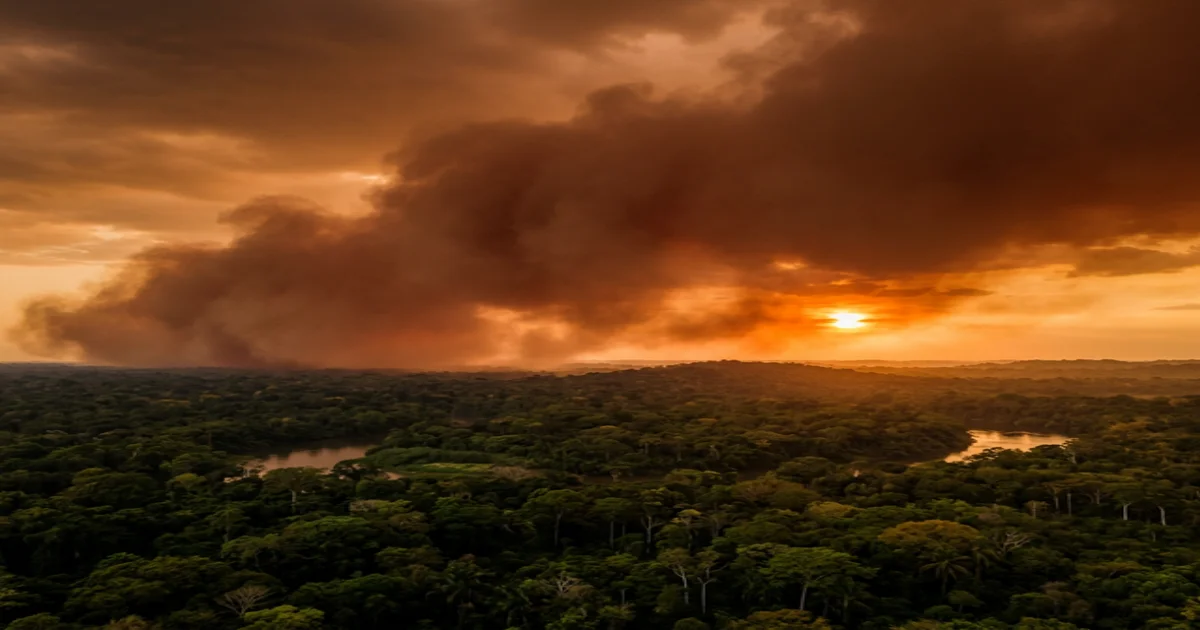
A massive dust plume from the Sahara Desert — the world's largest and hottest desert — is crossing the Atlantic Ocean and striking Northern and Northeastern Brazil in late February 2026. The microscopic particles, carried over 5,000 kilometers by trade winds, are raising concentrations of fine particulate matter (PM2.5 and PM10) in Brazilian air, altering the visual appearance of the sky, and posing real health risks to millions of people. This is not an isolated event: the "atmospheric bridge" between the Sahara and the Amazon is one of the most impressive natural phenomena on the planet — but climate change is dramatically altering this balance, with consequences that may intensify in the coming years.
What Is Happening Right Now: The Dust Plume in Numbers
Since Monday, February 23, 2026, atmospheric forecast maps have recorded a significant increase in particulate matter concentrations over northern South America. Peak concentrations occurred between Tuesday (24th) and Wednesday (25th), but effects are expected to persist until at least Friday (27th).
Current event data
| Metric | Value | Context |
|---|---|---|
| Dust origin | Bodélé Depression, Chad, Africa | Ancient lake bed, rich in fossils |
| Distance traveled | +5,000 km | From Africa to Northern Brazil |
| Particle type | PM10 and PM2.5 | PM2.5 is the most concerning |
| Regions affected | Northern and Northeastern Brazil | Amazonas, Pará, Maranhão, Ceará |
| Peak concentration | February 24-25 | Effects until 02/27 or longer |
| Other countries affected | Suriname, Guyana, Venezuela, Colombia | Also Ecuador, Peru and Bolivia |
What is PM2.5 and why is it so dangerous?
PM2.5 consists of particles with a diameter equal to or less than 2.5 micrometers — about 30 times smaller than a human hair. Because they are extremely small, these particles can:
- Penetrate deep into the lungs, reaching the pulmonary alveoli
- Enter the bloodstream, being distributed throughout the body
- Cause systemic inflammation, affecting the heart, brain, and other organs
- Remain suspended longer, traveling thousands of kilometers
While larger particles (PM10) tend to deposit in the upper airways and are partially filtered by the nose, PM2.5 bypasses all of the body's natural defense barriers. The World Health Organization (WHO) considers that there is no safe concentration of PM2.5 — any exposure already increases health risks.
Brazilian Regions on Alert: The Exposure Map
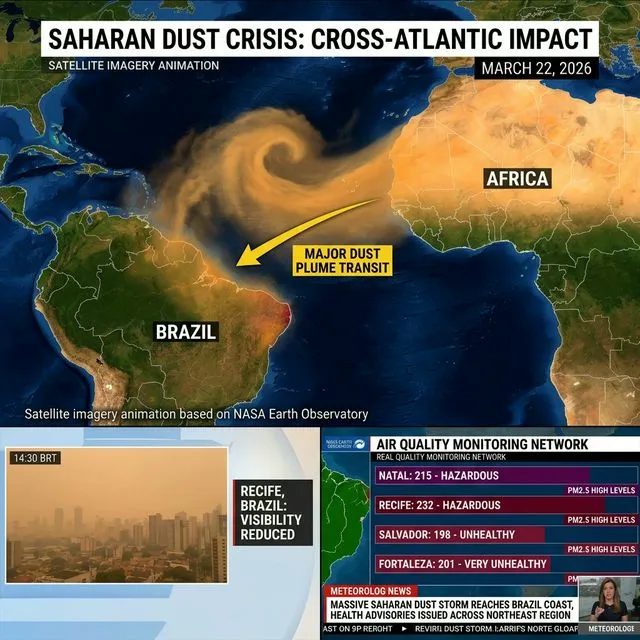
The Northern and Northeastern regions are most exposed to the Saharan dust plume due to their geographic proximity to the African coast and the direction of the northeast trade winds, which function as an "atmospheric conveyor belt" carrying particles directly to the South American continent.
States on direct alert
| State | Region | Exposure level | Observation |
|---|---|---|---|
| Amazonas | North | High | Capital Manaus may record drops in air quality |
| Pará | North | High | Belém and interior near the Amazon estuary |
| Amapá | North | High | First to receive the plume from the Atlantic |
| Roraima | North | Moderate to High | Boa Vista may experience hazy skies |
| Maranhão | Northeast | High | São Luís and western coast highly exposed |
| Piauí | Northeast | Moderate | Interior may record changes |
| Ceará | Northeast | Moderate | Fortaleza and coastal strip |
| Rio Grande do Norte | Northeast | Moderate | Natal with possible visual effects |
| Tocantins | North | Moderate | Indirect influence through regional dispersion |
Observable visual effects
The arrival of Saharan dust in Brazil involves particles so fine that they often cannot be seen with the naked eye in the Amazon, being detected only by specialized sensors and satellite images. However, during more intense events, effects become noticeable:
- Whitish or orange-tinted sky, especially on the horizon
- Reduced visibility on clear days
- More vibrant, reddish sunsets due to light scattering by suspended particles
- "Dusty" appearance of the air even without local dust activity
Health Risks: Who Is Most Vulnerable
Elevated PM2.5 presence in the atmosphere can cause a range of health problems, varying from mild discomfort to severe crises in vulnerable populations.
Most common symptoms during exposure
- Burning eyes and tearing
- Nose and throat irritation — burning sensation
- Persistent dry cough
- Headache
- Shortness of breath during physical activities
- Skin itching in sensitive individuals
Highest risk groups
| Group | Why? | Recommendation |
|---|---|---|
| Children (0-12 years) | Developing immune system, smaller airways | Avoid outdoor play during peak days |
| Elderly (65+) | Reduced lung capacity, higher chance of chronic diseases | Stay indoors with filtered ventilation |
| Asthmatics | Particles can trigger severe attacks | Keep rescue medication always accessible |
| COPD patients | Worsening of existing respiratory function | Avoid any outdoor physical exertion |
| Heart disease patients | PM2.5 in the bloodstream can cause arrhythmias | Monitor signs of chest discomfort |
| Pregnant women | Exposure associated with low birth weight | Limit outdoor time, wear mask if necessary |
| Outdoor workers | Prolonged exposure and greater inhalation | Use appropriate respiratory protection (N95 or equivalent) |
Health authority recommendations
- Reduce outdoor activities, especially intense physical exercise
- Keep windows and doors closed during peak concentration hours
- Use air humidifiers in indoor environments
- Drink plenty of water to keep airways hydrated
- Wear N95 or PFF2 masks if going outside during concentration peaks
- Rinse nostrils with saline solution upon returning home
- Seek medical attention if experiencing persistent breathing difficulty
The Sahara-Amazon Bridge: The Natural Fertilizer That Crosses the Atlantic
Despite the immediate health risks, Saharan dust plays an essential ecological role for the survival of the Amazon Rainforest. This is perhaps the most fascinating — and paradoxical — part of the entire phenomenon.
Where does the dust come from?
The main source of the dust that reaches Brazil is the Bodélé Depression, a plain in Chad, in central Africa. This location is the dry bed of an ancient giant lake — Mega-Chad — that dried up thousands of years ago. The fossilized sediment of microscopic organisms (diatoms) that lived in this lake became a deposit extremely rich in minerals, especially phosphorus and iron.
When strong winds sweep this plain, the material is lifted to altitudes of 3 to 6 kilometers and launched over the Atlantic Ocean. The journey to Brazil takes between 5 and 7 days.
The Amazon needs the Sahara to survive
The soils of the Amazon Rainforest are geologically ancient and extremely nutrient-poor. Approximately 75% of Amazonian soils are acidic, infertile, and phosphorus-deficient — the most critical nutrient for plant growth, DNA synthesis, and cellular energy production.
The region's torrential rains continuously wash this phosphorus from the soil and carry it into rivers. Without replenishment, the forest would gradually lose its capacity to sustain itself. This is where the Sahara enters as an unlikely ally.
The numbers of transatlantic fertilization
| Data | Value | Context |
|---|---|---|
| Total dust transported/year | ~182 million tons | From the Sahara to the Atlantic |
| Dust reaching the Amazon | ~27 million tons | 15% of total |
| Phosphorus deposited/year | ~22,000 tons | In the Amazon basin |
| Equivalence | ≈ phosphorus lost by rain | Replaces exactly what rain removes |
| Other minerals | Iron, potassium, calcium | Contribute to natural fertilization |
This amount of phosphorus — 22,000 tons per year — is almost exactly equal to the amount the forest loses through rainfall and river erosion. It is as if the planet had created an automatic compensation system between two apparently disconnected ecosystems, separated by an entire ocean.
Beyond fertilization: cloud nucleation
Saharan dust particles also act as cloud condensation nuclei (CCN). By carrying minerals into the atmosphere over the Amazon, the dust directly influences cloud formation and precipitation patterns in the region. Under certain conditions, however, this effect can reverse: an excessive concentration of particles can suppress the formation of deep clouds, inhibiting local rainfall — a paradoxical effect that climatologists monitor closely.
What Could Get Worse: Risk Scenarios for Brazil
If Saharan dust is a natural and annual phenomenon, why is there such an urgent alert? The answer lies in climate change, which is altering three critical variables of this system:
1. Changes in the Volume of Transported Dust
Research from Climate Central and NASA indicates that the volume of dust leaving the Sahara depends directly on rainfall in the Sahel — the semi-arid strip south of the desert. With global warming, climate models project increased rainfall in the Sahel. This means:
- More vegetation in the Sahel → Less exposed soil → Less dust generated
- Less phosphorus reaching the Amazon → Gradual soil nutrient depletion
- Possible decline in forest biomass over decades or centuries
This scenario is especially worrying because the Amazon already faces simultaneous pressures from deforestation, wildfires, and extreme droughts. Reducing mineral input from the Sahara would add another layer of stress to an already fragile ecosystem.
2. Intensification of Extreme Dust Events
Conversely, when dust events do occur, they tend to be more intense and concentrated. Changes in atmospheric circulation patterns can generate episodes of massive transport in which dangerous concentrations of PM2.5 reach Brazil in acute peaks, representing greater health risks than the historical average.
3. The Ticking Time Bomb of Desertification in the Northeast
Brazil's Semiarid region — spanning much of the Northeast and parts of Minas Gerais — already faces a desertification crisis affecting more than 27% of national territory since 1990. The affected areas already equal the size of England.
| Indicator | Current situation |
|---|---|
| Area under desertification | ~1,340,000 km² (estimate) |
| Municipalities with arid climate | Northern Bahia and southern Pernambuco |
| Average temperature | Rising, accelerating evaporation |
| Precipitation | Declining in several sub-regions |
| Productive soil lost | Increasing annually |
| Affected population | Tens of millions of Brazilians |
The combination of Saharan dust (which can inhibit local rainfall in certain scenarios) with global warming and local deforestation creates a spiral of degradation that can transform previously semi-arid areas into effectively arid areas — with devastating consequences for food production, water supply, and forced migration.
4. The Vicious Cycle: Less Forest = Less Rain = More Desertification
Tropical forests serve as decisive factors in regulating Brazil's rainfall systems. The Amazon, in particular, generates part of its own precipitation through evapotranspiration — the so-called "flying rivers" that transport moisture to the Central-West, Southeast, and South of the country.
If the Amazon loses biomass (whether through deforestation or through reduced Saharan fertilization), it produces less water vapor, generating less downwind rainfall. This dries out the Cerrado and the Semiarid, which in turn degrade further, further reducing regional moisture. It is a feedback cycle that, once accelerated, can be extremely difficult to reverse.
The Phenomenon in Global Perspective: Intercontinental Connections
Saharan dust transport is not just a Brazil-Africa phenomenon. It is a fundamental piece of the global climate system, connecting continents in ways we are only beginning to understand.
The Sahara feeds the Caribbean, the USA, and even Europe
The same dust plume that reaches Brazil also reaches the Caribbean, where it is known as the "Saharan Air Layer" (SAL). In the United States, Saharan dust is routinely detected in Florida and Texas, where it contributes to spectacular sunsets but also to air quality alert spikes.
In Europe, Saharan dust events transform the skies of Spain, Portugal, France, and Italy into orange tones, cover cars with a fine layer of sand, and trigger public health alerts.
The Atlantic connection with hurricanes
Ironically, Saharan dust has a suppressive effect on hurricane formation in the tropical Atlantic. Dust particles absorb solar radiation and heat the middle atmospheric layer, creating a temperature inversion that stabilizes the air and prevents the vertical development necessary for tropical cyclones. In years of intense dust activity, the hurricane season tends to be weaker — and vice versa.
With climate change potentially reducing dust volume in the long term, some scientists warn this could contribute to more active and devastating hurricane seasons in the coming decades.
The "lung" that depends on "dust"
The Sahara-Amazon relationship is perhaps the most elegant example of planetary ecological interdependence: the world's largest desert fertilizes the world's largest tropical forest, which in turn produces oxygen and regulates the climate for the entire planet. When one link in this chain breaks, the consequences cascade through the entire Earth system.
Historical Context: Previous Events and Trends
The arrival of Saharan dust in Brazil is not new. The phenomenon occurs every year, with greater intensity between December and April, when trade winds are stronger and the Intertropical Convergence Zone (ITCZ) shifts southward.
Notable recent events
| Year | Event | Impact |
|---|---|---|
| 2020 | Massive "Godzilla" plume | The largest in 50 years, struck the US and Caribbean with unprecedented force |
| 2021 | Recurrent July events | Orange sky in São Luís and Belém |
| 2022 | Intense March plume | Air quality drop in western Amazon |
| 2023 | Multiple February events | Detected by GOES and MODIS satellites |
| 2024 | Extended January-March plume | Contributed to drought period in the Amazon |
| 2026 | Current event | Feb 23-27, elevated concentrations over North and Northeast |
Long-term trend
Studies based on satellite data from NASA and Europe's Copernicus system indicate that:
- The total amount of transported dust from the Sahara varies significantly year to year
- There is an inverse correlation with Sahel rainfall: drier years in the Sahel = more dust
- Transport to the tropical Atlantic remains active but may decrease throughout the 21st century
- The intensity of individual peaks may increase even with decreasing averages
Monitoring: How to Track in Real Time
For those who want to follow the dust plume's evolution in real time, several tools are available:
Monitoring platforms
| Platform | What it shows | Access |
|---|---|---|
| CAMS (Copernicus) | Global aerosol forecast | atmosphere.copernicus.eu |
| NASA FIRMS | Satellite images of the plume | firms.modaps.eosdis.nasa.gov |
| INPE | National atmospheric monitoring | inpe.br |
| Windy.com | Real-time PM2.5 layer | windy.com ("Aerosol" layer) |
| IQAir | Air quality index by city | iqair.com |
| CPTEC/INPE | Weather forecast for Brazil | cptec.inpe.br |
Air Quality Index (AQI)
| Classification | PM2.5 (µg/m³) | Meaning |
|---|---|---|
| 🟢 Good | 0-12 | No risks |
| 🟡 Moderate | 12.1-35.4 | Sensitive individuals may feel effects |
| 🟠 Unhealthy for sensitive | 35.5-55.4 | At-risk groups should protect themselves |
| 🔴 Unhealthy | 55.5-150.4 | Everyone should reduce outdoor activities |
| 🟣 Very Unhealthy | 150.5-250.4 | Public health alert |
| 🟤 Hazardous | >250.5 | Health emergency |
Protection Guide: What to Do During the Plume Passage
For the general population
- Monitor air quality using apps like IQAir or AirVisual
- Avoid outdoor exercise during peak days (February 24-27)
- Keep windows closed during peak concentration periods
- Use air conditioning in recirculation mode (do not draw in external air)
- Wash clothes exposed on clotheslines during the period
For at-risk groups
- Asthmatics: keep inhalers always accessible and use preventively as directed
- Elderly: avoid going out in early morning hours when thermal inversions concentrate pollutants
- Parents: do not take small children to outdoor activities on peak days
- Pregnant women: consult obstetricians about additional protective measures
For outdoor workers
- Farmers, construction workers, delivery drivers: wear PFF2/N95 masks
- Enhanced hydration: drink at least 3 liters of water per day
- Breaks in enclosed environments: every 2 hours of exposure
The Science Behind It: Understanding the Trade Winds
Trade winds are persistent atmospheric currents that blow from east to west in tropical latitudes, between approximately 30°N and 30°S. They are responsible for transporting Saharan dust across the Atlantic.
How transport works
- Generation: Strong winds in the Sahara lift particles from dry soil to altitudes of 3-6 km
- Elevation: Solar heating creates updrafts that keep dust suspended in the Saharan Air Layer (SAL), between 1,500 and 5,500 meters altitude
- Transport: Trade winds carry the plume westward, over the tropical Atlantic
- Arrival: After 5-7 days, the finest particles reach northern South America
- Deposition: Part of the particles deposits on Amazonian soils and rivers; part remains suspended and gradually dissipates
The Saharan Air Layer (SAL) functions as an "atmospheric highway" dedicated to dust transport. It is hot and dry, contrasting with the humid tropical air below — this difference in temperature and humidity is what keeps the plume cohesive over thousands of kilometers.
Conclusion: An Alert That Goes Beyond Dust
The arrival of Saharan dust in Brazil in February 2026 is more than a curious meteorological phenomenon — it is a visceral reminder of how the planet's climate systems are interconnected. The same dust that fertilizes the Amazon can harm the health of millions. The same climate change that may reduce the flow of phosphorus to the forest may intensify the desertification of the Northeast.
The scenarios for worsening are real:
- Long-term reduction of Amazon fertilization due to Sahel rainfall changes
- Intensification of particulate matter peaks, with more acute health risks
- Acceleration of desertification in the Brazilian Semiarid
- Weakening of the "flying rivers" that irrigate Central-Southern Brazil
- Possible increase in Atlantic hurricane activity
For Brazil, the message is clear: invest in atmospheric monitoring, strengthen air quality alert systems, expand public health infrastructure in the most exposed regions, and above all, fight deforestation and climate change that threaten to break an ecological balance built over millennia.
The Sahara Desert is sending a message. The question is whether Brazil will listen — before the dust settles for good.
Useful emergency numbers for respiratory emergencies:
- 🚑 SAMU (Emergency Medical Service): 192
- 🛡️ Civil Defense: 199
- 🚒 Fire Department: 193
Frequently Asked Questions
Is Saharan dust visible to the naked eye in Brazil?
In most cases, no. The particles are so fine that the dust is detected only by specialized sensors and satellite images. During more intense events, however, you may notice a more whitish sky, orange tones on the horizon, and more vibrant sunsets. A "dry haze" sensation in the air can be an indicator of Saharan dust presence.
Is Saharan dust good or bad for the Amazon?
Both. The dust carries phosphorus and iron essential for the forest — without it, Amazonian soils would lose critical nutrients over time. However, at elevated concentrations, the same dust worsens air quality and can suppress local rainfall. It is a delicate balance that climate change threatens to destabilize.
Which Brazilian cities are most affected by Saharan dust?
The capitals of the North and Northeast are most exposed: Belém (PA), Manaus (AM), São Luís (MA), Macapá (AP), Boa Vista (RR), and Fortaleza (CE). Cities in the interior Amazon may also be affected, although effects are generally more subtle.
Could this phenomenon worsen in the coming years?
Yes. Climate change can alter both the quantity and intensity of dust events. Long-term, the reduction in phosphorus flow to the Amazon could compromise the forest's health. Short-term, individual events may become more intense, with greater public health risks. The advance of desertification in Brazil's Northeast is another growing concern.
Can Saharan dust reach Southeastern or Southern Brazil?
It is very rare. Trade winds direct the plume predominantly toward the North and Northeast. In exceptionally intense events, traces of dust can be detected at high altitudes over the Central-West, but at concentrations so low they do not affect ground-level air quality.
Sources: Diário do Comércio, Tempo.com, MetSul Meteorologia, g1 Globo, NASA CALIPSO, Climate Central, Copernicus/CAMS, INPE, Xataka, Portal Amazônia, ClickPetróleo e Gás, Correio do Povo, NIH (National Institutes of Health), InfoAmazônia, FAPESP. Data updated through February 26, 2026.