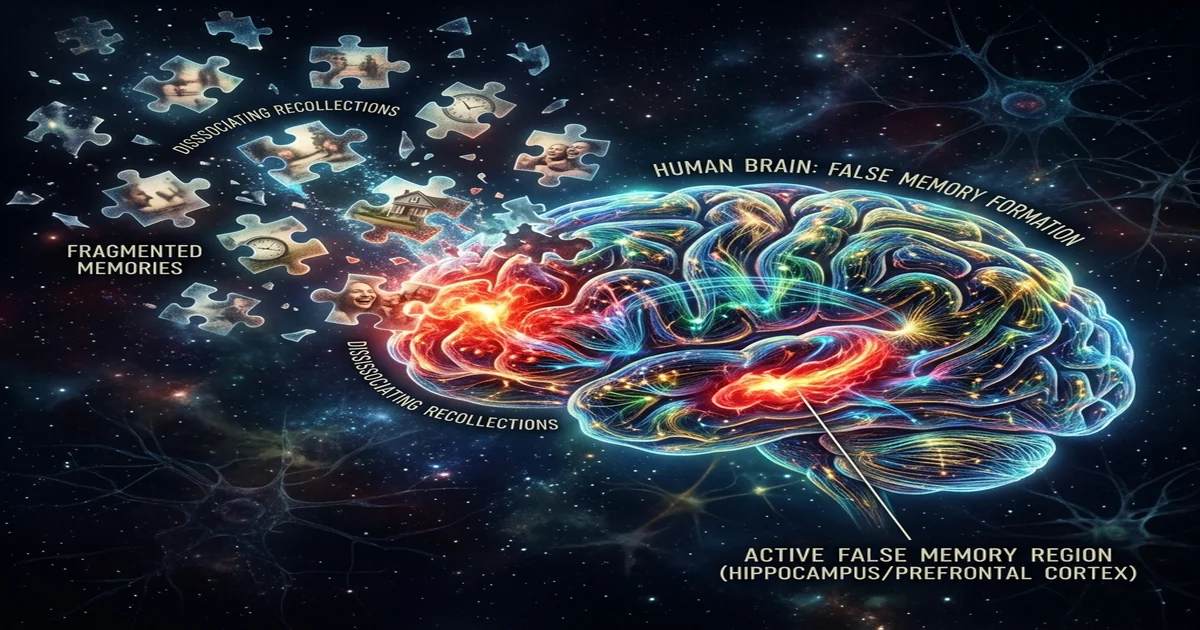
But it was from the 1990s onward that the revolution truly took hold, driven by two fronts: Elizabeth Loftus's experiments on false memories and the discovery of memory reconsolidation by Karim Nader.
Elizabeth Loftus, professor at the University of California, Irvine, is arguably the most important researcher in the history of human memory studies — and certainly the most controversial. Her experiments, conducted over more than four decades, demonstrated unequivocally that memories can be created from scratch.
In the most famous experiment, known as "Lost in the Mall," Loftus and her team presented young adults with four narratives of childhood events — three true (provided by family members) and one completely fabricated: that they had gotten lost in a shopping mall as children. After several interview sessions, 25% of participants not only believed the false event had occurred but developed rich and detailed memories about it, including descriptions of the person who "found" them, the emotions they felt, and visual details of the environment.
Subsequent studies went even further. Researchers managed to implant memories of:
- Being attacked by an animal
- Nearly drowning and being rescued by a lifeguard
- Witnessing a demonic possession
- Committing a crime during adolescence
In each case, a significant proportion of participants developed vivid and emotionally charged memories of events that never happened.
In 2000, neuroscientist Karim Nader, then at New York University, published a study that shook the foundations of memory neuroscience. Working with rats, Nader demonstrated that when a consolidated memory is recalled, it becomes temporarily unstable — returning to a malleable state similar to when it was first formed.
This process, called reconsolidation, means that every time you remember something, the memory needs to be "re-saved" by the brain. And in this re-saving process, it can be altered. New information, present-moment emotions, suggestions from other people — all of this can be incorporated into the memory without your awareness.
The implication is profound: the more you remember something, the more opportunities exist for the memory to be distorted. Your most cherished memories — those you revisit constantly — may paradoxically be the least faithful to reality.
If you are interested in how the brain processes information during sleep, check out our article on how sleep works and its 5 stages.
The fallibility of memory is not merely an academic curiosity. It has devastating consequences in areas that directly affect the lives of millions.
The most dramatic case is the criminal justice system. Eyewitness testimony is historically the most persuasive form of evidence in courts — and also one of the most flawed.
| Aspect |
Common Perception |
Scientific Reality |
Consequence |
| Witness confidence |
Confident witness = accurate witness |
Confidence and accuracy have no significant correlation |
Jurors trust confident witnesses, even when wrong |
| Event memory |
Recorded like a video at the time |
Reconstructed with each recollection, vulnerable to distortion |
Details change over time without the witness noticing |
| Suspect identification |
Reliable and objective process |
Highly suggestible by police procedures |
Mistaken identifications are the leading cause of wrongful convictions |
| Stress during event |
Improves memory because it is striking |
Impairs encoding of peripheral details |
Victims of violent crimes often remember fewer details |
| Elapsed time |
Memory remains stable |
Progressive deterioration with increasing distortions |
Testimony months after the event is significantly less reliable |
According to the Innocence Project, erroneous eyewitness testimony was the contributing factor in more than 69% of convictions overturned by DNA evidence. These are hundreds of people who spent years — in some cases, decades — in prison for crimes they did not commit, convicted by the flawed memory of a witness who genuinely believed what they were saying.
The case of Ronald Cotton is emblematic. In 1984, Jennifer Thompson was the victim of rape and identified Cotton as her attacker with absolute certainty. Cotton was sentenced to life in prison. Eleven years later, DNA tests proved he was innocent. Thompson was devastated — she truly believed Cotton was the perpetrator. Her memory had been contaminated by the police identification process, and every time she revisited the recollection, Cotton's face became more firmly consolidated as that of the attacker.
The question extends beyond the courtroom. Our identity — who we believe ourselves to be — is built upon the narrative we construct from our past experiences. If those experiences are imperfect reconstructions, what does that say about who we are?
Philosopher John Locke argued in the seventeenth century that personal identity is fundamentally based on the continuity of memory. You are the same person you were ten years ago because you remember being that person. But if your memories from ten years ago have been progressively altered with each recollection, the person you "remember" having been may never have existed in exactly that form.
Research from 2026 shows this phenomenon is particularly pronounced in emotionally charged memories — precisely those we most use to define who we are. Traumas, achievements, turning points: these are the memories we revisit most and, therefore, the most vulnerable to distortion.
To better understand the brain mechanisms behind this phenomenon, we recommend our article on how human memory works.
Memory reconsolidation also has profound implications for psychotherapy. On one hand, it represents an opportunity: if traumatic memories can be altered during reconsolidation, perhaps it is possible to "rewrite" traumas, reducing their emotional impact. Therapies based on this principle, such as memory reconsolidation therapy and updated EMDR (Eye Movement Desensitization and Reprocessing) protocols, are being developed and tested in 2026 with promising results for post-traumatic stress disorder (PTSD).
On the other hand, the same malleability that allows "healing" traumatic memories can also create problems. In the 1980s and 1990s, the so-called "recovered memory wars" devastated entire families when therapists, using suggestible techniques such as hypnosis and guided imagery, led patients to "recover" memories of childhood abuse that had never occurred. Parents were accused, families were destroyed, and lives were ruined — all based on memories that were, in fact, implanted during the therapeutic process.
Donna Bridge, neuroscientist at Northwestern University and one of the authors of the 2026 longitudinal study, explained in an interview with Nature: "What our data show unequivocally is that memory is not a storage system — it is a reconstruction system. Every act of remembering is an act of creation. This does not mean all memories are false, but it means no memory is a perfect copy of the original event."
Karim Nader, the discoverer of reconsolidation, added in a commentary published in Science: "When I published my results in 2000, many colleagues resisted the idea. Twenty-six years later, reconsolidation is one of the most replicated phenomena in neuroscience. The question is no longer whether memories change — it is how much and how often."
Elizabeth Loftus, now 82 years old and still active in research, was more direct in a statement to The Guardian: "People want to believe their memories are like photographs. But they are more like impressionist paintings — they capture the essence, but the details are filled in by imagination, expectation, and suggestion."
Not all researchers agree with the extent of the conclusions. Daniel Schacter, professor of psychology at Harvard and author of The Seven Sins of Memory, argues that while distortions are real and documented, "human memory is remarkably functional for most everyday purposes. It evolved not to be a perfect recorder, but to help us navigate the present and plan for the future — and at that, it is extraordinarily efficient."
The technological advances of 2026 are opening new frontiers in memory research:
High-resolution neuroimaging: New fMRI protocols allow observation of specific circuit activation during memory formation and reconsolidation, offering an unprecedented map of how the brain "edits" memories in real time.
Optogenetics in animal models: MIT researchers have already managed, in mice, to activate and deactivate specific memories using light — demonstrating that it is possible to directly manipulate engrams (the physical traces of memories in the brain). In 2026, these experiments are being refined to understand how true and false memories differ at the cellular level.
Artificial intelligence and pattern analysis: Machine learning algorithms are being trained to identify brain activation patterns that distinguish genuine memories from fabricated ones — a technology that, if perfected, could revolutionize the judicial system.
Several countries are revising their procedures in light of memory research findings:
- United States: The National Research Council recommended reforms in police identification procedures, including double-blind lineups and explicit instructions that the suspect may not be present
- United Kingdom: Courts began requiring that jurors be instructed about the limitations of human memory before evaluating eyewitness testimony
- Brazil: The National Council of Justice published guidelines in 2025 on the admissibility of eyewitness testimony, recommending special caution when testimony is the sole evidence
Understanding reconsolidation is generating new therapies for conditions such as PTSD, phobias, and anxiety disorders. In 2026, clinical trials are testing:
- Propranolol + reconsolidation: Administration of propranolol (a beta-blocker) during reconsolidation of traumatic memories to reduce their emotional charge
- Psychedelic-assisted reconsolidation therapy: Controlled use of MDMA and psilocybin to facilitate reconsolidation of traumatic memories in a therapeutic context
- Real-time neurofeedback: Training patients to modulate their own brain activity during reconsolidation
The science of 2026 confronts us with a truth most of us would prefer not to face: our memories are not faithful records of the past — they are creative reconstructions that change every time we access them. This does not mean all your memories are false. It means none of them are perfectly true.
This discovery need not be paralyzing. It can be liberating. If our memories are malleable, then we are not trapped in fixed narratives about who we are or what happened to us. The same plasticity that distorts our recollections also allows us to reinterpret them, give them new meaning, and, in therapeutic contexts, even heal them.
What neuroscience asks of us is not that we distrust everything we remember, but that we maintain a healthy dose of epistemic humility. That we recognize our version of events is exactly that — a version. And that other people, with their own imperfect reconstructions, may have versions equally valid and equally imperfect.
Because in the end, perhaps the most important question is not "did this really happen that way?" — but rather "what story am I telling myself, and is it serving me well?"
- Nader, K., Schafe, G. E., & Le Doux, J. E. (2000). "Fear memories require protein synthesis in the amygdala for reconsolidation after retrieval." — Nature
- Loftus, E. F. (2005). "Planting misinformation in the human mind." — Learning & Memory
- Innocence Project — Eyewitness Misidentification
- Bridge, D. J., & Paller, K. A. (2012). "Neural Correlates of Reactivation and Retrieval-Induced Distortion." — Journal of Neuroscience
- Shaw, J. (2016). The Memory Illusion: Remembering, Forgetting, and the Science of False Memory. — Random House
- Nature Neuroscience — Memory Reconsolidation Research (2026)