
On March 7, 2026, the largest coronal mass ejection of the current solar cycle struck Mars with unprecedented violence. The X9.2-class solar storm caused critical failures in at least three orbital probes, forced the Perseverance rover into safe mode, and generated auroras never before observed in Mars' thin atmosphere. The event — recorded in real time by NASA's MAVEN probe — raises urgent questions about the viability of human colonization of Mars and the risks that cosmic radiation poses for future crewed missions.
In this article, we'll detail exactly what happened, explain the science behind solar storms, analyze why Mars is so vulnerable, and discuss what this means for the ambitious plans of SpaceX, NASA, and space agencies worldwide.
What Are Solar Storms and How They Work
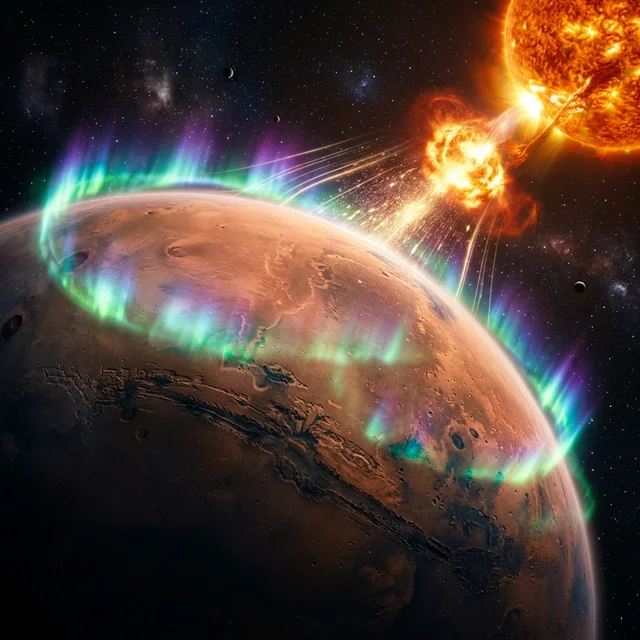
The Sun isn't a tranquil sphere of hot gas — it's a chaotic thermonuclear reactor with intense magnetic activity. Periodically, magnetic field lines on the solar surface violently reconnect, releasing colossal amounts of energy in events called solar flares. When these eruptions are accompanied by the expulsion of billions of tons of magnetized plasma, we get a coronal mass ejection (CME).
Solar Flare Classification
Solar flares are classified on a logarithmic scale, similar to the Richter scale for earthquakes:
| Class | Intensity | Frequency | Effects on Earth |
|---|---|---|---|
| A | Minimal | Constant | None perceptible |
| B | Weak | Frequent | Minimal |
| C | Moderate | Common | Possible radio interference |
| M | Strong | Occasional | Radio blackouts, auroras |
| X | Extreme | Rare | Geomagnetic storms, satellite damage |
| X9+ | Exceptional | Very rare | Widespread damage to space electronics |
The March 7 eruption was classified as X9.2 — the most powerful since the X9.3 of September 2017. But this time, the primary target wasn't our planet — it was Mars.
The Impact on Mars: Mission Chaos
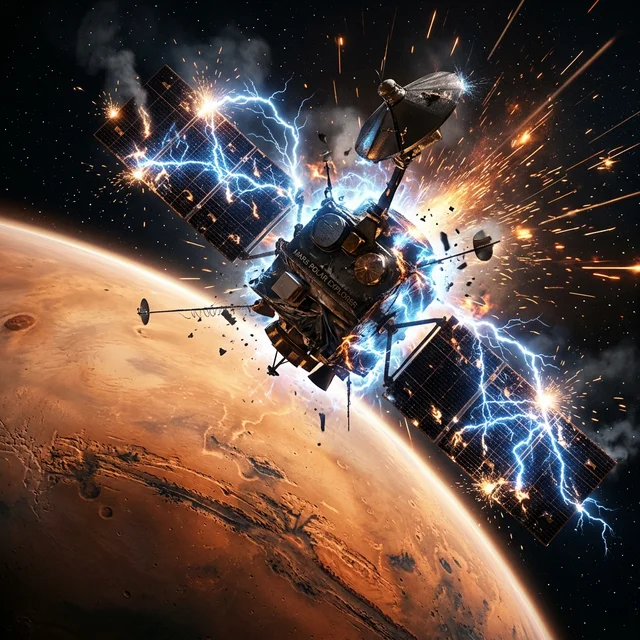
When the CME hit Mars, approximately 38 hours after the solar eruption, the effect was devastating for the robotic infrastructure on and around the planet.
Affected Probes
Mars Reconnaissance Orbiter (MRO): NASA's veteran probe, operational since 2006, automatically entered safe mode when its radiation sensors registered levels 800% above normal. Its HiRISE cameras were disabled for 72 hours.
MAVEN (Mars Atmosphere and Volatile Evolution): Ironically, the probe designed to study Mars' atmosphere collected the most data during the event. Its instruments recorded the erosion of 240 tons of Martian atmosphere in just 6 hours — a record.
ExoMars Trace Gas Orbiter (TGO): The European probe reported communication anomalies lasting 48 hours, with temporary loss of telemetry.
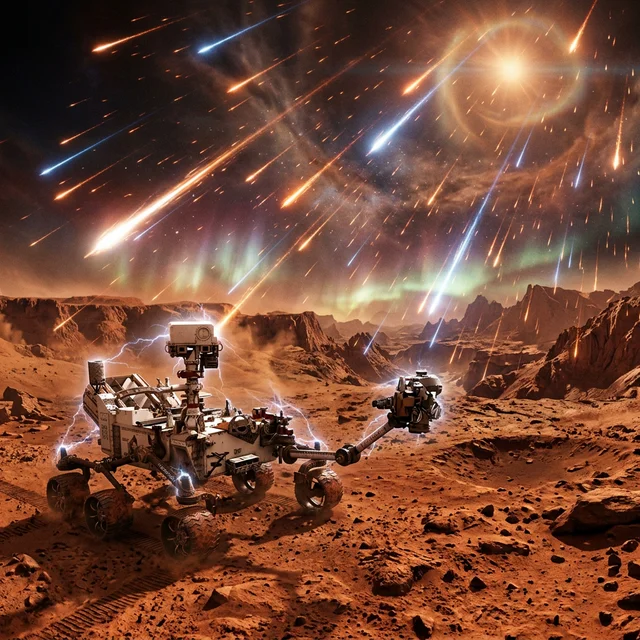
Perseverance (Rover): NASA's most advanced Mars rover automatically entered safe mode when its Radiation Assessment Detector (RAD) recorded radiation doses equivalent to 30 CT scans in 24 hours.
Ingenuity (Helicopter): The Martian helicopter had already ended its mission, but its solar panels would have been severely affected if still operational.
Auroras on Mars: An Unprecedented Spectacle
One of the most fascinating consequences was the generation of proton auroras over Mars. Unlike terrestrial auroras (caused by electrons), Martian auroras are caused by solar protons that interact directly with the atmosphere, since Mars lacks a global magnetic field to redirect them. MAVEN recorded ultraviolet emissions covering the entire dayside hemisphere — something never before observed.
Why Mars Is So Vulnerable
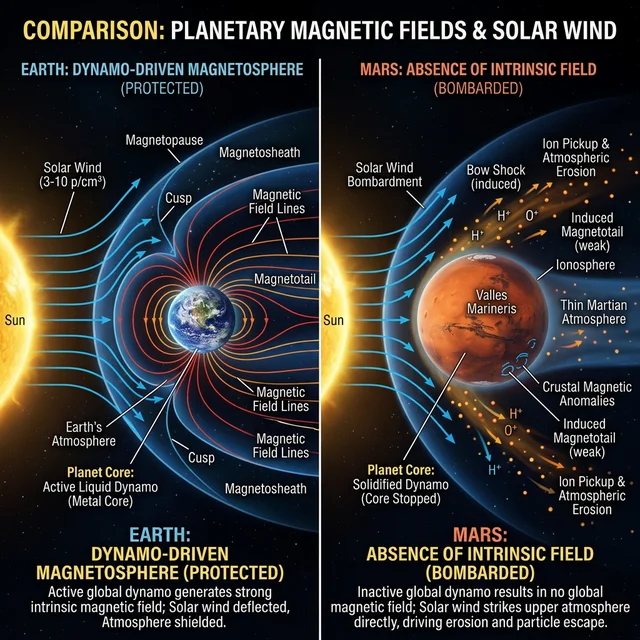
The answer lies in the absence of a magnetic field. Earth has a magnetosphere generated by liquid iron movement in its outer core — a giant magnetic shield that deflects most charged particles from the solar wind. Mars, however, lost its global magnetic field about 4 billion years ago, when its core cooled and solidified.
Earth vs. Mars: Radiation Protection
| Factor | Earth | Mars |
|---|---|---|
| Global magnetic field | Yes (strong) | No (absent) |
| Atmospheric pressure | 1,013 mbar | 6 mbar (~0.6%) |
| Surface radiation | ~0.33 mSv/day | ~0.67 mSv/day (2x more) |
| During X9 storm | ~2 mSv/day (shielded) | ~50 mSv/day (unprotected) |
| UV protection | Ozone blocks 97% | No significant UV protection |
The combination of no magnetic field and an extremely thin atmosphere makes Mars a hostile environment for human life in terms of radiation. On the Martian surface, an unprotected astronaut would receive the annual recommended radiation dose in less than 2 months.
Implications for Human Colonization

The March 2026 storm is a red alert for all Martian colonization programs. SpaceX plans to send the first crewed missions to Mars in the 2030s, and NASA has similar goals with the Artemis program. But how do you protect astronauts from events like this?
Proposed Solutions
Underground habitats: Build bases in natural lava tubes or excavate tunnels below the surface. Martian soil (regolith) is excellent radiation shielding — 2 meters of depth reduces exposure by 95%.
Artificial magnetic shields: NASA proposed in 2023 placing a magnetic field generator satellite at the L1 Lagrange point between the Sun and Mars. This "shield" would deflect charged particles before they reach the planet.
Special construction materials: Stanford University researchers developed in 2025 a high-density polyethylene and boron composite that blocks 60% of galactic cosmic rays while also providing structural protection.
Solar storm alerts: NASA's DONKI system (Database of Notifications, Knowledge, Information) can predict CMEs 24-48 hours in advance, giving astronauts time to seek shelter.
Radioprotective medications: Drugs like amifostine and new antioxidant compounds are being tested to reduce radiation-induced cellular damage. In 2026, an experimental NASA compound showed 40% reduction in DNA damage in organoid tests.
The Concerning Numbers
Data collected during the March storm paints a concerning picture for crewed missions:
- Surface radiation dose during event: ~50 mSv in 24 hours (annual recommended limit for nuclear workers: 50 mSv)
- Earth-Mars travel time: 6-9 months, during which astronauts would be exposed to deep space without planetary protection
- Estimated cost of adequate shielding for Martian habitat: $15-25 billion (radiation protection alone)
- Probability of X10+ storm during 2-year mission: ~15-25% during solar maximum
Solar Cycle 26 and the Future
The Sun operates in approximately 11-year cycles of increasing and decreasing activity. Solar Cycle 26 began in December 2024 and should reach maximum between 2028 and 2030 — exactly when the first crewed Mars missions are planned. This means astronauts would face the period of greatest solar activity during the most likely launch window.
Timeline of the Largest Solar Storms
- 1859 (Carrington Event): The largest recorded solar storm. If it occurred today, it would cause trillions of dollars in damage to global electronic infrastructure
- 1989: 9-hour blackout in Quebec, Canada, affecting 6 million people
- 2003 (Halloween Storms): Two X17 and X28 eruptions damaged satellites and forced transpolar flights to be rerouted
- 2012: A Carrington-magnitude CME "barely missed" Earth's orbit — if it had hit, damages would have been $2-4 trillion
- 2024: G5 geomagnetic storm caused auroras visible at tropical latitudes for the first time in 20 years
- 2026: X9.2 storm devastates Mars missions
The History of Mars' Atmosphere: 4 Billion Years of Erosion
To understand why solar storms are so devastating on Mars, it's essential to understand the planet's atmospheric history. Four billion years ago, Mars had a dense atmosphere, abundant liquid water, and possibly conditions to harbor life. So what happened?
The answer lies in the planet's core. Earth possesses an outer core of liquid iron in constant convection, generating a powerful global magnetic field. Mars, being smaller than Earth, cooled faster. Its core gradually solidified, the magnetic dynamo ceased, and the global magnetic field disappeared.
Without this protection, the solar wind began eroding Mars' atmosphere atom by atom, molecule by molecule. The MAVEN probe, launched specifically to study this process, estimated that Mars loses approximately 100 grams of atmosphere per second to space — a rate that multiplies dramatically during solar storms.
Data collected during the March 2026 storm showed that the atmospheric erosion rate increased 1,500 times during the event's 6-hour peak, with 240 tons of gas escaping to space. This is the most precise record ever obtained of real-time atmospheric erosion during a CME and provides crucial data for models attempting to reconstruct Mars' primitive atmosphere.
Scientists estimate that over 4 billion years, Mars lost the equivalent of an atmosphere with Earth-like pressure. If we could return all that atmosphere, Mars would have sufficient pressure to maintain liquid water on its surface — one of the prerequisites for terraforming.
Space Weather Prediction Systems
Solar storm prediction is a rapidly evolving science, but still far from perfect. The current system works as follows:
Monitoring Infrastructure
- Solar observatories in Earth orbit: Solar Dynamics Observatory (SDO), SOHO, and STEREO monitor the Sun 24 hours a day across multiple wavelengths
- Coronagraphs: Special cameras that block the solar disk to observe the corona, where CMEs originate
- L1 point satellites: The DSCOVR satellite, positioned between Earth and the Sun, provides 15-60 minute warnings before a CME hits Earth
- Computational models: Simulations like NASA's ENLIL model predict CME trajectory and speed with increasing accuracy
Limitations for Mars
The major issue is that all this infrastructure is focused on protecting Earth. Mars doesn't have dedicated early-warning satellites at its equivalent L1 point. When a CME is directed at Mars, scientists depend on calculations based on Earth-based observations — with significant margin of error.
For future crewed missions, NASA and ESA plan to launch a network of solar monitoring satellites in Martian orbit, but this won't happen before 2032, according to the most optimistic estimates.
The Private Sector's Response
The March 2026 storm accelerated private sector discussions about radiation protection:
- SpaceX: Elon Musk acknowledged that radiation protection is "the biggest unsolved challenge" for Starship on Mars voyages, announcing investments in advanced shielding materials
- Blue Origin: Jeff Bezos proposed space habitats with lunar regolith shielding as prototypes for future Martian bases
- Lockheed Martin: Presented a concept for an "emergency inflatable shelter" that could be deployed on the Martian surface in 30 minutes, providing protection against extreme solar events
- Axiom Space: Developing spacesuits with enhanced radiation protection, using layers of polyethylene and water as shielding
What Would Happen to ISS Astronauts?
The ISS orbits within Earth's magnetosphere, which provides significant protection against charged particles. During strong solar storms, however, ISS astronauts are evacuated to more heavily shielded modules (like the Russian Zvezda module), with 30-60 minutes warning time provided by L1 satellites.
In comparison, astronauts in transit to Mars — exposed to deep space without planetary protection for 6-9 months — would face exponentially greater risks. SpaceX's Starship has some structural protections, but experts warn they are insufficient for X9-class events or higher. This remains one of the most critical engineering challenges for crewed Mars missions planned in the 2030s.
Frequently Asked Questions
Can a solar storm completely destroy a Mars probe? Yes, theoretically. An X20+ storm could cause irreparable damage to electronics. Modern probes are designed to withstand X10-class events, but there's no absolute guarantee against exceptional events.
Would astronauts on Mars survive this storm? Yes, if they were inside a shielded or underground habitat. On the unprotected surface, the radiation dose would be dangerous but not immediately lethal. Effects would be cumulative and significantly increase lifetime cancer risk.
Was Earth also affected? Earth was not "aligned" with Mars during this specific CME, so our planet experienced minimal effects. However, this demonstrates that storms can be directional and unpredictable.
When will the next major solar storm be? It's impossible to predict exactly, but the Solar Cycle 26 maximum (2028-2030) will significantly increase the probability of X10+ events.
Did Mars ever have a magnetic field? Yes. Geological evidence shows Mars possessed a robust global magnetic field 4 billion years ago. Remnants of this field still exist as crustal magnetic anomalies, detectable by orbital probes, but insufficient to protect the planet from solar wind.
Historical Precedents: Solar Storms That Changed Space Exploration
The March 2026 event joins a growing list of solar storms that have impacted space missions throughout history:
- August 1972: Between Apollo 16 and 17, an X20+ solar storm struck. Had astronauts been on the lunar surface (without Earth's magnetosphere), they could have received a lethal radiation dose. This event is considered one of the strongest arguments for radiation shielding in crewed missions
- October 2003 ("Halloween Storms"): A series of X-class flares damaged the radiation detectors on Mars Odyssey and caused the Japanese ADEOS-II satellite to permanently fail. Total economic damage to Earth's infrastructure exceeded $2 billion
- September 2017: An X9.3 flare — the strongest of Solar Cycle 24 — caused GPS disruptions and radio blackouts across the Americas. On Mars, the Curiosity rover recorded a 6x increase in surface radiation
- February 2022: A moderate geomagnetic storm caused 40 SpaceX Starlink satellites to deorbit prematurely, costing approximately $100 million. This demonstrated vulnerability even for low-Earth orbit assets
- March 2026 (current event): The X9.2 storm that struck Mars directly, causing unprecedented probe failures and providing the most detailed dataset ever collected on Martian atmospheric erosion during a CME
Each of these events has provided invaluable data that informs the design of future spacecraft radiation shielding, warning systems, and operational protocols for crewed deep-space missions.
Conclusion: The Universe Reminds Us Who's in Charge
The March 2026 solar storm is a powerful reminder that the universe is vast, violent, and indifferent to our plans. But it's also an opportunity: every extreme event provides precious data that brings us closer to the dream of making humanity a multiplanetary species.
Mars awaits us — but it won't make it easy. And perhaps that's exactly the challenge our species needs to continue evolving as a scientific and technological civilization.
Sources and References
- NASA. "Major Solar Storm Impacts Mars Missions." March 2026. nasa.gov
- Nature Astronomy. "X9.2 Solar Storm: MAVEN Data and Atmospheric Erosion at Mars." 2026.
- SpaceWeather.com. "Record Solar Storm of Solar Cycle 26." spaceweather.com
- ESA. "ExoMars TGO Anomaly Report During March 2026 CME." esa.int
- Zeitlin, C. et al. "Measurements of Energetic Particle Radiation in Transit to Mars." Science, 2013.


