Local magnetic reconnection — Interactions between the Be star's magnetic field and its matter disk could generate energy bursts, similar to solar flares but on a much larger scale.
Stripped stellar companion — A star that had lost its outer layers could be interacting with the Be star in ways that produced X-rays.
Neutron star — An ultra-dense stellar remnant could be accreting matter from the Be star.
Accreting white dwarf — A compact stellar corpse could be siphoning material from the Be star, heating it to extreme temperatures in the process.
Earlier studies had already ruled out stripped stars and neutron stars because observations did not match theoretical predictions for those scenarios. Two possibilities remained: magnetic interactions involving the star itself, or an accreting white dwarf companion. Until now, no observation had allowed scientists to definitively choose between them.
To understand the gamma-Cas mystery, one must first grasp what makes Be stars so peculiar. The "B" refers to the spectral classification — hot, bluish stars, far more massive and luminous than the Sun. The "e" comes from "emission," indicating that these stars display emission lines in their optical spectra, caused by the gas disk surrounding them.
Be stars spin at impressive speeds — some reaching up to 70% of their critical rotation velocity, the point at which centrifugal force at the equatorial surface would equal gravity. This frantic rotation causes the star to periodically eject matter from its equatorial region, forming a decretion disk that can extend several times the star's radius.
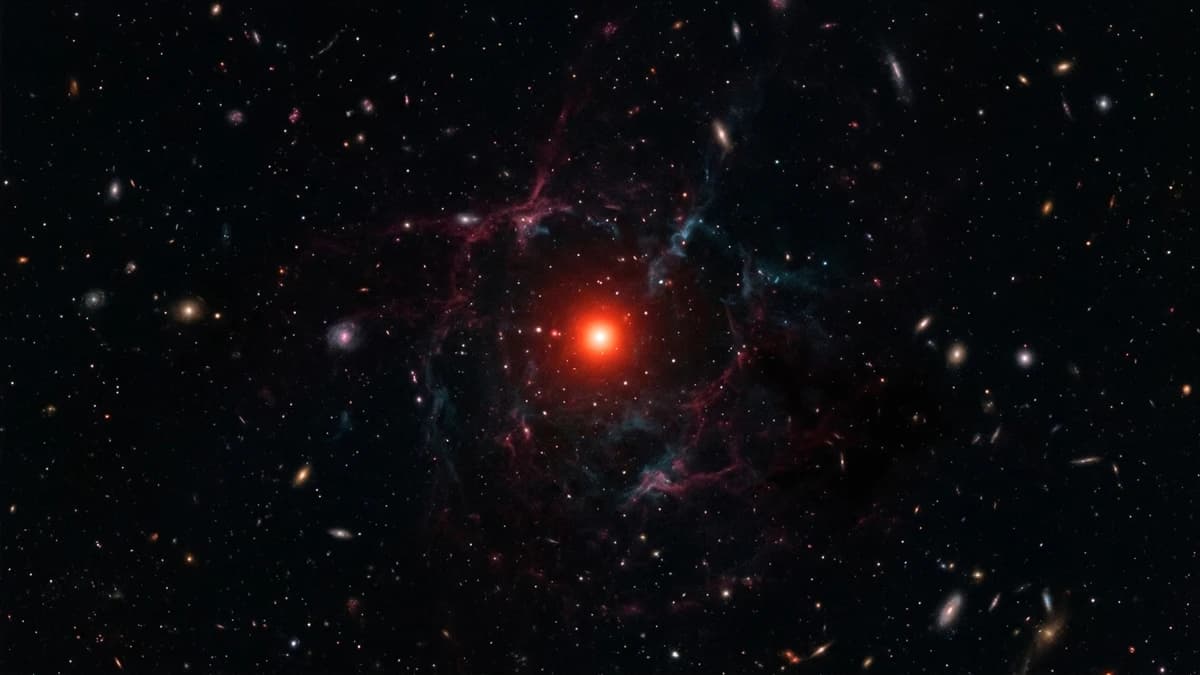
Gamma-Cas, as the first Be star ever identified, is the archetype of this class. Its rapid rotation, matter disk, and intense luminosity make it a natural laboratory for studying the most extreme physical processes occurring in massive stars.
The "culprit" revealed by the research — a white dwarf — is one of the most fascinating and common objects in the cosmos. When a star with a mass of up to about eight times that of the Sun exhausts its nuclear fuel, it expels its outer layers in a planetary nebula and leaves behind an ultra-dense core: the white dwarf.
Despite having a mass comparable to the Sun's, a typical white dwarf is roughly the size of Earth — meaning a teaspoon of its material would weigh about 5.5 tons. They produce no energy through nuclear fusion; they shine only from residual heat, slowly cooling over billions of years.
In gamma-Cas's case, the white dwarf is invisible — completely overwhelmed by the Be star's crushing brightness, which is thousands of times more luminous. Detecting it directly would be like trying to spot a firefly next to a stadium floodlight. That is why astronomers needed an indirect approach — and a revolutionary telescope.
XRISM (X-ray Imaging and Spectroscopy Mission) is a joint space mission of Japan's JAXA space agency, the European Space Agency (ESA), and NASA, launched in September 2023. Its primary instrument, Resolve, is an X-ray microcalorimeter that measures the energy of each individual X-ray photon with unprecedented precision.
Unlike conventional detectors, which group photons into broad energy bands, Resolve can distinguish subtle differences in X-ray energy — the equivalent of hearing each individual note in a symphony orchestra, rather than just the overall sound. This capability was essential for solving the gamma-Cas mystery, because it allowed astronomers to track minute changes in the velocity of the X-ray-emitting plasma over time.
If you're fascinated by discoveries that challenge our understanding of the cosmos, check out our article on gravitational waves detected by atoms, another revolution in how we observe the universe.
The resolution of the gamma-Cas mystery goes far beyond academic curiosity. It has profound implications for multiple areas of astrophysics and our understanding of stellar evolution.
| Aspect |
Before the Discovery |
After the Discovery |
Impact |
| Origin of γ Cas X-rays |
Unknown — two rival theories |
Confirmed: magnetic accreting white dwarf |
Closes 50 years of scientific debate |
| Be + white dwarf systems |
Theoretically predicted, never confirmed |
First clear, direct identification |
New class of astrophysical objects validated |
| Binary evolution models |
Predicted more systems with lower-mass Be stars |
Reality shows fewer systems with massive Be stars |
Models need revision |
| "γ Cas analogues" (~20 objects) |
Uncertain nature |
Now identified as Be + white dwarf systems |
All can be reclassified |
| Gravitational wave understanding |
Binary evolution models used as foundation |
Model revision affects gravitational wave predictions |
Impact on detectors like LIGO and Virgo |
| XRISM telescope |
Newly launched, capabilities being demonstrated |
Spectacular proof of concept for Resolve instrument |
Validates investment of hundreds of millions of dollars |
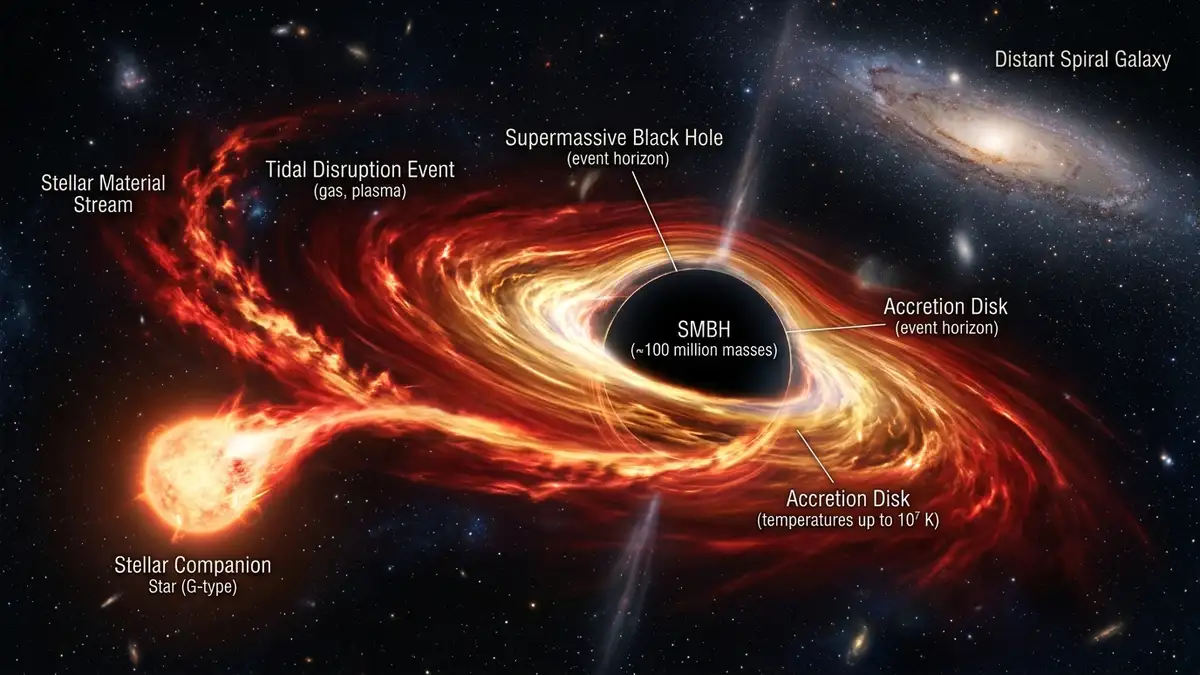
The scenario confirmed by the research works as follows: the white dwarf orbits the Be star every 203 days. During this orbit, the white dwarf's intense gravity — remember, it has the Sun's mass compressed into Earth's size — pulls material from the gas disk surrounding the Be star.
This material does not fall directly onto the white dwarf. Instead, it forms a second accretion disk around the compact companion. In the case of a magnetic white dwarf — as the XRISM data indicate — the magnetic field truncates this disk and channels the material toward the white dwarf's magnetic poles.
When the gas finally strikes the white dwarf's surface at the poles, it is violently decelerated, converting its kinetic energy into heat. The resulting temperatures exceed 100 million degrees — hot enough to emit intense X-rays. Some of these X-rays are reflected by the white dwarf's own surface, adding an extra component to the observed signal.
The key evidence came from an elegant application of the Doppler effect — the same principle that makes an ambulance siren sound higher-pitched as it approaches and lower-pitched as it recedes. The astronomers observed that the X-ray spectral lines (specifically, the ionized iron emission lines called Fe K) shifted in wavelength between the three observations taken in December 2024, February 2025, and June 2025.
Crucially, these velocity changes tracked the orbital motion of the white dwarf — not that of the Be star. If the X-rays had come from the Be star itself or from magnetic interactions on its surface, the velocity changes would have followed the Be star's orbital pattern. The fact that they followed the white dwarf's pattern was the "smoking gun" that solved the case.
Furthermore, the moderate width of the spectral lines (on the order of 200 km/s) ruled out the possibility of a non-magnetic white dwarf. In systems without a magnetic field, accretion occurs in the inner regions of the disk, which rotate rapidly and produce much broader lines. The observed width is consistent with a disk truncated by a magnetic field, where material is channeled to the poles.
Yaël Nazé, astronomer at the University of Liège and lead author of the study, expressed her team's satisfaction at solving an enigma that consumed entire careers:
"Several scenarios had been proposed to explain this emission. One of them involved local magnetic reconnection between the surface of the Be star and its disk. Others suggested X-rays to be linked to a companion, whether a star stripped of its outer layers, a neutron star, or an accreting white dwarf."
On the decisive evidence, Nazé explained: "The spectra revealed that the signatures of the high-temperature plasma change velocity between the three observations, following the orbital motion of the white dwarf rather than that of the Be star. This shift was measured with high statistical reliability. It is, in fact, the first direct evidence that the ultra-hot plasma responsible for the X-rays is associated with the compact companion, and not with the Be star itself."
The researcher also highlighted the broader consequences of the discovery for theoretical astrophysics: "This discrepancy suggests a revision of binary evolution models, particularly regarding the efficiency of mass transfer between components — a conclusion that aligns with that of several recent independent studies. Solving this mystery therefore opens up new avenues of research for the years to come."
Nazé concluded with a perspective connecting the discovery to one of modern physics' most exciting frontiers: "Understanding the evolution of binary systems is crucial for comprehending, for example, gravitational waves, as it is indeed massive binaries that emit them at the end of their lives."
The publication generated excitement across the international astrophysics community. The study not only solves a specific mystery but validates the transformative power of the XRISM telescope and its Resolve instrument. Since its launch in 2023, XRISM had already demonstrated impressive capabilities, but the resolution of the gamma-Cas enigma represents perhaps its most emblematic achievement to date — proof that investments in cutting-edge instrumentation can unlock answers to questions that resisted decades of investigation.
For those wanting to understand more about how fundamental particles and forces shape the universe, we recommend our article on the new particle discovered at CERN, another recent discovery challenging our models.
With gamma-Cas's nature finally established, the next logical step is to investigate the approximately 20 "γ Cas analogues" — stars displaying similar X-ray behavior. The expectation is that many, if not all, also harbor white dwarf companions. Observational campaigns with XRISM are already being planned to test this hypothesis.
The discovery revealed a significant discrepancy between theory and observation. Theoretical models predicted that Be + white dwarf systems would be more common and primarily associated with lower-mass Be stars. Reality shows they involve massive Be stars and represent about 10% of them — a smaller proportion than predicted.
This discrepancy suggests that the efficiency of mass transfer between binary system components — the process by which one star "donates" material to its companion — differs from what models assume. Revising these models is a priority because they serve as the foundation for predicting the rate of neutron star and black hole mergers — events that produce gravitational waves detectable by observatories like LIGO and Virgo.
The XRISM telescope, which proved its worth spectacularly with this discovery, will continue to be a central tool for high-energy astrophysics in the coming years. Its ability to produce X-ray spectra with unprecedented resolution opens possibilities for investigating a wide range of cosmic phenomena — from supermassive black holes to supernova remnants.
| Stage |
Estimated Timeframe |
Objective |
| Observations of γ Cas analogues |
2026-2027 |
Confirm white dwarfs in other systems |
| Revision of binary evolution models |
2026-2028 |
Adjust mass transfer predictions |
| Complete catalog of Be + white dwarf systems |
2027-2029 |
Map the entire known population |
| Impact on gravitational wave predictions |
2028+ |
Refine merger rates for LIGO/Virgo |
The gamma-Cassiopeiae mystery lasted exactly 50 years — from 1976, when the first anomalous X-rays were detected, to 2026, when XRISM finally revealed the culprit. During that half-century, generations of astronomers proposed theories, conducted observations, and debated passionately about the nature of those inexplicable emissions. The answer, in the end, was both elegant and humbling: an invisible white dwarf, an Earth-sized stellar corpse, hidden in the shadow of a blue giant thousands of times brighter, silently devouring its matter and converting it into X-rays of extraordinary intensity.
The discovery is a powerful reminder that the universe frequently hides its deepest answers in the most unlikely places — and that sometimes the most obvious suspect is not the real culprit. Gamma-Cas shines in the night sky as it always has, forming the central point of Cassiopeia's "W." But now we know that glow tells only half the story. The other half belongs to a companion no one could see — until a Japanese telescope, orbiting Earth hundreds of kilometers above, finally unmasked it.