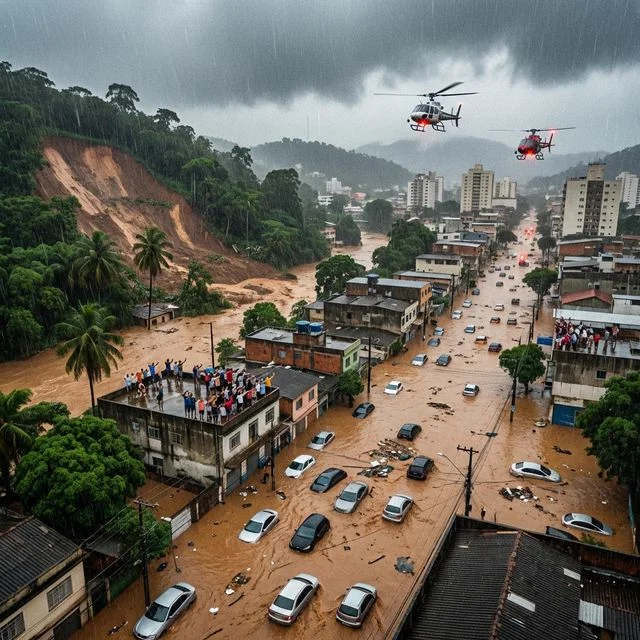
On February 24, 2026, the Brazilian city of Juiz de Fora, Minas Gerais, woke up to a nightmare. Streets had become rivers. Hillsides had collapsed into avalanches of mud. Cars floated like toys. At least 22 people were confirmed dead, 45 were missing — including children — and the Rio Paraibuna had overflowed for the first time since the 1940s. With 584 millimeters of rainfall accumulated in February alone — nearly 3.5 times the historical average — this became the wettest February in the city's recorded history and one of Brazil's deadliest weather disasters of 2026. The state of Minas Gerais declared three days of official mourning. The federal government recognized the state of public calamity. And the rain isn't stopping.
What Is Happening: The Catastrophe in Numbers
Between February 22 and 24, 2026, Juiz de Fora experienced the worst rainfall event in the city's recorded history. The numbers are staggering:
Rainfall data
| Metric | Value | Context |
|---|---|---|
| Total February rainfall | 584 mm | 3.4x the historical average (170.3 mm) |
| 24-hour maximum | 138.6 mm | Highest in 31 years |
| Peak hourly intensity | 70 mm/hour | Near UFJF campus |
| Previous record | Feb 1988 | Broken by over 120 mm |
| Percentage above average | 270% | Never before recorded |
Human toll (as of Feb 24, 2026)
| Category | Number |
|---|---|
| Confirmed deaths | 14–22 (varying by source) |
| Missing persons | 45 (including at least 5 children) |
| Buried/trapped | ~20 cases reported |
| Displaced persons | 440+ |
| Families evacuated | ~600 |
| Emergency calls | 432 (record for February) |
Sources: Defesa Civil de Juiz de Fora, Corpo de Bombeiros, CNN Brasil, EBC, Tribuna de Minas. Data as of February 24, 2026.
The Timeline of Destruction
Saturday–Sunday, February 22–23
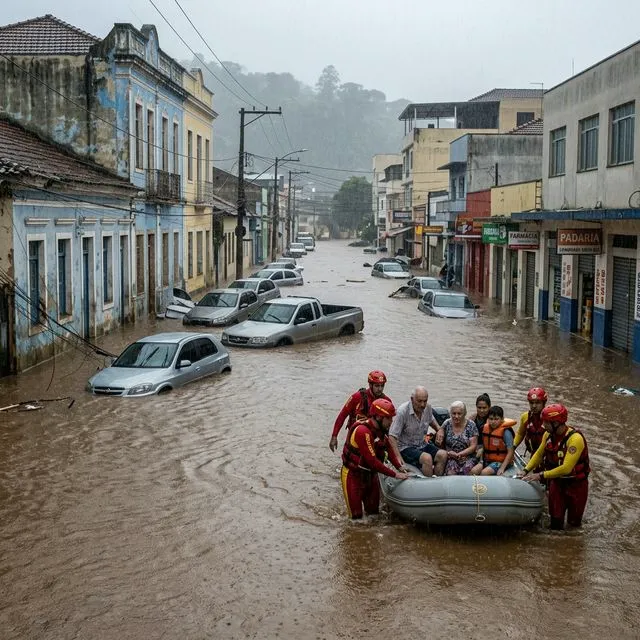
The first wave of heavy rainfall hit Juiz de Fora on Saturday evening, dumping over 100 mm in just a few hours. By Sunday morning, multiple neighborhoods were already reporting flooding and landslides:
- Bairro Democrata: streets completely submerged
- Mariano Procópio: historic district flooded
- Vitorino Braga: homes invaded by muddy water
- Santa Luzia: road access cut off
The Defesa Civil began issuing alerts and the city's emergency response teams were deployed. But the worst was yet to come.
Monday, February 24 — The Day the City Drowned
Between the night of Sunday and early Monday morning, an additional 138.6 mm of rain fell in just 24 hours — the highest single-day rainfall recorded in Juiz de Fora in 31 years. Some weather stations registered even more extreme figures:
- Station 1: 190.62 mm in 24 hours
- Station 2: 174.3 mm in 24 hours
- Station 3: 162.59 mm in 24 hours
The result was catastrophic:
- Rio Paraibuna overflowed — an event not seen since the 1940s, flooding entire neighborhoods along the riverbank
- Multiple streams burst their banks — córregos that run through the city became torrents of destruction
- Hillside collapses — the already saturated soil gave way, burying homes in mud and debris
- Bridges and tunnels shut down — critical infrastructure became impassable
The Deadliest Neighborhoods
The majority of fatalities occurred in working-class neighborhoods built on hillsides — areas long identified as high-risk by the Defesa Civil but where poverty and lack of alternatives keep families exposed:
| Neighborhood | Deaths | Type of Event |
|---|---|---|
| Bairro JK | Multiple | Landslide/burial |
| Santa Rita | Multiple | Landslide |
| Vila Ideal | Multiple | Flooding/burial |
| Lourdes | Multiple | Landslide |
| Vila Alpina | Multiple | Burial |
| São Benedito | Multiple | Landslide |
| Vila Olavo Costa | Multiple | Flooding |
| Parque Burnier | 5+ children missing | Landslide — ongoing search |
The scene in Parque Burnier is particularly heartbreaking: at least five children are among the missing, and search-and-rescue teams with sniffer dogs have been working nonstop since Monday morning.
Emergency Response: A City Fighting for Survival
Defesa Civil: record-breaking operations
The Defesa Civil of Juiz de Fora registered an unprecedented 432 emergency calls — shattering the previous February record of 352 calls set in 1988. The types of calls included:
- Flooding and inundation
- Landslides and mudslides
- Wall collapses
- Structural damage assessments
- Search and rescue
- Evacuations from risk areas
Bombeiros: search and rescue efforts
The Corpo de Bombeiros (Fire Department) responded to more than 40 emergency calls in just a few hours, deploying:
- Heavy rescue vehicles
- Inflatable boats for flooded neighborhoods
- Search-and-rescue dogs for buried victims
- Drones for aerial assessment
Government response
| Authority | Action |
|---|---|
| Juiz de Fora City Hall | Declared state of public calamity |
| State of Minas Gerais | Declared 3 days of official mourning |
| Federal Government | Officially recognized the calamity for resource release |
| Schools | All municipal schools suspended classes |
| City workers | Ordered to work remotely |
| Evacuations | ~600 families ordered to evacuate risk areas |
| Shelters | Municipal schools converted to emergency shelters |
The mayor of Juiz de Fora urged residents: "Stay home. Do not make unnecessary trips. If you are in a risk area, leave immediately."
Failed warnings
In a tragic irony, some residents of high-risk areas reported not receiving the Defesa Civil's "extreme danger" alerts — raising serious questions about the effectiveness of the warning system. The alerts were supposed to reach all registered mobile phones in affected zones, but reports indicate significant gaps in coverage.
The Rio Paraibuna: When History Repeats Itself
A river crossing through the heart of the city
The Rio Paraibuna is the main river of Juiz de Fora, running through the urban center. For decades, the city has managed the river's floodplain through engineering works — channeling sections, building retaining walls, and establishing green buffer zones. But on February 24, 2026, the Paraibuna exceeded all engineering limits.
The last time: 1940s
The last time the Rio Paraibuna overflowed to this extent was in the 1940s — nearly 80 years ago. That event led to major infrastructure investments and urban planning reforms. The 2026 overflow suggests that those protections are no longer sufficient in the face of:
- Accelerated urbanization of flood-prone areas
- Deforestation of surrounding hills
- Climate change increasing rainfall intensity
- Soil sealing by concrete and asphalt in the watershed
Comparison: Historical floods in Juiz de Fora
| Year | February Rainfall | Deaths | Key Event |
|---|---|---|---|
| 1940s | ~400 mm (est.) | Multiple | Rio Paraibuna overflow — led to major works |
| 1988 | 460 mm | Several | Previous wettest February on record |
| 2008 | 180+ mm | 3 | Significant flooding, multiple landslides |
| 2020 | 300+ mm | 5+ | Severe flooding season across MG |
| 2026 | 584 mm | 22+ | New record — Paraibuna overflows again |
Why Juiz de Fora Is So Vulnerable
Geography is destiny
Juiz de Fora sits in a valley of the Zona da Mata Mineira (Minas Gerais Forest Zone), surrounded by steep hills. The Atlantic Forest remnants that once absorbed rainfall have been progressively cleared for urbanization. The result is a city where:
- Water runs fast downhill on deforested slopes
- Soil is shallow on many hillsides, making them prone to collapse
- Streams are narrow and quickly overwhelmed
- Poor construction on hillsides creates deadly vulnerability
The social dimension
Like most Brazilian cities, Juiz de Fora's geography of risk maps almost perfectly onto its geography of poverty. The neighborhoods most affected — JK, Santa Rita, Vila Ideal, Vila Alpina — are predominantly lower-income communities where:
- Land is cheaper precisely because it's riskier
- Construction is often informal and lacks proper drainage
- Emergency evacuation routes are limited
- Infrastructure investment has been historically insufficient
This is not just a weather disaster. It is a social disaster amplified by inequality.
Minas Gerais: The State of Storms
Juiz de Fora is not an isolated case. Minas Gerais — Brazil's second most populous state — has a long and tragic history with deadly rainy seasons:
Major flood events in Minas Gerais
| Year | Event | Deaths | Notable Facts |
|---|---|---|---|
| 2011–2012 | Rainy season across MG | 20+ | Multiple cities affected |
| 2020 | January storms in BH | 72 | Belo Horizonte metropolitan area devastated |
| 2022 | February storms | 25+ | Multiple municipalities declared emergency |
| 2024 | Rio Grande do Sul floods | 183 | Worst Brazilian disaster in decades |
| 2026 | Juiz de Fora | 22+ | Record rainfall — ongoing |
Note: The 2024 RS floods, while in a different state, form part of the same pattern of intensifying extreme rainfall events across Brazil.
The Climate Connection: Why This Is Getting Worse
The science is clear
Every 1°C of global warming adds approximately 7% more water vapor to the atmosphere — providing more fuel for extreme precipitation events. The 2026 Juiz de Fora disaster fits a pattern that climate scientists have been warning about for years:
- Warmer Atlantic Ocean = more evaporation = more moisture flowing inland
- More intense ZCAS (South Atlantic Convergence Zone) = prolonged heavy rainfall over southeastern Brazil
- La Niña/El Niño cycles intensifying extremes in different regions
- Deforestation of the Amazon and Cerrado disrupting "flying rivers" — atmospheric moisture transport that historically distributed rainfall more evenly
What the data shows
| Indicator | Trend |
|---|---|
| Extreme rainfall events in SE Brazil | +30% since 1980 |
| Days with >50mm rainfall in MG | Increasing |
| Frequency of record-breaking months | Accelerating |
| Average February rainfall in JF (last 10 years) | Above historical average |
| Number of declared emergencies in MG | Rising year over year |
How to Help: Solidarity and Donations
If you want to help the victims of the Juiz de Fora floods:
Official channels
- Prefeitura de Juiz de Fora: Official donation points at municipal schools being used as shelters
- Defesa Civil de Juiz de Fora: Accepting donations of water, non-perishable food, clothing, hygiene products, and blankets
- Corpo de Bombeiros de MG: Coordinating volunteer efforts
What to donate
| Priority | Items |
|---|---|
| 🔴 Urgent | Drinking water, baby food/formula, diapers, medications |
| 🟡 High | Non-perishable food, blankets, mattresses, towels |
| 🟢 Helpful | Clothing, shoes, personal hygiene products, cleaning supplies |
What NOT to do
- Do not go to affected areas unless you are a trained volunteer — you risk becoming another victim
- Do not spread unverified information — share only official updates from Defesa Civil and Corpo de Bombeiros
- Do not block emergency routes — keep roads clear for rescue vehicles
Survival Guide: What to Do During a Flood
If you are in a risk area NOW
- Leave immediately — go to higher ground
- Do NOT try to cross flowing water — 15 cm of moving water can knock you down, 60 cm can sweep away a car
- Call 199 (Defesa Civil) or 193 (Bombeiros)
- Take documents and medications — leave belongings behind if necessary
- Do NOT return home until authorities declare it safe
During heavy rain
- Stay inside on the highest floor possible
- Turn off electricity at the main breaker if water enters your home
- DO NOT touch electrical equipment or downed power lines
- Keep your phone charged and monitor official alerts
- Have an emergency bag ready: documents, medications, flashlight, water, phone charger
Warning signs of a landslide
- Cracks in walls or ground near your home
- Tilting trees, fences, or poles
- Water suddenly appearing from the ground or hillside
- Rumbling sounds from the hillside
- Doors or windows that suddenly won't close properly (structural shifting)
If you see ANY of these signs: EVACUATE IMMEDIATELY. Do not wait for an official alert.
What Happens Next: Forecast and Ongoing Risks
Weather forecast (Feb 25–28)
Meteorologists warn that more rain is expected in the coming days across the Zona da Mata Mineira. With the soil completely saturated from 584 mm of accumulated rainfall, even moderate additional rain could trigger:
- New landslides on already weakened hillsides
- Secondary flooding from rivers still above normal levels
- Structural collapses of buildings damaged but still standing
- Health risks from contaminated floodwater (leptospirosis, dengue, waterborne diseases)
Long-term implications
The 2026 Juiz de Fora disaster will inevitably reignite debates about:
- Urban planning — allowing construction in high-risk zones
- Climate adaptation — investing in drainage, reforestation, and early warning systems
- Social housing — providing safe alternatives for families living on hillsides
- Emergency preparedness — fixing gaps in the alert system that failed residents
- Federal infrastructure funding — building resilient cities for a warming world
Conclusion: A Tragedy That Was Predictable
The Juiz de Fora floods of February 2026 are devastating — but they are not surprising. Scientists have warned for years that extreme rainfall events are becoming more frequent and more intense, particularly in southeastern Brazil. Urban planners have identified the at-risk neighborhoods. Emergency managers have mapped the vulnerable hillsides.
And yet, families still live in the path of destruction. Alerts still fail to reach the most vulnerable. Rivers still overflow into unprotected communities.
The 584 mm of rain that fell on Juiz de Fora in February 2026 is a record. But in a warming world, today's record is tomorrow's average. The real question is: will Brazil invest in protecting its most vulnerable cities before the next record is broken?
The dead and missing of Juiz de Fora deserve an answer.
Emergency numbers in Brazil:
- 🚒 Bombeiros: 193
- 🛡️ Defesa Civil: 199
- 🚑 SAMU: 192
- 👮 Polícia Militar: 190
Frequently Asked Questions
What caused the historic floods in Juiz de Fora?
The floods in Juiz de Fora in 2026 were caused by a combination of extreme rainfall (record-breaking precipitation in a short period), urban factors (impermeable surfaces, inadequate drainage systems, construction in flood-prone areas), and environmental degradation (deforestation of hillsides, silting of rivers). Climate change intensified the rainfall patterns, making extreme events more frequent and severe in the region.
Is Juiz de Fora prone to flooding?
Yes, Juiz de Fora has a history of flooding due to its geographic characteristics: the city is built in a valley surrounded by hills, with the Paraibuna River running through its center. Rapid urbanization since the 1970s reduced permeable surfaces and overwhelmed drainage infrastructure. The city experiences regular flooding during the rainy season (October-March), but the 2026 event was exceptional in its intensity and damage.
How can cities prevent catastrophic flooding?
Effective flood prevention requires multiple strategies: expanding and maintaining drainage systems, creating retention basins and flood parks, preserving riparian vegetation and hillside forests, prohibiting construction in flood-prone areas, implementing permeable pavement, building green infrastructure (rain gardens, green roofs), installing early warning systems, and updating urban planning codes. Cities like Tokyo and Amsterdam are global references in flood management with massive underground retention systems.
Are floods getting worse in Brazil?
Data indicates yes. Brazil has experienced increasingly severe flood events in recent years: Rio Grande do Sul (2024), Petrópolis (2022), Bahia (2021), and numerous other events. Climate change is intensifying rainfall patterns, while continued urbanization and deforestation worsen the impact. The National Center for Monitoring Natural Disasters (CEMADEN) reports a significant increase in extreme rainfall events across Brazil. Investment in infrastructure and early warning systems has not kept pace with the growing risk.
Sources: Defesa Civil de Juiz de Fora, Corpo de Bombeiros de MG, CNN Brasil, EBC (Agência Brasil), Tribuna de Minas, Climatempo, Rádio Catedral JF, Correio Braziliense, Revista Oeste, O Tempo, G1 Zona da Mata, RTP. Data updated through February 24, 2026.
Additional references: INMET, Climatempo, CEMADEN, Defesa Civil Nacional