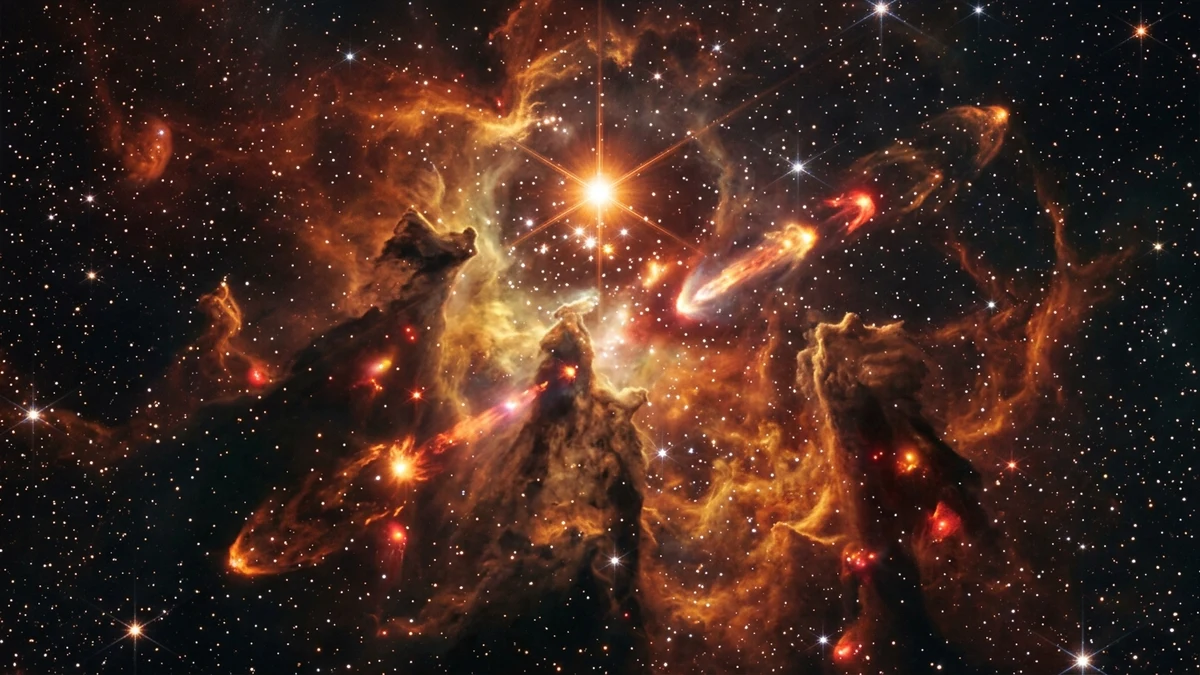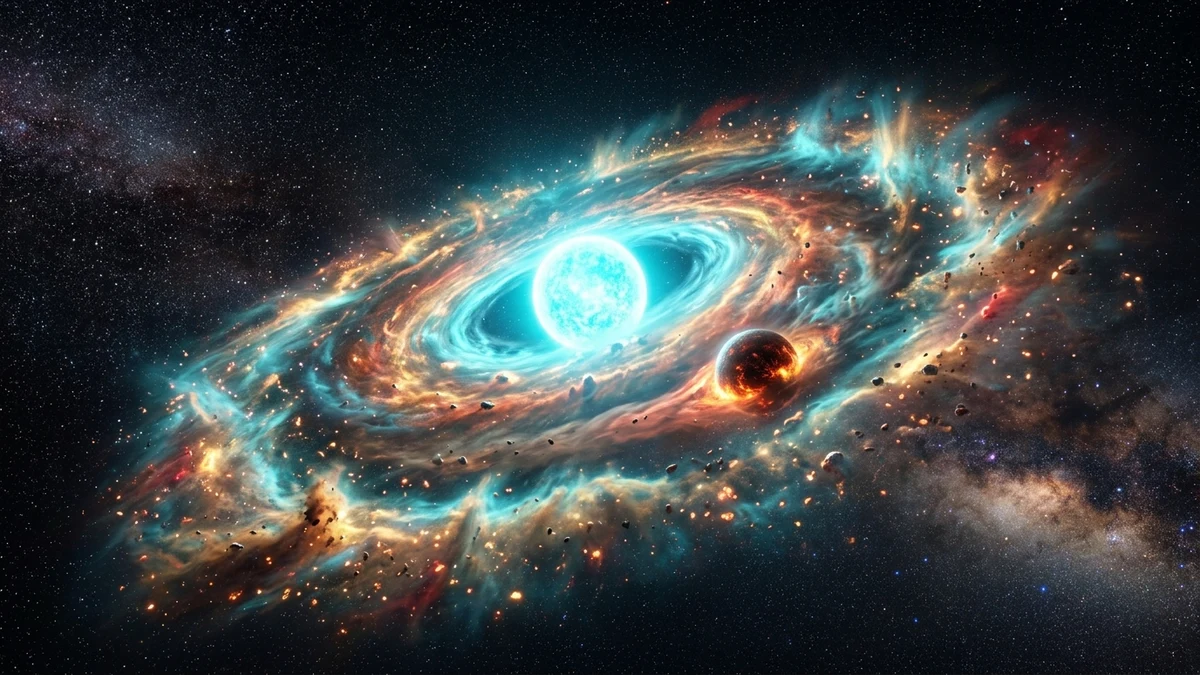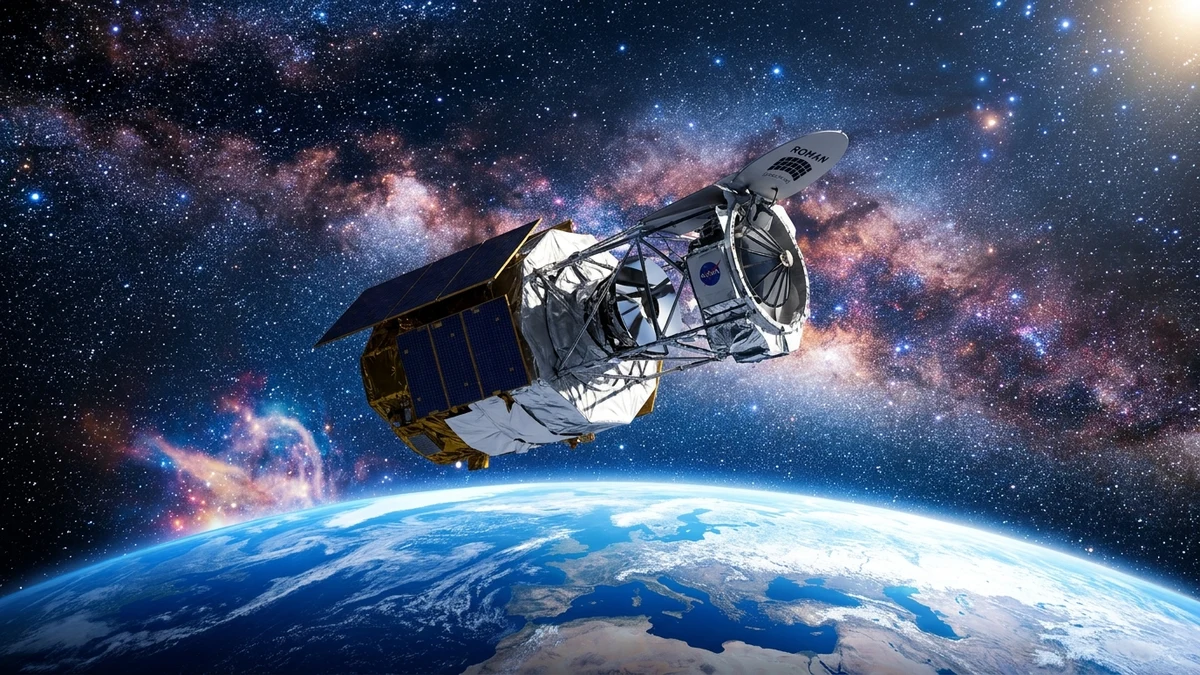
NASA and SpaceX have officially completed final environmental and acoustic qualification testing, clearing flight readiness certification for the flagship Nancy Grace Roman Space Telescope ahead of its scheduled liftoff aboard a Falcon Heavy rocket from Kennedy Space Center. Outfitted with a 2.4-meter primary mirror and a 300-megapixel Wide Field Instrument, NASA's next-generation orbital observatory boasts a field of view one hundred times greater than that of the legendary Hubble Space Telescope while maintaining equivalent diffraction-limited optical sharpness. The flagship mission's primary objectives are unraveling the cosmological mystery of dark energy and conducting the most comprehensive exoplanet census in astronomical history.
While the James Webb Space Telescope operates as a high-magnification "cosmic microscope" designed for targeted spectroscopic investigations of individual early galaxies and exoplanetary atmospheres, the Roman Space Telescope functions as an ultra-fast panoramic camera capable of charting massive celestial expanses in record operational windows. Over its five-year primary baseline mission stationed at the Sun-Earth Lagrange point 2 (L2), Roman will harvest more raw optical and near-infrared telemetry than Hubble accumulated across more than thirty-five years of operational history.
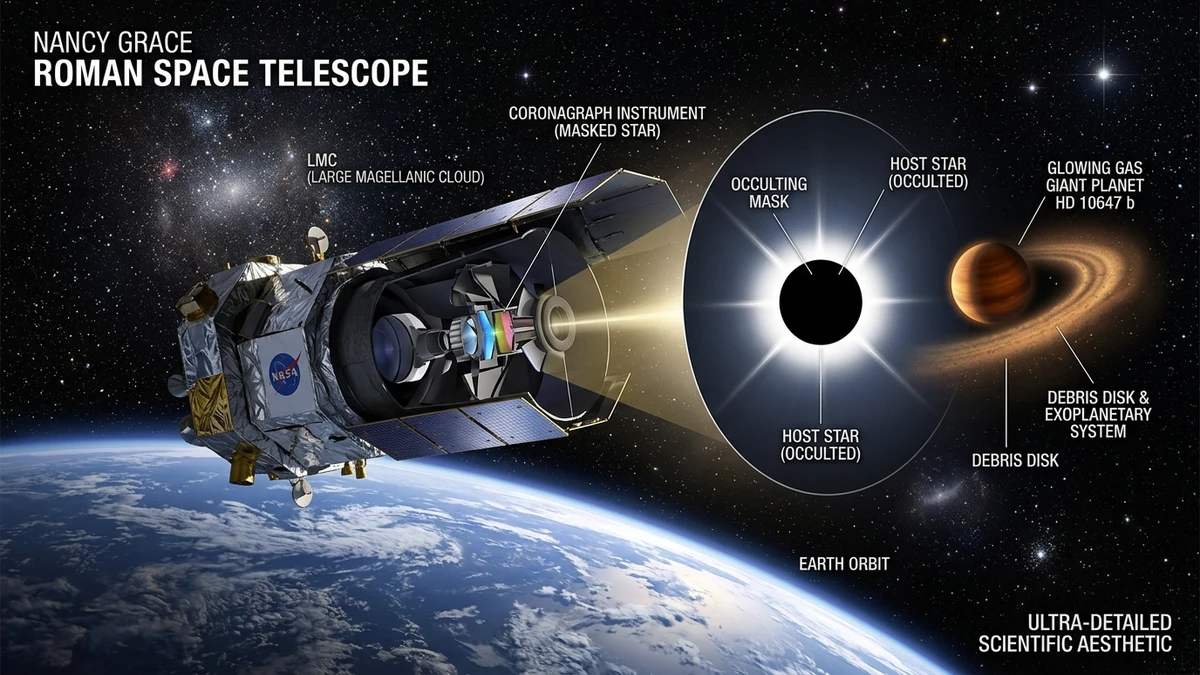
Among the mission's most anticipated technological breakthroughs is the Roman Coronagraph Instrument, an advanced starlight-suppression system utilizing high-actuator deformable mirrors and phase masks to dim parent star glare by a factor of one billion. This extreme contrast capability will allow astrophysicists to directly image reflected starlight from Jupiter-sized gas giants and temperate super-Earths, while also detecting rogue planets wandering through interstellar voids via high-cadence gravitational microlensing surveys.
Flagship Comparison: Hubble versus James Webb versus Nancy Grace Roman
The operational coexistence and architectural synergy of NASA's three great space observatories heralds a transformative golden era for modern observational astrophysics. To evaluate the observational capabilities introduced by the Roman Space Telescope in August 2026, we must evaluate its technical parameters against the Hubble and James Webb platforms. Roman's vast near-infrared footprint will revolutionize cosmological surveys and galactic statistics.
| Engineering Parameter | Hubble Space Telescope (1990) | James Webb Space Telescope (2021) | Nancy Grace Roman Space Telescope (2026) |
|---|---|---|---|
| Primary Mirror Aperture | 2.4 meters (monolithic glass) | 6.5 meters (segmented beryllium) | 2.4 meters (monolithic high-precision) |
| Instantaneous Field of View | 0.005 square degrees (narrow focus) | 0.007 square degrees (deep focus) | 0.281 square degrees (100x Hubble's spatial coverage) |
| Focal Plane Array Resolution | ~16 Megapixels (WFC3) | ~68 Megapixels (NIRCam) | ~300.8 Megapixels (Wide Field Instrument) |
| Primary Scientific Mandate | General UV, optical, and near-IR astrophysics | Deep-field early universe & exoplanet spectroscopy | Dark energy mapping, wide-field cosmological census |
During rigorous thermal-vacuum integration campaigns conducted at NASA's Goddard Space Flight Center, Roman's focal plane demonstrated sensitivity exceeding baseline mission requirements, supporting daily downlink volumes of 1.4 terabytes via the Deep Space Network. Crucially, all Roman science telemetry will be released to the global scientific community without proprietary embargo periods, empowering open-science discoveries in real time.
Roman's dark energy investigations will deploy weak gravitational lensing and baryon acoustic oscillation surveys across more than one billion galaxies spanning eleven billion years of cosmic evolution. By measuring the accelerating expansion rate of the cosmos with unprecedented precision, cosmologists will test whether Einstein's cosmological constant remains immutable or if modifications to general relativity are required across cosmic horizons.
The Galactic Exoplanet Census and Dark Matter Mapping
Beyond dark energy, the Roman Space Telescope will execute the most statistically complete exoplanet census in history. Its galactic bulge microlensing survey will discover thousands of exoplanets occupying wide orbits analogous to Jupiter and Saturn, filling critical observational gaps left by the Kepler and TESS transit missions.
Astrophysicists anticipate cataloging hundreds of free-floating rogue worlds ejected during early planetary system dynamics. Simultaneously, the Wide Field Instrument will map dark matter scaffolding by measuring subtle gravitational shear distortions imprinted on background galaxy profiles. The mission promises to transform our understanding of cosmic structure formation and the prevalence of planetary architectures across the Milky Way.
The Nancy Grace Roman Space Telescope exemplifies humanity's enduring drive to chart the cosmic frontier. By opening an unprecedented panoramic window onto deep space, this flagship observatory brings us closer to answering fundamental questions about the destiny of the universe and our place within it.
Frequently Asked Questions
What makes the Roman Space Telescope different from Hubble and Webb?
Roman features a panoramic field of view 100 times larger than Hubble at identical optical resolution, enabling it to survey vast swathes of sky in fractions of the time required by targeted observatories.
How will Roman investigate dark energy?
It will measure the expansion history of the universe and dark matter distribution across more than one billion galaxies using weak gravitational lensing and baryon acoustic oscillations.
How will the observatory find new exoplanets?
Roman combines a high-cadence gravitational microlensing survey to detect cool, wide-orbit planets with an active Coronagraph Instrument that dims starlight to image exoplanets directly.
Official Scientific References
- NASA Nancy Grace Roman Space Telescope — Official mission portal at Goddard Space Flight Center detailing instrument architectures and launch updates.
- SpaceX Launch Manifest — Flight qualification data for Roman's Falcon Heavy orbital insertion profile.
- Nature Astronomy — Peer-reviewed studies on dark energy cosmological constraints and Roman microlensing capabilities.