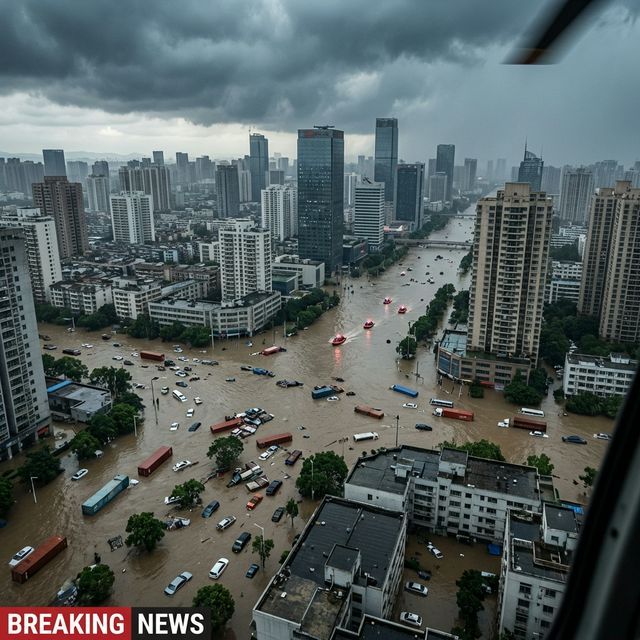
In 1931, China was swallowed by water. Between 1 and 4 million people drowned, starved, or died of disease — making the floods of the Yangtze, Huai, and Yellow Rivers the deadliest natural disaster ever recorded in human history. That number is so staggering it surpasses the entire population of several major capitals combined. And the most disturbing part? Water keeps killing. In 2024, Rio Grande do Sul experienced the worst climate catastrophe in Brazil's history, and Valencia, Spain, was devastated in mere hours. If you think floods are just "heavy rain," prepare to reconsider everything.
The Deadliest Flood in History: China, 1931 — Up to 4 Million Dead
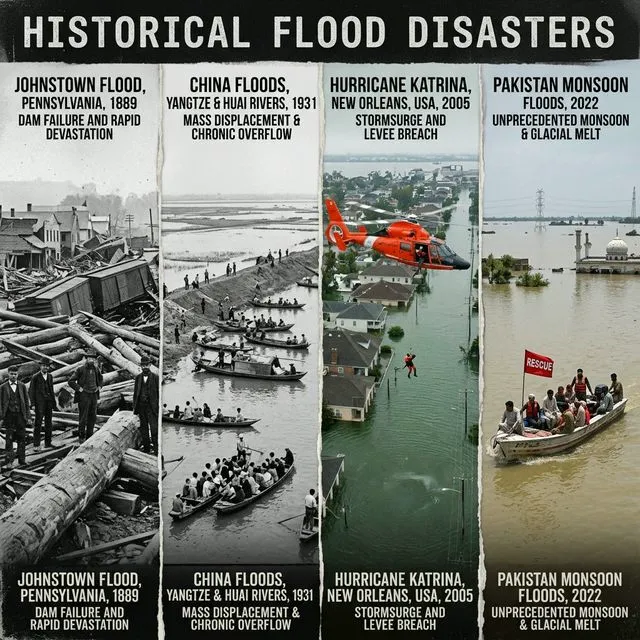
No documented natural disaster in human history has killed more people than the floods that ravaged China in 1931. Between July and August of that year, the three largest rivers in the country — Yangtze, Huai, and Yellow River — overflowed simultaneously after months of torrential rain combined with mountain snowmelt.
Numbers that defy comprehension
Water covered an area equivalent to the state of São Paulo. Entire cities vanished within hours. The dikes, built with primitive techniques, simply gave way under the pressure of billions of cubic meters of water.
Death estimates vary between 1 million and 4 million people — the range exists because counting the dead was impossible in a China without modern communication infrastructure. Drownings represented only a fraction of victims. Most died in the following weeks and months from:
- Widespread famine: rice crops were completely destroyed
- Cholera and typhus epidemics: contaminated water became a deadly breeding ground
- Massive displacement: millions were left without shelter, food, or clean water
According to League of Nations records, the 1931 flood directly affected 28.5 million people — roughly 25% of China's population at the time.
Yellow River, 1887 — "China's Sorrow" Collects Its Toll
The Yellow River (Huang He) is called "China's Sorrow" for a terrible reason: its floods have killed more people over the centuries than any other river in the world. In September 1887, torrential rains raised the river's level to heights never before recorded.
The earthen dikes broke near the city of Zhengzhou, Henan Province. Water spread across a densely populated plain, covering 130,000 km² of fertile land — an area larger than Greece.
- Estimated deaths: between 900,000 and 2 million people
- Displaced: over 2 million families
- Agricultural destruction: entire harvests destroyed across 11 provinces
Red River Delta, Vietnam, 1971 — 100,000 Dead in Hanoi
In August 1971, the Red River Delta overflowed during monsoon season, flooding vast areas around Hanoi, Vietnam's capital. The flood killed approximately 100,000 people and displaced millions.
Bangladesh: A Country Defined by Water
Bangladesh is possibly the most flood-vulnerable country on the planet. Approximately 80% of its territory lies in alluvial floodplains. The Bhola Cyclone (1970) killed between 300,000 and 500,000 people. In 1991, another devastating cyclone claimed 138,000 lives.
Indian Ocean Tsunami, 2004 — 230,000 Dead Across 14 Countries
Waves up to 30 meters swept the coasts of 14 countries. 230,000 people died within hours. Indonesia lost 170,000 citizens in Banda Aceh alone. The most tragic aspect: at the time, no tsunami warning system existed in the Indian Ocean.
Rio Grande do Sul, Brazil, 2024 — The Worst Climate Disaster in Brazilian History
Between late April and early May 2024, the state of Rio Grande do Sul experienced what experts classified as the largest environmental disaster in Brazil's history.
| Data | Value |
|---|---|
| Confirmed deaths | 184 |
| Missing | 25 |
| Injured | 806 |
| People affected | 2.3 million |
| Displaced | 580,000+ |
| Total damages | R$ 89 billion (~$17 billion USD) |
Source: RS Civil Defense / Gov.br
Spain — Valencia, 2024: Europe Is Also Vulnerable
In November 2024, devastating floods hit Valencia, Spain, leaving over 200 dead. In some areas, 8 hours of rain equaled an entire year's precipitation. Authorities were heavily criticized for delayed warnings.
The Future: Why Floods Will Get Worse
According to the World Meteorological Organization (WMO), the planet is entering an era of more severe climate extremes. Over the past 50 years, floods and storms have caused 58,700 deaths and losses of US$ 115 billion. Climate-related disasters accounted for 45% of deaths and 74% of economic losses globally.
For every 1°C increase in global temperature, the atmosphere can hold approximately 7% more moisture — meaning significantly heavier rainfall than our drainage systems were designed to handle.
The Human Cost Beyond Death Tolls
Flood statistics typically focus on death counts, but the true human cost extends far beyond mortality figures. Survivors of major floods face devastating long-term consequences that rarely make headlines.
Mental Health Crisis
Studies published in The Lancet Planetary Health show that flood survivors experience post-traumatic stress disorder (PTSD) at rates comparable to war veterans. In Rio Grande do Sul, mental health professionals reported a 340% increase in anxiety and depression diagnoses in the six months following the 2024 floods. Children are particularly vulnerable — research from Bangladesh shows that children who experience major floods are twice as likely to develop chronic anxiety disorders.
Economic Devastation for Generations
When a flood destroys a family's home, the financial impact can last decades. In the United States, FEMA data shows that the average flood victim takes 7-10 years to fully recover financially. For low-income families, recovery may never be complete. The 2024 Rio Grande do Sul disaster left an estimated 200,000 families facing financial ruin, with many losing everything they had built over a lifetime.
Disease and Public Health
Floodwaters are essentially toxic soup — mixing sewage, industrial chemicals, agricultural runoff, and decomposing organic matter. The World Health Organization estimates that waterborne diseases following major floods kill thousands of additional victims in the weeks and months after the initial event. Cholera outbreaks, leptospirosis, and mosquito-borne diseases like dengue and malaria surge dramatically in flood-affected areas.
Engineering Marvels: How Some Cities Fight Back
While many cities remain vulnerable, some have invested billions in flood protection infrastructure that offers hope for the future.
Tokyo's Underground Temple
Japan's Metropolitan Area Outer Underground Discharge Channel — nicknamed the "Underground Temple" — is the world's largest underground flood diversion facility. Located beneath the suburbs of Tokyo, this massive system can redirect 200 cubic meters of water per second through tunnels 50 meters underground. Since its completion in 2006, it has prevented billions of dollars in flood damage.
The Thames Barrier
London's Thames Barrier, completed in 1984, protects 125 square kilometers of central London from tidal surges. The barrier has been raised over 200 times since its construction. However, rising sea levels mean that the barrier is being used more frequently than originally planned, and engineers are already designing its replacement for the 2070s.
Singapore's Marina Barrage
Singapore built the Marina Barrage to create a freshwater reservoir while simultaneously providing flood control for the low-lying city center. The system uses nine giant steel gates and a network of pumps that can drain water into the sea during heavy rainfall, protecting one-sixth of Singapore's land area.
These engineering solutions demonstrate that flood protection is possible — but requires sustained political will, massive investment, and long-term planning that extends beyond election cycles.
Climate Change: The Multiplier Effect
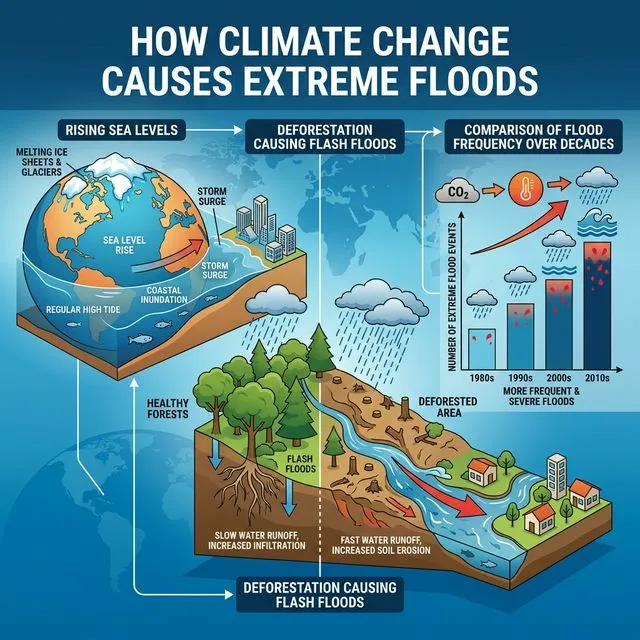
The relationship between climate change and flooding is not speculative — it is measurable and accelerating. NASA satellite data shows that global precipitation patterns have shifted dramatically since 1980, with wet regions getting wetter and dry regions getting drier.
The Numbers Are Clear
- Arctic ice loss has reduced the temperature gradient between poles and equator, slowing the jet stream and causing weather systems to stall — producing prolonged rainfall events
- Sea level rise of 20 cm since 1900 means storm surges reach further inland than ever before
- Warmer oceans fuel more powerful hurricanes and cyclones, which dump unprecedented amounts of rain
- The frequency of Category 4 and 5 hurricanes has increased by approximately 25% since the 1980s
The Intergovernmental Panel on Climate Change (IPCC) projects that by 2100, extreme precipitation events that currently occur once every 20 years will happen every 5-10 years in most regions. For coastal cities, the combination of sea level rise and more intense storms creates a compounding threat that current infrastructure was never designed to withstand.
Conclusion: Water Does Not Forgive
Floods have killed more people throughout history than earthquakes, volcanoes, and tsunamis combined. And science tells us, with disturbing clarity, that the worst is yet to come. Rio Grande do Sul in 2024 was not an anomaly — it was a warning. The question isn't if the next great flood will happen. It's when. And the answer, increasingly, is: sooner than we expect.
The Johnstown Flood, 1889 — America's First Great Disaster
On May 31, 1889, the South Fork Dam in Pennsylvania collapsed after days of heavy rain, sending 20 million tons of water rushing toward the city of Johnstown at speeds of up to 60 km/h. The wall of water was reportedly 18 meters high and carried trees, houses, and railroad cars in its path.
The Devastating Toll
- Deaths: 2,209 people (including 99 entire families)
- Destroyed: 1,600 homes completely obliterated
- Debris field: A massive pile of wreckage at the Stone Bridge caught fire, killing survivors trapped in the debris
- Economic damage: $17 million in 1889 dollars (approximately $500 million today)
The Johnstown Flood became a turning point in American disaster response. It led to the first major fundraising campaign by the American Red Cross, led by Clara Barton, and sparked nationwide debates about dam safety and the responsibility of wealthy dam owners. The South Fork Fishing and Hunting Club, whose members included Andrew Carnegie and Henry Clay Frick, had neglected dam maintenance for years — yet no member was ever held legally responsible.
The North Sea Flood, 1953 — Europe's Wake-Up Call
On the night of January 31, 1953, a devastating storm surge struck the coasts of the Netherlands, Belgium, and England. The combination of a severe windstorm and a spring tide created water levels 5.6 meters above normal in some areas.
Impact Across Three Nations
| Country | Deaths | Evacuated | Area Flooded |
|---|---|---|---|
| Netherlands | 1,836 | 72,000 | 1,650 km² |
| England | 307 | 32,000 | 1,000 km² |
| Belgium | 28 | 10,000 | 35 km² |
The disaster fundamentally changed the Netherlands' approach to water management. The Dutch government launched the Delta Works — one of the most ambitious engineering projects in human history. This system of dams, sluices, locks, dikes, and storm surge barriers took over 40 years to complete and cost approximately €5 billion. The Maeslantkering storm surge barrier, completed in 1997, can close automatically when water levels rise dangerously, protecting the port of Rotterdam and 1.5 million people.
The Delta Works is now considered one of the Seven Wonders of the Modern World by the American Society of Civil Engineers — proof that human engineering can, when properly funded and maintained, provide remarkable protection against nature's fury.
The Mississippi River Flood, 1927 — Reshaping America
The Great Mississippi Flood of 1927 was the most destructive river flood in the history of the United States. After months of heavy rain, the Mississippi River broke through levees in 145 places, flooding 70,000 km² across seven states.
Staggering Numbers
- Displaced: 700,000 people (many for months)
- Deaths: Officially 246, but historians estimate 500-1,000
- Homes destroyed: 130,000
- Economic damage: $400 million in 1927 dollars (~$7 billion today)
- Duration: The flood lasted from April to August
The 1927 flood had profound political consequences. The federal government's inadequate response — particularly the treatment of African American refugees who were forced into labor camps — contributed to the Great Migration of Black Americans from the South to northern cities. It also led to the Flood Control Act of 1928, which gave the Army Corps of Engineers responsibility for Mississippi River flood control, fundamentally changing the relationship between the federal government and natural disaster management.
Lessons From History: What We Keep Getting Wrong
Despite centuries of devastating floods, humanity continues to make the same critical mistakes:
Building in Floodplains
An estimated 1 billion people worldwide live in flood-prone areas, and that number is growing. Economic incentives to build near water — for agriculture, transportation, and commerce — consistently override safety concerns. In the United States alone, the National Flood Insurance Program has paid out over $70 billion in claims since its creation in 1968.
Deforestation and Urbanization
Forests act as natural sponges, absorbing rainfall and releasing it slowly. When forests are cleared for agriculture or development, water runs off immediately, overwhelming rivers and drainage systems. The Amazon rainforest, which serves as a decisive factor in South America's water cycle, has lost approximately 17% of its forest cover in the last 50 years. Scientists warn that approaching the 25% deforestation threshold could trigger a tipping point where the forest can no longer sustain itself, with catastrophic consequences for rainfall patterns across the continent.
Inadequate Warning Systems
The 2004 Indian Ocean tsunami killed 230,000 people partly because no warning system existed. After the disaster, the international community invested in the Indian Ocean Tsunami Warning System, which has since saved countless lives. Yet many flood-prone regions still lack adequate early warning infrastructure. In Valencia, Spain, in 2024, authorities were criticized for sending emergency alerts too late — after water had already begun flooding streets.
The Economic Argument for Prevention
The World Bank estimates that every $1 invested in flood prevention saves $7 in disaster recovery costs. Yet governments consistently underfund prevention in favor of post-disaster relief, which is more politically visible but far less cost-effective.
Frequently Asked Questions
What was the deadliest flood in history?
The 1931 China floods are considered the deadliest, killing an estimated 1-4 million people along the Yangtze and Huai rivers. Other devastating floods include the 1887 Yellow River flood with over 900,000 deaths.
Are floods the most destructive natural disaster?
Floods are the most common and widespread natural disaster, affecting more people annually than any other type. They account for about 40% of all natural disasters worldwide and cause an estimated $40 billion in damage annually.
How does climate change affect flooding?
Climate change increases flood risk through warmer air holding more moisture, melting glaciers increasing river flows, rising sea levels worsening coastal flooding, and changing weather patterns creating more intense storms.
Can cities be made flood-proof?
No city can be completely flood-proof, but risk can be dramatically reduced. The Netherlands uses extensive dikes and storm surge barriers. Tokyo's underground discharge channel can handle massive floods. Green infrastructure is increasingly used worldwide.
Sources: World Meteorological Organization (WMO), Brazilian Federal Government (Gov.br), Wikipedia, UN.org, Forbes Brasil, RS Civil Defense.
References: National Geographic, BBC Weather, IPCC