AI + Quantum Computer: What Changes for Our Reality?
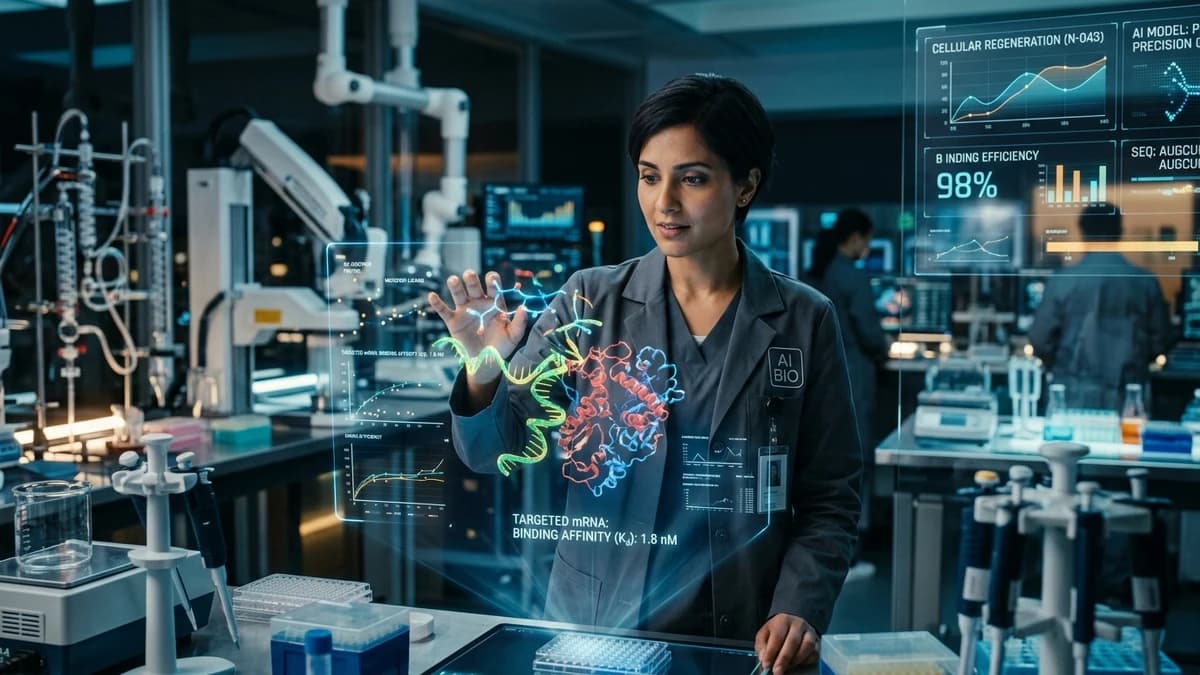
In January 2026, IBM demonstrated for the first time a hybrid system where its 1,386-qubit Heron quantum processor executed a molecular optimization subroutine that would take a classical supercomputer 47 years to solve — and delivered the result in 4 minutes and 12 seconds. This was not a lab trick. It was the first documented case of "practical quantum advantage" applied to a commercially relevant problem: designing a new molecule for Alzheimer's treatment, commissioned by Roche Pharmaceutical.
This moment marks a turning point. For the first time, the question shifts from "when will quantum computers be useful?" to "what happens when we connect artificial intelligence to this computational power?" The implications touch every aspect of modern life — from the medicine you take to the apps you use, from your bank's security to the weather forecast for next year. This article compares, in accessible language and based on verified sources, current AIs with emerging quantum AI, and projects what we can expect in the coming years.
Today's AIs: Powerful but Limited
How Classical AI Works
The artificial intelligences we use in 2026 — ChatGPT-5, Gemini 2.5, Claude Opus 4, Grok 3, among others — run on classical computers based on silicon transistors. These processors operate with bits: units of information that are either 0 or 1. Each calculation is a sequence of binary operations — on or off, yes or no, true or false.
The power of these AIs comes from two factors: massive volumes of training data (trillions of tokens of text, images, and code) and GPU hardware (like NVIDIA H100 and B200 chips) that perform trillions of operations per second in parallel. OpenAI's GPT-5, for example, was trained at an estimated cost of $500 million in electricity and hardware, using approximately 25,000 H100 GPUs over 90 days.
What Classical AIs Do Well
Current AIs excel at:
Pattern Recognition: They identify faces, diseases in medical exams, banking fraud, and anomalies in data with superhuman accuracy. The PathAI system detects breast cancer in mammograms with 99.4% accuracy — surpassing human radiologists (96.6%).
Language Processing: They translate 100 languages in real-time, write code, summarize 500-page legal documents in 3 minutes, and maintain complex conversations indistinguishable from human interactions.
Content Generation: They create photorealistic images (DALL-E 3, Midjourney V7), videos up to 2 minutes long (Sora), music (Suno), and even entire short films. By 2026, Hollywood studios are already using AI to generate digital extras, weather effects, and younger versions of aging actors.
What Classical AIs CANNOT Do (and Why)
Despite all their power, classical AIs are fundamentally limited by a mathematical problem known as "combinatorial explosion." As the number of variables in a problem increases, the time required to calculate all possibilities grows exponentially — not linearly.
Concrete Example: To simulate the behavior of a caffeine molecule (25 atoms), a classical computer needs a few hours. To simulate a penicillin molecule (41 atoms), it needs weeks. To simulate a protein with 200 amino acids (thousands of atoms), it would need more time than the age of the universe. Each additional atom doubles the calculation time.
This means that problems such as designing new drugs by testing trillions of molecular combinations, optimizing routes for thousands of vehicles simultaneously, modeling the global climate with city-by-city precision, or breaking modern cryptography — are beyond the computational reach of any classical computer, even using all the GPUs on the planet in parallel.
Quantum Computing: The Leap
Bits vs. Qubits
The quantum computer replaces the bit with the qubit (quantum bit). The difference is revolutionary: while a bit can be 0 OR 1, a qubit can be 0 AND 1 simultaneously — a phenomenon called superposition. It's as if, instead of choosing between one door or another, you could pass through both at the same time.
In addition to superposition, qubits exploit quantum entanglement: two entangled qubits remain connected in such a way that the state of one instantaneously affects the state of the other, regardless of the distance between them. Einstein called this "spooky action at a distance" — and it's real.
The combined power: 50 qubits in superposition represent 2⁵⁰ simultaneous states — approximately 1 quadrillion (1,125,899,906,842,624) possibilities processed in parallel. A classical computer would need 1 quadrillion conventional bits to represent the same solution space. With 300 qubits, the number of simultaneous states exceeds the number of atoms in the observable universe.
The State of the Art in 2026
The most advanced operational quantum processors in 2026 include:
| Company | Processor | Qubits | Highlight |
|---|---|---|---|
| IBM | Heron | 1,386 | First case of practical quantum advantage |
| Willow | 105 | Error correction below threshold | |
| IonQ/Cambridge | Forte Enterprise | 256 | Trapped ion architecture |
| Microsoft | Majorana 1 | 8 topological | Topological qubits (more stable) |
| Fujitsu | Quantum Discovery | 1,000+ | Focus on computational chemistry |
The central challenge remains: qubits are extremely fragile. They need to operate at temperatures close to absolute zero (-273.15°C), and any environmental interference causes "decoherence" to the quantum state, corrupting the calculation. The error rate of quantum computers in 2026 is approximately 0.1-1% per operation — too high for many applications without sophisticated error correction.
Quantum AI: What Changes When We Combine the Two?
Quantum AI (QAI) does not replace classical AI — it complements it. The most likely model, which is already under development in 2026, is the quantum-classical hybrid system: classical AI does what it does best (language processing, pattern recognition, user interface), while the quantum processor acts as a "co-processor" for tasks that are classically intractable.
What Changes in Practice
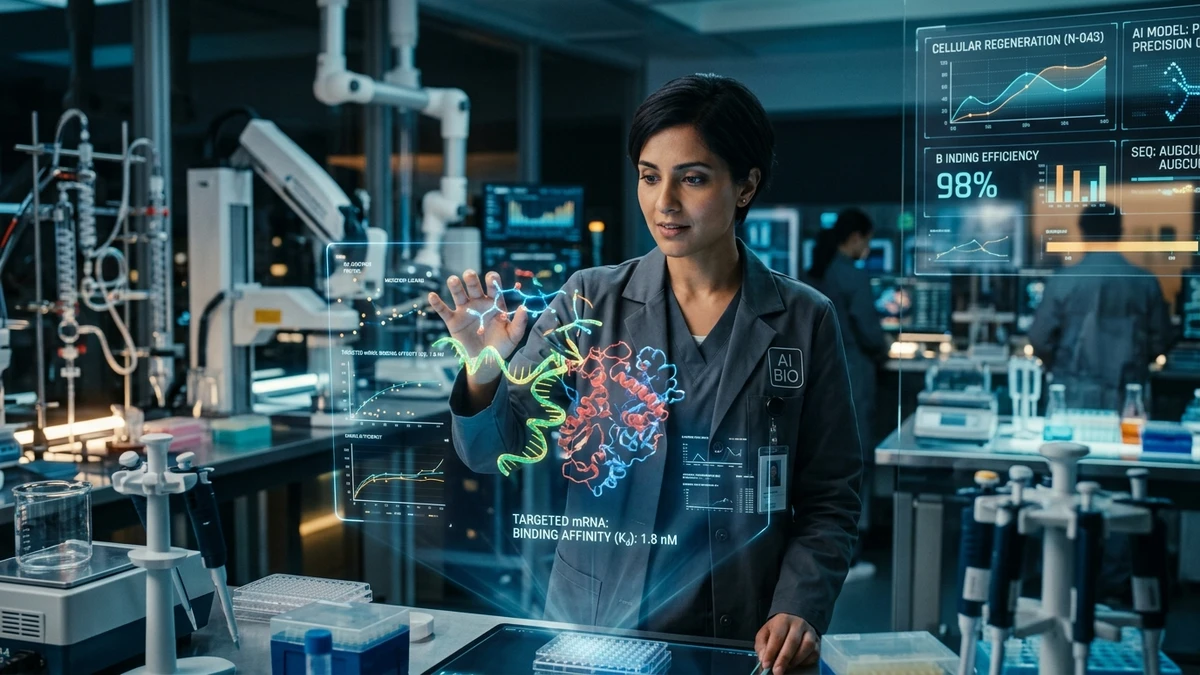
1. Drug Discovery: from 12 years to 12 months. The current process of developing a new drug takes an average of 12 years and costs $2.6 billion. Most of that time is spent simulating how molecules interact with proteins in the human body — a problem of combinatorial explosion. With quantum AI, it is possible to simulate millions of molecular combinations in days, identifying viable candidates without the need for exhaustive laboratory tests. IBM/Roche's demonstration in January 2026 proved that this is not just theory.
2. Cryptography: the end of the world as we know it? Most current digital security (banks, emails, governments) uses RSA encryption — which relies on the difficulty of factoring huge numbers. A classical computer would take billions of years to break an RSA-2048 key. A quantum computer with ~4,000 stable qubits could do it in hours, using Shor's algorithm. In 2026, no quantum computer has 4,000 stable qubits — but the trajectory points to 2030-2035. Therefore, governments and companies are already migrating to "post-quantum" encryption (algorithms resistant to quantum attacks). NIST (National Institute of Standards and Technology) published the first post-quantum encryption standards in August 2024.
3. Logistical Optimization: more efficient than humans. Problems like fleet routing (what's the best path for 10,000 trucks to deliver 300,000 packages in 50 cities?) are exponentially complex. Quantum computers can explore all possible routes simultaneously, finding optimal solutions that classical computers cannot reach. Companies like DHL and Amazon are already testing quantum optimization algorithms on IBM and Google cloud platforms.
4. Climate Prediction: from weeks to hours. Current climate models divide the atmosphere into grids of 25-100 km and project up to 7-10 days with good accuracy. Quantum AI could process grids of 1 km with projections of months, incorporating variables such as deep ocean currents, volcanic activity, and human emissions in real-time.
5. Materials and Batteries: the next revolution. Simulating new materials (superconductors, electrolytes for batteries, catalysts for clean energy) requires modeling quantum interactions between electrons — something classical computers do poorly and quantum computers do naturally. The discovery of solid-state batteries, high-temperature superconductors, or catalysts for green hydrogen could be accelerated by decades.
Comparison: Classical AI vs. Quantum AI
| Aspect | Classical AI (2026) | Quantum AI (Emerging) |
|---|---|---|
| Basic unit | Bit (0 or 1) | Qubit (superposition of states) |
| Main strength | Pattern recognition, language | Optimization, molecular simulation |
| Hardware | GPUs (NVIDIA H100, B200) | Quantum processors (IBM, Google, IonQ) |
| Operating cost | $0.01-1 per query | $10-1,000 per quantum task |
| Availability | Ubiquitous (cell phones, cloud) | Limited (cloud, specialized centers) |
| Maturity | Industrial, scaled | Experimental, moving towards utility |
| Best for | Everyday tasks, conversations, creation | Intractable problems, simulation, cryptography |
| Status 2026 | Dominant, industry standard | Co-processor for specialized tasks |
What Can We Expect (Realistic Timeline)
2026-2028 — Initial Hybrid Era. Quantum systems act as co-processors in the cloud for specific tasks (molecular simulation, optimization). Accessible via IBM Quantum, Google Cloud, Amazon Braket. They do not reach the end consumer.
2029-2032 — Consistent Quantum Advantage. Quantum computers with 10,000+ qubits and robust error correction. Accelerated discovery of drugs and materials. Massive migration to post-quantum encryption. First "quantum AIs" integrated into corporate virtual assistants.
2033-2040 — Transformative Quantum AI. Quantum processors with millions of qubits. Quantum AI solves problems that are impossible today: long-term climate prediction with local accuracy, complete simulation of the human proteome, real-time optimization of global energy networks. Potential disruption in finance, health, energy, and national security.
What This Is NOT (Myth Busting)
Myth 1: "Quantum computers are faster for everything." False. For most everyday tasks (browsing the internet, editing documents, running games, using social media), classical computers are more efficient. Qubits are only superior for problems with exponential structure — optimization, simulation, factorization.
Myth 2: "Quantum AI will be conscious." There is no evidence that quantum processing produces consciousness, despite speculative theories like Roger Penrose's "objective orchestration." Quantum AI will be more powerful, not more "alive."
Myth 3: "It will replace all jobs." Quantum AI will initially affect jobs in research, quantitative finance, large-scale logistics, and cybersecurity. For most professions, classical AI is already the ongoing disruption — quantum computing is a second wave that arrives later.
Impact on Everyday Reality
For the average citizen in 2026, quantum AI is still invisible. You won't have a "personal quantum computer" — just as you don't have a nuclear power plant in your backyard, even if your electricity comes from one. The impact arrives indirectly: better and cheaper medications, cell phone batteries that last a week, more accurate weather forecasting, and banking transactions protected by unbreakable encryption.
The real change happens when quantum AI makes possible what was previously impossible. We're not talking about improving ChatGPT — we're talking about solving problems that no computer on Earth can solve today. And some of these problems, like treating Alzheimer's or reversing global warming, are worth more than any advancement in chatbots.
FAQ - Frequently Asked Questions
What is a qubit and how is it different from a bit?
A classical bit stores exactly one value: 0 or 1. It's like a light switch — on or off. A qubit (quantum bit) exploits properties of quantum mechanics to exist in superposition — being 0 and 1 simultaneously until measured. When multiple qubits are entangled, they can represent 2ⁿ simultaneous states (where n is the number of qubits). This means that 50 qubits process over 1 quadrillion possibilities in parallel — something that would require a classical computer with 1 quadrillion bits to match.
Will current AIs like ChatGPT become obsolete?
No. Classical AIs will continue to dominate everyday tasks: conversations, content creation, text analysis, image recognition, and user interaction. What changes is that they will have a "quantum co-processor" for specialized tasks — like molecular simulation. Think of the current CPU-GPU relationship: your CPU does the general work, the GPU accelerates graphics. Similarly, classical AI will do the general tasks and delegate intractable problems to the quantum processor. AIs in 2030 will be more powerful, not fundamentally different.
When will I have a personal quantum computer?
Probably never — at least not with the current superconducting models, which require cooling to -273°C and ultra-pure vacuum environments. Access will be via the cloud, as is already the case with AWS Braket, IBM Quantum, and Google Cloud. You will use quantum capacity without knowing it — just as you already use GPUs in data centers when you ask ChatGPT to generate an image. Quantum computing will be an "invisible utility," like electricity.
Can quantum computing break my bank's security?
Theoretically, yes — eventually. Shor's algorithm allows a quantum computer to break RSA encryption, used in banking transactions. However, this requires ~4,000 stable qubits, and in 2026 no processor reaches that level with the necessary stability. The most conservative estimate is 2030-2035. Governments and banks are already migrating to "post-quantum" encryption resistant to quantum attacks. In August 2024, NIST published the first official standards, and Brazilian banks like Banco do Brasil and Itaú have already initiated pilot migration programs.
Brazil in the Quantum Race
Brazil, although not among the global leaders in quantum computing, has made significant strides in 2025-2026. The Quantum Computing Research Center at USP, in partnership with LNCC (National Laboratory for Scientific Computing) in Petrópolis, has been operating since 2024 the first large-scale quantum simulator in Latin America. Embraer invested R$ 45 million in a route optimization program using quantum algorithms in partnership with IBM. Banco do Brasil initiated a pilot program for post-quantum encryption in December 2025, and Itaú announced a partnership with IonQ for testing financial risk analysis using cloud quantum processing. The Brazilian quantum startup ecosystem is also growing: QCentroid (São Paulo) and QuantumLeap (Campinas) raised a combined R$ 23 million in venture capital in 2025 to develop quantum optimization software applied to logistics and agribusiness.
Sources and References
- ET Edge Insights — Quantum AI 2026 Inflection Point
- Medium — Hybrid Quantum-Classical AI Systems
- VivaTech — Qubits vs Bits Explainer
- IQM — Quantum Computing State of Art 2026
- IoT World Today — Quantum AI Applications
- NIST — Post-Quantum Cryptography Standards
- IBM Research — Quantum Advantage Demonstration