
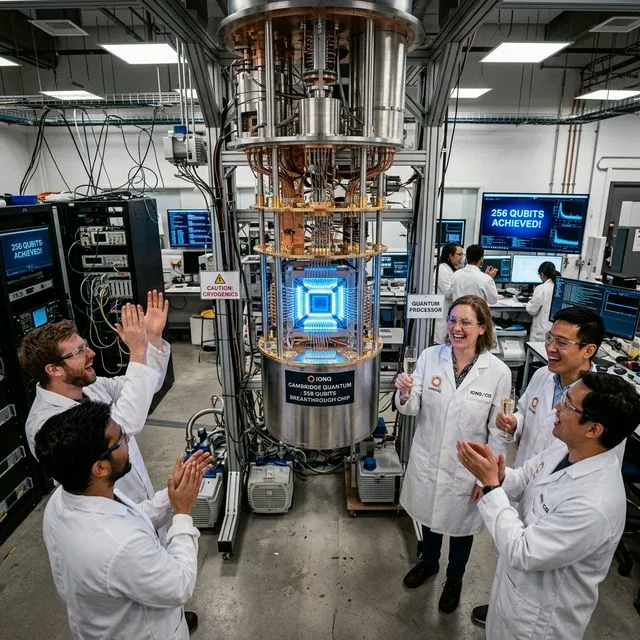
Quantum computing just took its most significant step toward practical application. IonQ, one of the leading quantum technology companies, announced a partnership with the University of Cambridge to establish the IonQ Quantum Innovation Centre — equipped with the most powerful quantum processor ever deployed on a university campus: 256 qubits based on trapped ions.
This isn't just another "quantum potential" announcement — it's the first time a commercial-scale quantum machine has been placed directly in the hands of academic researchers, with the explicit goal of solving real problems in medicine, AI, materials science, and cryptography.
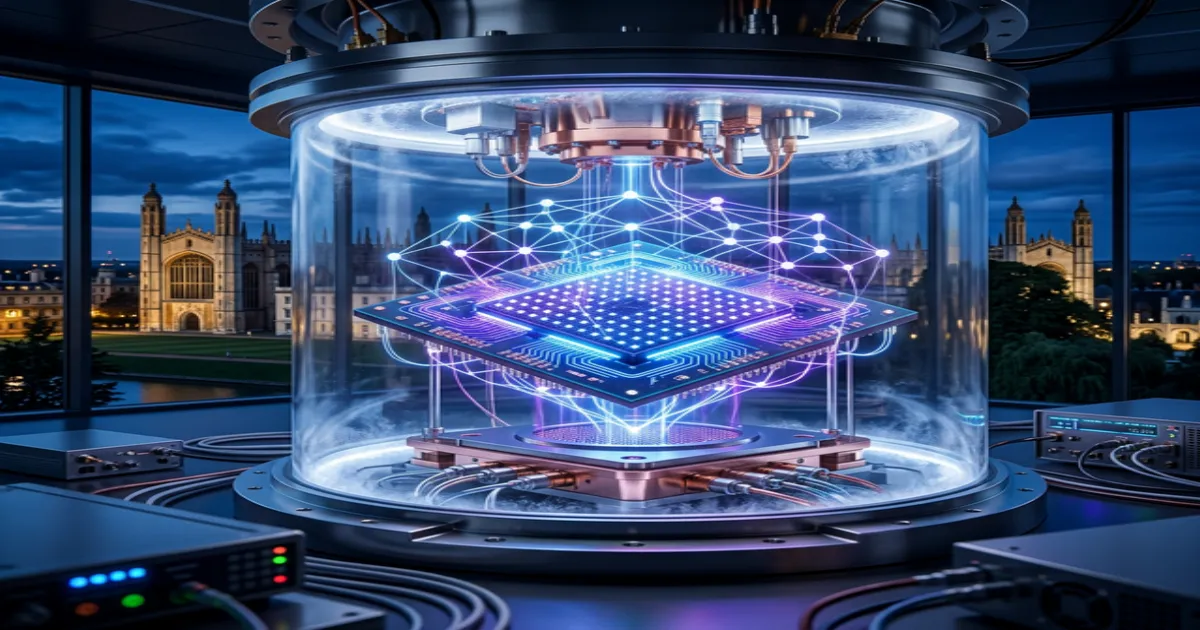
What Are 256 Qubits: Why This Number Matters
A classical computer operates with bits — units that are 0 or 1. A quantum computer uses qubits — units that can be 0, 1, or both simultaneously through quantum superposition. When qubits connect via quantum entanglement, computational capacity grows exponentially.
- 50 qubits can simulate states beyond the world's most powerful supercomputers
- 100 qubits achieve "quantum supremacy"
- 256 qubits represent a state space of 2^256 possibilities — larger than the total atoms in the observable universe
IonQ's Technology: Trapped Ions
IonQ traps individual ytterbium atoms in electromagnetic fields and manipulates their quantum states with precision lasers. Advantages:
- Superior fidelity: trapped ion qubits maintain coherence longer
- Full connectivity: any qubit can interact with any other qubit
- Room temperature: unlike superconducting systems requiring near absolute zero
- Chip scalability: 6th-gen uses photonic chips
The Quantum Innovation Centre: What Will Be Done
1. Drug Discovery
Simulating complex molecules to discover new medications. Simulations taking years on supercomputers may be completed in hours.
2. Materials Science
Designing new materials — high-temperature superconductors, carbon capture catalysts, next-gen battery materials.
3. Quantum AI
Training ML models using quantum optimization, potentially reducing time and energy for training massive LLMs.
4. Cryptography and Security
Developing post-quantum cryptography to protect against the inevitable "Q-Day" — when quantum computers can break RSA encryption protecting virtually all modern digital infrastructure.
Q-Day: The Threat Nobody Can Ignore
The most urgent aspect of quantum computing isn't what it can build, but what it can destroy. Q-Day is when a quantum computer can break RSA-2048 protecting:
- All global banking transactions
- Military communications
- Billions of medical records
- Critical infrastructure
Experts estimate Q-Day between 2030 and 2040. The threat is so serious that governments already practice "harvest now, decrypt later."
Where IonQ Stands
| Company | Technology | Qubits | Primary Focus |
|---|---|---|---|
| IonQ | Trapped ions | 256 | Commercial + Academic |
| IBM | Superconductors | 1,121 (Condor) | Enterprise |
| Superconductors | 105 (Willow) | Research | |
| Microsoft | Topological | ~50 (experimental) | Azure Quantum |
IonQ doesn't have IBM's raw numbers, but qubit quality — measured by fidelity and connectivity — is superior. It's the difference between 1,000 broken calculators and 256 perfect ones.
Conclusion: The Future Is in Cambridge
The university where Newton formulated gravity, Turing invented computing, and Hawking unraveled black holes now houses the machine that could solve humanity's most complex problems. 256 qubits in the hands of some of the planet's most brilliant researchers.
Sources and References
- IonQ — Quantum Innovation Centre
- University of Cambridge — Press Release
- Nature Physics — Ion Trap Quantum Computing
- MIT Technology Review — Quantum Computing 2026
Last updated: March 11, 2026


