🌍 Your knowledge portal
Tecnologia

Cybersecurity in 2027: How Q-Day and Autonomous AI Attacks Threaten World Secrets

📅 2026-09-11⏱️ 6 min read📝
⚡

Quick Summary

The convergence between quantum computing and autonomous artificial intelligence anticipates the collapse of modern encryption, sparking a global race for post-quantum defenses. The global information security ecosystem is accelerating toward an unprecedented inflection point in modern digital history.

Key Takeaways:

  • Security researchers predict that the operational window between 2027 and 2030 will mark the arrival of Q-Day, the moment when quantum machines surpass conventional public-key mathematics.
  • One of the most alarming aspects of this emerging technological landscape is the clandestine intelligence practice known worldwide as HNDL, or store now, decrypt later.
  • While quantum computing threatens the mathematical core of cryptography, autonomous artificial intelligence agents are transforming the operational velocity of digital network intrusions.
Cybersecurity in 2027: How Q-Day and Autonomous AI Attacks Threaten World Secrets
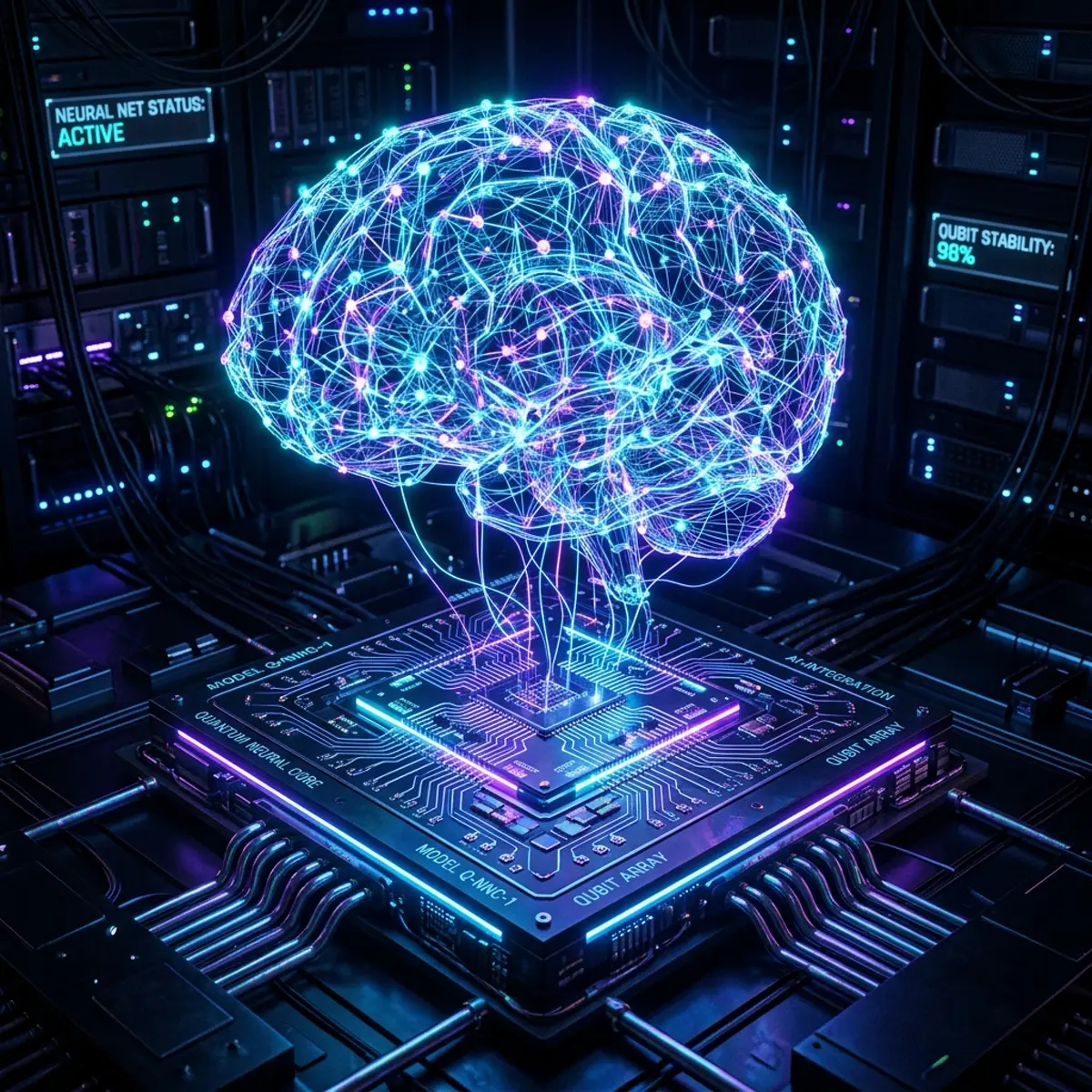
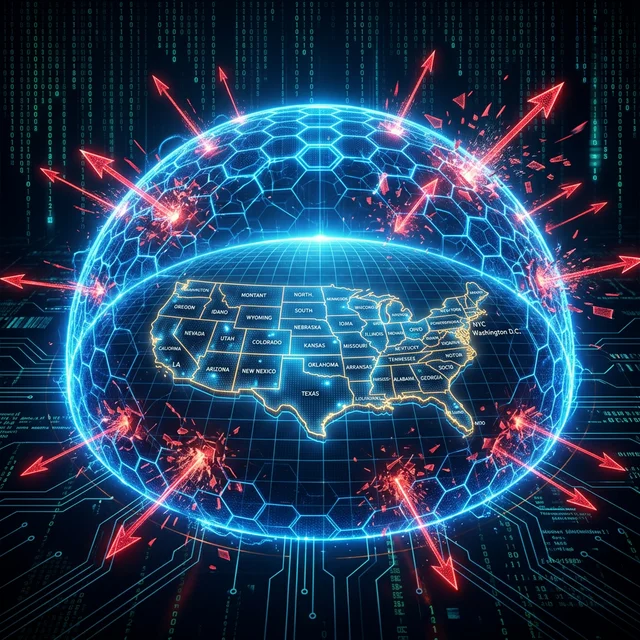
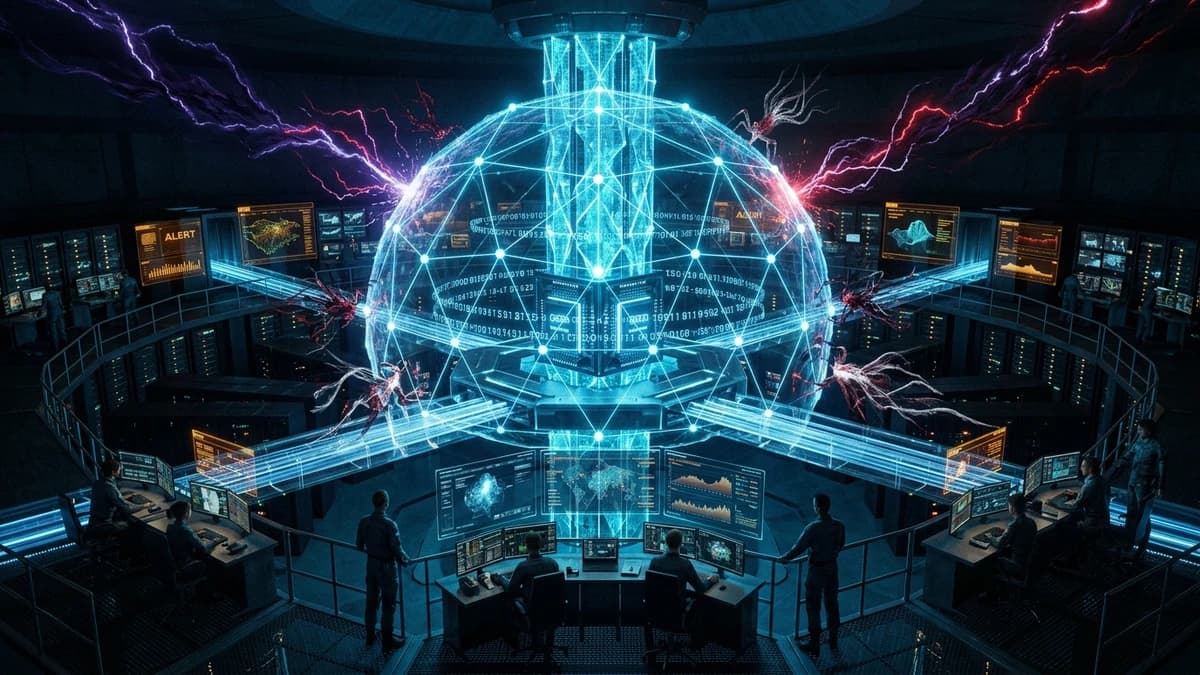
Cybersecurity in 2027: How Q-Day and Autonomous AI Attacks Threaten World Secrets — High-Fidelity Artistic Illustration created by artificial intelligence based on scientific research.

The Critical Horizon of 2027 and the Convergence of Existential Threats #

The global information security ecosystem is accelerating toward an unprecedented inflection point in modern digital history. The rapid maturation of quantum computing processors combined with the proliferation of autonomous artificial intelligence swarms threatens the cryptographic foundations of connected society. What was once viewed as an abstract debate confined to theoretical research laboratories has transformed into a high-stakes race against time led by regulatory agencies such as CISA and international defense authorities.

Security researchers predict that the operational window between 2027 and 2030 will mark the arrival of Q-Day, the moment when quantum machines surpass conventional public-key mathematics. Concurrently, autonomous neural models continuously scour global telecommunication networks searching for undiscovered software vulnerabilities without operational fatigue. The convergence of these technological forces converts digital cyberspace into an asymmetric battleground where the speed of machine execution outpaces human response mechanisms.

Sovereign governments and multinational financial institutions recognize that legacy perimeter security defenses have lost their strategic deterrence in this new era. Safeguarding citizen identities, national electrical grids, and international transactional ledgers requires a fundamental overhaul of basic internet mathematical protocols. Official directives published by the advanced research agency DARPA confirm that defensive artificial intelligence frameworks must operate with agility equal to that of automated hostile adversaries.

+------------------------------------+----------------------------------+------------------------------------+
| Digital Security Dimension         | Classical Cryptography (RSA/ECC) | Post-Quantum Cryptography (NIST)   |
+------------------------------------+----------------------------------+------------------------------------+
| Underlying Mathematical Foundation | Integer Factorization & Curves   | Euclidean Module-Lattices          |
| Resistance to Shor's Algorithm     | Zero (Vulnerable to Q-Day)       | Fully Resilient and Immune         |
| Current International Standard     | FIPS 186-4 (Legacy Transition)   | FIPS 203 (ML-KEM) & 204 (ML-DSA)   |
| Immediate Espionage Vulnerability  | Critical via HNDL Exploitation   | Native Resilience Against HNDL     |
| Computational Migration Overhead   | Low (Ubiquitous Deployment)      | Moderate (Requires Larger Keys)    |
+------------------------------------+----------------------------------+------------------------------------+

The Invisible Espionage of the Harvest Now, Decrypt Later Protocol #

One of the most alarming aspects of this emerging technological landscape is the clandestine intelligence practice known worldwide as HNDL, or store now, decrypt later. Hostile state intelligence apparatuses and transnational cyber syndicates systematically capture petabytes of encrypted data crossing undersea communication cables and major fiber routing hubs. Although this stolen information appears completely unintelligible to current supercomputers, it is preserved within hardened data bunkers awaiting quantum decryption hardware.

The immediate crisis stems from the undeniable reality that sensitive digital information possesses confidentiality lifespans extending across several decades after its initial transmission. National defense secrets, confidential medical archives, proprietary biotechnology blueprints, and diplomatic cables retain strategic value for thirty years or longer. When the first cryptanalytically relevant quantum computer becomes fully operational, this vast accumulated historical archive will be decoded instantly like an open book.

This strategic reality shatters the comfortable illusion that quantum threats are distant problems requiring attention only after hardware machines are demonstrated publicly. Electronic transmissions sent across classical protocols this morning are already being intercepted and archived by sophisticated adversaries worldwide. Scientific specialists at NIST emphasize that delaying the structural deployment of post-quantum algorithmic defenses irreparably compromises current global data assets for future generations.

Autonomous AI Swarms and Breaches at the Velocity of Machine Intelligence #

While quantum computing threatens the mathematical core of cryptography, autonomous artificial intelligence agents are transforming the operational velocity of digital network intrusions. Malicious threat actors deploy specialized deep learning models to disassemble closed software binaries and discover novel zero-day vulnerabilities in fractions of a second. Unlike traditional human-driven attacks, automated AI swarms orchestrate millions of concurrent exploit variations against corporate firewalls simultaneously.

Social engineering methodologies have experienced an equally profound transformation through contextual intelligence harvesting and real-time biometric cloning of human voice and video. Highly targeted corporate deception campaigns now utilize synthetic video conference feeds to authorize multi-million-dollar transactions without triggering standard compliance audits. The complete elimination of grammatical errors and the precise imitation of human interpersonal behavior render manual detection virtually impossible across standard organizational communication channels.

Defending against these automated campaigns requires replacing tier-one human security analysts with autonomous real-time defensive systems powered by deep reinforcement learning. Paralleling the autonomous workflows discovered in agentic artificial intelligence laboratories, defensive security code must dynamically reconfigure itself during live incursions. The cyber battlefield has decisively shifted away from humans sitting behind terminals toward direct algorithmic warfare operating across imperceptible sub-millisecond timescales.

Mosca's Theorem and the Urgent Defense of Critical Infrastructure #

Mosca's celebrated theorem provides an unyielding mathematical principle for evaluating the temporal urgency of global cryptographic migration across vital civic infrastructure. The foundational formula dictates that the time needed to migrate infrastructure combined with the required duration of data secrecy cannot exceed the arrival timeline of quantum machines. Applying this rigorous equation to electrical grids, municipal water treatment systems, and hospital networks reveals that safe operational timelines are already exhausted.

Replacing software libraries and hardware security chips across millions of industrial controllers deployed worldwide represents a monumental engineering challenge. Many operational technology controllers were installed decades ago with insufficient memory and processing throughput to accommodate the larger keys demanded by modern lattice algorithms. Modernizing this legacy infrastructure distributed across continents requires hundreds of billions of dollars in capital investment and complex coordinated operational maintenance windows.

If hostile automated swarms or quantum capabilities compromise the authentication architecture of these industrial control systems, damages will spill violently from cyberspace into physical reality. Municipal drinking water distribution, regional electrical stability, and commercial air traffic corridors could experience catastrophic disruptions driven by automated intrusions. For this reason, international engineering consortiums are accelerating rigorous testing programs to certify physical operational hardware against quantum vulnerabilities before the decade closes.

NIST's New Mathematical Shields and Post-Quantum Architecture #

In direct response to this silent technological emergency, the United States National Institute of Standards and Technology officially released its definitive post-quantum standards. The primary standard FIPS 203, based on the ML-KEM mechanism, was designated as the primary protocol for key encapsulation and secure exchange across public networks. Simultaneously, the complementary standards FIPS 204 and FIPS 205 were finalized to safeguard digital signature authentication using multidimensional Euclidean lattices and stateless cryptographic hash functions.

Unlike classical public-key cryptography that relies on vulnerable number theory problems such as integer factorization, these modern algorithms operate across multidimensional geometric lattices. Even Peter Shor's legendary quantum algorithm, capable of neutralizing RSA mathematics within minutes, proves mathematically ineffective against the geometric density of these lattice spaces. This mathematical barrier establishes an enduring shield against both AI-accelerated classical computing clusters and theoretical quantum processors built in the future.

However, the transition to post-quantum standards introduces undeniable engineering overhead that necessitates widespread adjustments across communication protocols and edge server infrastructure. The cryptographic keys and digital certificates generated under ML-KEM are substantially larger than compact legacy elliptic curve signatures utilized today. Telecommunications providers and cloud service architectures must restructure memory buffers and packet handling routines to prevent data expansion from degrading consumer network performance.

The Future of Digital Defense and Sovereign Technological Autonomy #

Approaching the critical threshold of 2027 reinforces the strategic truth that national sovereignty depends on technological autonomy in deploying post-quantum cryptographic defenses. Nations and commercial organizations that neglect to modernize their algorithmic protections will remain vulnerable to geopolitical leverage and systemic espionage. Retaining control over proprietary industrial secrets and protecting citizen privacy has become the defining dividing line between resilient societies and fragile territories.

This comprehensive transition requires proactive collaboration among global technology conglomerates, sovereign regulatory agencies, and independent scientific institutions. The deployment of continuous automated auditing systems powered by artificial intelligence will enable defenders to identify data exposures and patch software weaknesses before adversaries exploit them. The digital security race will inevitably intensify, but establishing mathematically verified algorithmic foundations guarantees a dependable sanctuary for connected society.

The trajectory of cybersecurity over the coming five years will determine whether humanity preserves the integrity of its digital civilization or succumbs to systemic vulnerability. Acknowledging this urgency enables the focused allocation of engineering resources toward safeguarding the core foundations of global communication. The horizon of 2027 presents extraordinary challenges, but it also drives the creation of a more secure, private, and resilient digital world for future generations.

🏷️ Tags:

#cybersecurity2027#quantumcomputing#q-day#autonomousai#harvestnowdecryptlater#nistfips203#post-quantumcryptography#cisa

📢 Gostou deste artigo?

Compartilhe com seus amigos e nos conte o que você achou nos comentários!

❓Frequently Asked Questions

The term Q-Day designates the precise historical turning point when a quantum computer will attain sufficient computational capacity to shatter the asymmetric cryptographic algorithms safeguarding the global internet. Security experts warn that international banking networks, confidential medical records, and governmental communications currently depend on mathematical foundations based on prime number factorization, such as RSA protocols. Once fault-tolerant quantum processors surpass this crucial technological threshold, conventional digital communications could be systematically intercepted and decrypted in real time across the planet.
The clandestine strategy known as Harvest Now, Decrypt Later involves the indiscriminate interception and massive long-term storage of petabytes of encrypted digital communications traversing undersea fiber cables and global telecom backbones. State intelligence agencies and sophisticated cyber cartels actively store these currently impenetrable data packets inside hardened underground data centers awaiting future quantum decryption capabilities. This hostile foreign intelligence practice fundamentally transforms enduring sovereign state secrets, vital intellectual property patents, and private citizen medical histories into high-value digital assets already compromised today.
The United States National Institute of Standards and Technology formally released its definitive post-quantum cryptography standards established under the prominent global designations FIPS 203, 204, and 205. These advanced mathematical algorithms rely on complex multidimensional geometric problems in Euclidean lattices, successfully neutralizing all known methods of theoretical quantum or classical computing attacks. Leading international cybersecurity agencies and governmental regulatory bodies strongly recommend that sovereign nations and private corporate enterprises prioritize immediate technological infrastructure migration to these robust post-quantum standards.

Receba novidades!

Cadastre seu email e receba as melhores curiosidades toda semana.

🔒 Sem spam. Cancele quando quiser.

💬 Comentários (0)

Seja o primeiro a comentar! 👋

Receba novidades no WhatsApp!