
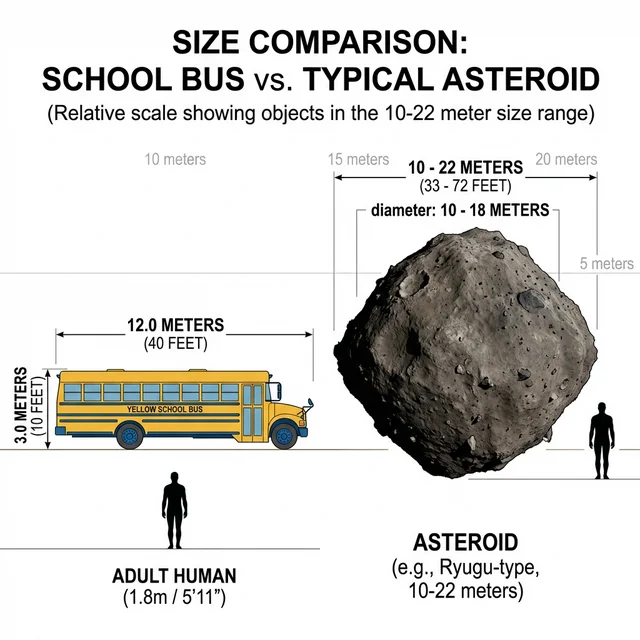
On the morning of March 11, 2026, a space rock the size of a school bus passed by Earth at a distance closer than the Moon — and the most unsettling part is that astronomers only discovered it four days earlier. Asteroid 2026 EG1, with an estimated diameter between 10 and 22 meters, passed just 317,791 kilometers from our planet, traveling at an impressive speed of 34,621 km/h. This flyby, while posing no collision risk, reignited the global debate about gaps in humanity's planetary defense capabilities.
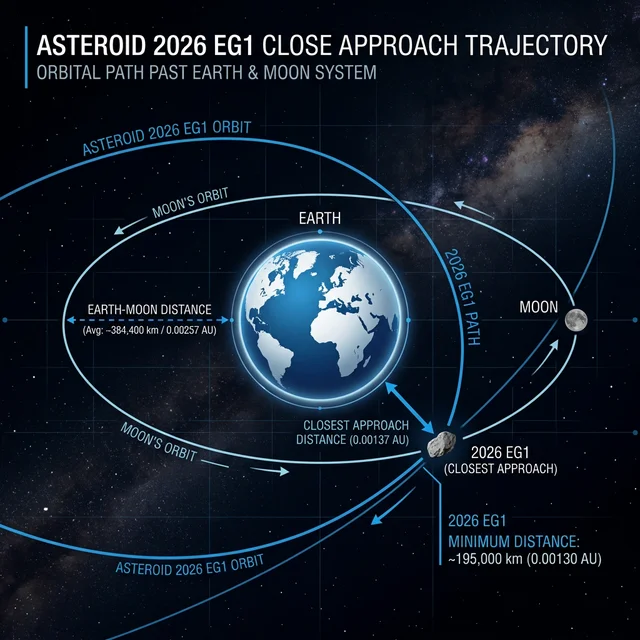
The event occurred at 11:42 UTC (6:42 AM Eastern Time), when the asteroid crossed over the Antarctic region, invisible to the naked eye but perfectly tracked by telescopes around the world. To put the proximity in context: the Moon orbits Earth at an average distance of 384,400 km, meaning 2026 EG1 passed at 0.83 lunar distances — technically closer to us than the Moon.
What We Know About 2026 EG1
Asteroid 2026 EG1 was discovered on March 7, 2026, by the Catalina Sky Survey, operated by the University of Arizona. With only four days of advance warning, astronomers had limited time to calculate its orbit with precision.
Physical Characteristics
| Property | Value |
|---|---|
| Designation | 2026 EG1 |
| Estimated diameter | 10 – 22 meters |
| Speed | 34,621 km/h (9.6 km/s) |
| Minimum distance from Earth | 317,791 km |
| Distance in lunar units | 0.83 LD |
| Flyby date | March 11, 2026, 11:42 UTC |
| Closest point | Over Antarctica |
| Orbital class | Apollo |
| Discovered on | March 7, 2026 |
| Discovered by | Catalina Sky Survey |
The asteroid belongs to the Apollo orbital class, a group of asteroids whose orbits cross Earth's. Apollo asteroids are considered potentially hazardous when they exceed 140 meters in diameter. At a modest 10-22 meters, 2026 EG1 did not reach that threshold, but its size is comparable to the Chelyabinsk meteorite that caused destruction in Russia in 2013.
The Pass Over Antarctica
The closest approach occurred over Earth's most remote and uninhabited continent — Antarctica. While this location minimized any theoretical risk to human populations, it also meant that few ground-based observatories had ideal conditions to capture detailed images of the object.
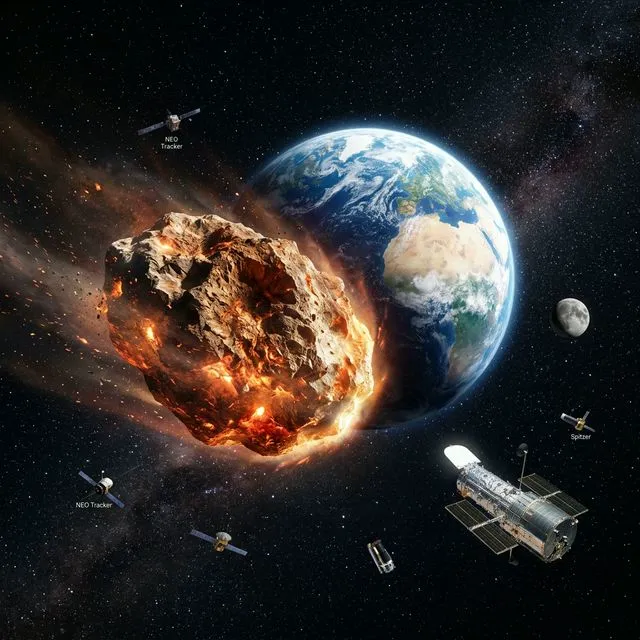
NASA's Goldstone Observatory radio telescopes in California, along with the Arecibo Observatory (rebuilt in 2025 after its 2020 collapse), were able to track the object with sufficient precision to refine its orbital parameters. Radar observations revealed that the asteroid has an irregular shape, likely a fragmented rock typical of remnants from the solar system's formation.
Why Was It Discovered So Late?
The discovery of asteroid 2026 EG1 just four days before its Earth flyby is, without question, the most concerning aspect of this event. How is it possible that, in 2026, with all available technology, a 10 to 22-meter object can pass this close without anyone detecting it in advance?
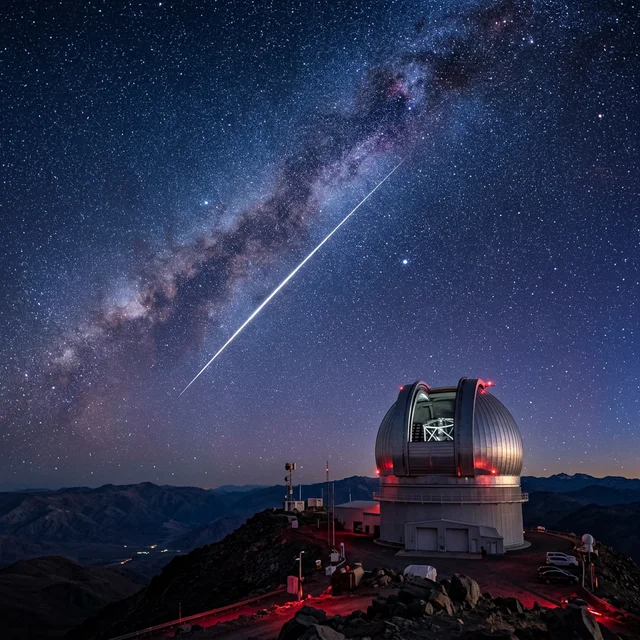
The answer lies in the fundamental limitations of our space surveillance systems:
Size and Reflectivity
Bus-sized asteroids reflect very little sunlight, making them extremely difficult to detect against the blackness of space. Unlike larger asteroids that can reflect enough light to be captured by routine surveys, objects in the 10-20 meter range are effectively "invisible" until they are relatively close. The apparent magnitude of 2026 EG1, for example, was below 25 on the astronomical scale — comparable to trying to find a coin tossed onto a football field as seen from space.
Approach Direction
Many asteroids approach Earth from the direction of the Sun, a zone practically impossible to monitor with ground-based telescopes. NASA's NEO Surveyor mission, planned to observe in infrared from space, will partially address this blind spot, but its launch is scheduled for 2028.
Volume of Space
Space is incomprehensibly vast. Even with dozens of dedicated telescopes scanning the sky every night, the fraction effectively monitored at any given moment is surprisingly small. NASA estimates that we know only about 40% of asteroids larger than 140 meters — and for objects in the 10-50 meter range, that number drops below 1%.
Albedo and Composition
Another critical factor is albedo — an object's ability to reflect light. Carbonaceous asteroids (C-type), which make up approximately 75% of the known asteroid population, are extremely dark, with albedos as low as 0.03 (reflecting only 3% of the light they receive). For comparison, fresh snow has an albedo of 0.9. This means many asteroids are literally darker than asphalt, making their detection against the black background of deep space extraordinarily difficult.
Composition also determines behavior during atmospheric entry. Rocky asteroids (S-type) tend to fragment in the atmosphere, creating airbursts like Chelyabinsk. Metallic asteroids (M-type), composed of iron and nickel, are more resistant and more likely to survive atmospheric transit and strike the surface as solid meteorites.
Chelyabinsk and Tunguska: What Happens If One of These Asteroids Hits Earth?
The most relevant comparison event is the Chelyabinsk meteorite, which entered Earth's atmosphere on February 15, 2013, over the Russian city of the same name. That object was approximately 17-20 meters in diameter — within the same size range as 2026 EG1.
The result was devastating: the atmospheric explosion at 30 km altitude released energy equivalent to 440-500 kilotons of TNT — about 30 times the Hiroshima atomic bomb. The resulting shockwave damaged over 7,200 buildings in six cities, and glass shards from the sonic explosion injured about 1,500 people.
The Timeline of Terror
The event lasted less than one minute:
- 09:20:33 — The object enters the atmosphere at 19 km/s (68,400 km/h), 55 times the speed of sound
- 09:20:40 — Brightness reaches luminosity greater than the Sun
- 09:20:48 — Main fragmentation at 30 km altitude
- 09:20:56 — Shockwave hits the ground, shattering millions of square meters of glass
- 09:21:30 — A 654 kg fragment strikes Lake Chebarkul
No warning system detected the meteor before its atmospheric entry. It approached from the direction of the Sun — exactly the blind spot that NEO Surveyor aims to address.
The Tunguska Event (1908)
For larger objects in the same category, the Tunguska Event is revelatory. A 50-80 meter asteroid exploded over Siberia in 1908, flattening 80 million trees across 2,150 km² — an area equivalent to a major metropolitan city. The 10-15 megaton explosion was 1,000 times more powerful than Hiroshima. Fortunately, the region was uninhabited. Had a similar event occurred over a modern metropolis, the consequences would have been catastrophic.
If 2026 EG1 had followed a collision trajectory, the outcome would have depended on entry angle and composition. An impact similar to Chelyabinsk over a densely populated area like São Paulo, Mumbai, or Tokyo could cause tens of thousands of injuries and tens of billions of dollars in damage.
The Planetary Defense System in 2026
Humanity is not completely defenseless against cosmic threats. In the past decade, significant advances have been made:
DART: The Proof of Concept
In September 2022, NASA's DART mission demonstrated that it is possible to alter an asteroid's orbit by crashing a spacecraft into it. The mission impacted Dimorphos, a moon of asteroid Didymos, and altered its orbital period by 33 minutes — far more than the predicted 7 minutes. However, this technique requires months or years of advance notice. With only four days of warning, as in the case of 2026 EG1, there would be nothing we could do.
ESA's Hera Mission
In October 2024, the European Space Agency launched the Hera mission to visit the Didymos-Dimorphos system and study the effects of the DART impact in detail. Hera will provide crucial data on mass, composition, and internal structure, essential for refining deflection models. Its arrival is expected in late 2026.
Vera C. Rubin Observatory
The Vera C. Rubin Observatory in Chile, operational since 2025, scans the entire visible sky every three nights. It is expected to detect 90% of objects larger than 140 meters in the next ten years. For smaller objects like 2026 EG1, the improvement will be partial — physics imposes fundamental limits on optical detection of small, dark rocks.
NEO Surveyor
NASA's NEO Surveyor mission, a dedicated infrared space telescope, is scheduled for launch in 2028. Operating in space at infrared wavelengths, it will detect asteroids by the heat they emit — including those approaching from the direction of the Sun, the biggest blind spot for ground-based telescopes. The program's total cost is $1.2 billion, an insignificant fraction compared to the destructive potential of an asteroid impact.
Why Planetary Defense Matters
For many people, the passage of a bus-sized asteroid may seem like a trivial event — after all, it didn't hit us. But the numbers tell a different and concerning story:
| Category | Size | Known | % Cataloged | Risk |
|---|---|---|---|---|
| Global extinction | > 1 km | ~950 | ~95% | Very low |
| Regional devastation | 140m – 1km | ~11,000 | ~40% | Low |
| Urban destruction | 50 – 140m | ~3,000 | ~5% | Moderate |
| Local damage (Chelyabinsk-type) | 10 – 50m | ~2,000 | < 1% | High |
The category in which 2026 EG1 falls — 10 to 50 meters — is precisely the most problematic: high frequency of occurrence and extremely low cataloging rate. It is estimated that millions of objects in this size range cross Earth's vicinity, and we know less than 1% of them.
The Frequency of Cosmic Visitors
Earth receives visitors from space much more frequently than most people realize. Small meteoroids — sand grain-sized fragments — hit our atmosphere constantly, creating the famous "shooting stars." Larger objects, however, are rarer but not uncommon.
According to NASA estimates, an object the size of 2026 EG1 (10-20 meters) enters Earth's atmosphere approximately once every 10 to 30 years. Most of these events occur over oceans or uninhabited areas, going completely unnoticed. However, increasing global urbanization means the probability of an impact affecting an inhabited area is slowly increasing over time.
Notable Recent Events
The passage of 2026 EG1 is not an isolated event. In recent years, several asteroids have made remarkably close flybys:
- 2023 BU (January 2023): Passed just 3,600 km above Earth's surface — closer than many geostationary satellites.
- 2024 BX1 (January 2024): A mere 1-meter asteroid detected only hours before disintegrating in the atmosphere over Berlin, Germany.
- Apophis (April 2029): This 370-meter asteroid will pass just 31,000 km from Earth, closer than communication satellites. It will be visible to the naked eye in several regions worldwide.
- 2019 OK (July 2019): A 130-meter "city-killer" asteroid that passed 72,000 km away without prior warning.
What the Future Holds
The astronomical community is in consensus: we need to do more to protect Earth. NASA's Planetary Defense Coordination Office and the European Space Agency (ESA) are expanding their detection programs and working together to develop more robust mitigation strategies.
NASA's planetary defense budget has grown from $60 million annually in 2015 to over $200 million in 2026, but experts argue more investment is needed. The total cost of the NEO Surveyor program, for example, is approximately $1.2 billion — a fraction of other space programs' costs and insignificant compared to the potential destruction from an asteroid impact.
International Cooperation
Planetary defense is, by nature, a global effort. The International Asteroid Warning Network (IAWN), coordinated by the UN, connects observatories from dozens of countries in a real-time data sharing system. When 2026 EG1 was detected, information was distributed to observatories worldwide within hours, allowing multiple stations to refine the object's trajectory.
The Space Mission Planning Advisory Group (SMPAG), also under UN auspices, is responsible for coordinating an international response should an asteroid on a collision course be detected. Simulations conducted in 2024 and 2025 made it clear that cooperation between space agencies from different countries would be essential for mounting a deflection mission in sufficient time.
Brazil's Role
Brazil, despite not having a dedicated planetary defense agency, contributes to the global effort through the National Observatory (ON) and the National Astrophysics Laboratory (LNA). The Pico dos Dias Observatory in Minas Gerais and the future GMTO (Giant Magellan Telescope Observatory), in which Brazil is a partner, will significantly expand near-Earth object detection capabilities from the southern hemisphere.
The southern hemisphere is relatively under-monitored compared to the northern hemisphere, where most major observatories are concentrated. The 2026 EG1 flyby over Antarctica perfectly illustrates the need for greater observational coverage in the austral hemisphere.
The Economics of Asteroids
Ironically, objects like 2026 EG1 don't just represent threats — they are also potential sources of valuable resources. Asteroid mining, while still in the conceptual stage, is considered by many economists and engineers as the next frontier of space exploration. A metallic asteroid just 25 meters in diameter could contain precious metals — such as platinum, palladium, and gold — with an estimated value of billions of dollars.
Companies like AstroForge and TransAstra are actively developing prospecting and space mining technologies, with demonstration missions planned for the end of the decade. Data collected during asteroid flybys like 2026 EG1 indirectly contribute to these efforts.
The Torino Scale and Real Risk
Astronomers use the Torino Scale to classify the impact risk of near-Earth objects. The scale ranges from 0 (no risk) to 10 (certain collision with global consequences). 2026 EG1 was classified as level 0 — no collision risk — but the fact that it was discovered with only four days of advance notice means that, had it posed a real threat, humanity would have had virtually zero time to react.
Currently, no known asteroid has a classification above 0 on the Torino Scale for the next 100 years. However, this is not necessarily comforting: as demonstrated by 2026 EG1, many potentially dangerous objects have simply not yet been discovered. What we don't know can, quite literally, hit us.
Conclusion: A Cosmic Reminder
The passage of asteroid 2026 EG1 serves as a powerful reminder: we live in a dynamic and sometimes dangerous solar system. While statistical probabilities are in our favor, the certainty is that, at some point in the future, a significant asteroid will be on a collision course with Earth. The question is not if this will happen, but when — and whether we will be prepared when that day comes.
The good news is that, for the first time in human history, we have the technology to detect cosmic threats and potentially deflect dangerous asteroids. The challenge is to invest adequately in this capability before it needs to be used in a real emergency. As Carl Sagan said decades ago: "The dinosaurs became extinct because they didn't have a space program." It's up to us to ensure we don't repeat their fate.
The next significant flyby will occur on April 13, 2029, when asteroid Apophis — 370 meters in diameter with an estimated mass of 27 million tons — will pass just 31,000 km from Earth. Unlike 2026 EG1, Apophis is large enough to cause regional devastation in the event of a collision, and will be visible to the naked eye in the night sky from several regions, including Brazil. This event will be a unique opportunity to test our detection and tracking systems under real conditions — and a visceral reminder of the vulnerability of our fragile blue planet floating in the vast and unpredictable cosmos.
Scientists around the world are preparing for the Apophis flyby as both a scientific goldmine and a planetary defense exercise. Multiple space agencies plan to send spacecraft to Apophis during its close approach, turning a potential threat into an unprecedented opportunity to study a large near-Earth asteroid up close. The data gathered will be invaluable for refining our understanding of asteroid composition, structure, and behavior — knowledge that could one day prove essential for deflecting a true Earth-threatening object.
Sources: NASA Center for Near Earth Object Studies (CNEOS), Catalina Sky Survey, International Astronomical Union, Associated Press, Space.com, The Planetary Society


