Black Holes Explained: Everything You Need to Know ⚫🌌
Black holes are the most extreme objects in the universe — regions of space where gravity is so intense that nothing, absolutely nothing, not even light traveling at 300,000 km/s, can escape. They warp time, swallow entire stars, and defy the laws of physics as we know them.
But black holes are not merely cosmic curiosities. They are fundamental to the structure of the universe: they exist at the center of virtually every galaxy, influence star formation, and may hold the key to unifying the two greatest theories of physics — general relativity and quantum mechanics.
From a theoretical idea proposed in 1783 to the first direct photograph in 2019, the history of black holes is also the story of how humanity learned to see the invisible.
🔭 What Is a Black Hole?
A black hole is a region of spacetime where matter has been compressed into such a small volume that the resulting gravity becomes — as far as we know — infinitely strong. At the central point, called the singularity, all mass is concentrated in a theoretically infinitesimal space: zero volume, infinite density.
Surrounding the singularity is the event horizon — an invisible boundary marking the point of no return. Anything that crosses the event horizon — light, matter, information — can never escape again. This is why black holes are black: light that enters never comes back out.
To understand the scale: the event horizon of the black hole at the center of the Milky Way (Sagittarius A*) has a radius of 12 million kilometers — about 17 times the Sun's radius. But the mass concentrated there equals 4 million Suns. If all of Earth's mass were compressed into a black hole, the event horizon would be just 1.7 centimeters in diameter — smaller than a marble.
📜 History: From Wild Idea to Observed Reality
1783: English geologist John Michell proposes the idea of "dark stars" — objects so massive that not even light could escape. Pierre-Simon Laplace independently reaches the same conclusion in 1796.
1915: Einstein publishes the Theory of General Relativity, providing the mathematical foundation for black holes — though he himself did not believe they existed in nature.
1916: Karl Schwarzschild solves Einstein's equations and calculates the Schwarzschild radius — the distance from the center below which nothing escapes. This is the first mathematical description of an event horizon.
1964: Cygnus X-1, an X-ray source in the constellation Cygnus, is identified as a probable black hole — the first observational candidate.
1974: Stephen Hawking proposes that black holes emit radiation (Hawking Radiation) and can eventually evaporate.
2015: LIGO detects gravitational waves for the first time, from the merger of two black holes 1.3 billion light-years away. Nobel Prize in Physics in 2017.
2019: The Event Horizon Telescope captures the first direct image of a black hole (M87*).
2020: Roger Penrose, Reinhard Genzel, and Andrea Ghez win the Nobel Prize in Physics for mathematically proving that black holes are an inevitable consequence of general relativity and for discovering the supermassive compact object at the center of the Milky Way.
⚙️ How Do Black Holes Form?
Death of Massive Stars (Stellar Collapse)
The most common formation pathway is the death of massive stars. A star with at least 20-25 times the Sun's mass lives by burning hydrogen and helium in its core. When nuclear fuel runs out, the star loses the pressure that counterbalanced its own gravity.
What happens next is brutally fast: the core collapses upon itself in less than one second — from a diameter of thousands of kilometers to just ~20 km. The outer layers are expelled in a supernova — an explosion visible from galaxies away, brief but brighter than billions of stars combined.
If the remnant core has more than ~3 solar masses (the Tolman-Oppenheimer-Volkoff limit), no known force — not even neutron repulsion — can prevent complete gravitational collapse. Matter is compressed until it forms a singularity. A black hole is born.
Supermassive Black Holes: The Billion-Dollar Question
The origin of supermassive black holes (millions to billions of solar masses) is one of astrophysics' greatest mysteries. They exist at the center of virtually every galaxy, but how did they grow so enormous so quickly?
Hypotheses include: merger of many smaller black holes over billions of years; direct collapse of massive gas clouds in the early universe (skipping the star phase); or primordial "seeds" formed fractions of a second after the Big Bang.
The James Webb Space Telescope has been complicating the problem: in 2023-2024, it discovered supermassive black holes in galaxies that existed when the universe was less than 700 million years old — seemingly insufficient time to grow so large through conventional merging.
📏 The Three Types of Black Holes
Stellar Black Holes (3-100 M☉)
The most common — they exist in the billions in each galaxy. They form from the death of massive stars. The first confirmed, Cygnus X-1 (1964), has about 21 solar masses. In 2019, LIGO detected the merger of two stellar black holes that produced a black hole of 142 solar masses — the most massive ever observed through gravitational waves.
Supermassive Black Holes (10⁶-10¹⁰ M☉)
The giants. They inhabit the center of virtually every galaxy. Sagittarius A*, at the center of the Milky Way, has ~4 million M☉. The largest ever discovered, Phoenix A, has an impressive 100 billion solar masses — with an event horizon larger than the entire Solar System.
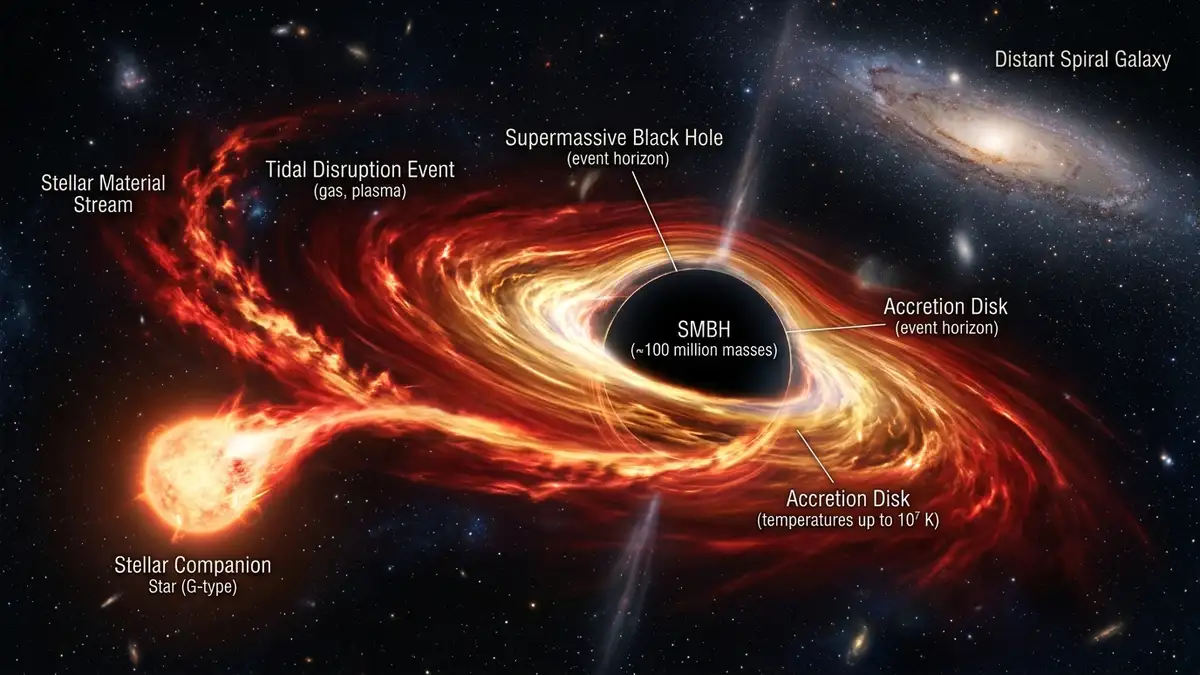
When matter falls into supermassive black holes, it heats to billions of degrees and emits energy jets extending for thousands of light-years — the so-called quasars, visible at cosmic distances.
Intermediate Black Holes (10²-10⁵ M☉)
The "missing link." Few have been confirmed — the most convincing detected by LIGO in 2019 (GW190521, ~142 M☉). They may be the intermediate stage between stellar and supermassive, but their formation is still debated.
📸 The First Photo: The Event Horizon Telescope
On April 10, 2019, humanity saw a black hole for the first time. The Event Horizon Telescope (EHT) — a network of 8 synchronized radio telescopes around the globe, functioning as a virtual telescope the size of Earth — captured the image of M87*, the 6.5-billion-solar-mass supermassive black hole at the center of galaxy Messier 87, 55 million light-years away.
The image shows an asymmetric bright ring of superheated gas around a dark central shadow — exactly as predicted by General Relativity. The ring is asymmetric because matter moving toward us appears brighter (relativistic Doppler effect).
To produce it, the EHT collected 5 petabytes of data (equivalent to 5,000 years of MP3s) that were physically transported on hard drives to processing centers — the volume was too large to transmit over the internet.
In May 2022, the EHT revealed the first image of Sagittarius A, our galaxy's black hole. Sgr A is 1,500 times smaller and closer than M87*, which paradoxically made capture harder: matter orbits so fast that it changes appearance in minutes, requiring far more sophisticated imaging techniques.
🕳️ What Happens Inside a Black Hole?
Nobody knows for certain — and this is one of physics' greatest open questions. General Relativity predicts that all matter is compressed into a singularity of infinite density, but quantum mechanics suggests that infinities do not exist in nature. The two theories are incompatible at the singularity, meaning one of them (or both) is incomplete.
The experience of falling into a black hole depends dramatically on size:
In a stellar black hole (small), tidal forces would be so extreme that your body would be stretched vertically and compressed horizontally — a process physicists actually call spaghettification (a technical term, not a joke).
In a supermassive black hole (enormous), tidal forces at the event horizon would be gentle enough that you would cross it without noticing anything special — at least initially. But from that point on, returning would be physically impossible.
For an outside observer, you would appear to slow down, freeze, and gradually darken at the event horizon, becoming increasingly red until you vanished — because extreme gravity stretches light and slows time.
⏰ Black Holes and Time
One of the most fascinating consequences: gravity slows down time. The stronger the gravity, the slower time passes — a measurable effect that GPS satellites must correct daily (clocks in orbit run ~45 microseconds faster per day than clocks on the surface).
Near a black hole, this effect is extravagant. If you spent one hour orbiting close to the event horizon of a supermassive black hole, years or decades could have passed for someone on Earth.
The film Interstellar (2014), with consultation from Nobel laureate Roger Penrose and physicist Kip Thorne (also a Nobel laureate), dramatized this: one hour on planet Miller, near the black hole Gargantua, equaled 7 years on Earth. This is not science fiction — it is a direct mathematical consequence of General Relativity.
☢️ Hawking Radiation: Can Black Holes Die?
In 1974, Stephen Hawking made a theoretical discovery that shocked the scientific community: black holes are not completely black. They emit extremely weak radiation — called Hawking Radiation — caused by quantum effects at the event horizon.
The mechanism: in the quantum vacuum, particle-antiparticle pairs constantly appear and annihilate. At the event horizon, one particle can fall into the black hole while the other escapes. The escaping particle carries energy, and the black hole loses equivalent mass. Over unimaginably long timescales, the black hole completely evaporates.
For a stellar black hole, this process would take 10⁶⁷ years — far longer than the age of the universe (13.8 billion years). For a supermassive one, 10¹⁰⁰ years. But very small primordial black holes (if they exist) could be evaporating right now.
Hawking Radiation has never been directly observed — it is extremely weak — but it has profound implications for fundamental physics, including the famous Information Paradox: if matter (and the information it carries) falls into a black hole and the black hole eventually evaporates, where does the information go?
🌍 Are Black Holes Dangerous to Earth?
No. The nearest confirmed black hole, Gaia BH1, is about 1,560 light-years away — far too distant for any gravitational influence.
Black holes are not cosmic vacuum cleaners. They only gravitationally affect objects that come very close. If the Sun were magically replaced by a black hole of the same mass, Earth would continue orbiting normally in the same orbit — it would just become extremely cold and dark.
Frequently Asked Questions
Can black holes be used for time travel?
The time distortion near black holes would theoretically allow "traveling to the future" (experiencing less time than distant observers). Travel to the past would require exotic structures like wormholes, which are theoretically possible but never observed.
What is a white hole?
The theoretical opposite of a black hole: a region from which matter and light can only exit, never enter. Predicted mathematically by General Relativity, they have never been observed. Some theorists speculate that the Big Bang could have been a white hole.
How many black holes exist?
A 2022 estimate (Sicilia et al.): ~40 quintillion (4 × 10¹⁹) stellar black holes in the observable universe. Each galaxy has at least one supermassive black hole at its center.
Can the LHC create a black hole?
It is physically possible in theories with extra dimensions, but any black hole created would have subatomic mass and evaporate via Hawking Radiation in ~10⁻²⁷ seconds — before swallowing a single atom. There is no risk.
Sources: Event Horizon Telescope Collaboration (2019, 2022), LIGO/Virgo Collaboration, NASA, Hawking S.W. "Particle Creation by Black Holes" (1975), Sicilia et al. "The Stellar-Mass Black Hole Population" (ApJ, 2022), Penrose R. (Nobel Lecture, 2020). Updated January 2026.
Read also: