10 Bizarre Facts About the Universe That Will Blow Your Mind 🌌🤯
The universe is far stranger than any science fiction could ever imagine. The laws of physics allow things that seem absurd — diamond rain, singing stars, planets made of precious gems, and the disconcerting revelation that you've never actually touched anything in your entire life.
These 10 facts are scientifically proven. They're not theories, not speculation — they're observations confirmed by telescopes, particle accelerators, and space missions. And each one is more bizarre than the last.
1. It Rains Diamonds on Neptune and Uranus
On the ice giants of the outer solar system, conditions are so extreme that the methane (CH₄) in the atmosphere is literally crushed into diamonds that precipitate like rain toward the core.
The mechanism works like this: approximately 5,000 miles below the atmospheric surface, pressure reaches 200,000 times that of Earth's surface and temperature exceeds 8,500°F. Under these conditions, methane molecules dissociate — hydrogen atoms are released and carbon atoms crystallize into diamond structure.
Scientists estimate that millions of tons of diamonds are continuously floating and precipitating in these atmospheres. Some crystals may reach the size of icebergs, slowly sinking over thousands of years until they settle in a "liquid diamond ocean" around the core.
This isn't just theory: researchers at the SLAC National Accelerator Laboratory (Stanford) recreated these conditions in 2017 using high-power lasers on polystyrene (which has a carbon-hydrogen ratio similar to methane) and observed the formation of nanodiamonds in real time. Diamond rain is a phenomenon happening right now, 2.8 billion miles away.
2. Space Has a Smell — And It's Like Barbecue
Astronauts who have performed spacewalks consistently report that, upon returning to the airlock, space has a distinct smell. Multiple descriptions converge: hot metal, charred meat, gunpowder, and industrial welding.
The odor is caused by polycyclic aromatic hydrocarbons (PAHs) — complex carbon molecules that form when stars die and that permeate the interstellar medium. These molecules adhere to spacesuits during EVAs (extravehicular activities) and are detected by smell when astronauts return to the pressurized environment.
The fascinating detail: PAHs are the same compounds produced when you barbecue — incomplete combustion of carbon generates exactly these molecules. Space literally smells like cosmic barbecue.
In 2020, a company called Eau de Space marketed a perfume that replicated the smell of space, based on descriptions from NASA astronauts. The bottles sold out in hours.
3. There's a Diamond Planet Worth More Than the World Economy
The exoplanet 55 Cancri e, located 40 light-years away in the Cancer constellation, is composed mainly of crystallized carbon — essentially a giant diamond twice the size of Earth.
With a mass 8 times that of Earth and a surface temperature of ~4,400°F, conditions are far too hostile for a visit. But the numbers are absurd: scientists estimate that at least one-third of the planet's mass is pure diamond — which would represent a value of approximately $26.9 nonillion (26.9 × 10³⁰). For reference, the entire world GDP is ~$100 trillion. The planet is worth 269 quintillion times more than the entire human economy.
In 2012, researchers at Yale University published the study that confirmed the crystalline carbon composition. Since then, other "diamond planets" have been identified, suggesting that carbon-rich planets may be relatively common in the galaxy.
4. The Sun Makes Music (And Scientists Have Recorded It)
The Sun produces sound waves generated by turbulent plasma convections on its surface — bubbles of gas at 10,000°F rising and falling like water boiling in a cosmic pot. These waves travel through the star's interior and create vibration patterns that scientists capture through helioseismology.
NASA and ESA converted these vibrations into frequencies audible to humans. The result is mesmerizing: a deep, continuous hum that resembles a choir of Tibetan monks or the low drone of a didgeridoo. Different regions of the Sun "sing" at different frequencies, creating a layered cosmic symphony.
Sound doesn't travel through the vacuum of space — we couldn't hear it even if we were nearby. But the vibrations are detected by instruments that measure oscillations on the solar surface. Studying these waves allows scientists to map the Sun's interior with precision — it's literally a stellar ultrasound.
5. Right Now, You're Traveling at 1.3 Million mph
Sitting here, reading this article, apparently motionless — you're moving through the cosmos at absolutely dizzying speeds. Each layer of movement adds up:
| Movement | Speed |
|---|---|
| Earth's rotation (at equator) | 1,037 mph |
| Earth around the Sun | 66,500 mph |
| Solar System in the Milky Way | 514,000 mph |
| Milky Way toward Virgo | 1,300,000 mph |
Approximate total: 1.3 million mph relative to the cosmic microwave background (the most "absolute" reference frame we have).
We feel absolutely nothing because everything around us moves together. It's the same principle as being inside an airplane: at 550 mph, your coffee stays stable on the tray because it's also going 550 mph. Speed is only perceptible relative to something stationary — and in the universe, nothing is stationary.
6. You've Never Touched Anything in Your Life
If you could remove all the empty space from the atoms in your body, all of humanity — 8 billion people — would fit in a sugar cube. Atoms are 99.9999999% empty space. The atomic nucleus is minuscule compared to the electron cloud surrounding it.
To visualize: if an atom were the size of a football stadium, the nucleus would be a pea at the center of the field. Everything else — stands, field, corridors — would be empty space with electrons orbiting like gnats in the upper rows.
And here's the even more disturbing fact: when you "touch" something — a table, another person, any object — your atoms never make contact with the object's atoms. What you feel is the electromagnetic repulsion between the electron clouds of your atoms and those of the object.
You've never actually touched anything. Literally never. Every sensation of touch you've ever had was electromagnetic force — an interaction at a distance between particles that never meet.
7. The Universe Has an Alcohol Cloud 288 Billion Miles Across
The molecular cloud Sagittarius B2, located 26,000 light-years from the center of the Milky Way, contains a mind-boggling amount of ethyl alcohol — the same alcohol in beer, wine, and spirits.
The cloud is 288 billion miles in diameter (1,000 times the diameter of the solar system) and contains enough ethyl alcohol to fill 400 trillion trillion liters of beer. If all of humanity drank non-stop, it would take longer than the age of the universe to finish.
Beyond ethanol, the cloud contains methanol, acetone, and dozens of other complex organic molecules. These molecules form when carbon, hydrogen, and oxygen atoms combine on the surfaces of cosmic dust grains in extremely cold molecular clouds (~10 Kelvin).
The deeper implication: comets that bombarded early Earth carried these same organic molecules. Cosmic alcohol may have contributed to the prebiotic chemistry that eventually generated life. The universe doesn't just produce alcohol — it may have used alcohol to seed us.
8. A Spoonful of Neutron Star Would Weigh More Than Every Building in New York City
When massive stars die in supernovas, their cores collapse into spheres just 12 miles in diameter that contain more mass than the entire Sun. These are neutron stars — the densest objects in the universe after black holes.
A teaspoon (~5 ml) of neutron star material would weigh approximately 1 billion tons — more than all the buildings, vehicles, and objects in New York City combined. If you dropped that spoon on Earth, it would pass through the planet like a bullet through an ice cube.
The density is so extreme that protons and electrons are compressed into neutrons — hence the name. It's pure nuclear matter, with no empty space between particles.
And as if that weren't enough, neutron stars spin at absurd speeds. Pulsars (neutron stars that emit beams of radiation) complete up to 716 rotations per second (PSR J1748-2446ad). Imagine a 12-mile object with the mass of the Sun spinning nearly a thousand times per second — the surface moves at ~24% the speed of light.
9. The Universe Expands Faster Than Light (And That's Legal)
The expansion of the universe is accelerating — driven by a mysterious force called dark energy that makes up 68% of all energy in the cosmos. Distant galaxies are moving away from us faster than the speed of light.
This seems to violate Einstein's relativity, which says nothing can travel faster than light. But there's a crucial distinction: relativity prohibits objects from moving faster than light through space. The expansion of the universe is space itself expanding — and for that, there's no speed limit.
The most intuitive analogy: imagine dots drawn on a balloon. When you inflate the balloon, all the dots move away from each other — but none of them is moving across the surface. The surface is growing.
The consequence is sobering: there are galaxies already so distant that their light will never reach us — the space between us grows faster than photons can cross it. The observable universe is smaller than the actual universe. There is cosmos we will never see, no matter how long we wait or what technology we develop.
10. You Are Literally Made of Dead Stars
Every carbon atom in your muscles, every calcium atom in your bones, every iron atom in your blood was forged inside stars that died billions of years ago.
The process works like this: stars fuse hydrogen into helium for most of their lives. Massive stars (much larger than the Sun) continue fusing helium into carbon, carbon into oxygen, oxygen into silicon, and so on, creating progressively heavier elements in concentric layers — like a cosmic onion. When they reach iron, fusion no longer produces enough energy to sustain the star. The core collapses. The star explodes as a supernova, scattering all these elements through interstellar space.
These atoms drift for millions of years until gravity gathers them into new molecular clouds, which collapse into new solar systems — with rocky planets made of those same elements.
The hydrogen in your body (in every water molecule) was created directly in the Big Bang, 13.8 billion years ago. The heavier elements came from generations of stars that lived and died before the Sun existed.
As Carl Sagan said: "We are a way for the cosmos to know itself." It's not poetry — it's astrophysics.
Bonus: The Universe May Be a Hologram
The holographic principle, proposed by physicist Leonard Susskind and refined by Juan Maldacena (1997), suggests that all information contained in a three-dimensional volume of space can be described by a theory that lives on the two-dimensional boundary of that volume — like a hologram.
This doesn't mean the universe is "fake" or a "simulation." It means there may exist a mathematically equivalent description of reality that uses fewer dimensions than the ones we perceive. It's one of the most profound ideas in modern theoretical physics — and there's growing mathematical evidence in its favor.
The Invisible Universe: Dark Matter and Dark Energy
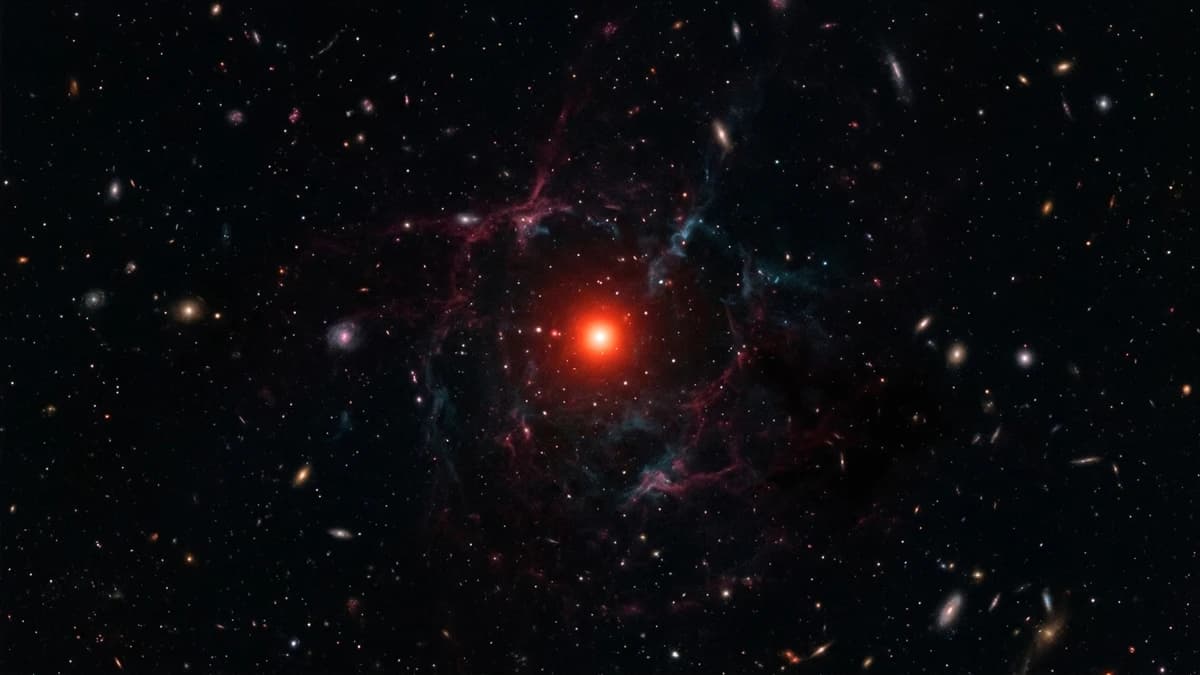
One of the most disconcerting facts about the universe is that everything we can see, from stars to galaxies, planets and nebulae, represents merely 5% of the total matter and energy in the cosmos. The remaining 95% is composed of dark matter (approximately 27%) and dark energy (approximately 68%), two mysterious components that scientists have yet to directly observe.
Dark matter does not emit, absorb, or reflect light, making it completely invisible to our telescopes. However, we know it exists because its gravity affects the movement of visible galaxies. Without dark matter, galaxies would spin so fast they would disintegrate. Scientists have built massive underground detectors, like the XENON experiment in Italy, attempting to capture elusive dark matter particles, but results have remained elusive.
Dark energy is even more mysterious. Discovered in 1998 when astronomers observed that the universe's expansion is accelerating rather than slowing down, dark energy acts as a repulsive force pushing galaxies ever farther apart. If this acceleration continues, in the distant future galaxies will move so far apart they will become invisible to each other, leaving each galaxy isolated in an apparently empty universe.
Black Holes: The Cosmic Monsters
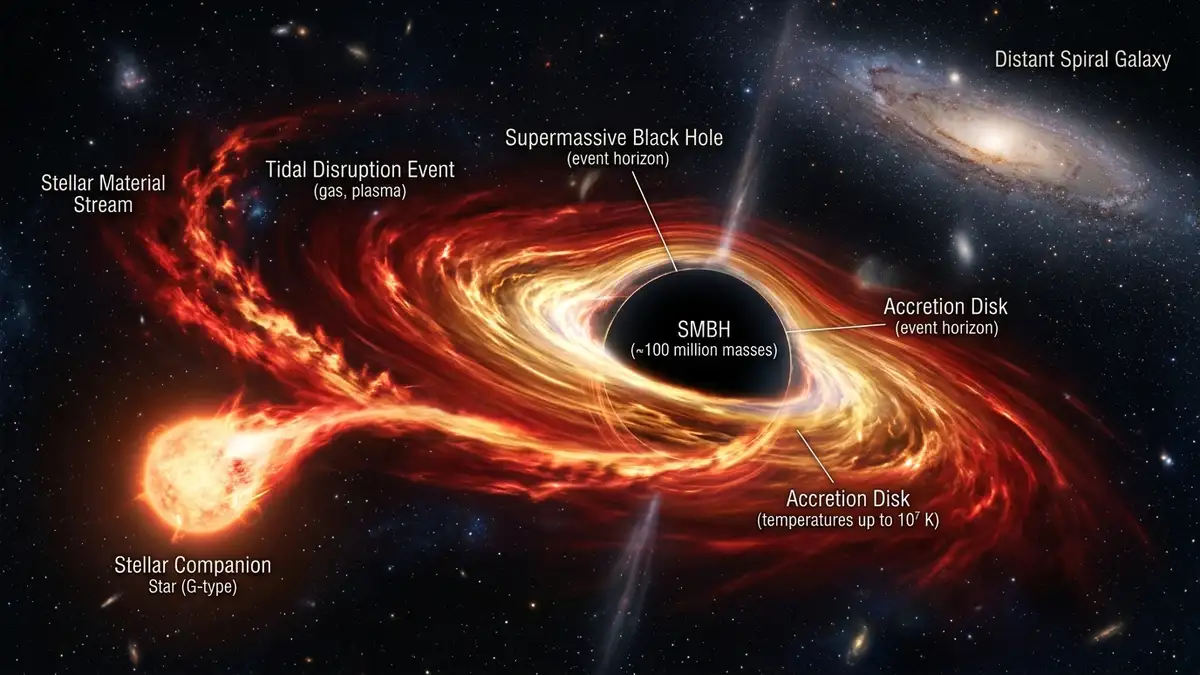
Black holes are perhaps the strangest and most fascinating objects in the universe. Formed when massive stars collapse under their own gravity at the end of their lives, these objects have gravity so intense that not even light can escape them. The supermassive black hole at the center of our galaxy, known as Sagittarius A*, has a mass equivalent to 4 million suns compressed into a space smaller than Mercury's orbit.
In 2019, the Event Horizon Telescope captured the first direct image of a black hole, located at the center of galaxy M87, 55 million light-years away. This historic image showed a bright ring of superheated gas swirling around a dark central shadow, confirming predictions from Einstein's theory of general relativity made over a century earlier.
Gravitational Waves: Listening to the Universe
In 2015, the LIGO observatory detected gravitational waves for the first time, ripples in the fabric of spacetime predicted by Einstein a century earlier. These waves were produced by the merger of two black holes 1.3 billion light-years away, an event so violent it released more energy in a fraction of a second than all the stars in the observable universe combined. The detection opened an entirely new window for observing the cosmos.
The Fermi Paradox: Where Is Everyone?
With billions of Sun-like stars in our galaxy, many of them billions of years older than ours, the probability of advanced extraterrestrial civilizations seems overwhelmingly high. Yet we have found no evidence of their existence. This contradiction, known as the Fermi Paradox, remains one of the great mysteries of astrobiology.
Frequently Asked Questions
Can we hear the Sun singing?
Not directly — sound doesn't travel in a vacuum. The vibrations are detected by instruments (helioseismographs) and converted into audible frequencies for study.
Is it possible to mine diamonds from other planets?
Not with current technology. Neptune is 2.8 billion miles away, and the pressure in its depths is impossible to withstand. But it's a theoretical goal of future space mining.
Does the expansion of the universe violate Einstein?
No. Relativity limits the speed of objects through space. The expansion of space itself has no limit — and that's what carries distant galaxies beyond the speed of light.
Sources: NASA, ESA, SLAC National Accelerator Laboratory, Madhusudhan N. "A possible carbon-rich interior in super-Earth 55 Cancri e" (ApJ Letters, 2012), Sagan C. "Cosmos" (1980). Updated January 2026.
Read also: