Everything About Black Holes: What They Are and How They Work 🕳️🌌
Imagine an object so dense that not even light - the fastest thing in the universe - can escape from it. A place where time practically stops. Where gravity is so intense it tears the very fabric of space-time. An object that defies everything we know about physics and forces us to rethink the fundamental laws of the universe.
This isn't science fiction. These are black holes - the most extreme, mysterious, and fascinating objects in the cosmos.
For decades, black holes were just mathematical theory, predicted by Einstein but considered too impossible to exist. Today, we know there are millions of them just in our galaxy. We've photographed one. We've detected gravitational waves from collisions between them. And we've discovered there's a supermassive black hole at the center of practically every galaxy - including ours.
But what exactly are black holes? How do they form? What happens if you fall into one? And why are scientists so obsessed with them?
Get ready for a journey to the strangest objects in the universe - where the physics we know stops working and the impossible becomes reality.
What Is a Black Hole? Scientific Definition 🤔
The Simple Definition
A black hole is a region of space where gravity is so intense that nothing - absolutely nothing - can escape from it. Not even light, which travels at 300,000 km/s, can get out. It's literally a hole in the universe.
The Technical Definition
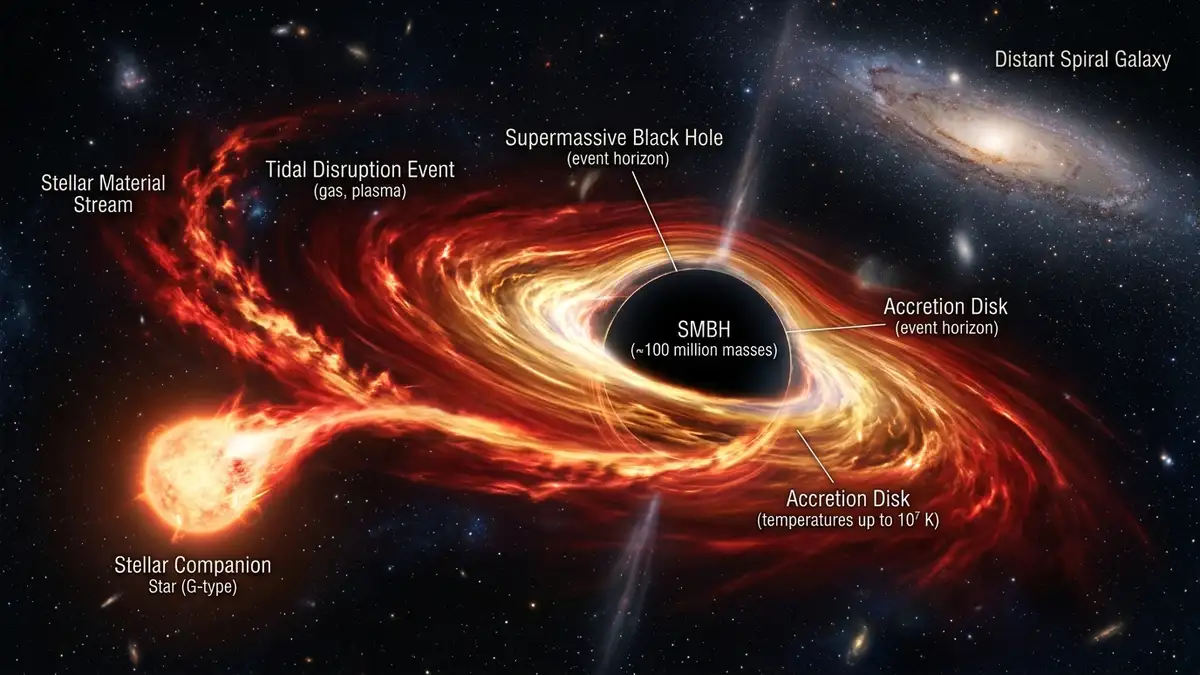
More precisely, a black hole is a gravitational singularity surrounded by an event horizon - the point of no return. It's the final result of the gravitational collapse of a massive star, where all matter is compressed into an infinitely small and dense point.
Why Are They "Black"?
The name is literal: they're black because they don't emit light. Since gravity is so strong that not even light escapes, we can't see them directly. They're literally invisible. We only know they exist by the effects they cause around them.
Fundamental Characteristics
Mass:
- Varies from 3 solar masses (3x the Sun's mass) to billions of solar masses
- The greater the mass, the larger the black hole
- But physically, all mass is concentrated in an infinitely small point
Size (Schwarzschild Radius):
- Stellar black hole: ~10-30 km diameter
- Supermassive black hole: millions to billions of km
- But remember: this is the size of the event horizon, not the singularity
- The singularity itself is infinitely small
Density:
- Infinite at the center (singularity)
- All mass concentrated in zero volume
- Defies our understanding of physics
Gravity:
- So strong it curves space-time to the extreme
- Creates a "well" in the fabric of the universe
- Affects time, light, and matter around it
How Do Black Holes Form? The Stellar Life Cycle 💫
Formation of Stellar Black Holes
Most black holes are born from the death of massive stars. It's a violent and spectacular process:
Phase 1: Massive Star (20+ Solar Masses)
- Star needs to be at least 20 times more massive than the Sun
- Burns hydrogen into helium (nuclear fusion)
- Fusion pressure balances gravity
- Star remains stable for millions of years
- The larger the star, the faster it burns fuel
Phase 2: Fuel Depletion
- Hydrogen in core runs out
- Star begins burning helium, then carbon, oxygen, etc.
- Creates layers like an onion
- Iron core forms at center
- Iron cannot be fused (doesn't release energy)
- Fusion stops
Phase 3: Catastrophic Collapse
- Without fusion pressure, gravity wins
- Core collapses in a fraction of a second
- Speed: 70,000 km/s (23% of light speed)
- Protons and electrons are crushed together
- Form neutrons
- Core becomes super-dense neutron ball
Phase 4: Supernova
- Outer layers fall onto core
- Bounce back violently
- Spectacular explosion: Supernova
- Shines brighter than entire galaxy for weeks
- Spreads heavy elements through space
- Visible billions of light-years away
Phase 5: Birth of Black Hole
- If core has more than 3 solar masses
- Not even neutrons can withstand the pressure
- Collapse continues
- Nothing can stop it
- Forms singularity
- Event horizon appears
- Black hole is born
What Happens If You Fall Into a Black Hole? 🌀
This is the question everyone asks. The answer is fascinating, terrifying, and depends on who's observing.
For You (The One Falling)
Initial Approach:
- Start feeling gravity pulling
- Accelerate toward black hole
- Speed increases constantly
- Can still escape (if you have powerful rocket)
Spaghettification: The Universe's Strangest Death
What It Is:
- Gravitational tidal force
- Gravity on feet is much stronger than on head
- Difference stretches your body
- Literally turn into spaghetti
- Technical process: "tidal stretching"
When It Happens:
- Depends on black hole size
- Small black hole: Before horizon
- Large black hole: After horizon
- Or never (if large enough)
Stellar Black Hole (10 solar masses):
- Spaghettification at ~1,000 km from horizon
- Instant death
- Body stretched until atoms separate
- Becomes plasma stream
- Long before crossing horizon
Supermassive Black Hole (millions of solar masses):
- Can cross horizon intact
- Weaker tidal force (larger horizon)
- Spaghettification happens near singularity
- Have time to "enjoy" the fall
- But eventually die
Detailed Description:
- Feet pulled stronger than head
- Body starts stretching
- Unbearable pain
- Bones break
- Muscles tear
- Skin stretches
- Blood vessels rupture
- Organs separate
- Cells separate
- Atoms separate
- Becomes particle stream
For External Observer (Who's Watching)
Completely Different View:
Approach:
- Sees you accelerating
- Getting faster
- Approaching horizon
Near Horizon:
- You start slowing down (apparently)
- Get redder (redshift)
- Movements slow down
- Like slow motion
At Horizon:
- You freeze
- Stop completely
- Get increasingly red
- Image gradually disappears
- Never sees you cross
Why?
- Extreme time dilation
- Time passes differently near horizon
- For you: Normal time
- For observer: Your time stops
- Effect of General Relativity
The First Photo of a Black Hole (2019): Historic Moment 📸
Event Horizon Telescope: Earth-Sized Telescope
The Challenge:
- Black holes are small (astronomically)
- Very distant
- Would need Earth-sized telescope
- Impossible to build
The Solution:
- Network of 8 radio telescopes
- Spread around the world
- Work together (interferometry)
- Create virtual Earth-sized telescope
- Resolution: See orange on Moon
Locations:
- Chile (ALMA, APEX)
- Hawaii (JCMT, SMA)
- Arizona (SMT)
- Mexico (LMT)
- Spain (IRAM)
- Antarctica (SPT)
M87*: The Target
Why M87:*
- Very large (6.5 billion M☉)
- Relatively close (55 million light-years)
- Very active (visible jet)
- Good target
Observations:
- April 2017
- 5 nights
- Petabytes of data
- Hard drives sent by plane
- Processing: 2 years
The Team:
- 200+ scientists
- 60 institutions
- 20 countries
- Led by Sheperd Doeleman
- Katie Bouman (imaging algorithm)
The Historic Image
Revelation:
- April 10, 2019
- Simultaneous press conferences worldwide
- Global headlines
- Historic moment
What We See:
- Bright ring (accretion disk)
- Dark shadow in center (event horizon)
- Asymmetry (rotation + jet)
- Exactly as Einstein predicted
Details:
- Shadow diameter: 40 billion km
- Disk temperature: Billions of degrees
- Matter velocity: 99% of light
- Confirmed General Relativity
Importance:
- First direct visual evidence
- Confirmed 100-year-old theories
- Opened new era of astronomy
- Inspired entire world
Myths vs. Reality: Dispelling Misconceptions ❌✅
MYTH #1: Black Holes Suck Everything Around Them
❌ MYTH:
- Black holes are cosmic vacuum cleaners
- Suck everything near them
- Will swallow galaxy
- Grow infinitely
✅ REALITY:
- Gravity works like any object
- Only affects very close objects
- If Sun became black hole (won't), Earth would continue orbiting normally
- Need to be VERY close to be sucked in
- Most stars in galaxy are safe
Safe Distance:
- Sgr A*: Need to be within ~1 light-year
- We're 26,000 light-years away
- Completely safe
- Will never affect us
MYTH #2: They're Portals to Other Dimensions
❌ MYTH:
- Black holes are wormholes
- Lead to another universe
- Instant interstellar travel
- Science fiction is real
✅ REALITY:
- Probably not portals
- Everything that enters is destroyed
- Singularity is end of line
- Wormholes are different (and theoretical)
- Even if they were, spaghettification kills you
MYTH #3: They'll Swallow the Universe
❌ MYTH:
- Black holes grow forever
- Eventually will swallow everything
- End of universe
- Cosmic apocalypse
✅ REALITY:
- They evaporate (Hawking Radiation)
- Lose mass slowly
- Eventually disappear
- Takes trillions of years
- But not eternal
Conclusion: Why Black Holes Matter 🌟
Laboratories of Extreme Physics
Black holes are the most extreme objects in the universe. Studying them helps us understand:
1. Gravity:
- General Relativity tested to extreme
- Where Newton fails, Einstein works
- But Einstein also has limits
- Need quantum theory of gravity
2. Space-Time:
- How it works
- How it can be curved
- Limits of curvature
- Fundamental nature of universe
3. Time:
- Extreme time dilation
- Can time stop?
- Time and space swap places
- Nature of time
4. Matter:
- What happens at infinite densities
- Limits of matter
- Transition to singularity
- Physics beyond known
5. Information:
- Can it be destroyed?
- Information paradox
- Quantum mechanics vs. Relativity
- Fundamental physics
Impact on Science
Discoveries:
- Gravitational waves (2015)
- First photo (2019)
- Nobel Prizes
- New astronomy
Technology:
- Ultra-sensitive detectors
- Massive data processing
- Imaging algorithms
- International cooperation
Inspiration:
- Public fascination
- Inspiration for young scientists
- Science fiction
- Popular culture
Unanswered Questions
Remaining Mysteries:
- What happens at singularity?
- Is information preserved?
- How did supermassives form?
- Do primordi exist?
- Can they be used for space travel?
Future:
- More observations
- Better theories
- Quantum theory of gravity
- Answers will come
Final Message
Black holes are:
- Stranger than fiction
- More fascinating than we imagined
- More important than they seem
- Windows to fundamental physics
- Key to understanding universe
Studying them isn't just curiosity. It's understanding the fundamental laws that govern everything. It's discovering the limits of the possible. It's exploring the unknown.
And the most incredible thing? We're just beginning. The greatest discoveries about black holes are yet to come.
The universe is strange, wonderful, and full of black holes. And that's fascinating.
Frequently Asked Questions
What happens if you fall into a black hole?
If you fell into a stellar black hole, tidal forces would stretch you into a thin strand in a process called spaghettification. For supermassive black holes, you could cross the event horizon without immediately noticing, but you would never escape. Time would slow dramatically from an outside observer's perspective as you approached the event horizon.
Can black holes destroy Earth?
The nearest known black hole is over 1,000 light-years away, posing no threat to Earth. A black hole would need to be extremely close to affect our solar system. Black holes do not suck in everything around them; at a distance, they exert the same gravitational pull as a star of equivalent mass.
How are black holes detected if light cannot escape?
Scientists detect black holes through their effects on surrounding matter: X-rays emitted by superheated gas spiraling into them, gravitational lensing of light from background stars, gravitational waves from black hole mergers (detected by LIGO), and the motion of stars orbiting invisible massive objects.
What is at the center of a black hole?
At the center lies a singularity, a point of theoretically infinite density where known physics breaks down. General relativity predicts this singularity, but quantum mechanics suggests something else may occur. Resolving this contradiction is one of the greatest challenges in theoretical physics and may require a theory of quantum gravity.
Read also: