Artemis II Breaks Record: Humans Reach the Greatest Distance From Earth in History
On April 6, 2026, at 15:47 UTC, four astronauts aboard the Orion capsule achieved a historic milestone: 406,000 kilometers from Earth — the greatest distance humans have ever been from our planet. The previous record, set by Apollo 13 in 1970, was surpassed by more than 5,000 kilometers.
The Artemis II mission, launched on April 1, 2026, represents humanity's return to the lunar vicinity after more than half a century. But unlike the Apollo missions, this is not just a demonstration of technological capability — it's the first step of a program that intends to establish permanent human presence on the Moon.
The Historic Crew
Aboard Orion are four astronauts who have entered the history books:
Reid Wiseman — Commander
A veteran of two space missions, Wiseman leads the crew. At 49, he brings experience from 165 days in space, including a stay on the International Space Station in 2014.
Victor Glover — Pilot
Glover makes history as the first Black person to travel beyond low Earth orbit. A Navy test pilot, he had already made history in 2020 as the first Black astronaut to be part of a long-duration crew on the ISS.
Christina Koch — Mission Specialist
Koch holds the record for continuous time in space by a woman: 328 days. Now, she becomes the first woman to travel to the Moon — a milestone that NASA highlights as a symbol of progress in space inclusion.
Jeremy Hansen — Mission Specialist
Canadian Hansen is the first non-American to travel to the Moon. His presence represents the international partnership that defines the Artemis program, with contributions from Canada, Europe, Japan, and other countries.
The Most Powerful Rocket Ever Built
Artemis II launched aboard the Space Launch System (SLS), the most powerful rocket ever built by humanity. At 98 meters tall and capable of generating 39.1 meganewtons of thrust, the SLS surpasses even the legendary Saturn V that took Apollo astronauts to the Moon.
SLS Specifications
| Feature | Value |
|---|---|
| Height | 98 meters |
| Launch thrust | 39.1 MN |
| Payload to lunar orbit | 27 tons |
| Cost per launch | $2.2 billion |
| Propulsion | 2 solid fuel boosters + 4 RS-25 engines |
The launch occurred at 6:35 PM EDT on April 1, from Launch Complex 39B at Kennedy Space Center, Florida. Millions watched live as the 1,500-meter column of fire illuminated the Florida sky.
The 10-Day Journey
The Artemis II mission is a crucial test flight that validates all systems necessary for future lunar landing missions.
Day 1: Launch and Orbit Insertion
After launch, Orion spent approximately 25 hours in Earth orbit, allowing the crew to verify all spacecraft systems before firing the upper stage for translunar injection.
Days 2-4: Journey to the Moon
During the three-day trip to the Moon, astronauts conducted scientific experiments, tested long-distance communication systems, and documented their journey with high-resolution cameras.
Days 5-6: Lunar Flyby
The most dramatic moment of the mission: Orion passed just 130 kilometers from the lunar surface, closer than any crewed spacecraft since Apollo 17 in 1972. During the flyby, astronauts photographed potential landing sites for Artemis III.
Days 7-10: Return to Earth
Using lunar gravity as a slingshot, Orion began its journey back. Reentry into Earth's atmosphere, scheduled for April 11, will test the most advanced heat shield ever built, capable of withstanding temperatures of 2,760°C.
The Distance Record
On April 6, at 15:47 UTC, Orion reached its farthest point from Earth: 406,000 kilometers. To put it in perspective:
- It's 1,000 times farther than the International Space Station
- Light takes 1.35 seconds to travel that distance
- If you drove at 100 km/h non-stop, it would take 169 days to get there
The previous record belonged to Apollo 13, which reached 400,171 km in April 1970 — ironically, during an emergency mission after an onboard explosion.
Words from the Astronauts
"Looking at Earth from here... it seems so fragile, so small," said Christina Koch in a live broadcast. "You viscerally understand why we need to protect it."
Victor Glover added: "I'm thinking about all the children who will see this and dream they can be here one day. Because they can. It doesn't matter where you come from."
Scientific and Political Significance
Artemis II is not just a test mission — it's a statement of intent.
Preparing the Ground for Artemis III
The next mission, Artemis III, scheduled for 2028, will take the first humans to the lunar surface since 1972. Data collected by Artemis II is essential to ensure the safety of this historic mission.
21st Century Space Competition
China has announced plans to land astronauts on the Moon by 2030. India, Japan, and even private companies like SpaceX have lunar ambitions. Artemis II reaffirms American leadership in space exploration.
International Cooperation
Unlike the Cold War space race, the Artemis program is fundamentally international. The Canadian Space Agency provided the Canadarm3 robotic arm. ESA contributed the European Service Module. Japan and other countries participate with technology and funding.
The Future: Gateway and Lunar Base
Artemis II is just the beginning of an ambitious program that includes:
Gateway — Lunar Space Station
A small space station in lunar orbit will serve as a stopover point for surface missions. The first modules are expected to launch in 2027.
Artemis Base Camp
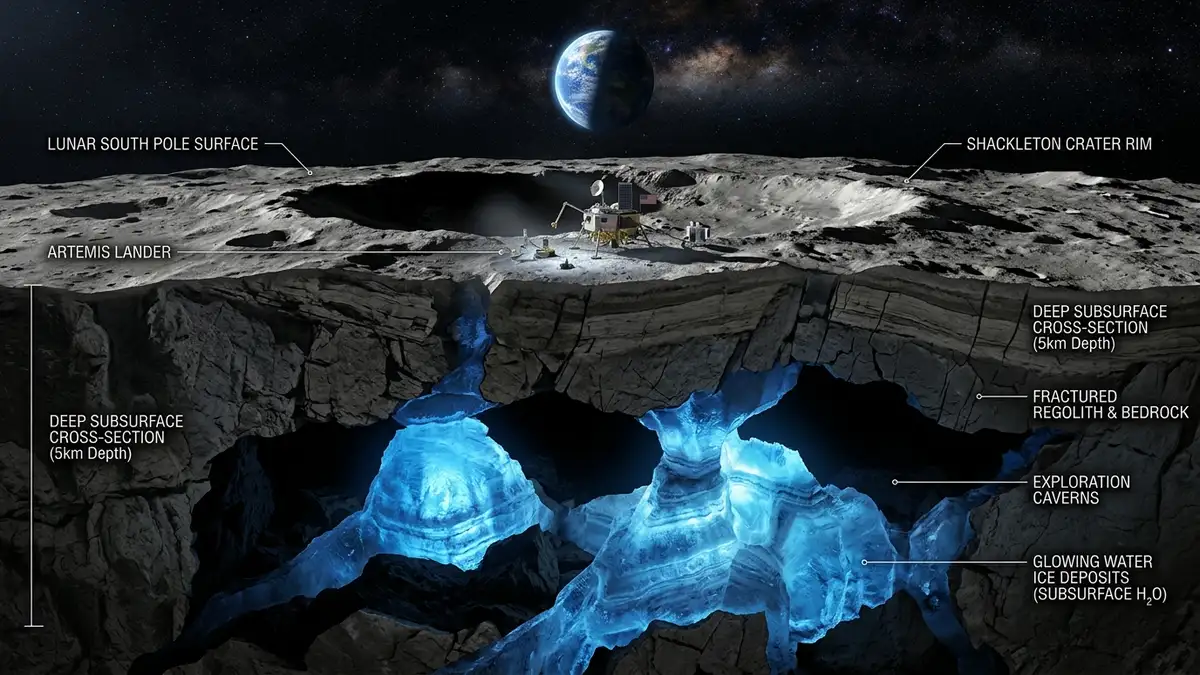
NASA plans to establish a permanent base at the lunar south pole, where permanently shadowed craters contain water ice that can be converted into rocket fuel and drinking water.
Springboard to Mars
Experience gained on the Moon will be fundamental for the eventual crewed mission to Mars, planned for the 2040s.
Challenges and Criticisms
Not everything is celebration. The Artemis program faces significant criticism:
Astronomical Costs
Each SLS launch costs approximately $2.2 billion — compared to less than $100 million for a SpaceX Falcon Heavy. Critics argue that NASA should use cheaper commercial rockets.
Constant Delays
Artemis II was originally scheduled for 2024. Technical problems with the heat shield and other systems caused two-year delays.
Scientific Relevance
Some scientists question whether crewed lunar missions justify their cost, arguing that robots can do lunar science for a fraction of the price.
The Apollo Legacy
Artemis II inevitably evokes comparisons with the Apollo missions. But there are fundamental differences:
Technology
Orion carries more computing power in a single chip than the entire Apollo program combined. Its navigation, communication, and life support systems represent 50 years of technological advances.
Diversity
The Artemis II crew includes the first woman and the first Black person to travel to the Moon — a stark contrast to the exclusively male and white crews of the Apollo era.
Sustainability
While Apollo was a race to plant a flag, Artemis aims to establish permanent presence. The difference is between a visit and a move.
FAQ - Frequently Asked Questions
Why did it take 50 years to return to the Moon?
After Apollo 17 in 1972, political and public interest in lunar exploration dramatically decreased. The Vietnam War, economic crises, and the perception that "we already won the space race" led to the cancellation of Apollo 18, 19, and 20 missions. In the following decades, NASA focused on the Space Shuttle and the International Space Station. Only in the 2010s, with the Artemis program, did the Moon become a priority again. Factors such as competition with China, technological advances, and the economic potential of lunar resources renewed interest in lunar exploration.
What's the difference between Artemis and Apollo?
Apollo was a race to reach the Moon first during the Cold War, with short-duration missions focused on demonstrating technological superiority. Artemis aims to establish sustainable presence on the Moon, with longer missions, permanent infrastructure (Gateway and Base Camp), and focus on science and preparation for Mars. Technologically, Orion is much more advanced than Apollo, with more efficient life support systems, high-speed communications, and capacity for missions up to 21 days. Additionally, Artemis is an international program, while Apollo was exclusively American.
When will humans walk on the Moon again?
NASA plans to land astronauts on the Moon with the Artemis III mission, currently scheduled for 2028. The mission will use SpaceX's Starship HLS landing system to take two astronauts to the lunar surface, where they will remain for approximately one week. However, the program has already suffered several delays, and the date may change depending on Starship development progress and other technical and budgetary factors.
Does Brazil participate in the Artemis program?
Brazil signed the Artemis Accords in 2021, becoming the first Latin American country to join the program. Although it has no direct technological contributions in Artemis II, participation opens doors for future collaboration, including potential involvement in lunar scientific missions, space technology development, and eventually the possibility of a Brazilian astronaut participating in Artemis missions. The Brazilian Space Agency (AEB) works on satellite and space technology projects that may benefit from the partnership.
Is it possible to see Orion from Earth?
During certain phases of the mission, Orion can be visible as a bright point in the night sky, similar to a satellite. However, at 400,000 km distance, it is too small to be seen with the naked eye most of the time. NASA provides live broadcasts and online tracking tools that allow following the spacecraft's position in real time. Powerful amateur telescopes can, under ideal conditions, capture Orion as a point of light moving against the stellar background.
Sources and References
- NASA - Artemis II Mission
- NBC News - Artemis II astronauts circle the moon
- Canadian Space Agency - Artemis II record
- Forbes - NASA's Artemis 2 Launches