Artemis II Part 2: The Journey Home — Reentry, Risks and Historic Splashdown
Ten days. 1.6 million kilometers traveled. Four astronauts who ventured farther from Earth than any human in history. Now, on this Friday, April 10, 2026, Reid Wiseman, Victor Glover, Christina Koch and Jeremy Hansen face the 14 most dangerous minutes of the mission: atmospheric reentry at 40,000 km/h and splashdown in the Pacific Ocean.
If you read Part 1 — The Astronauts' Journey to the Moon, you followed the SLS launch, the translunar injection, the 3 days of transit through the cosmic void, deep space dining, and the lunar flyby at 6,500 km from the surface that established the new record of 406,773 km from Earth.
Now it's time to come home. And coming home from deep space is, paradoxically, more dangerous than going.
🔴 Watch Live — NASA TV
NASA broadcast the entire Artemis II return coverage live. Watch the full replay:
Phase 1: European Service Module Separation — Saying Goodbye to Orion's "Backpack"
Twelve hours before splashdown, Orion Integrity begins the final major maneuver: separation from the European Service Module (ESM), built by Airbus Defence and Space for ESA.
The ESM was the operational heart throughout the entire mission. With its 33 engines (1 main OMS-E and 32 auxiliary), 4 solar panels and 8,600 kg of propellant, it provided everything: propulsion, electricity, thermal control, water and oxygen. Without it, Orion is just a 5-meter conical capsule with a heat shield.
Why separate? The service module has no heat shield. If it entered the atmosphere together, superheated fragments could damage the capsule and kill the crew. Separation occurs at ~30,000 km from Earth, and the ESM is directed for complete atmospheric burn-up — disintegrating into harmless fragments over the South Pacific, far from air and sea routes.
At the moment of separation, the four astronauts lose all primary propulsion, all solar power generation and much of their life support. From here on, Orion runs on internal batteries and oxygen reserves: power for ~11 hours, oxygen for ~24 hours. There is zero margin for error.
Phase 2: Heat Shield Orientation — The Shield Between Life and Death
After separation, the crew executes the most critical maneuver before reentry: orienting Orion with the Avcoat heat shield pointed forward, in the direction of flight. An error of a few degrees in this orientation and the spacecraft would burn up like a meteor.
The Avcoat shield is 5 meters in diameter and weighs 3,175 kg. It is the largest ablative structure ever built by humanity. Ablation works as a planned sacrifice: layers of material deliberately vaporize during reentry, absorbing heat and creating a protective gas layer between the 2,760°C plasma and the spacecraft structure at less than 200°C internally.
The Shield Controversy: Lessons from Artemis I
Here is the risk that kept engineers awake for 3 years. During Artemis I (uncrewed mission, 2022), the heat shield suffered anomalous char loss: pieces of Avcoat broke off in larger fragments than predicted. Investigation revealed the material was insufficiently permeable — gases generated during reentry became trapped, building internal pressure that cracked the shield.
For the crewed Artemis II, NASA made a controversial choice: did not replace the shield, but modified the reentry trajectory to a "lofted" version (higher and shorter), avoiding the exact thermal conditions that caused the Artemis I problem. Critics, including former astronauts, argued this was a workaround — "fly as is" without fixing the root cause. NASA responded that extensive ground testing and computational modeling guaranteed safety.
The choice worked — but the 14 minutes of reentry were, without doubt, the most tense in recent space exploration history.

Phase 3: Skip Reentry — Skipping Through the Atmosphere Like a Stone on Water
7:53 PM EDT, April 10, 2026. Orion Integrity hits the reentry interface at 122 km altitude, traveling at 39,429 km/h — Mach 32. Fast enough to travel from New York to Los Angeles in 6 minutes.
From this moment, the skip reentry technique begins — never before used on a crewed NASA mission. Here's how it works:
First Dive (Skip)
Orion dives into the upper atmosphere between 80 and 60 km altitude. Air molecule friction compresses gas ahead of the shield, creating a 2,760°C plasma envelope — half the temperature of the Sun's surface. The Avcoat shield absorbs and dissipates heat through ablation.
Astronauts experience up to 4G deceleration — each feels as if they weigh 4 times more. Commander Reid Wiseman monitors navigation data while his arms weigh 62 pounds each. The spacecraft decelerates from 39,000 to ~27,000 km/h.
The "Skip" (Ballistic Phase)
After ~3 minutes, Orion partially exits the atmosphere, "skipping" like a stone thrown on water. It briefly rises to ~90 km altitude, momentarily reducing G-load and allowing trajectory adjustments. This skip is what makes the technique revolutionary: it enables landing precision of just 2 km — compared to 20 km for Apollo missions.
Second Dive (Final Descent)
Orion dives definitively into dense atmosphere. Final deceleration from 27,000 to 480 km/h in approximately 3 minutes. The plasma disappears, communications blackout ends and Houston reestablishes contact.
The communications blackout lasts ~16 minutes. During this period, no signal enters or leaves Orion. Houston, family members, and 2 billion global viewers sit in absolute silence, waiting to hear Reid Wiseman's voice confirming: "Houston, Integrity is nominal."
Minute-by-Minute Return Timeline
| Time (EDT) | Event | Altitude | Speed |
|---|---|---|---|
| ~07:00 AM | Service Module Separation (ESM) | ~30,000 km | 12,000 km/h |
| ~07:30 AM | Heat shield orientation | ~25,000 km | 15,000 km/h |
| 7:53 PM | Reentry interface | 122 km | 39,429 km/h |
| 7:53-8:05 PM | Skip reentry + comms blackout | 60-90 km | 39,000→480 km/h |
| 8:05 PM | Drogue parachutes (2 units) | 7.6 km | 480 km/h |
| 8:06 PM | Main parachutes (3 units, 35m each) | 3 km | 210→32 km/h |
| 8:07 PM | SPLASHDOWN — Pacific Ocean | 0 m | 32 km/h |
Phase 4: Parachutes — 11 Chutes Between Life and Death
At 7.6 km altitude, pyrotechnic charges eject the parachute module cover. Two drogue chutes deploy, stabilizing the capsule and reducing speed from 480 to 210 km/h.
At 3 km altitude, three main parachutes unfurl. Each is 35 meters in diameter — wider than a Boeing 737's wingspan. Together, they brake Orion from 210 to 32 km/h. Manufactured by Airborne Systems using Kevlar nylon, they were tested 47 times in drop tests in the Arizona desert.
The total system includes 11 parachutes (2 drogue + 3 pilot + 3 main + 3 reserve). If 1 of the 3 mains fails, the other 2 support the weight. If 2 fail, the crew survives with a harder impact, but survivable. If all 3 fail... the scenario is not publicly discussed by NASA.
Phase 5: Splashdown — 8:07 PM EDT, Pacific Ocean
Splash. Orion Integrity touches the Pacific Ocean at 32 km/h, approximately 150 km off San Diego, California. The impact is equivalent to a car crash at 20 mph — cushioned by pneumatic dampers under the astronauts' seats.
The capsule floats in Stable 1 position (heat shield down, hatch up). Five inflatable flotation bags ensure stability even in 2-meter waves. Inside Orion, all four astronauts remain strapped to their seats, following a ~20-minute checklist to verify structural integrity, check for leaks, and purge residual gases.
Phase 6: Recovery — USS John P. Murtha and the Divers
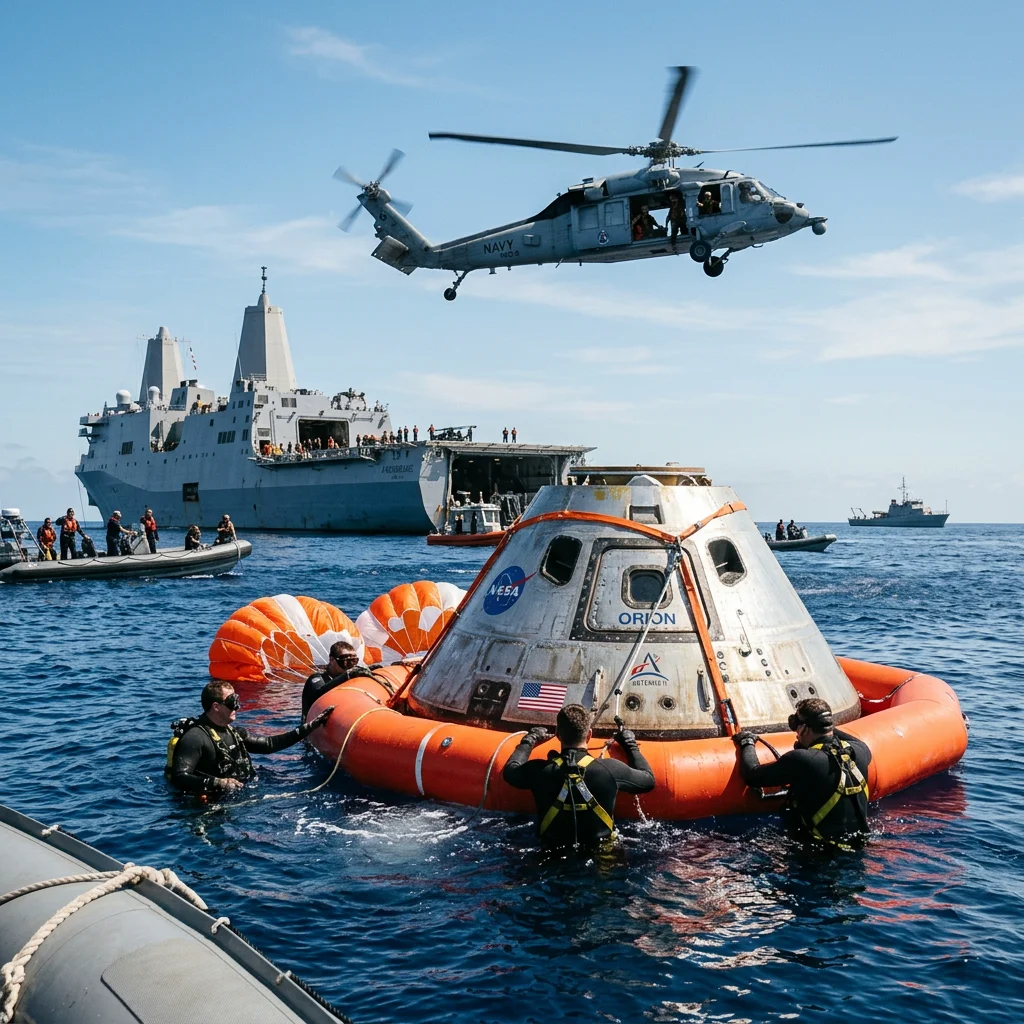
Amphibious ship USS John P. Murtha (LPD-26) waits 3 km from the projected impact point, with a team of 40 Navy divers, doctors, NASA technicians and MH-60S Seahawk helicopters.
The recovery process follows a protocol tested 18 times:
- Helicopters arrive in ~5 minutes and conduct HD camera visual inspection
- Divers jump into the water, swim to the capsule and install additional flotation collar
- Tow line connects to USS John P. Murtha
- Capsule is towed to the ship's well deck (floodable dock)
- Astronauts are extracted through the side hatch into an inflatable raft
- Initial medical evaluation on deck — vitals, vestibular balance, blood pressure
- Helicopter transport to Kennedy Space Center if needed
Total recovery time: approximately 2 hours from splash to astronaut standing on the ship's deck.
The Risks Nobody Talks About
Deep space reentry is categorically different from returning from the International Space Station. Here are the Artemis II-specific risks that NASA prefers to downplay in public communications:
Reentry speed 70% higher. ISS returns at 28,000 km/h. Orion returns at 39,400 km/h. That means 2.5 times more kinetic energy to dissipate, more heat on the shield, and smaller margin of error in trajectory.
Heat shield with problematic history. The same Avcoat design that partially failed on Artemis I. NASA chose to "fly as is" with modified trajectory rather than redesign. It worked — this time.
Extended communications blackout. 16 minutes without contact. If something goes wrong during that period, Houston cannot help. The astronauts are completely alone.
Splashdown impact. 32 km/h hitting ocean water is equivalent to hitting concrete. Cervical injuries are possible even with dampers. NASA trained the astronauts in impact tanks for 6 months.
Post-splash capsule toxicity. Residual hydrazine (attitude control thruster fuel) can leak. Divers conduct atmosphere testing before opening the hatch.
Complete Mission Numbers
| Data | Value |
|---|---|
| Total duration | 10 days, 6 hours, 52 minutes |
| Total distance traveled | ~1.6 million km |
| Maximum distance from Earth | 406,773 km (record) |
| Maximum speed | 39,429 km/h (reentry) |
| Peak shield temperature | 2,760°C |
| Reentry G-forces | up to 4G |
| Parachutes used | 11 (2 drogue + 3 pilot + 3 main + 3 reserve) |
| Blackout duration | ~16 minutes |
| Mission cost | ~US$4.2 billion |
| Recovery ship | USS John P. Murtha (LPD-26) |
What Comes Next: Artemis III, IV and the Path to Mars
Artemis II proved that humans can travel to deep space and return safely in the most advanced hardware ever built. Every sensor, every telemetry reading and every crack (or absence of crack) in the heat shield will be analyzed over the next 18 months.
Artemis III (planned 2027): Orion + SpaceX Starship HLS integration demonstration in low Earth orbit. Docking and crew transfer test that is prerequisite for landing on the Moon.
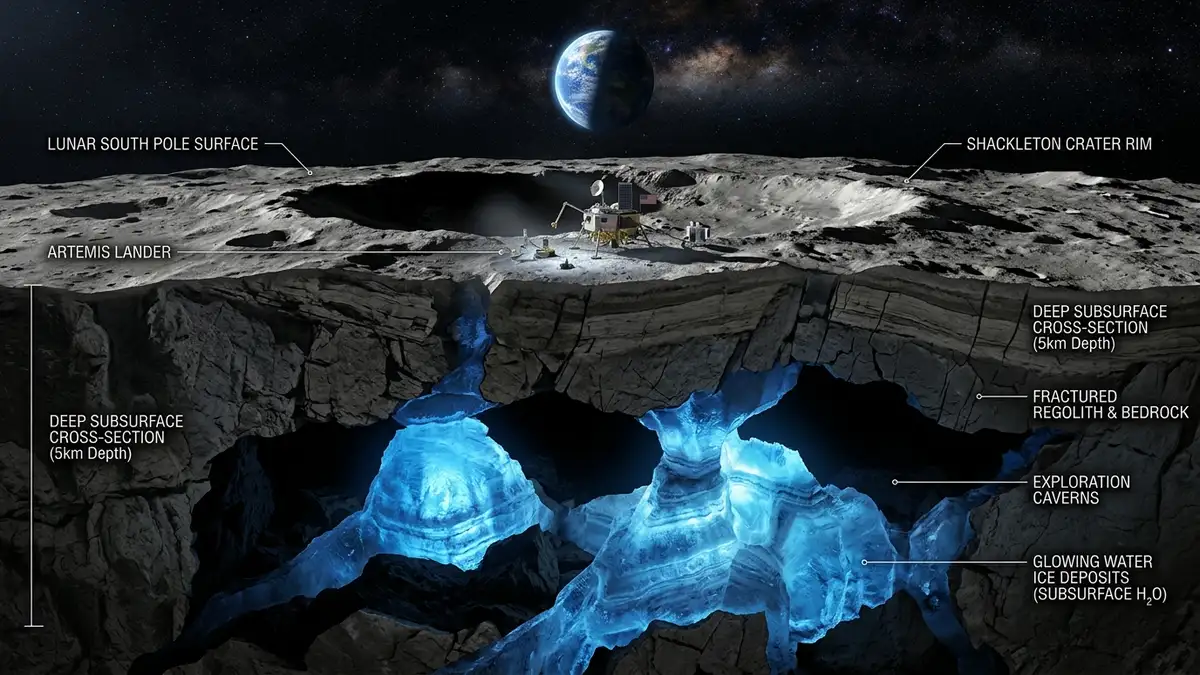
Artemis IV (planned 2028): the first woman and next man will step on the lunar surface in the south pole region, where permanently shadowed craters contain water ice — a fundamental resource for the future Lunar Gateway Base.
Mars (2030s horizon): every system tested on Artemis II — heat shield, long-duration life support, cosmic radiation, high-speed reentry — is a brick in the path to the 9-month journey to Mars.
FAQ — Frequently Asked Questions
How fast does Orion reenter the atmosphere?
Orion hits the reentry interface at 39,429 km/h (Mach 32), equivalent to traveling from New York to Los Angeles in 6 minutes. It's 70% faster than ISS reentry, generating 2.5 times more kinetic energy and temperatures up to 2,760°C on the heat shield. The skip reentry technique dissipates this energy across two separate atmospheric dives, reducing maximum G-load to 4G and enabling 2 km landing precision.
What is skip reentry?
Skip reentry makes the capsule dive into the upper atmosphere, partially decelerate using air molecule friction, "skip" briefly back out of the atmosphere like a stone on water, and dive definitively for landing. The advantage is twofold: it distributes heat across two dives (protecting the shield) and allows trajectory adjustments between dives (ensuring precision). It was first tested on uncrewed Artemis I in 2022, but Artemis II is the first crewed mission to use the technique in NASA's program.
Is the Orion heat shield safe?
After the char loss problem on Artemis I (2022), NASA chose to keep the Avcoat shield design but modified the reentry trajectory to a shorter "lofted" version. This change avoids the specific thermal conditions that caused the previous failure. While it performed perfectly on Artemis II, the decision remains controversial among experts. The shield will be completely analyzed after recovery and results will directly influence design for Artemis III and IV missions.
How long does recovery take after splashdown?
From the moment of Pacific splashdown to astronauts standing on the USS John P. Murtha's deck, the process takes approximately 2 hours. It includes helicopter visual inspection, divers installing flotation collar, capsule towing to ship dock, astronaut extraction and initial medical evaluation. The four crew members remain in their seats for ~20 minutes after impact for integrity checklist and gas purge before hatch opening.