Artemis II: The Complete Journey of the Astronauts to the Moon in 2026
On April 1, 2026, at 12:15 UTC, NASA's SLS (Space Launch System) rocket tore through the Florida sky carrying four astronauts toward the Moon — the first human crew to leave Earth orbit since Apollo 17 in December 1972. Fifty-four years separate that last lunar farewell from this new cosmic endeavor, and the entire world is watching every second of the Artemis II mission in real-time.
The Orion capsule, named Integrity by the crew, carries Reid Wiseman, Victor Glover, Christina Koch, and Jeremy Hansen on a free-return trajectory that will take them 406,773 km from Earth — farther than any human has ever traveled. This article reconstructs each phase of the journey, from launch to splashdown, based on official data from NASA, ESA, and verified aerospace sources.
The Crew: Who Are the Four Astronauts
The selection of the Artemis II crew was announced by NASA in April 2023, marking the first time in over half a century that astronauts have been designated to fly beyond low Earth orbit.
Reid Wiseman — Commander. U.S. Navy Captain, 49 years old, former F/A-18 fighter pilot. Veteran of a mission to the ISS in 2014 (165 days in space), accumulated over 13 hours of spacewalks. Served as head of NASA's Astronaut Office between 2020 and 2022. His experience in military and space operations made him the natural choice to lead the agency's most ambitious mission in decades.
Victor Glover — Pilot. U.S. Navy Commander, 50 years old, test pilot. In 2020, he made history as the first Black astronaut to be part of a long-duration crew on the ISS (167 days). In Artemis II, Glover is responsible for piloting the Orion during critical maneuvers such as the translunar injection and atmospheric reentry. He becomes the first Black astronaut to travel beyond low Earth orbit.
Christina Koch — Mission Specialist. Electrical engineer, 47 years old, holder of the record for the longest single spaceflight by a woman: 328 consecutive days on the ISS between 2019 and 2020. Participated in the first all-female spacewalk. Oversees life support systems, communications, and scientific experiments. She becomes the first woman to travel beyond low Earth orbit.
Jeremy Hansen — Mission Specialist (CSA). Colonel in the Canadian Air Force, 50 years old, former CF-18 fighter pilot. Selected by the Canadian Space Agency in 2009, he had never flown to space before — the most spectacular debut in the history of space exploration. He is the first non-American astronaut designated for a lunar mission, a result of the NASA-CSA bilateral agreement.
The Spacecraft: Orion and the European Service Module
The Orion capsule is the most advanced spacecraft ever built for human transport in deep space. With a diameter of 5 meters and capacity for up to six astronauts, it withstands cosmic radiation, thermal variations from -157°C to +121°C, and reentry at speeds exceeding 40,000 km/h.
The European Service Module (ESM), from Airbus Defence and Space/ESA, has 33 engines (1 main OMS-E and 32 auxiliary), 4 solar panels with a total wingspan of 19 meters, and carries 8,600 kg of propellant. It provides propulsion, electricity, thermal control, and stores vital resources.
The Avcoat thermal shield, with a diameter of 5 meters, is the largest ablation structure ever built. It protects against temperatures of up to 2,760°C during reentry — half the temperature of the solar surface.
Phase 1: The Launch — From Kennedy to Space
The launch occurred from Launch Complex 39B, Kennedy Space Center, Florida. The SLS Block 1 measures 98 meters, weighs 2,608 tons, and generates 3.99 meganewtons of central thrust (RS-25) plus 14.4 meganewtons from the two solid rocket boosters.
In the first 2 minutes, the SLS reached Mach 6 (~7,400 km/h) while the solid boosters separated at an altitude of 48 km. The core stage burned for another 6 minutes. The Orion and the second stage ICPS reached low Earth orbit at an altitude of 185 km, traveling at 28,000 km/h.
After 2 orbits (~3 hours) of checks, the Trans-Lunar Injection (TLI) burn followed: 18 minutes of propulsion from the ICPS accelerating the Orion from 28,000 to 39,400 km/h — the escape velocity from Earth's gravity to begin the 3-day journey to the Moon.
Phase 2: Trans-Lunar Transit — 3 Days in Cosmic Void
After the TLI, the Orion followed a free-return trajectory — the same technique used in the Apollo missions. If all propulsion systems fail, lunar gravity naturally curves the spacecraft back to Earth. It is the ultimate cosmic safety net.
The spacecraft traveled at an average speed of 3,800 km/h, slowing down as it moved away from Earth. The Earth-Moon gravitational equilibrium point occurs at 334,000 km from Earth, when the Orion slows to 3,200 km/h before lunar gravity begins to pull it back again.
What do astronauts eat in deep space?
The menu includes over 100 items in four categories: thermally stabilized (fruits, vegetables, meats), irradiated (steaks, chicken sterilized by ionizing radiation), freeze-dried (soups, eggs, shrimp, coffee — rehydrated with water), and intermediate moisture (nuts, granola, tortillas that replaced bread since the Gemini era to avoid floating crumbs).
Each astronaut consumes 2,800 calories daily in 3 meals and 2 snacks. Water comes from the fuel cells of the service module. An innovation is 500-calorie energy bars developed by NASA's Space Food Research Lab in collaboration with Cornell University, fortified with vitamin D and omega-3 for neurological protection against cosmic radiation.
Cosmic radiation: the invisible danger
Outside Earth's magnetosphere, the crew faces galactic cosmic radiation (GCR) and solar energetic particles (SPE). The Orion has "storm" areas — reinforced spaces for shelter during solar events. In 10 days, each astronaut receives ~6 mSv of radiation, equivalent to 30 chest X-rays. Personal dosimeters monitor exposure in real-time.
Phase 3: The Lunar Flyby — 6,500 km from the Surface
On April 6, 2026, the Orion Integrity reached its closest approach: between 6,500 and 7,600 km from the lunar surface — close enough to distinguish craters like Tycho and Copernicus, the lunar seas, and the Apennine Mountains with the naked eye.
The spacecraft travels at 8,300 km/h relative to the Moon. Here, a new absolute record is set: 406,773 km from Earth, surpassing Apollo 13's 400,171 km (1970).
What do astronauts document?
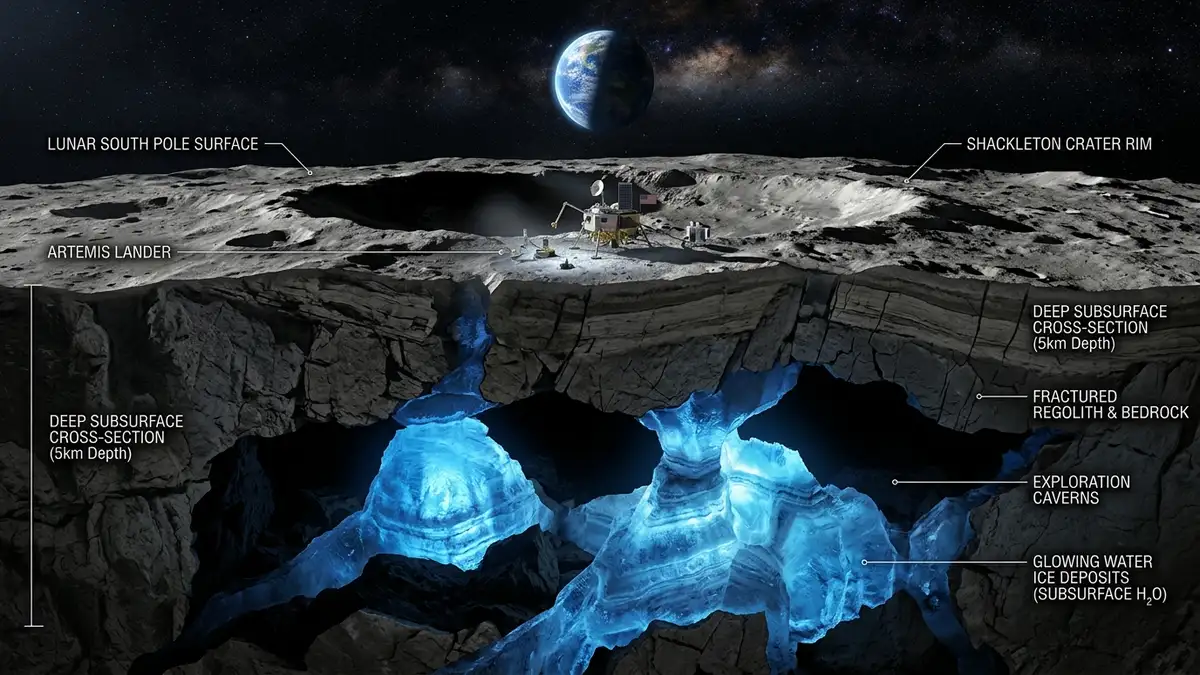
Visual and photographic observations of candidate landing sites for Artemis IV (scheduled for 2028), including the lunar south pole, where craters like Shackleton and Cabeus contain confirmed water ice — an essential resource for future lunar bases.
The Orion passes behind the Moon for ~34 minutes with total communication blackout — the signal does not penetrate 3,474 km of lunar rock. For the first time since Apollo 17, humans experience this absolute cosmic silence.
Instruments perform real-time radiation measurements, map lunar magnetic fields, and test optical navigation — a system that uses stars and the lunar surface as references without relying on terrestrial signals, essential for future deep space missions.
Phase 4: The Return — 252,000 km Back Home
Lunar gravity "throws" the Orion back to Earth. The spacecraft spends 3.5 days returning, accelerating with the increasing gravitational pull of Earth.
The Orion separates from the European Service Module (which burns up in the atmosphere) and orients the thermal shield for reentry at 40,000 km/h (Mach 32).
The skip reentry: bouncing through the atmosphere
The "skip reentry" technique makes the spacecraft dive into the upper atmosphere, partially decelerate, briefly rise, and then dive definitively. This keeps G-forces below 4G and allows for precision in landing.
The Avcoat shield withstands 2,760°C during deceleration from 40,000 to 480 km/h in ~5 minutes. Three drogue parachutes deploy at 7.6 km, followed by three main parachutes (35m in diameter each) reducing speed to 32 km/h.
Splashdown in the Pacific
Landing is scheduled for April 10, 2026, 150 km off the coast of San Diego, California. The USS Portland (LPD-27) awaits with divers and recovery systems. The complete recovery process takes about 2 hours.
Impact and Historical Significance
Artemis II demonstrates that humanity can return to deep space safely, 54 years after the last time. Every tested system paves the way for Artemis IV in 2028.
The mission marks a shift in space geopolitics: European service module, Canadian astronaut, contributions from Japan and international partners. The accumulated cost of the Artemis program reaches $93 billion, but every dollar invested in space exploration returns between $5 and $14 in applied technological innovation for life on Earth — from heat-resistant materials to advances in radiation medicine and water purification.
Artemis II is not a repetition of Apollo. It is the first chapter of a permanent human presence on the Moon, a platform for the future journey to Mars, and proof that international space exploration — cooperative rather than competitive — is the model for the future.
FAQ - Frequently Asked Questions
How long does the journey from Earth to the Moon take on Artemis II?
The outbound journey takes approximately 3 days (72 hours) after the Trans-Lunar Injection burn. The total mission lasts 10 days. The speed varies from 39,400 km/h (shortly after TLI) to 3,200 km/h (at the gravitational equilibrium point), averaging 3,800 km/h. The trajectory was optimized to maximize lunar observation and minimize propellant consumption, including wide safety margins for testing all critical systems of the spacecraft.
At what speed does the spacecraft travel during the lunar flyby?
The Orion travels at ~8,300 km/h relative to the Moon and ~5,900 km/h relative to Earth during the flyby. During reentry (April 10), it will reach 40,000 km/h — measured in real-time by NASA's Deep Space Network, a network of giant antennas in California, Spain, and Australia that maintains continuous communication with the spacecraft, except during its passage behind the lunar far side.
Will the astronauts land on the Moon?
No. Artemis II is exclusively a flyby. In February 2026, NASA reclassified Artemis III as a demonstration in low Earth orbit (test of Orion + Starship HLS/SpaceX + Blue Moon/Blue Origin integration). The human landing has been moved to Artemis IV (2028), when the first woman and the next man will set foot on the Moon in the south pole region, where confirmed water ice exists.
What is the maximum distance from Earth?
The Orion reaches 406,773 km (252,757 miles) — a new record surpassing Apollo 13 (400,171 km, 1970). At this distance, Earth appears as a blue disk the size of a coin at arm's length. The Moon is on average 384,400 km away, but the free-return trajectory exceeds lunar orbit.
What happens if something goes wrong?
The free-return trajectory ensures automatic return via lunar gravity, without maneuvers — as in Apollo 13. The Orion carries redundant propellant, life support with 72 extra hours, and an emergency LAS system that separates the capsule from the rocket in milliseconds. NASA maintains rescue teams at multiple oceanic locations for rapid recovery in any scenario.
The Space Race of 2026: Who Else Wants the Moon?
Artemis II does not happen in a geopolitical vacuum. In 2026, at least four lunar programs are competing — or cooperating — for a presence on the Moon.
China — Chang'e Program. The China National Space Administration (CNSA) plans crewed missions to the Moon by 2030 with the Chang'e program. Chang'e 6 (2024) has already brought back samples from the far side of the Moon — a technical feat that NASA has not accomplished. Chang'e 7 and 8, scheduled for 2026-2028, will build the foundation for the future International Lunar Research Station (ILRS), planned in partnership with Russia, Pakistan, and Venezuela. The ILRS is seen as a direct geopolitical alternative to the U.S.-led Artemis program, creating two "lunar blocs" that mirror terrestrial tensions.
India — Chandrayaan Program. Following the historic success of Chandrayaan-3 (August 2023), which made India the fourth country to softly land on the Moon (and the first at the south pole), ISRO (Indian Space Research Organisation) is advancing toward Chandrayaan-4 — a sample return mission planned for 2028. India has also signed the Artemis Accords, aligning itself with the American bloc in lunar geopolitics.
SpaceX — Starship HLS. Elon Musk's SpaceX was contracted by NASA to build the Human Landing System (HLS) based on Starship — the vehicle that will take astronauts from lunar orbit to the surface in Artemis IV. The Starship is simultaneously the most ambitious and most delayed rocket in space history: standing 120 meters tall and capable of 150 tons to orbit, it has already conducted suborbital and orbital test flights, but the crewed flight schedule remains uncertain. The Orion-Starship integration is one of the main objectives of the redefined Artemis III in LEO.
Blue Origin — Blue Moon. Jeff Bezos's company has developed the Blue Moon Mk2 as a second lunar landing system for the Artemis program, ensuring redundancy in case of delays with Starship. The Blue Moon was selected by NASA in May 2023 as a "sustained provider" of lunar landing services for Artemis V and beyond.
The implications for humanity
The convergence of these programs means that, for the first time since 1972, multiple nations and private companies are genuinely preparing for a human presence on the Moon — not as symbolic visits of flags and footprints, but as the establishment of permanent infrastructure. Lunar bases, ice mining at the south pole, telescopes on the far side, and eventual stepping stones to Mars are real objectives with real budgets and plausible (if optimistic) timelines.
Artemis II, with its four astronauts orbiting the Moon right now in April 2026, is the first concrete step of this new era. It is not the goal — it is the starting point. And as Reid Wiseman, Victor Glover, Christina Koch, and Jeremy Hansen look at the lunar surface from 6,500 km away, they know that the next humans to see it up close will have the mission to descend, step, and stay.
The Artemis II mission is, above all, a promise fulfilled — the promise that humanity would not abandon the Moon forever. Every piece of data transmitted, every photo captured, every second of silence on the lunar far side inscribes a new page in the most ambitious chapter of human exploration. And that page is still being written as you read this article, with four astronauts hundreds of thousands of kilometers from home, gazing at our closest celestial rock and dreaming of the day we can call it home.
Sources and References
- NASA — Artemis II Mission Overview
- Wikipedia — Artemis II
- Space Policy Online — Artemis II Status
- Universe Today — Artemis II Trajectory
- Airbus — European Service Module
- Canadian Space Agency — Jeremy Hansen