Artemis II Splashes Down After Moon Flyby
At 8:07 PM Eastern Daylight Time on April 10, 2026, the Orion capsule named "Integrity" hit the waters of the Pacific Ocean off San Diego — and with it, a 53-year wait came to an end. For the first time since Apollo 17 in December 1972, human beings had traveled to the Moon and returned to tell the story.
What Happened
The Artemis II mission launched on April 1, 2026, from Kennedy Space Center in Florida aboard the Space Launch System (SLS) rocket. The crew comprised four astronauts: Reid Wiseman (commander), Victor Glover (pilot), Christina Koch (mission specialist) — all from NASA — and Jeremy Hansen from the Canadian Space Agency (CSA).
Over ten days in space, the team executed a series of orbital maneuvers that culminated in the mission's most anticipated moment: the flyby of the far side of the Moon on April 6, 2026. That day, at 1:56 PM Eastern Time (ET), Artemis II surpassed the human spaceflight distance record held by Apollo 13 since 1970. The Orion capsule reached a maximum distance of 252,756 miles from Earth — approximately 406,706 kilometers.
The return to Earth was equally dramatic. The capsule endured a 16-minute communications blackout during atmospheric reentry, a period when external temperatures soared to thousands of degrees Celsius. Three parachutes measuring 116 feet in diameter (about 35 meters) deployed in sequence, slowing Orion to an impact speed between 17 and 19 miles per hour before touching down in the Pacific.
Reid Wiseman, visibly emotional after the hatch opened, told reporters: "I'm at a loss for words." Victor Glover became the first Black astronaut to travel beyond low Earth orbit. Christina Koch made history as the first woman on a lunar mission. Jeremy Hansen was the first Canadian to participate in a circumlunar flight.
The U.S. Navy conducted the recovery operation in Pacific waters, hoisting the capsule and crew onto the recovery vessel. All four astronauts underwent initial medical examinations and were declared in good health.
Context and Background
To grasp the magnitude of Artemis II, one must look back more than half a century. In December 1972, astronauts Eugene Cernan, Harrison Schmitt, and Ronald Evans completed the Apollo 17 mission — the last time humans had been near the Moon. Cernan, upon leaving the lunar surface, spoke the famous words: "We leave as we came and, God willing, as we shall return, with peace and hope for all mankind."
That promise took 53 years to fulfill.
The Apollo program was terminated by a combination of factors: budget cuts, shifting political priorities, and the perception that the space race against the Soviet Union had already been won. In the decades that followed, NASA focused its efforts on low Earth orbit — first with the Space Shuttle, then with the International Space Station (ISS).
The Artemis program was officially born in 2017, during the Trump administration, with the goal of returning to the Moon and establishing a sustainable presence as a stepping stone to Mars. The name honors Artemis, the Greek goddess of the Moon and twin sister of Apollo.
Artemis I, launched in November 2022, was an uncrewed mission that tested the SLS rocket and Orion capsule on a 25-day circumlunar flight. The mission was deemed a success, paving the way for the crewed Artemis II.
The development of SLS and Orion faced years of delays and cost overruns. The total cost of the Artemis program through 2026 exceeded $93 billion, according to estimates from NASA's Office of Inspector General. Critics repeatedly questioned whether the investment was justifiable, while supporters argued that lunar exploration is essential for humanity's scientific and technological advancement.
The crew selection also carried deep symbolism. Victor Glover, a Navy fighter pilot and ISS veteran, represented a milestone in the diversity of space exploration. Christina Koch, holder of the women's record for continuous time in space (328 days on the ISS), brought unmatched operational experience. Jeremy Hansen, a Canadian fighter pilot and astronaut since 2009, symbolized the international cooperation that underpins the Artemis program.
The SLS rocket, standing 322 feet tall with 8.8 million pounds of thrust at launch, is the most powerful vehicle ever built by NASA. Each launch costs approximately $4.1 billion, a figure that has generated intense debate about the program's long-term sustainability.
Impact on the Population
The Artemis II splashdown reverberates far beyond scientific circles. The mission directly affects the economy, education, technology, and global geopolitics.
| Aspect | Before Artemis II | After Artemis II | Impact |
|---|---|---|---|
| Crewed lunar exploration | Stalled since 1972 | Successfully resumed | Opens path to Artemis III (2027) and lunar base |
| Human distance record | Apollo 13 (1970) | Artemis II (2026) — 252,756 miles | New milestone in space history |
| Diversity in deep space | Only white men beyond low orbit | First Black astronaut and first woman on lunar mission | Historic representation |
| International cooperation | Apollo was exclusively American | Canada as active partner (Jeremy Hansen) | Model for future multilateral missions |
| Aerospace industry | Reliance on traditional government contracts | Ecosystem with SpaceX, Boeing, Lockheed Martin | Over 1,100 supplier companies across 49 states |
| STEM education | Declining interest in space careers | Renewed enthusiasm among youth | Surge in aerospace engineering enrollments |
| Reentry technology | Heat shield tested only without crew | Validated with humans aboard | Proven safety for future missions |
The Artemis program's supply chain involves more than 1,100 companies spread across 49 U.S. states, generating tens of thousands of direct and indirect jobs. Lockheed Martin, responsible for the Orion capsule, employs approximately 5,000 people on that project alone. Boeing and Northrop Grumman supply critical SLS components.
For the general public, the most immediate impact is psychological and cultural. The live broadcast of the splashdown drew record audiences on streaming platforms and social media. NASA recorded over 200 million combined views across its official channels during the mission.
In education, American and Canadian universities reported significant increases in inquiries about aerospace engineering programs in the weeks leading up to the splashdown. The "Artemis effect" on the next generation of scientists and engineers is compared to the impact the Apollo program had in the 1960s and 1970s.
The validation of Orion's heat shield with a human crew aboard is a crucial technical advance. During reentry, the capsule faced temperatures of approximately 5,000 degrees Fahrenheit — half the temperature of the Sun's surface. The success of the AVCOAT heat shield confirms the technology is ready for even more ambitious missions.
What the Key Players Are Saying
Reid Wiseman, the mission commander, summed up the crew's sentiment with a phrase that quickly went viral: "I'm at a loss for words." At a press conference after recovery, Wiseman elaborated: "Looking at Earth from the far side of the Moon changes something inside you. It's not just a view — it's a perspective that redefines who we are."
Victor Glover, aware of the historic weight of his participation, stated that he hoped his presence on the mission would inspire "every child who looks at the sky and wonders if there's room for them up there." Glover emphasized that diversity in space exploration is not merely symbolic but operationally advantageous: "Diverse teams make better decisions. That's science, not politics."
Christina Koch highlighted the importance of validating Orion's systems with a human crew: "Every sensor, every life support system, every emergency procedure was tested under real conditions. That's what gives us confidence to take the next step."
Jeremy Hansen, representing the Canadian Space Agency, stated that the mission "demonstrates that space exploration is a global endeavor." Canada contributed the Canadarm3, a robotic arm that will be installed on the future Gateway station in lunar orbit.
Bill Nelson, NASA Administrator, called the splashdown "the beginning of a new golden age of space exploration." Nelson reinforced the agency's commitment to the Artemis III timeline for 2027: "We proved we can go to the Moon safely. Now we're going to land on it."
The international scientific community reacted with cautious enthusiasm. Researchers from the European Space Agency (ESA) noted that data collected by Orion during the lunar flyby will be fundamental for planning future long-duration missions. Scientists from JAXA (Japan's space agency) expressed interest in collaborations for Artemis IV and beyond.
Elon Musk, CEO of SpaceX — the company providing the Starship landing module for Artemis III — posted on social media: "Congratulations to NASA and the crew. Next step is the surface." SpaceX holds a $2.89 billion contract with NASA to develop the Human Landing System based on Starship.
Next Steps
The success of Artemis II establishes a clear roadmap for the program's next phases:
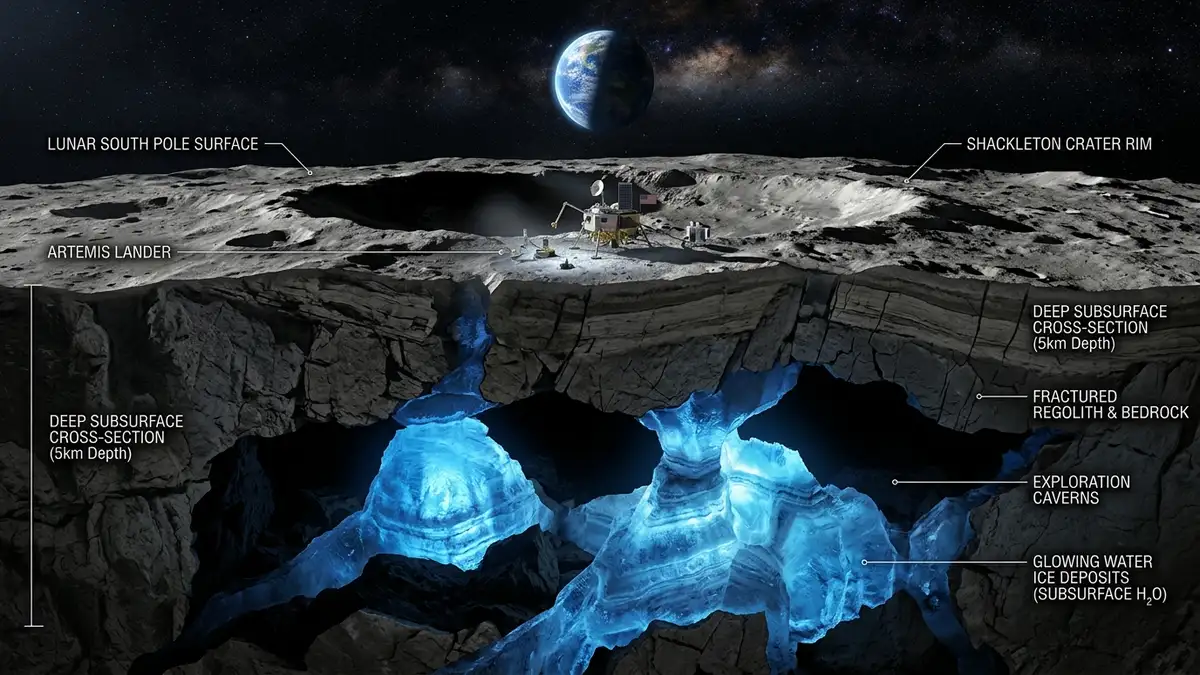
Artemis III (planned for 2027): The mission will carry two astronauts to the lunar surface for the first time since 1972. The landing module will be a modified version of SpaceX's Starship. The astronauts are expected to land in the lunar south pole region, where there is evidence of water ice in permanently shadowed craters.
Artemis IV (planned for 2028): This mission will include the initial assembly of the Gateway station in lunar orbit. Gateway will serve as a waypoint for future surface missions and, eventually, as a stepping stone to Mars.
Sustainable lunar base (2030-2035 horizon): The Artemis program's long-term goal is to establish a permanent human presence on the Moon. This includes pressurized habitats, lunar resource extraction systems (especially water), and communication and power infrastructure.
The Artemis II crew will undergo weeks of detailed medical examinations and technical debriefings. Data collected during the mission — including radiation measurements, life support system performance, and crew physiological responses — will be analyzed by NASA teams and international partners.
The Orion capsule "Integrity" will be transported back to Kennedy Space Center for inspection. Engineers will examine the heat shield, parachutes, and all critical systems to identify potential improvements for future missions.
On the political front, the success of Artemis II strengthens NASA's position in budget negotiations with Congress. The program faces constant pressure to justify its high costs, and a successful crewed mission is the most powerful argument the agency can present.
Geopolitical competition is also intensifying. China announced plans to send astronauts to the Moon by 2030 through its Chang'e program. India, following the success of Chandrayaan-3 in 2023, has also expressed crewed lunar ambitions. The success of Artemis II reaffirms American leadership in space exploration, but the race is far from decided.
Closing
Fifty-three years separate Eugene Cernan's footprints in lunar dust and Orion's plunge into Pacific waters. In that interval, entire generations were born, grew up, and aged without seeing a human being beyond low Earth orbit. Artemis II did not merely end that wait — it redefined what is possible.
Reid Wiseman, Victor Glover, Christina Koch, and Jeremy Hansen did not set foot on the Moon. But by flying around it, by breaking Apollo 13's distance record, by validating every Orion system with their own lives at stake, they paved the way for those who will come next. The next time humans look at the Moon up close, it will be to stay.
Artemis II proved that humanity has not given up on exploration. It proved that diversity strengthens, that international cooperation works, and that 53 years of waiting can end with three parachutes, an ocean, and four astronauts at a loss for words.
The cultural significance of this achievement cannot be overstated. For generations that grew up after Apollo, the Moon was a destination that humanity had visited but seemingly abandoned. Artemis II has reignited the collective imagination and reminded the world that the greatest achievements of our species come when we reach beyond what seems possible. The images of four astronauts emerging from the Orion capsule into the Pacific sunlight will define this era as surely as Neil Armstrong's first steps defined the 1960s.
Sources and References
- The Guardian — Artemis II splashdown coverage
- Space.com — Artemis II mission details and timeline
- NASA Official — Artemis II mission page
- Phys.org — Artemis II distance record and lunar flyby
- Live Science — Orion capsule reentry and recovery
- USA Today — Artemis II crew profiles and reactions
- Time — Historical context of lunar exploration
- Forbes — Artemis program costs and economic impact
- Florida Today — Kennedy Space Center launch coverage
- AccuWeather — Pacific Ocean recovery conditions