The world's most dangerous border has exploded. In 2026, the conflict between Afghanistan and Pakistan has transformed from diplomatic tension into open war — with airstrikes, ground offensives, hundreds dead, and a humanitarian crisis already affecting millions of civilians on both sides of the Durand Line. What was once limited to border skirmishes has evolved into one of Central Asia's most severe geopolitical crises since the fall of Kabul in 2021, with a real risk of destabilizing the entire region.
What's Happening: Timeline of the Escalation
Tensions between Islamabad and Kabul had been rising since 2022, when the Taliban regained power in Afghanistan. But it was in 2025 that the conflict took on an unprecedented military dimension — and 2026 brought the most violent escalation yet.
Timeline of critical events
| Date | Event | Impact |
|---|---|---|
| Aug/2021 | Taliban retakes Kabul | Pakistan celebrates but loses control over militias |
| Nov/2023 | Pakistan launches mass deportation of Afghans | 1.7 million refugees forced to return |
| Mar/2024 | Pakistani airstrikes on Afghan soil | Taliban condemns as "act of war" |
| Dec/2024 | TTP offensive in Khyber Pakhtunkhwa province | Dozens of Pakistani soldiers killed |
| Jan/2025 | Pakistan launches Operation Azm-e-Istehkam | Largest military operation since 2014 |
| Jul/2025 | Taliban closes Torkham border for weeks | Bilateral trade collapses |
| Sep/2025 | Cross-border airstrikes — both sides | First confirmed bombardments from both governments |
| Dec/2025 | Taliban attack on military base in Balochistan | 47 Pakistani soldiers killed |
| Feb/2026 | Total escalation — multiple active fronts | Undeclared open war |
The present: February 2026
In recent weeks, the situation has worsened dramatically:
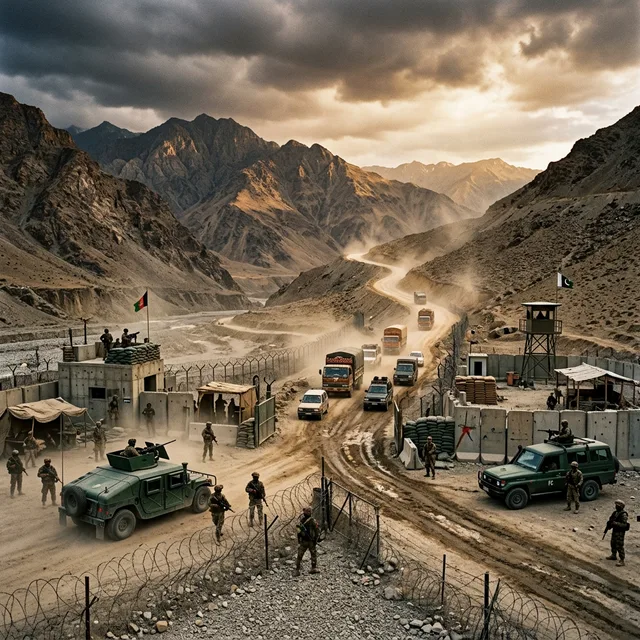
- Pakistani airstrikes on at least 5 Afghan provinces, including Paktika, Khost, and Kunar
- Taliban retaliation with artillery and mortar fire against Pakistani border posts
- Complete closure of Torkham and Chaman border crossings
- Troop movements on both sides along the entire Durand Line
- Thousands of civilians displaced in both directions
Why They're at War: The Roots of the Conflict
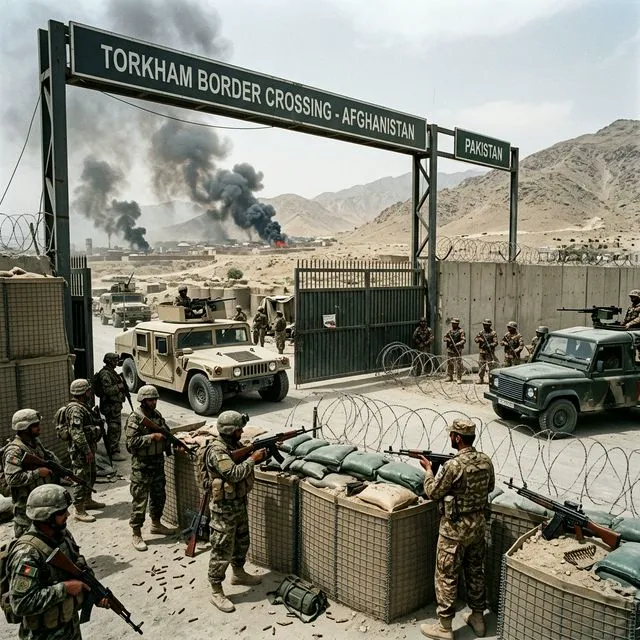
To understand the war of 2026, we need to go back over a century — to the creation of the border that divides them.
The Durand Line: the border nobody accepts
In 1893, British diplomat Sir Mortimer Durand drew a 2,640 km line dividing Pashtun territories between what is now Afghanistan and Pakistan. No Afghan government has ever recognized this border as legitimate.
| Aspect | Detail |
|---|---|
| Created | 1893, by the British Empire |
| Length | 2,640 km of mountains and deserts |
| People divided | Pashtun ethnicity — ~50 million people cut in half |
| Recognition | Pakistan recognizes it; Afghanistan never has |
| Fencing | Pakistan built barbed wire fencing along ~90% of the length |
| Official crossings | Torkham (main) and Chaman |
For the Taliban, the Durand Line is a colonial imposition that artificially divides their people. For Pakistan, it's a sovereign international border. This contradiction is the root of nearly every conflict between the two countries.
The TTP: the monster Pakistan created
The Tehrik-i-Taliban Pakistan (TTP) — the "Pakistani Taliban" — is the direct catalyst of the current war. Founded in 2007, the group emerged from the same madrassas and jihadist networks that Pakistan financed for decades to use as a tool of regional policy.
The cruel irony: Pakistan helped create the original Taliban in the 1990s as a tool of influence in Afghanistan. Now, an offshoot of that same movement has turned against the Pakistani state itself.
The TTP's declared goal is to overthrow Pakistan's government and implement Sharia across the country. Since the Taliban recaptured Kabul in 2021, the TTP has gained:
- Safe sanctuary on Afghan soil
- Accelerated recruitment among unemployed Pashtun youth
- Captured weaponry from US forces, abandoned during withdrawal
- Ideological legitimacy from the Taliban's victory over the Americans
The role of the Afghan Taliban
The Afghan Taliban — officially the "Islamic Emirate of Afghanistan" — maintains an ambiguous position regarding the TTP:
- Publicly, it denies supporting attacks against Pakistan
- In practice, it takes no action against the TTP operating on its territory
- Ideologically, it shares affinities with the TTP
- Strategically, it uses the TTP as a pressure lever against Islamabad
This ambiguity is what fuels the escalation. Pakistan demands the Taliban dismantle the TTP. The Taliban refuses. Pakistan attacks unilaterally. The Taliban retaliates. The cycle repeats — each time more violent.
The Numbers: Deaths, Displaced, and Destruction
Numbers are imprecise — both sides manipulate statistics — but independent estimates paint a devastating picture.
Confirmed casualties (consolidated estimates)
| Metric | 2024 | 2025 | 2026 (to Feb) |
|---|---|---|---|
| Pakistani soldiers killed | ~300+ | ~685 | ~120+ |
| TTP militants killed (PAK claim) | ~2,000+ | ~3,500+ | ~800+ |
| Afghan civilians killed (PAK strikes) | ~100+ | ~300+ | ~150+ |
| Pakistani civilians killed (TTP attacks) | ~400+ | ~900+ | ~200+ |
| Terrorist attacks in Pakistan | 685 | 1,100+ | ~250+ |
Humanitarian crisis
| Indicator | Situation |
|---|---|
| Afghan refugees deported | 1.7 million since Nov/2023 |
| Internally displaced (Pakistan) | ~1.5 million in KPK and Balochistan |
| Internally displaced (Afghanistan) | ~2.8 million total |
| Children out of school | ~4 million in conflict zones |
| Humanitarian corridors | Blocked at multiple points |
| Food insecurity | 23.7 million Afghans — 50% of population |
Weapons and Tactics: How the War Is Fought
The 2026 conflict is asymmetric by nature — Pakistan has a conventional army with air power; the Taliban uses guerrilla warfare and the TTP operates as an insurgency.
Pakistani arsenal
| Capability | Description |
|---|---|
| Air Force | F-16, JF-17 Thunder, Burraq and NESCOM drones |
| Artillery | M109 Howitzer, Chinese SH-15 |
| Infantry | 650,000 active soldiers + 500,000 paramilitaries |
| Intelligence | ISI — one of the world's most powerful intelligence services |
| Nuclear | ~170 nuclear warheads (deterrent against India, not applicable to this conflict) |
Taliban/TTP arsenal
| Capability | Description |
|---|---|
| Light weapons | AK-47s, RPGs, .50 cal machine guns, sniper rifles |
| Captured artillery | American M119 Howitzers, 82mm mortars |
| Vehicles | Humvees and MRAPs captured from the US |
| IEDs | Improvised explosive devices — primary tactical weapon |
| Estimated TTP strength | 30,000–40,000 fighters |
| Afghan Taliban strength | ~80,000 regular fighters |
Predominant tactics
Pakistan:
- Precision airstrikes on alleged TTP camps in Afghanistan
- Counter-insurgency operations in Khyber Pakhtunkhwa and Balochistan
- Encirclement and fortification of the Durand Line
- Mass deportation of Afghan refugees as political pressure
Taliban/TTP:
- Ambushes on military convoys on mountain roads
- Suicide attacks on bases and checkpoints
- IEDs on highways — leading cause of Pakistani deaths
- Filmed kidnappings and executions for propaganda
- Coordinated attacks on infrastructure (power lines, bridges)
Global Impact: Why the World Should Pay Attention
The Afghanistan-Pakistan conflict is not a localized dispute — its shockwaves reach across global geopolitics.
1. The nuclear risk
Pakistan is the only Islamic country with nuclear weapons. Any instability threatening control of Pakistan's nuclear arsenal is a nightmare for global security. The TTP has already attacked military bases housing nuclear components — in 2014, it attempted to storm Kamra Air Base, which houses nuclear-capable fighters.
2. China is directly involved
The China-Pakistan Economic Corridor (CPEC) — a $62 billion investment — runs through exactly the regions most affected by the conflict. Chinese workers have already been targets of attacks in Balochistan. Beijing has a direct interest in stabilizing the region but without military involvement.
3. India watches with strategic satisfaction
The India-Pakistan rivalry means New Delhi views Pakistani weakening as strategic gain. India maintains diplomatic channels with the Afghan Taliban — something unthinkable a decade ago — while Pakistan is distracted by its western border.
4. The US washed its hands
After the chaotic 2021 withdrawal, Washington has very little influence over the Taliban and limited interest in re-engaging. The American posture is containment from a distance — monitoring terrorist threats without committing troops.
5. Drug trafficking route
Afghanistan produces 80% of the world's opium and is one of the largest methamphetamine producers on the planet. Trafficking routes pass predominantly through Pakistan. The conflict disrupts anti-drug operations and creates lawless zones where drug trafficking thrives.
Military Comparison: Powers in Numbers
| Indicator | Pakistan | Afghanistan (Taliban) |
|---|---|---|
| Active military | 654,000 | ~80,000 |
| Reservists | 500,000 | Unknown |
| Military budget | $10.3 billion | ~$200 million (estimate) |
| Combat aircraft | 400+ | ~40 (captured, questionable condition) |
| Tanks | 2,680+ | ~600 (captured from US) |
| Nuclear arsenal | ~170 warheads | None |
| GDP | $376 billion | $14.5 billion |
| Population | 240 million | 42 million |
| Key allies | China, Saudi Arabia | No formal recognition |
Despite overwhelming superiority in conventional numbers, Pakistan faces the same dilemma the US faced for 20 years: it's impossible to defeat an insurgency in mountainous terrain against an enemy that knows every inch of the territory and has nothing to lose.
Future Scenarios: Where Is This Conflict Headed?
Scenario 1: Controlled escalation (most likely)
Exchanges of attacks continue, with both sides maintaining bellicose rhetoric but avoiding total declared war. The TTP intensifies operations, Pakistan responds with surgical airstrikes, and the humanitarian crisis worsens without resolution.
Probability: 60%
Scenario 2: International mediation
China intervenes as mediator, pressuring both sides toward a ceasefire and negotiations. Turkey and Qatar — which maintain relations with the Taliban — also participate. A limited agreement on border control is reached.
Probability: 20%
Scenario 3: Total escalation
A major terrorist attack on Pakistani soil (like Peshawar 2014, with 150 children killed) provokes a massive Pakistani ground offensive into Afghanistan. The Taliban responds with general mobilization. The conflict becomes a short-duration conventional war with thousands of deaths.
Probability: 15%
Scenario 4: Internal destabilization of Pakistan
The TTP manages to carry out simultaneous attacks in multiple Pakistani cities, generating political instability and a potential military coup. This scenario is the most globally dangerous because of nuclear weapons.
Probability: 5%
History Repeats: Dangerous Precedents
The current conflict echoes devastating historical patterns:
- USSR in Afghanistan (1979–1989): The superpower was defeated by mujahideen funded by... Pakistan
- USA in Afghanistan (2001–2021): 20 years, $2.3 trillion, 170,000 dead — and the Taliban returned to power
- Pakistan in FATA (2004–2017): Military operations on its own territory against the TTP — victory declared, but the TTP resurged stronger
The lesson nobody seems to learn: no conventional power has ever permanently defeated an insurgency in Afghanistan. The "Graveyard of Empires" continues collecting its toll.
Conclusion: A War Without Winners
The conflict between Afghanistan and Pakistan in 2026 is tragic not only for its violence but for its predictability. Every factor fueling this war was identified years ago — decades, in some cases — and nothing was done to defuse them.
The result is an equation with losers at every position:
- Afghan civilians lose homes, families, and hope
- Pakistani civilians live under constant TTP terror
- The Pakistani army wears itself down in a war it cannot win
- The Taliban consumes scarce resources in an already bankrupt country
- The region loses stability, investment, and development
- The world gains more refugees, more terrorism, and more instability
The defining question of 2026 is not whether the conflict will end — it's how many more lives it will cost before someone finds the courage to sit at the table and talk.
Read Also
- Ukraine-Russia War — The Numbers the World Needs to See
- Arsenal of the Apocalypse: The Weapons of the Ukraine War
- Third World War — Possible Scenarios
Frequently Asked Questions
Are Pakistan and Afghanistan officially at war?
Not in the formal legal sense. Neither country has declared war on the other. What exists is a de facto armed conflict, with airstrikes, ground operations, and border combat — but without a formal declaration of war. This ambiguity is intentional: both avoid total diplomatic escalation while conducting military operations.
What is the TTP and how is it different from the Afghan Taliban?
The TTP (Tehrik-i-Taliban Pakistan) is the "Pakistani Taliban" — an insurgent group fighting against Pakistan's government. Although they share a name and ideology with the Afghan Taliban, they are distinct organizations with separate leaderships. The Afghan Taliban governs Afghanistan; the TTP wants to overthrow Pakistan's government. The central issue is that the Afghan Taliban tolerates the TTP's presence on its territory.
Is there a risk of nuclear weapons being used?
The risk is extremely low. Pakistan's nuclear weapons exist as a deterrent against India, not Afghanistan. However, the global concern is about the stability of nuclear control — if the TTP insurgency destabilizes the Pakistani state enough to compromise the chain of command.
How long could this conflict last?
Conflicts in the region have historically lasted decades. Without a fundamental change in dynamics — such as effective Chinese mediation or an internal transformation of the TTP — the conflict is likely to persist at varying intensity for at least 3 to 5 years.
Sources: Al Jazeera, BBC, Reuters, Dawn News, ACLED (Armed Conflict Location & Event Data Project), Long War Journal, ICG (International Crisis Group), UNHCR, The Hindu, South China Morning Post, Brookings Institution, SIPRI. Data updated to February 27, 2026.