Billions of dollars in gold, jewels, and historical artifacts are scattered across the planet — buried, sunken, or simply forgotten. Some were hidden during wars, others went down with ships, and many vanished along with entire civilizations. Professional treasure hunters spend fortunes trying to find them.
What makes these treasures so fascinating isn't just their monetary value. It's the story behind each one: empires that fell, pirates who defied nations, wars that redrew maps. Every lost treasure is an unfinished chapter of human history.
Why do so many treasures remain lost?
| Factor | Explanation | Example |
|---|---|---|
| Ocean depth | 95% of the ocean floor has never been explored | Spanish galleons |
| Wars and destruction | Records and maps were destroyed | Nazi Amber Room |
| Intentional secrecy | Hidden so they would never be found | Knights Templar Treasure |
| Geographic changes | Earthquakes, erosion, and vegetation alter landscapes | Montezuma's Gold |
| Legal disputes | Governments prevent the search | San José Ship |
1. Yamashita's Treasure — The largest stolen fortune in history
Estimated value: $100–300 billion
Probable location: Philippines
During World War II, the Japanese army systematically looted 12 Asian countries. Gold, jewels, Buddha statues, diamonds — everything was confiscated and transported to the Philippines under the command of General Tomoyuki Yamashita.
When Japan's defeat became inevitable, the treasure was supposedly hidden in more than 170 tunnels and caves across the Philippine islands. Engineers who dug the hiding places were executed to keep the secret. Yamashita himself was captured and hanged in 1946 without revealing the location.
Since then, hundreds of expeditions have been organized. Former Philippine president Ferdinand Marcos allegedly found part of the treasure in the 1970s, which would explain his inexplicable wealth. To this day, Filipinos occasionally find gold bars in remote caves.
2. The Amber Room — The "Eighth Wonder of the World"
Estimated value: $500 million
Probable location: Russia or Germany
Built in 1701 for the King of Prussia, the Amber Room was an entire chamber lined with six tons of amber panels, gold, and mirrors. It was gifted to Tsar Peter the Great and installed in the Catherine Palace near Saint Petersburg.
In 1941, Nazi soldiers dismantled the room in 36 hours and transported it to Königsberg (present-day Kaliningrad). In 1945, amid Allied bombings, the room disappeared. Theories suggest it was destroyed in the bombings, hidden in salt mines, or transported aboard a submarine.
A replica was unveiled in 2003 after 24 years of work and $11 million invested. But the original — if it survived — is worth 50 times more.
3. The Knights Templar Treasure
Estimated value: Incalculable
Probable location: France, Scotland, or Oak Island (Canada)
The Knights Templar were the wealthiest military order of the Middle Ages. Over 200 years, they accumulated lands, gold, and relics across Europe and the Middle East. They invented the international banking system and were richer than many kings.
On October 13, 1307 (a Friday the 13th — the origin of the superstition), King Philip IV of France ordered the arrest of all Templars. But when soldiers arrived at the order's headquarters in Paris, the treasure had vanished the night before.
Templar ships departed from the port of La Rochelle loaded with the treasure. Where did they go? Theories point to Scotland (where the Templars had allies), Oak Island in Canada (where a mysterious pit was discovered in 1795), or even the Americas — 200 years before Columbus.
4. Montezuma's Gold — The lost Aztec treasure
Estimated value: Billions of dollars
Probable location: Mexico
When Hernán Cortés arrived in Tenochtitlán in 1519, he was dazzled by the wealth of the Aztec Empire. Emperor Montezuma II gifted the Spaniards gold, silver, and jewels — but it was only a fraction of the real treasure.
On the "Noche Triste" (Night of Sorrows) of June 30, 1520, the Aztecs drove the Spaniards out of the city. Soldiers who tried to flee carrying gold sank at the destroyed bridges over Lake Texcoco. When Cortés returned and conquered the city in 1521, Montezuma's great treasure had disappeared.
The Aztecs had supposedly hidden most of the gold in caves and lakes before the final fall. Modern expeditions using ground-penetrating radar have found underground chambers beneath Mexico City, but excavations are forbidden by the Mexican government for archaeological reasons.
5. The San José Ship — The "Holy Grail of shipwrecks"
Estimated value: $17 billion
Location: Found in 2015 off the coast of Colombia
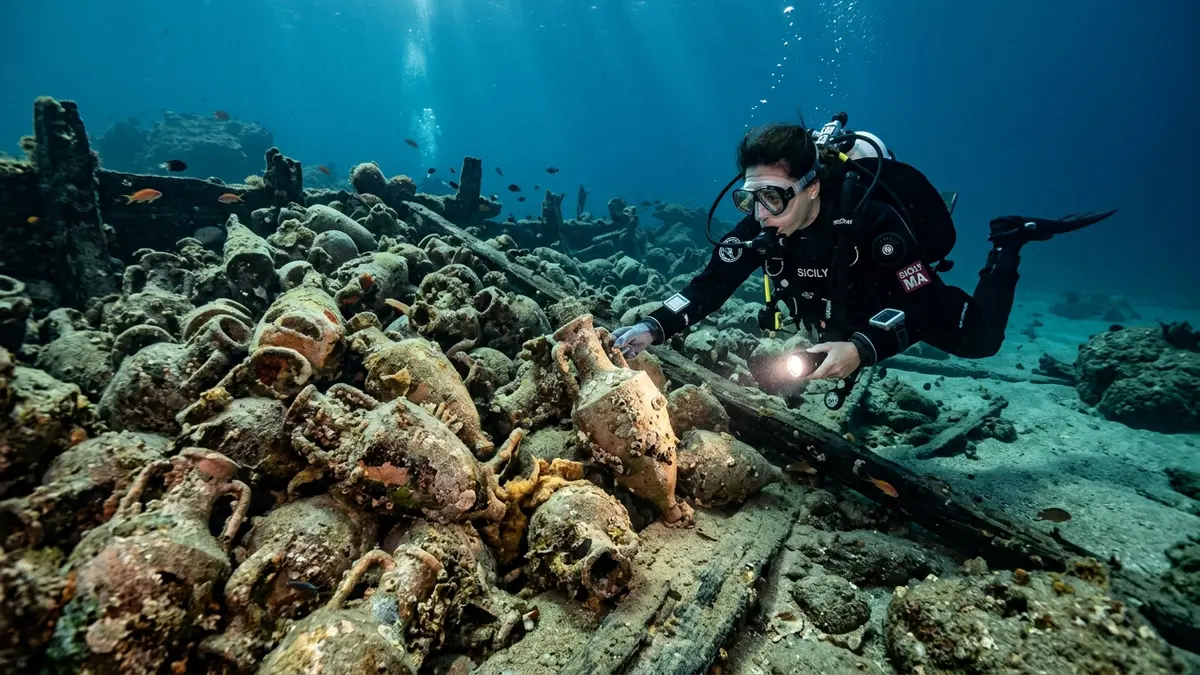
The Spanish galleon San José sank in 1708 during a battle with British ships near Cartagena, Colombia. It carried gold, silver, and emeralds collected from South American colonies — the largest cargo ever carried by a single ship in history.
In 2015, the Colombian Navy located the wreckage at 600 meters depth using underwater robots. The images revealed bronze cannons, Chinese porcelain, and piles of intact gold coins on the seabed.
But recovery is stalled by a legal dispute between Colombia (which claims it as national heritage), Spain (which claims ownership of the ship), an American salvage company (which says it found the ship first in 1981), and the Bolivian people (whose ancestors mined the gold). While the lawyers argue, $17 billion rests on the floor of the Caribbean.
6. The Treasure of Lake Guatavita — The legend of El Dorado
Estimated value: Unknown, possibly billions
Location: Colombia
The legend of El Dorado was born from an actual ritual of the Muisca, an indigenous people of Colombia. The new chief was covered in gold dust and sailed to the center of Lake Guatavita, where he dove in while offerings of gold and emeralds were thrown into the water.
This ritual took place for centuries. Spanish conquistadors tried to drain the lake in 1545 — they found some gold pieces, but most remained in the muddy bottom. In 1898, a British company managed to drain the lake almost completely, but the mud hardened in the sun like concrete before they could excavate.
Today, the lake is a protected heritage site and any search attempt is forbidden. It is estimated that centuries of gold and emerald offerings still rest beneath meters of sediment.
7. The Library of Ivan the Terrible
Estimated value: Historically priceless
Probable location: Underground Moscow
Ivan IV, the first Tsar of Russia, inherited from his Byzantine grandmother a collection of ancient manuscripts that included lost Greek and Roman texts — possibly works by Aristotle, Cicero, and Livy that exist nowhere else in the world.
Ivan ordered underground chambers built beneath the Kremlin to protect the library from fires (Moscow was made of wood and caught fire regularly). After his death in 1584, the library vanished.
Archaeologists believe it may be in the extensive tunnels beneath Moscow, many of which have never been explored. The Russian government has conducted sporadic searches, but the Kremlin's underground is a labyrinth of centuries of construction built upon construction.
8. Captain Kidd's Treasure
Estimated value: Millions of dollars
Probable location: Caribbean, Madagascar, or the U.S. East Coast
William Kidd started as a legitimate privateer hired by the British Crown to fight pirates in the Indian Ocean. But in 1698, he captured the ship Quedagh Merchant loaded with silk, gold, and spices — and was accused of piracy.
Before being arrested in Boston in 1699, Kidd buried part of his treasure on Gardiner's Island, near New York. That portion was recovered and used as evidence at his trial. But Kidd insisted until the gallows (1701) that the main treasure was hidden elsewhere and offered to reveal it in exchange for clemency. The offer was refused.
Treasure hunters have scoured the Caribbean and the coast of Madagascar for three centuries. In 2015, a 50-kilogram silver bar was found in Madagascar and attributed to Kidd, but its authenticity was disputed.
9. Nazi Gold in Lake Toplitz
Estimated value: Millions of dollars (plus historical value)
Location: Lake Toplitz, Austria
In the final days of World War II, SS officers sank crates into Lake Toplitz in the Austrian Alps. The lake is 100 meters deep and has layers of submerged logs that make diving extremely dangerous — at least two divers have died trying.
Expeditions in 1959 and 2000 recovered crates containing counterfeit British pounds (part of Operation Bernhard, a Nazi plan to destabilize the British economy) and SS documents. But divers report that more crates remain at inaccessible depths.
Rumors persist that the lake hides gold stolen from Holocaust victims, documents about secret Swiss bank accounts, and even prototypes of experimental weapons. The Austrian government has restricted diving in the lake since 1963.
10. The Menorah of the Temple of Jerusalem
Estimated value: Historically and religiously priceless
Probable location: The Vatican, Constantinople, or destroyed
The solid gold Menorah from the Second Temple of Jerusalem was the most sacred object in Judaism. When the Roman general Titus destroyed the Temple in 70 AD, the Menorah was taken to Rome as a war trophy — a scene immortalized on the Arch of Titus, which still stands today.
The Menorah remained in Rome for centuries. When the Vandals sacked Rome in 455, they supposedly took it to Carthage (present-day Tunisia). When the Byzantine general Belisarius conquered Carthage in 534, he may have sent it to Constantinople or returned it to Jerusalem.
Another popular theory is that the Menorah is in the Vatican's vaults. In 1996, the Israeli government formally asked the Vatican to check its archives. The Vatican denied possessing it. The Menorah has been lost for nearly 2,000 years.
Modern treasure hunter checklist
- ✅ Research historical documents and ancient maps
- ✅ Use technology: ground-penetrating radar, sonar, drones
- ✅ Check local laws regarding archaeological finds
- ✅ Consult professional historians and archaeologists
- ✅ Document everything with photos, videos, and GPS coordinates
- ✅ Never dig in protected areas without authorization
- ✅ Be skeptical of "authentic" treasure maps for sale
- ✅ Be prepared to spend more than you find
Quick test: could you find these treasures?
- An 18th-century document mentions "gold buried under the third stone north of the old church." The church was demolished in 1850. How do you locate the spot?
- A shipwreck is found in international waters. Three countries claim the treasure. Who has the legal right?
- You find a cave with Japanese World War II inscriptions in the Philippines. What is your next step?
- A metal detector indicates gold 3 meters deep on private property. What do you do?
- Nazi documents mention a "special cargo" sent to Argentina in 1945. How do you investigate?
Frequently Asked Questions
How much is the total value of lost treasures in the world?
Estimates vary enormously, but experts calculate between $60 billion and $1 trillion in known treasures that have not yet been recovered. This includes shipwrecks, war treasures, and historical artifacts. The real value could be much higher, since many treasures remain unknown.
Is it legal to keep a treasure you find?
It depends on the country and the circumstances. In Brazil, archaeological finds belong to the federal government. In international waters, maritime salvage law applies. In England, the "Treasure Act" requires you to declare finds. Always consult a lawyer before digging.
Has anyone ever gotten rich finding treasures?
Yes. Mel Fisher spent 16 years and his entire fortune searching for the galleon Nuestra Señora de Atocha, which sank in 1622 off Florida. In 1985, he found $450 million in gold and silver. But for every Fisher, there are thousands who spent everything and found nothing.
Why do governments prevent treasure hunting?
To protect historical heritage. Amateur treasure hunters frequently destroy valuable archaeological context when digging without proper methods. An artifact removed from its context loses much of its scientific value. Additionally, there are sovereignty disputes over treasures in territorial waters.
Which treasure is most likely to be found?
Yamashita's Treasure in the Philippines, because there is concrete evidence of its existence, the general location is known, and underground detection technology is advancing rapidly. The San José Ship has already been found — the challenge now is political and legal, not technical.
Are there lost treasures in Brazil?
Yes, several. Besides the Central Bank of Fortaleza robbery (R$140 million never recovered), there are legends about bandeirante gold in Minas Gerais, Jesuit treasures in the South, and Dutch gold sunk off the coast of Pernambuco during the 17th-century invasions.