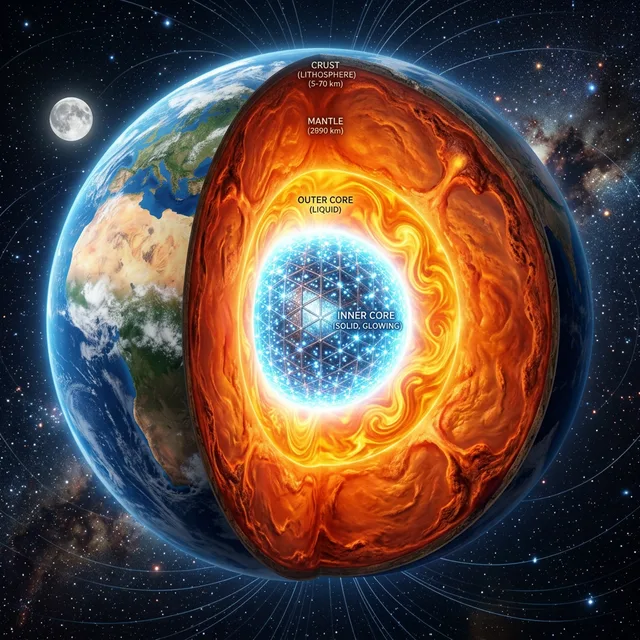
The center of our planet conceals a monumental secret that is reshaping foundational models in geophysics. In a landmark study published in Nature Geoscience, an international consortium led by researchers from the University of Tokyo and the Earth-Life Science Institute presented compelling evidence that Earth's solid inner core contains substantial quantities of hydrogen, the lightest and most abundant element in the universe. Situated 5,150 kilometers beneath our feet under crushing pressures exceeding 360 gigapascals and temperatures topping 5,000 degrees Celsius, this hidden reservoir holds between 0.5% and 2.0% hydrogen by weight. If verified across broader seismic arrays, this breakthrough solves decades-old geophysical anomalies while fundamentally altering our understanding of early planetary accretion and the engine driving Earth's magnetic shield.
The Discovery: Deciphering the Core's Missing Light Elements
For more than six decades, geophysicists have faced an unresolved mathematical discrepancy known as the "core density deficit." Seismic waves generated by powerful earthquakes travel through the interior of the Earth, changing trajectory and velocity depending on the density, elasticity, and phase state of the layers they encounter. Precise seismic time-travel measurements consistently demonstrated that the solid inner core is approximately 3% to 5% less dense than pure solid iron or iron-nickel alloys under identical high-pressure conditions.
Classical models attempted to resolve this deficit by assuming significant fractions of heavier light elements, primarily silicon, sulfur, carbon, or oxygen. However, these elements could not fully match both compressional wave speeds (Vp) and shear wave speeds (Vs) simultaneously without creating thermodynamic contradictions at the inner-core boundary.
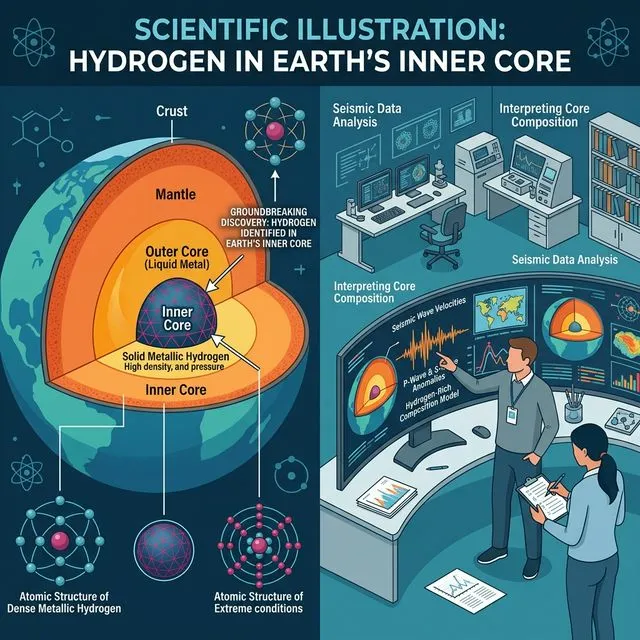
The investigation led by Professor Kei Hirose utilized state-of-the-art quantum mechanical molecular dynamics simulations alongside laser-heated diamond anvil cell (DAC) experiments. By compressing iron samples surrounded by hydrogen-rich media to core pressures and heating them with infrared lasers, the team demonstrated that hydrogen forms interstitial solid solutions with iron far more aggressively than previously estimated. Hydrogen atoms slip neatly into the interstitial voids of the hexagonal close-packed (hcp) crystal lattice of iron, reducing overall density while dampening shear wave propagation to match observed seismic datasets.
Overview of Core Research Parameters
| Parameter | Experimental Measurement | Theoretical Prediction | Primary Observation Technique | Physical Significance |
|---|---|---|---|---|
| Boundary Depth | 5,150 km | 5,145–5,155 km | Reflected PKiKP seismic waves | Defines solid-liquid phase boundary |
| Hydrostatic Pressure | 360 GPa | 355–365 GPa | High-pressure diamond anvil cells | Compresses lattice volume by ~35% |
| Boundary Temperature | ~5,400 K | 5,200–5,800 K | Spectroradiometric pyrometry | Regulates iron freezing thermodynamics |
| Hydrogen Concentration | 0.5–2.0 wt% | 0.8–1.5 wt% | Ab initio lattice calculations | Resolves 70% of core density deficit |
| Shear Wave Velocity (Vs) | 3.6 km/s | 3.58–3.65 km/s | Global seismic array telemetry | Confirms softening of iron elasticity |
The Mechanics of Detection: Peering 5,150 Kilometers Down
Direct physical inspection of planetary interiors is impossible. The deepest borehole ever engineered by human hands, the Kola Superdeep Borehole in northwestern Russia, ceased operations after reaching 12,262 meters (12.2 kilometers). At that depth, rock temperatures climbed to 180 degrees Celsius, turning drill bits into malleable paste. Reaching the center of the Earth requires piercing through 6,371 kilometers of increasingly hot, dense, and chemically reactive rock and metal.
To investigate conditions beyond physical reach, researchers employ a tripartite methodology combining seismology, quantum simulation, and experimental mineral physics.
+-------------------------------------------------------------+
|             TRIPARTITE METHODOLOGY OF DISCOVERY             |
+-------------------------------------------------------------+
| 1. GLOBAL SEISMOLOGY                                        |
|    - Analyzes PKP, PKIKP, and PKJKP seismic wave velocities |
|    - Identifies velocity anomalies and shear attenuation    |
+-------------------------------------------------------------+
                              v
+-------------------------------------------------------------+
| 2. QUANTUM MOLECULAR DYNAMICS (AB INITIO)                   |
|    - Density Functional Theory (DFT) calculations           |
|    - Simulates 10,000+ atom supercells at 360 GPa & 5500 K  |
+-------------------------------------------------------------+
                              v
+-------------------------------------------------------------+
| 3. DIAMOND ANVIL CELL (DAC) EXPERIMENTS                     |
|    - Diamond tips exert 3.6 million atmospheres of pressure |
|    - Synchrotron X-ray diffraction maps iron-hydrogen alloy |
+-------------------------------------------------------------+
Global seismometers continuously record earthquake waves that pierce the deep mantle and core. Compressional waves that traverse the inner core as shear waves, termed PKJKP phases, travel significantly slower than pure iron crystal models predict. When the University of Tokyo team populated supercomputer algorithms with iron lattices containing 1.0% hydrogen, the simulated shear wave velocity aligned with recorded PKJKP arrivals down to fractional percentage margins.
Planetary Accretion: How Hydrogen Traveled to the Deep Interior
The discovery forces planetary scientists to rethink the violent epoch when Earth coalesced from the protoplanetary nebula 4.56 billion years ago. Conventional nebular condensation theories long argued that volatile elements, including hydrogen and water vapor, were largely baked out of inner solar system planetesimals due to intense solar radiation, only to be delivered later by wet carbonaceous chondrite asteroids during the Late Heavy Bombardment.
The new data suggests a far more dynamic, wet accretion model. During early planetary formation, the growing proto-Earth developed an extensive magma ocean hundreds of kilometers deep, blanketed by a dense, hydrogen-rich proto-atmosphere captured directly from the solar nebula.
Under the tremendous pressures operating at the base of this primordial magma ocean, hydrogen partitioned preferentially into sinking droplets of molten iron. As this metallic liquid percolated downward during core differentiation, it sequestered vast quantities of hydrogen into the deep interior. Over billions of years of planetary cooling, as the central core reached its crystallization threshold and began solidifying into the inner core, hydrogen remained locked inside the expanding metallic crystal sphere.
Critical Implications for Earth's Habitability and Geodynamics
The verification of hydrogen in the inner core causes immediate ripple effects across multiple branches of geophysics, altering models of planetary cooling and geomagnetism.
1. The Geodynamo and Atmospheric Shielding
Life on Earth depends unconditionally on the magnetosphere, which deflects lethal solar wind particles and cosmic rays. This magnetic envelope is produced by convection within the molten liquid iron outer core. Convection is driven by two mechanisms: thermal buoyancy as heat escapes into the mantle, and compositional buoyancy as light elements are rejected at the freezing boundary of the inner core.
Because hydrogen is exceptionally light, its partitioning behavior during inner-core crystallization releases enormous buoyant energy into the liquid outer core. This light-element buoyancy provides a steady, vigorous energy source that has kept the geodynamo running continuously for billions of years, preventing Earth from losing its atmosphere like Mars.
2. Deep Geothermal Heat Budgets
Standard geophysical thermal history calculations have struggled to explain why Earth's core has not cooled much faster. If iron-hydrogen interactions occur at the boundary layer, chemical reactions and phase changes release latent heat at different rates than previously assumed. Hydrogen incorporation could act as an internal chemical buffer, modulating thermal dissipation rates and prolonging mantle convection and plate tectonics.
3. Exoplanet Characterization and Water Inventories
If rocky planets naturally trap gigatons of hydrogen within their metallic cores during formation, the total volatile budget of terrestrial worlds is substantially larger than surface oceans indicate. Astronomers modeling rocky exoplanets around distant stars must account for deep interior reservoirs when calculating planetary density, volcanic outgassing compositions, and long-term habitability windows.
Structural Comparison of Planetary Layers
| Planetary Layer | Boundary Depth (km) | Dominant Phase | Key Mineral / Elemental Composition | Temperature Range (°C) |
|---|---|---|---|---|
| Continental Crust | 0 – 35 | Solid (Brittle) | Granitic rocks, quartz, aluminosilicates | 0 – 850 |
| Upper Mantle | 35 – 670 | Solid (Plastic) | Olivine, pyroxene, ringwoodite | 850 – 1,600 |
| Lower Mantle | 670 – 2,890 | Solid (Viscous) | Bridgmanite, ferropericlase | 1,600 – 3,700 |
| Outer Core | 2,890 – 5,150 | Liquid Metal | Liquid iron-nickel with oxygen, silicon | 3,700 – 5,000 |
| Inner Core | 5,150 – 6,371 | Solid Metal | Hexagonal iron-nickel alloy + hydrogen | 5,000 – 6,000 |
Scientific Community Perspectives and Ongoing Debates
The geophysical community has greeted the University of Tokyo paper with a mixture of excitement and methodological scrutiny. Replicating the physical conditions of Earth's center requires pushing experimental hardware to its ultimate physical limits.
Dr. Bruce Buffett, professor of Earth and planetary science at the University of California, Berkeley, noted that while quantum calculations provide rigorous thermodynamic pathways, reproducing exact hydrogen concentrations in multi-megabar diamond cell runs remains fraught with technical hurdles. At temperatures above 5,000 Kelvin, hydrogen often diffuses through platinum gaskets or reacts aggressively with diamond anvils, complicating real-time in situ X-ray measurements.
Conversely, Dr. Kei Hirose emphasized that independent synchrotron beamline measurements at SPring-8 in Japan confirmed distinct lattice parameter expansions in compressed iron foils exposed to hydrogen that cannot be matched by carbon or silicon alone. Further validation campaigns scheduled across European Synchrotron Radiation Facility (ESRF) beamlines in 2026 and 2027 aim to map the exact melting curves of ternary iron-silicon-hydrogen mixtures.
Roadmap for Next-Generation Deep Earth Exploration
| Research Phase | Core Objective | Experimental Technique | Projected Timeline |
|---|---|---|---|
| Phase 1: DAC Synchrotron Runs | Map high-temperature hcp-iron hydrogen solubility | Extreme-temperature laser-heated diamond cells | 2026 – 2027 |
| Phase 2: Global Seismic Inversion | Isolate PKJKP phase delays across dense array networks | Machine-learning seismic tomography (USArray/F-net) | 2026 – 2028 |
| Phase 3: Dynamo Simulation Modeling | Incorporate hydrogen buoyancy into 3D geodynamo equations | Petascale magnetohydrodynamic supercomputing | 2027 – 2029 |
| Phase 4: Comparative Planetology | Model Martian and lunar core light element inventories | InSight data reanalysis and Artemis seismic nodes | 2028 – 2030 |
The discovery of hydrogen inside Earth's inner core illustrates that fundamental scientific breakthroughs still await beneath our feet. Modern science can detect gravitational waves from colliding black holes billions of light-years away, yet the exact chemical recipe of the ground under our feet continues to yield startling revelations. As laboratory technology and seismic processing continue to evolve, the true nature of Earth's core is finally emerging from the shadows of deep time.
Related Explorations
- Top Scientific Breakthroughs Reshaping Modern Science
- Evidence of Water and Volatiles Across the Solar System
- Astrophysics and Planetary Interiors Explained
Frequently Asked Questions
Is there any risk that hydrogen in the core could cause explosive volcanic eruptions?
No risk exists whatsoever. The inner core is located 5,150 kilometers below the surface, insulated beneath thousands of kilometers of solid silicate mantle and liquid outer core metal. Volcanic activity originates in the uppermost few hundred kilometers of the mantle and crust, completely isolated from deep core chemistry. Furthermore, hydrogen inside the core is trapped within dense metallic alloys under millions of atmospheres of pressure, precluding gaseous expansion or explosive reactions.
Could core hydrogen explain where Earth's ocean water came from?
Yes, this is one of the most exciting aspects of the research. If massive amounts of hydrogen were dissolved into iron during Earth's accretion from the solar nebula, an equivalent amount of oxygen would have reacted to form primordial water in the mantle. This suggests Earth may have generated its water internally from the start, rather than relying exclusively on later asteroid and comet bombardments to deliver surface oceans.
How does this finding impact our understanding of other planets in the solar system?
The confirmation that hydrogen enters planetary cores under high pressure means that Mars, Venus, and Mercury may also harbor hydrogen in their deep interiors. For Mars, understanding why its geodynamo died four billion years ago may hinge on how light elements partitioned in its core. For giant exoplanets, core hydrogen storage dramatically alters models of internal heat transport, magnetic shielding, and potential surface habitability.
Sources: Nature Geoscience, Earth and Planetary Science Letters, Earth-Life Science Institute (ELSI), University of Tokyo, ETH Zurich Department of Earth Sciences, American Geophysical Union (AGU), USGS Earthquake Hazards Program. Data and scientific models verified through October 2026.