Robots Explore Lava Tubes: The Caves That Could Shelter Humanity on Moon and Mars
In the volcanic depths of Lanzarote, in the Canary Islands, three robots are learning to navigate an environment that could determine the future of space colonization. The mission: master the exploration of lava tubes — natural caves formed by ancient magma flows that exist on Earth, the Moon, and Mars.
In April 2026, a team of European researchers completed the most ambitious phase of the CoRob-X project, demonstrating that autonomous robots can map, analyze, and prepare these tunnels for eventual human habitation. The results could revolutionize our plans to establish permanent presence beyond Earth.
Why Lava Tubes Are So Important
The surface of the Moon and Mars is incredibly hostile to human life. Cosmic radiation, micrometeorites, extreme temperatures, and vacuum (in the lunar case) make building surface habitats a monumental challenge. But just below that deadly surface exist perfect natural shelters.
What Are Lava Tubes
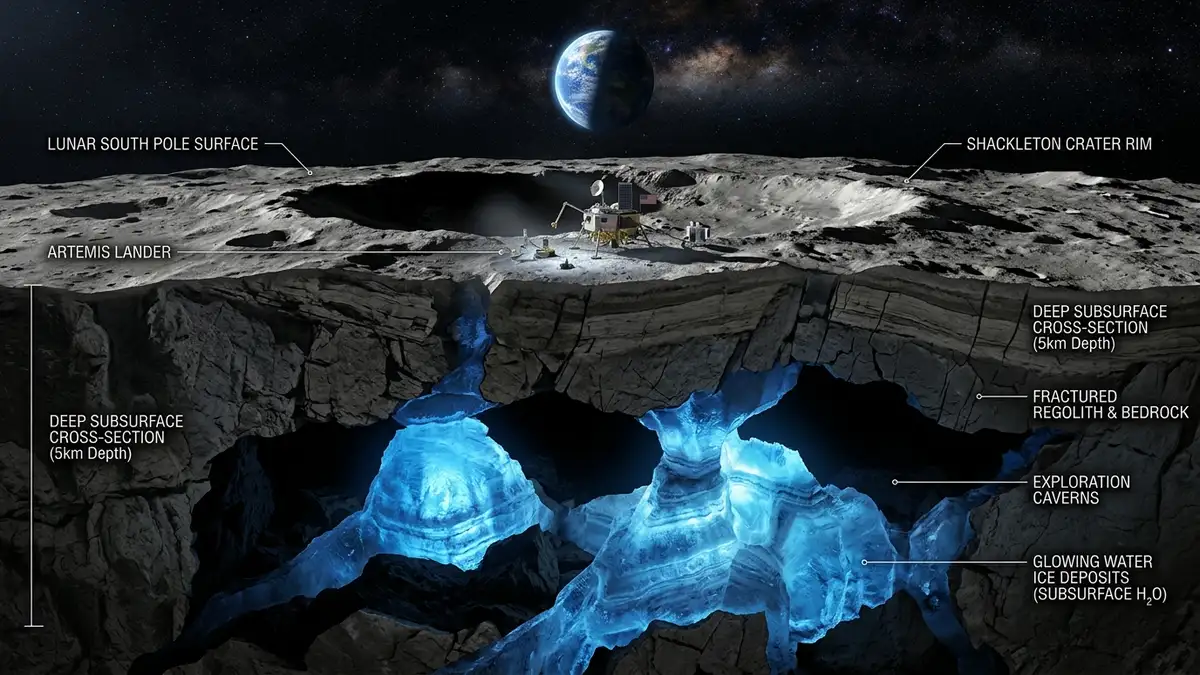
Lava tubes form when the outer layer of a lava flow cools and solidifies while the interior continues flowing. When the eruption ends, the magma drains, leaving behind a hollow tunnel that can extend for kilometers.
On Earth, these tunnels rarely exceed 30 meters in diameter. But on the Moon, with gravity six times weaker, they can be gigantic — some estimated at more than 1 kilometer wide and hundreds of meters tall. They are natural underground cathedrals.
Advantages for Colonization
The benefits of using lava tubes as habitats are extraordinary:
Radiation protection: The rock above blocks cosmic rays and solar radiation that, on the lunar surface, would cause cancer in astronauts within months.
Stable temperature: While the lunar surface varies from -173°C at night to 127°C during the day, the interior of tunnels maintains a constant temperature of approximately -20°C — cold, but manageable.
Impact protection: Micrometeorites constantly bombard the lunar surface. Inside a tunnel, this risk is eliminated.
Abundant space: A single lunar lava tube could house an entire city, with room for agriculture, industry, and housing.
Simplified construction: Instead of building structures from scratch, simply seal and pressurize existing caves.
The CoRob-X Project
CoRob-X (Cooperative Robots for Extreme Environments) is an initiative of the European Space Agency (ESA) in partnership with universities and technology companies across Europe.
The Three Robots
The team developed three complementary robots, each specialized in a function:
LUVMI-X (Lunar Volatile and Mineralogy Investigation)
A six-wheeled rover designed for initial exploration. Equipped with:
- LIDAR for 3D mapping
- Spectrometer for mineral analysis
- High-resolution cameras
- Radiation sensors
- Capability to operate in total darkness
DAEDALUS (Descent And Exploration in Deep Autonomy of Lunar Underground Structures)
A 46 cm diameter sphere designed to descend into vertical pits — the "skylights" that provide access to tunnels. Features:
- Spherical design to survive falls
- 360° stereoscopic cameras
- Extenders for stabilization
- Communication via fiber optic cable
- Autonomy for initial exploration
TRAILER (Tethered Reconnaissance and Inspection for Lunar Exploration Robot)
A detailed inspection robot that follows DAEDALUS via cable. Functions:
- In-depth geological analysis
- Sample collection
- Installation of permanent sensors
- Preparation for human missions
The Lanzarote Tests
Lanzarote was chosen for its extensive lava tube systems, formed 3,000-5,000 years ago by eruptions from the Corona volcano. The tunnel system extends for more than 7 kilometers, including the famous Cueva de los Verdes and Jameos del Agua.
Phase 1: Mapping (January 2026)
LUVMI-X spent three weeks mapping tunnel sections, creating high-resolution 3D models. The robot operated in complete darkness, navigating only by LIDAR and infrared sensors.
Results:
- 2.3 km of tunnels mapped
- 2 cm resolution in 3D model
- Identification of 47 potential sites of scientific interest
- Zero human intervention needed after mission start
Phase 2: Vertical Descent (February 2026)
DAEDALUS was tested in vertical pits up to 30 meters deep. The sphere was launched from drones and descended in controlled fall, demonstrating ability to survive impact and begin exploration immediately.
Results:
- 12 successful descents
- Survival of falls up to 25 meters
- 360° mapping during descent
- Stable communication via fiber optic
Phase 3: Cooperative Exploration (March-April 2026)
The three robots worked together in a complete lunar mission simulation. LUVMI-X identified a tunnel entrance, DAEDALUS descended for initial reconnaissance, and TRAILER followed for detailed analysis.
Results:
- Autonomous coordination between the three robots
- Decision-making without Earth communication (simulating lunar delay)
- Identification of potential resources (water ice in simulation)
- Preparation of "landing zone" for future human mission
Scientific Discoveries
Beyond validating the technology, the tests revealed valuable information about the tunnels themselves.
Structural Stability
TRAILER analyses confirmed that Lanzarote tunnels have remained stable for thousands of years, even with occasional seismic activity. This suggests that lunar tunnels, in a geologically calmer environment, would be extremely safe.
Internal Microclimate
Sensors detected that tunnel interiors maintain remarkably constant humidity and temperature, even when external conditions vary drastically. On the Moon, this would mean a much easier environment to control.
Potential Resources
Spectrometers identified minerals that, in lunar context, would be valuable for construction and oxygen production. The basaltic composition of the tunnels is similar to what we expect to find on the Moon.
The Path to the Moon
CoRob-X results directly feed ESA's plans for lunar exploration.
Precursor Mission (2028)
ESA plans to send a version of DAEDALUS to the Moon in 2028, as part of the Lunar Caves Reconnaissance mission. The goal is to descend into one of the "skylights" identified by orbiters and confirm the existence of accessible tunnels.
Priority targets include:
- Marius Hills: Region with more than 200 identified skylights
- Mare Tranquillitatis: Near the Apollo 11 landing site
- South Pole: Where water ice may exist in permanently shadowed tunnels
Robotic Exploration (2030-2032)
If the 2028 mission confirms suitable tunnels, a fleet of robots will be sent for complete mapping and preparation. This would include:
- Installation of lighting
- Sealing of fissures
- Preparation of landing areas
- Establishment of communications
Human Presence (2035+)
The ultimate goal is to establish a permanent human habitat in a lunar lava tube. The vision includes:
- Pressurized modules inside the tunnel
- Hydroponic agriculture using artificial light
- Mining of local resources
- Base for deeper missions into the solar system
Implications for Mars
Everything we learn about lunar tunnels applies, with modifications, to Mars.
Martian Tunnels
Mars also has extensive lava tube systems, particularly in the Tharsis region, home to the largest volcanoes in the solar system. Some Martian tunnels may be even larger than lunar ones.
Additional Advantages
On Mars, tunnels offer additional protection against dust storms that can last months and cover solar panels. The Martian atmosphere, though thin, also means pressurizing tunnels would be easier than on the Moon.
Unique Challenges
Mars's distance (up to 24 minutes of communication delay) makes robotic autonomy even more critical. Robots will need to make complex decisions without Earth guidance.
International Competition
Europe is not alone in the race for lava tubes.
United States
NASA funds cave exploration robot research through the BRAILLE program (Biologic and Resource Analog Investigations in Low Light Environments). Tests occur in lava tubes in Hawaii and New Mexico.
China
CNSA included tunnel exploration in its plans for the permanent lunar base planned for 2035. Chinese robots have already mapped caves in Yunnan province as preparation.
Japan
JAXA developed UZUME (Unprecedented Zipangu Underworld of the Moon Exploration), a robot concept specifically designed for lunar tunnels.
Private Companies
Startups like Astrobotic (USA) and ispace (Japan) are also developing technology for underground exploration, seeing commercial potential in mining and space tourism.
Remaining Challenges
Despite success in Lanzarote, significant obstacles remain.
Underground Communication
Radio signals don't penetrate rock. Solutions include fiber optic cables, serial repeaters, or acoustic communication through rock.
Lunar Dust
Lunar regolith is abrasive and electrostatically charged, potentially damaging equipment. Robots will need special protection.
Energy
Solar panels don't work underground. Options include compact nuclear reactors, long-duration batteries, or power cables from the surface.
Sealing
Pressurizing a natural tunnel requires sealing all fissures — a challenge in structures kilometers in length.
FAQ - Frequently Asked Questions
How do we know lava tubes exist on the Moon?
Lunar orbiters, including NASA's Lunar Reconnaissance Orbiter and Japan's Kaguya probe, have photographed more than 200 "skylights" — circular holes in the lunar surface that appear to be collapsed entrances to underground tunnels. Some of these openings are more than 100 meters in diameter. Radar analyses have also detected underground voids consistent with tunnels. Although no robot has yet descended into a lunar tunnel, evidence of their existence is considered very strong by the scientific community.
How much would it cost to build a base in a lunar tunnel?
Estimates vary enormously, but ESA calculates that an initial base for 4-6 people in a lunar tunnel would cost between US$ 50-100 billion over 15-20 years. This is significantly less than building an equivalent surface base, which would require structures shielded against radiation and impacts. The main cost is not construction itself, but transporting equipment and supplies from Earth. As launch technologies become cheaper (thanks to companies like SpaceX), these costs should decrease.
Could humans live permanently in lunar tunnels?
Technically, yes. With adequate pressurization, temperature control, oxygen production (possibly extracted from lunar rock), water (from polar ice or recycled), and food (hydroponic agriculture), humans could live indefinitely in lunar tunnels. The biggest challenges are psychological — living permanently underground, without natural light, 384,000 km from home. Studies in Antarctic bases and submarines suggest that personnel rotation and careful habitat design can mitigate these problems.
Why not build surface habitats?
Surface habitats are possible, but much more difficult and expensive. Radiation shielding (meters of regolith or water), micrometeorite protection, and systems to handle extreme temperature variations would be necessary. Lava tubes offer all this naturally. Additionally, the space available in a tunnel is vastly larger than any structure we could transport from Earth. The surface will probably be used for facilities that need sunlight (panels, observatories), while housing and industry would be underground.
When will humans first enter a lunar tunnel?
If current plans hold, the first human exploration of a lunar tunnel could occur between 2035 and 2040. This depends on the success of precursor robotic missions (2028-2032), availability of reliable lunar transport (SpaceX's Starship or equivalent), and continued funding from space agencies. China announced plans for a permanent lunar base by 2035, which may include tunnel exploration. International competition could accelerate this timeline.
Sources and References
- ESA - CoRob-X Project
- Nature Astronomy - Lunar lava tubes as habitats
- Planetary Science Journal - Lanzarote analog tests
- Space.com - Robots explore lava tubes
- IEEE Spectrum - DAEDALUS robot design