In the early hours of March 3, 2026, the Moon will slowly vanish from the sky — and re-emerge dressed in blood-red. It's the total lunar eclipse, one of the most spectacular and accessible astronomical phenomena nature offers. No special equipment needed, no risk to the eyes, and visible to billions of people worldwide, the March 2026 "Blood Moon" promises to be an unforgettable spectacle.
While the world deals with geopolitical crises and tensions pushing humanity toward the abyss, the cosmos reminds us that beauty exists beyond our wars. The Moon will turn red for nearly an hour on the most impressive night of 2026.
What Is a Total Lunar Eclipse?
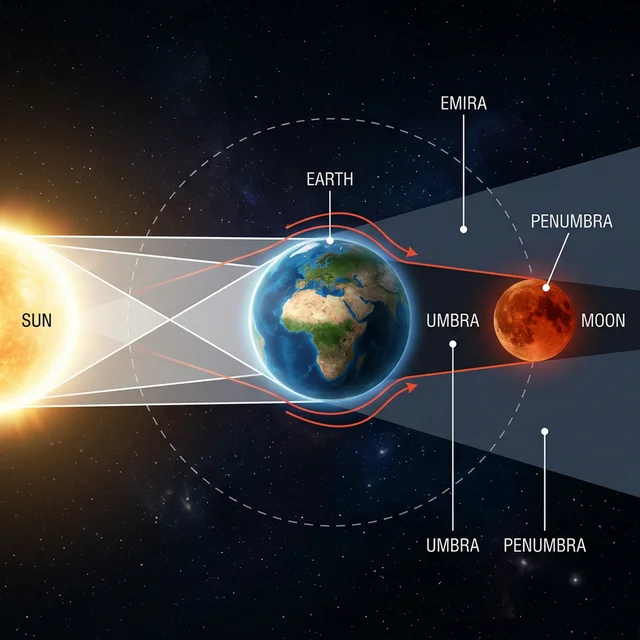
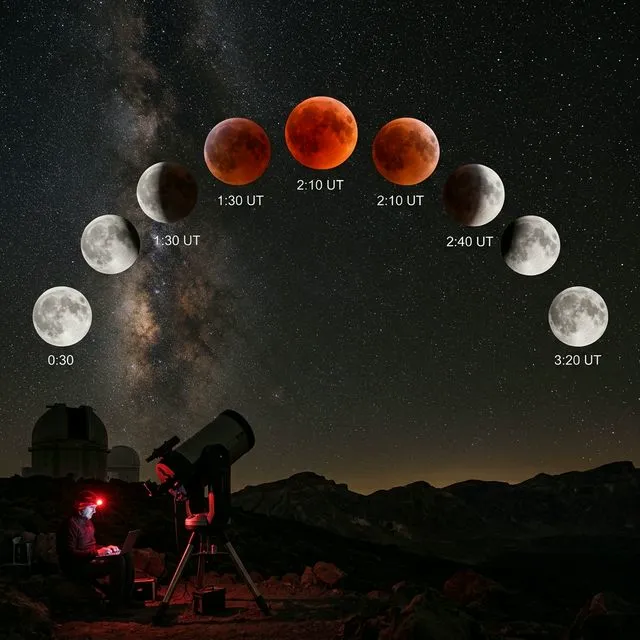
A total lunar eclipse occurs when Earth positions itself exactly between the Sun and Moon, blocking direct sunlight. But instead of simply disappearing, the Moon takes on dramatic colors — shades of red, copper, orange and even brown — that earned it the name "Blood Moon" throughout millennia.
Why Does the Moon Turn Red?
The answer lies in a phenomenon called Rayleigh scattering — the same one that makes our sunsets orange:
- Earth's atmosphere acts as a filter: When sunlight passes through the atmosphere, gas molecules scatter shorter wavelengths (blue and violet)
- Red light "bends" around Earth: Longer wavelengths — red and orange — are refracted by Earth's atmosphere toward the Moon
- The Moon is bathed in red: Even in Earth's shadow, the Moon receives this filtered red light
Lunar vs. Solar Eclipse
| Feature | Lunar Eclipse | Solar Eclipse |
|---|---|---|
| What's blocked | Sunlight on Moon | Sunlight on Earth |
| Safe to watch? | ✅ Yes, naked eye | ❌ No, requires special filter |
| Totality duration | 30-100 minutes | 2-7 minutes |
| Visibility | Entire night hemisphere | Narrow strip of few km |
March 3, 2026 Eclipse: Technical Data
| Parameter | Value |
|---|---|
| Date | March 3, 2026 |
| Type | Total |
| Total event duration | 5 hours 39 minutes |
| Totality duration | 58 minutes 19 seconds |
| Maximum eclipse (UTC) | 11:33 UTC |
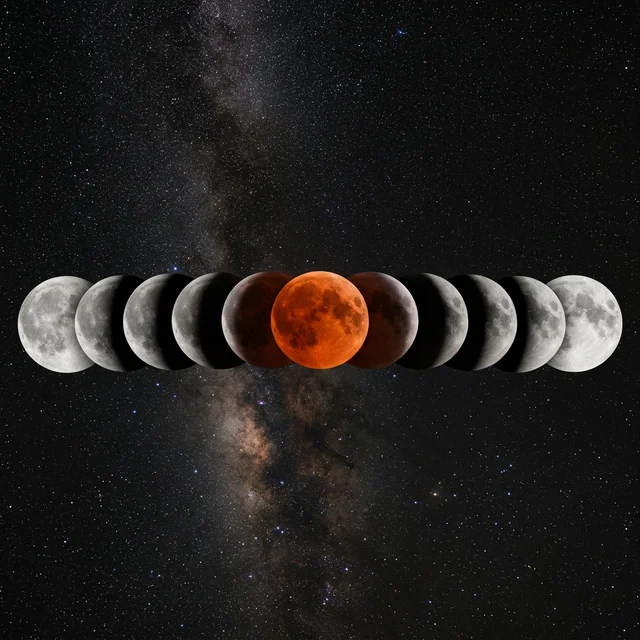
Phase-by-Phase Timeline
| Phase | Time (UTC) | What Happens |
|---|---|---|
| Penumbral eclipse begins | 08:50 | Earth's partial shadow touches the Moon |
| Partial eclipse begins | 09:57 | Earth's dark shadow starts "biting" the Moon |
| Totality begins | 11:04 | Moon entirely in shadow — intense red |
| Maximum eclipse | 11:33 | Deepest point — Moon at most intense red |
| Totality ends | 12:02 | Moon begins exiting the shadow |
| Partial eclipse ends | 13:09 | Last shadow portion leaves the Moon |
| Penumbral eclipse ends | 14:29 | Event concluded |
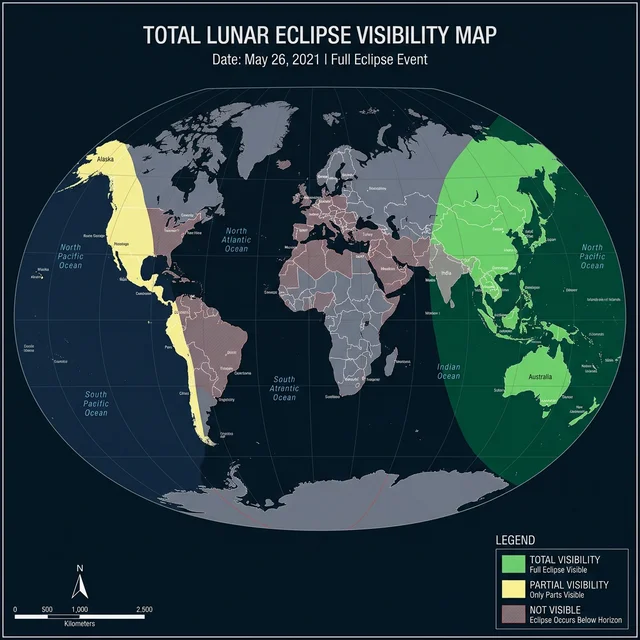
Where Will It Be Visible?
| Region | Visibility | Details |
|---|---|---|
| East Asia (Japan, Korea, eastern China) | 🟢 Complete | Totality 20:04-21:02 local time (Tokyo) |
| Australia & New Zealand | 🟢 Complete | Totality 22:04-23:02 AEDT (Sydney) |
| Central Pacific | 🟢 Complete | Visible all night |
| Western North America | 🟡 Partial (pre-dawn) | Totality at 02:04-03:02 PST |
| Eastern North America | 🟡 Partial (pre-dawn) | Totality at 06:04 EST — Moon very low |
| South America | 🟡 Partial (pre-dawn) | Visible in western regions |
| Europe | 🔴 Not visible | Moon below horizon |
| Africa | 🔴 Not visible | Moon below horizon |
The Science Behind the Colors
The Danjon Scale
| Level | Appearance | Cause |
|---|---|---|
| L0 | Very dark Moon, nearly invisible | Very polluted or volcanic atmosphere |
| L1 | Dark gray or brown | Substantial atmospheric particles |
| L2 | Dark red or rust | Average atmospheric conditions |
| L3 | Brick-red with yellowish edge | Relatively clean atmosphere |
| L4 | Bright copper-red or orange | Very clean atmosphere |
Astronomers estimate the March 2026 eclipse will be classified between L2 and L3 — a dramatic dark red, potentially deeper due to recent Mount Semeru eruption particles.
How to Observe and Photograph
Unlike solar eclipses, lunar eclipses are absolutely safe to observe with the naked eye. No filter or special glasses needed.
Tips for best experience:
- Choose a dark location away from city lights
- Adapt your eyes for 20 minutes in darkness
- Use binoculars (7x50 or 10x50) for incredible surface details
- Watch for stars that become visible near the Moon during totality
- Note the gradual color transition: white → yellow → orange → red
Photography Settings
| Equipment | Suggested Settings | Result |
|---|---|---|
| Smartphone | Night mode, max zoom, tripod | Good for social media |
| DSLR/Mirrorless | 200-600mm lens, ISO 400-1600, 1-4s exp | Detailed red Moon photos |
| Telescope + Camera | Adapter coupling, low ISO | Surface details with color |
| Timelapse | Photo every 30-60s for 3-4 hours | Spectacular progression video |
Lunar Eclipses in Human Culture
Throughout history, lunar eclipses generated fear, wonder and mythology:
- Andean peoples (Incas): Believed a cosmic jaguar attacked the Moon
- Ancient China: A celestial dragon tried to devour the Moon
- Mesopotamia: Eclipse was an omen of the king's death
- Vikings: Two wolves pursued the Sun and Moon
- Hindus: The demon Rahu swallowed the Moon periodically
- Brazilian Indigenous: For the Tupinambá, a jaguar attacked the Moon
Upcoming Eclipses
| Date | Type | Visible in Americas? |
|---|---|---|
| March 3, 2026 | Total ← THIS ONE | 🟡 Partial (western regions) |
| August 28, 2026 | Partial | 🟢 Yes |
| February 20, 2027 | Penumbral | 🟢 Yes |
| December 31, 2028 | Total | 🟢 Fully visible |
Connection to the Planet Parade
This eclipse occurs just days after the spectacular Planet Parade of February-March 2026, when six planets aligned in the sky. The astronomical coincidence is remarkable.
Orbital Mechanics, Atmospheric Transmission Physics, and Astrophotography Protocols
From the perspective of celestial mechanics, the March 3, 2026 total lunar eclipse occurs because the Moon reaches its full phase within 1.5 degrees of the descending node of its orbit, where the lunar orbital plane intersects the Earth-Sun ecliptic plane. Because the Moon's orbit is inclined by 5.14 degrees relative to the ecliptic, most full moons pass either north or south of Earth's shadow cone; only during eclipse seasons spaced roughly 173.3 days apart does syzygy align Sun, Earth, and Moon closely enough for the lunar disk to traverse both the outer penumbra and the central umbral shadow.
Belonging to Lunar Saros Series 133, the March 2026 event exhibits an umbral magnitude of 1.1507, meaning the Moon's southern limb penetrates deeply into Earth's dark umbral core while the northern limb passes closer to the shadow boundary. This geometric offset produces a noticeable brightness and chromatic gradient across the lunarmaria during the 58 minutes and 19 seconds of totality between 11:04 UTC and 12:02 UTC, with Mare Frigoris and the northern highlands displaying a brighter coppery-orange rim while Tycho and the southern craters sink into a darker brick-red shadow.
Spectroscopic observations conducted during total lunar eclipses transform the Moon into a giant reflective mirror for probing Earth's own stratosphere and mesosphere. As solar photons graze the terrestrial limb along a 360-degree terminator ring, molecular Rayleigh scattering removes wavelengths shorter than 500 nanometers while stratospheric ozone (the Chappuis absorption band between 500 and 700 nanometers) imparts a subtle turquoise fringe along the inner umbral edge during the transition between partial and total phases.
Furthermore, the Danjon luminosity rating of L2 to L3 forecast for March 2026 reflects the optical depth of stratospheric sulfate aerosols injected by recent volcanic activity in the Indonesian archipelago, including Mount Semeru. When volcanic plumes increase aerosol extinction at altitudes between 15 and 30 kilometers, less refracted red light reaches the lunar regolith, shifting the Blood Moon's visual spectrum toward deep rust and charcoal tones measurable by calibrated CCD photometers.
Thermal infrared radiometry collected during totality also reveals an extreme thermodynamic shock across the lunar surface: deprived of direct solar irradiance, the uppermost millimeters of porous lunar regolith cool by more than 150 Kelvin within ninety minutes, while dense basaltic boulders inside young impact craters like Copernicus and Aristarchus retain subsurface heat and glow as thermal anomalies in infrared telescope imagery.
For astrophotographers and citizen scientists positioned across East Asia, Australia, New Zealand, and western North America, capturing both the sunlit penumbral phases and the dim umbral totality requires bracketing dynamic range by more than ten photographic stops. Transitioning from shutter speeds of 1/500 second at ISO 100 during the initial partial bite at 09:57 UTC to exposures of 1 to 2 seconds at ISO 800–1600 on an equatorial tracking mount at maximum eclipse (11:33 UTC) preserves sharp selenographic crater detail alongside the surrounding background stars of the constellation Leo.
Technical documentation compiled for "Total Lunar Eclipse 'Blood Moon' March 2026" within the Science and Nature research domain demonstrates how empirical parameters tied to lunar eclipse, blood moon, astronomy require continuous verification across the institutional datasets examined under "What Is a Total Lunar Eclipse?". Cross-referencing primary observations involving March, Moon, Blood Moon, Total Lunar Eclipse alongside quantitative benchmarks (5 hours, 4 hours) establishes a reproducible analytical framework for tracking subsequent developments across the eclipse lunar total lua de sangue marco 2026 dossier.
Complementing the core analytical summary ("Total lunar eclipse on March 3, 2026 turns the Moon blood red. Learn where to see it, times, the science behind it, and how to photograph this cosmic spectacle."), technical evaluation across the sub-sections (Why Does the Moon Turn Red?, Lunar vs. Solar Eclipse, Phase-by-Phase Timeline) confirms that the empirical indicators tracked in 2026 rely on strict methodological verification and peer-reviewed auditing to inform long-term institutional policy.
Conclusion: Look Up
In a world that seems increasingly chaotic, astronomical phenomena like the total lunar eclipse remind us of something fundamental: we are passengers on a rock orbiting a star, orbited by a moon that periodically turns red as it crosses our shadow.
There's nothing we need to buy, subscribe to, or install to witness this spectacle. Just look up.
References