
Jared Isaacman isn't a typical NASA administrator. The billionaire who commanded the private Polaris Dawn missions and bought his ticket to orbit with his own money took leadership of NASA in February 2025 with a self-declared mission: "Stop studying Mars and start going to Mars."
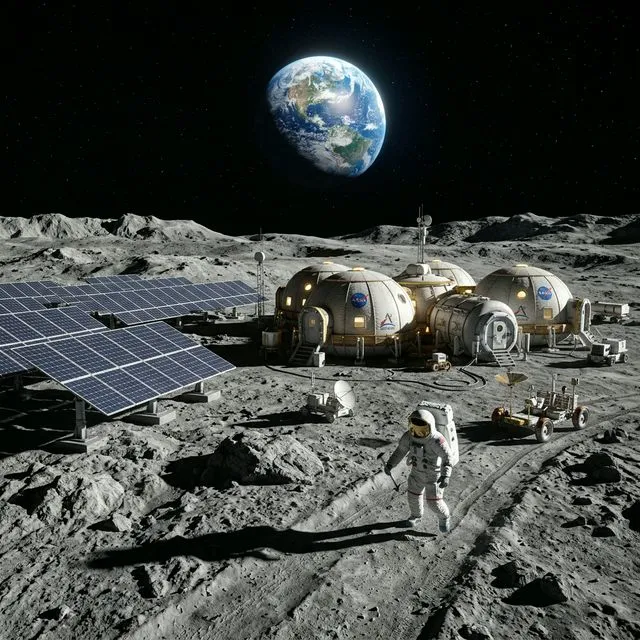
On March 24, 2026, Isaacman delivered his most ambitious promise. At a press conference at Kennedy Space Center, Florida, he revealed Program Ignition — NASA's most aggressive plan since the Apollo era, combining two goals that seemed to belong to the next century:
- A permanent habitable lunar base by end of 2028
- The first crewed mission to Mars with nuclear propulsion by 2030
"America didn't go to the Moon to plant a flag and come home," Isaacman declared. "This time, we're going to stay."
What Is Program Ignition
Ignition isn't a replacement for the Artemis program — it's its radical acceleration. While the original Artemis envisioned gradual lunar presence throughout the 2030s, Ignition compresses the timeline and adds Mars as a concrete objective with a defined date.
The program has three pillars:
Pillar 1: South Pole Lunar Base
The base will be built in Shackleton Crater, chosen for water ice, near-continuous solar energy on the crater rim, and radiation protection. Using Sierra Space inflatable modules (LIFE Habitat technology), the habitat will accommodate 4 astronauts in continuous permanence, expandable to 8.
Pillar 2: Nuclear Thermal Propulsion (NTP)
NASA will test the DRACO engine (Demonstration Rocket for Agile Cislunar Operations) in orbit, developed with DARPA and BWX Technologies. Nuclear propulsion is 2 to 5 times more efficient than chemical propulsion, cutting the Earth-Mars trip from 7-9 months to 3-4 months.
| Route | Chemical Propulsion | Nuclear Propulsion |
|---|---|---|
| Earth → Mars | 7-9 months | 3-4 months |
| Complete round trip | ~2.5 years | ~13-16 months |
Pillar 3: Crewed Mars Mission (2030)
The Mars mission will feature a crew of 4 astronauts, 13-16 months total duration (including 30 days on the Martian surface), using a modified SpaceX Starship with DRACO NTP propulsion.

The Budget and the Space Race Against China
Ignition has an estimated budget of $93 billion over five years (2026-2030), equivalent to ~2% of the US defense budget. China's International Lunar Research Station (ILRS), developed jointly with Russia, aims for construction beginning in 2028, making the competition more urgent than ever.
Key industrial partners include SpaceX ($14.2B), Boeing ($8.7B), Lockheed Martin ($6.3B), BWX Technologies ($3.1B), and Sierra Space ($2.8B).

Challenges and FAQ
Major challenges include nuclear safety in space, radiation exposure on Mars, crew psychology during 13+ month isolation, and political survival across administrations.
Is NASA really going to Mars in 2030?
That's the declared goal. Historically, NASA timelines experience 2-5 year delays. A crewed Mars mission between 2032-2035 is considered more realistic.
Is nuclear propulsion safe?
The reactor is only activated in space, eliminating launch risks. Nuclear propulsion was successfully tested by NASA in the 1960s-70s (Project NERVA).
Will China get there first?
Unlikely for the Moon (US has a 2-3 year lead). For Mars, the race is more open — China plans crewed missions "before 2035."
Sources and References
- NASA — Press Conference: "Program Ignition" (March 24, 2026)
- DARPA — DRACO Program Status Update (March 2026)
- Congressional Budget Office — "Cost Analysis: NASA Ignition Program" (2026)
- CNSA — International Lunar Research Station Roadmap 2026-2035


