
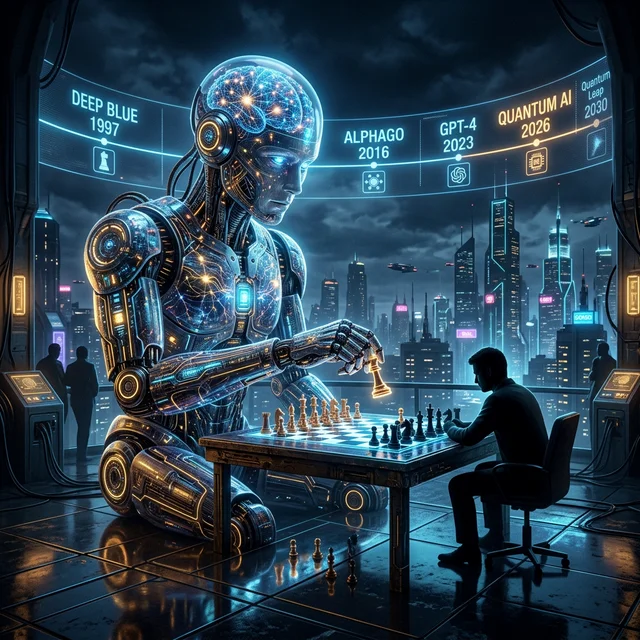
We are living through one of the greatest revolutions in human history — and most people still haven't realized how fast everything is changing. In 1997, when IBM's Deep Blue computer defeated world chess champion Garry Kasparov, the world was stunned. Nearly 30 years later, in 2026, Artificial Intelligence doesn't just beat humans at chess — it writes code better than most programmers, diagnoses diseases more accurately than experienced doctors, creates art that wins international competitions, and makes autonomous decisions that impact billions of lives daily.
This is not a surface-level article about "what is AI." This is a deep dive into the guts of the revolution we're living through: how the AI brain works compared to ours, exactly when the machine surpassed humans in each domain, what autonomous agents mean for the future of work, and why quantum computing may be the next existential threat — or next salvation — of civilization.
Biological Neurons vs. Artificial Neurons: A Comparison That Will Change How You See AI
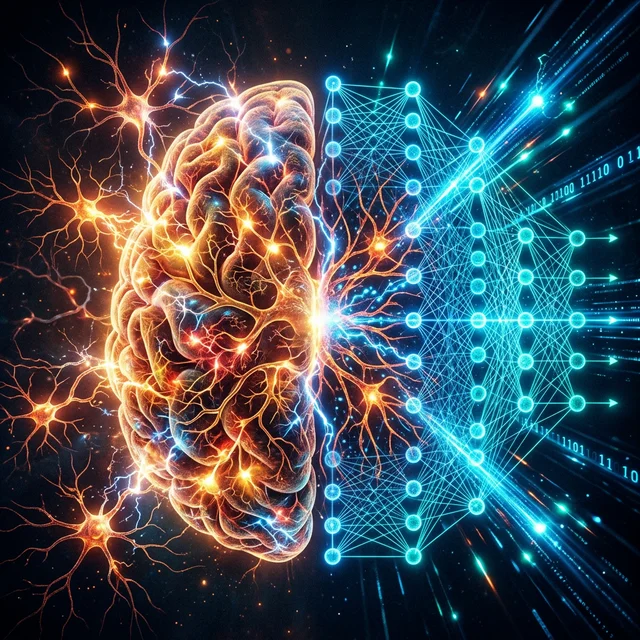
To understand the scale of what's happening, we first need to understand the most powerful tool nature ever created — the human brain — and how AI attempted to copy it.
The Human Brain: The Original Machine
The human brain contains approximately 86 billion neurons, each connected to other neurons by up to 10,000 synapses. This results in roughly 100 trillion synaptic connections — a number so vast it exceeds the number of stars in 1,000 Milky Way galaxies. Each synapse can transmit electrochemical signals at speeds of up to 120 meters per second, and the entire brain consumes only about 20 watts of energy — less than a light bulb.
The Artificial Neural Network: The Copy
An artificial neural network works in a fundamentally different way, despite the similar name. Instead of biological neurons, it uses mathematical nodes organized in layers. Each node receives numerical inputs, applies an activation function (like ReLU or sigmoid), and produces an output that feeds the next layer.
The Table That Reveals Everything
| Feature | Human Brain | Neural Network (GPT-5, 2026) |
|---|---|---|
| Neurons/Nodes | 86 billion | ~1.8 trillion parameters |
| Connections | ~100 trillion synapses | Trillions of weighted connections |
| Signal speed | 120 m/s (electrochemical) | 300,000 km/s (electric/optical) |
| Energy consumption | 20 watts | 1-10 megawatts (datacenter) |
| Time to learn to walk | ~12 months | Hours (in simulation) |
| Time to learn a language | 5-7 years | Weeks (with enough data) |
| Genuine creativity | ✅ Yes | ❌ Pattern recombination |
| Consciousness | ✅ Yes | ❌ No (philosophical debate) |
| Multitasking | Limited (2-3 tasks) | Unlimited (massive parallelism) |
| Long-term memory | ~2.5 petabytes estimated | Unlimited (with storage) |
| Energy efficiency | 🥇 Incomparable | 🔴 500,000x less efficient |
| Calculation speed | ~10¹⁶ operations/second | ~10¹⁸ operations/second |
The fundamental difference is not in quantity — it's in the nature of computation. The human brain is massively parallel and extremely energy-efficient. An artificial neural network is sequentially deep and brutally resource-intensive. The human brain consumes the equivalent of one banana per hour; training GPT-4 consumed energy equivalent to more than 10,000 American homes for a year.
But AI has an overwhelming advantage: raw speed and scalability. While a human needs 20 years to become a doctor, an AI can process every medical article ever published in history in a matter of days. And that advantage only grows with time.
There is also a fundamental difference in how these two systems learn. The human brain uses what neuroscientists call synaptic plasticity — connections between neurons strengthen or weaken based on experience, a continuous process that begins in the womb and only ends at death. An artificial neural network, on the other hand, learns through backpropagation — a mathematical algorithm that adjusts millions of numerical weights to minimize the error between the expected answer and the generated answer. It's like tuning an instrument with millions of strings at the same time.
The practical result is that AI can absorb the experience of thousands of human lifetimes in a matter of hours. A language model like GPT-5 was trained on texts representing the equivalent of reading 24 hours a day for thousands of years. No human being could accumulate that volume of information in a single lifetime, or even ten lifetimes. This difference in learning speed is what makes the competition between humans and AI increasingly unequal with each passing year.
The History of Machine Beating Man: From Chess to Total Supremacy
1997: Deep Blue vs. Kasparov — The Day Everything Changed
On May 11, 1997, in New York City, IBM's supercomputer Deep Blue defeated world chess champion Garry Kasparov 3½ to 2½ in a six-game match. It was the first time in history that a machine beat the world's best chess player under official tournament conditions.
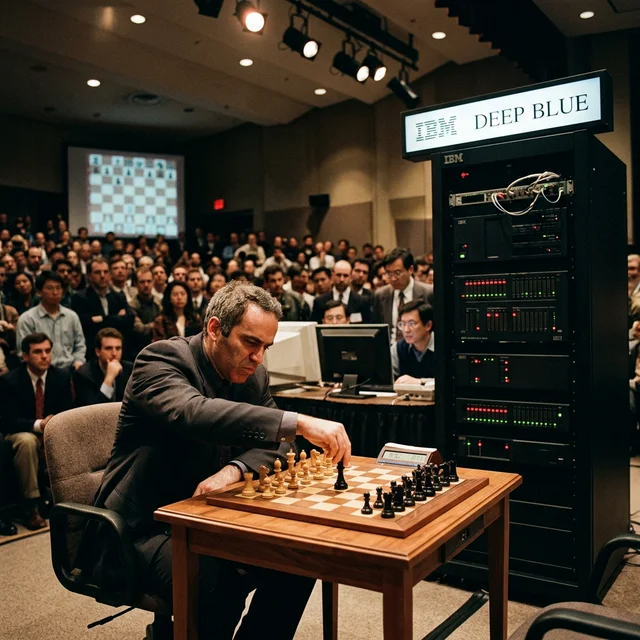
What makes this victory fascinating is how Deep Blue played. Unlike modern AI, Deep Blue used brute force: it could evaluate 200 million positions per second, combining specialized hardware (480 custom VLSI chips) with a database of 700,000 grandmaster games. It didn't learn — it calculated. Every decision was the result of an exhaustive search through the tree of possibilities, evaluating millions of possible lines of play before choosing the move that maximized its chances according to an evaluation function programmed by human beings.
Kasparov was so disturbed by the defeat that he accused IBM of cheating, suggesting a human was secretly helping the machine. Years later, Kasparov admitted that what truly defeated him was not the computational power itself, but the psychological pressure of playing against something that had no fear, never got tired, and never made errors from nervousness. IBM never allowed a rematch. The machine was dismantled and parts of it now reside at the Smithsonian Institution and the Computer History Museum.
The cultural impact of this defeat was immense. For the first time, humanity had to confront the idea that intelligence — or at least a very specific form of intelligence — was no longer exclusively human territory. Headlines in the world's largest newspapers announced that the era of human supremacy in chess was over. And they were right.
2016: AlphaGo vs. Lee Sedol — The Most Impressive Moment
If Deep Blue was the first crack in the armor of human supremacy, AlphaGo was the earthquake. In March 2016, Google DeepMind's AI system defeated South Korean champion Lee Sedol 4-1 in the game of Go — a game that experts believed was impossible for computers to master within decades. Go has astronomical complexity: while chess has approximately 10⁴⁷ possible positions, Go has over 10¹⁷⁰ — a number that exceeds the number of atoms in the observable universe by an absurd factor. The tree of possibilities in Go is so vast that brute force simply doesn't work. AlphaGo had to learn something that seemed to require genuine human intuition.
Even more impressive: AlphaZero, released in 2017, learned to play chess from absolute zero — without seeing a single human game — and in just 4 hours of self-play training surpassed the Stockfish engine, which was the result of decades of human optimization. AlphaZero played millions of games against itself, independently discovering strategic principles that humans took centuries to understand, and in some cases, inventing strategies no human had ever conceived.
What Would a Human Need to Beat Chess AI Today?
In 2026, the question is no longer "can AI beat humans at chess" — it's how impossible it has become for any human to beat an AI. Look at the numbers:
| Player/Engine | Elo Rating | Position |
|---|---|---|
| Stockfish 17 (AI, 2026) | ~3,700 | Strongest engine |
| AlphaZero (AI, Google DeepMind) | ~3,600 | Learned chess in 4 hours |
| Leela Chess Zero (AI, open source) | ~3,500 | Neural network |
| Magnus Carlsen (human, 2024) | 2,882 | Best human ever |
| Garry Kasparov (human, peak 1999) | 2,851 | Second best ever |
| Strong amateur | ~1,800 | Club level |
The 800+ Elo point difference between Stockfish and Magnus Carlsen means that in a series of 1,000 games, the human would probably win zero. The AI doesn't just play better — it plays in a completely different dimension. To put this in perspective, the difference between Magnus Carlsen and a strong amateur is about 1,000 Elo points. The difference between Stockfish and Carlsen is almost as large. This means that, to the AI, the best human chess player in the world is practically equivalent to an intermediate-level player.
For a human to honestly beat Stockfish 17, they would need a set of circumstances that borders on the impossible: the engine would need to be limited to evaluating only one or two positions per second instead of 100 million, its opening database would need to be erased, and the human would need unlimited time while the AI has only seconds per move. Even with all these restrictions, the AI would probably still draw most games.
Anti-Computer Tactics: What Never Really Worked
There's a fascinating theory in the chess world called "Anti-Computer Tactics" (or "Computer Bashing"), popularized by grandmasters who faced chess engines in the 2000s. The idea was to use closed and static positions, where positional evaluation (something humans were historically better at) matters more than tactical calculation (where AI dominates). The reasoning was simple: if you don't allow the computer to use its tactical advantage, perhaps you can exploit it in positions that require deep strategic understanding.
Grandmasters like Hikaru Nakamura and Vladimir Kramnik experimented with these techniques in exhibition matches against weaker engines. The strategy partially worked against 2005-2010 era engines, which relied heavily on tactical search and had positional evaluation programmed by humans. However, modern neural network engines (like AlphaZero and Leela Chess Zero) completely eliminated this weakness by learning positional evaluation in a superhuman way — precisely because they learned by playing millions of games against themselves, developing a positional sense that no human can match.
The Complete Timeline: When AI Surpassed Humans
| Year | Milestone | What Happened | Significance |
|---|---|---|---|
| 1997 | Deep Blue vs. Kasparov | AI wins at chess | First victory in a strategy game |
| 2011 | Watson (IBM) on Jeopardy! | AI wins at general knowledge quiz | Natural language processing |
| 2016 | AlphaGo vs. Lee Sedol | AI wins at Go (4-1) | Go has 10¹⁷⁰ possible positions — considered impossible for AI |
| 2017 | AlphaZero | Learned chess from scratch in 4 hours and beat Stockfish | Self-supervised learning |
| 2019 | AlphaStar | AI reaches Grandmaster level in StarCraft II | Real-time strategy with incomplete information |
| 2020 | GPT-3 | Texts that humans can't distinguish from human writing | Language generation |
| 2021 | AlphaFold 2 | Predicts structure of 200 million proteins | Revolution in biology/medicine |
| 2022 | DALL-E 2 / Stable Diffusion | AI generates art that wins human competitions | Visual art |
| 2023 | GPT-4 | Passes medical, law, and MBA exams | Advanced reasoning |
| 2024 | Devin (Cognition AI) | First autonomous "AI software engineer" | Autonomous programming |
| 2025 | Autonomous Agents | AIs make decisions and execute tasks without supervision | Operational autonomy |
| 2026 | Quantum AI (first tests) | Combination of quantum computing + AI | Potential for exponential disruption |
The pattern is clear: each new frontier that seemed exclusively human was conquered by AI in increasingly shorter intervals. In chess, AI took 50 years (1950-1997). In Go, 20 years. In art, 5 years. In autonomous programming, 2 years. This exponential acceleration shows no signs of slowing down, and the emergence of quantum computing threatens to compress these timelines even further.
Autonomous Agents: The AI That Works 24/7 Without Sleeping, Without Complaining, Without Stopping
What Differentiates an Autonomous Agent from a Chatbot
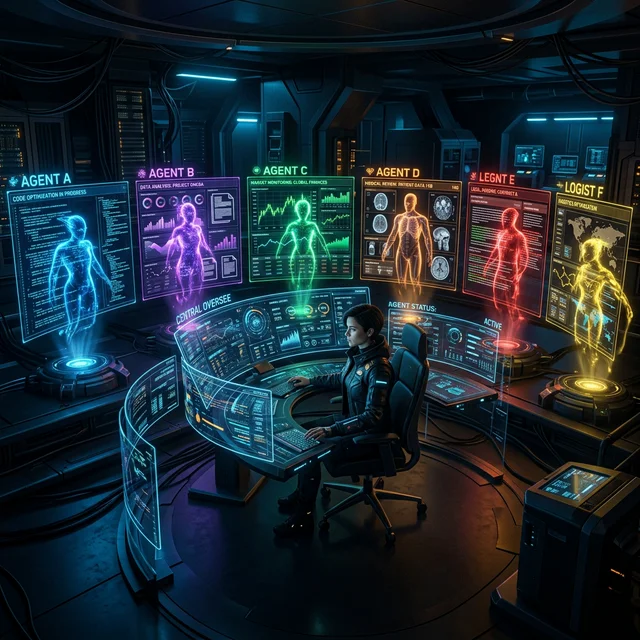
The most transformative leap of 2025-2026 isn't a bigger or faster model — it's the emergence of autonomous AI agents. While a chatbot (like the original ChatGPT) was a question-and-answer tool, an autonomous agent is a digital entity that takes on objectives and acts to achieve them. It can browse the web, write and execute code, manage files, interact with APIs, send emails, and make decisions — all without human intervention for each individual step.
Think of it this way: a chatbot is like a consultant who answers questions when asked. An autonomous agent is like hiring a full-time employee who receives a project brief and executes it end-to-end, reporting back only when finished or when they encounter something they can't resolve on their own.
How Much an Agent Learns vs. How Much a Human Learns
This comparison is devastating:
| Learning Metric | Human Being | AI Agent |
|---|---|---|
| Hours to master basic programming | ~10,000 (Mastery Rule) | 100-500 hours of training |
| Time to read all of Wikipedia | ~10 years of constant reading | ~2 hours |
| Medical papers processed per day | 5-10 (a good researcher) | All of PubMed (37 million+) |
| Fluent languages | 2-5 (exceptional polyglot) | 100+ simultaneously |
| Improvement with practice | Logarithmic (diminishing returns) | Linear/exponential (data = improvement) |
| Knowledge transfer | Irreplicable (each person learns from scratch) | Instantaneous (copy the weights) |
| Availability | 8-12 productive hours/day | 24/7/365 |
| Consistency | Variable (fatigue, emotion, mood) | 100% consistent |
The last item — knowledge transfer — is the most transformative. When a human specializes in an area for 20 years, that knowledge dies with them (unless they write books or teach). When an AI learns something, all copies of the AI instantly know the same thing. It's as if training one doctor automatically trained every doctor in the world simultaneously. This represents a paradigm shift in how knowledge accumulates and propagates through civilization.
Productivity Comparison: Human vs. Agent Team
| Task | Team of 5 Humans | 1 Human + 5 AI Agents | Difference |
|---|---|---|---|
| Develop a complete app | 3-6 months | 2-4 weeks | 5-8x faster |
| Analysis of 10,000 contracts | 6 months | 48 hours | 90x faster |
| Create marketing campaign | 2-3 weeks | 2-3 days | 7x faster |
| Complete market research | 4-6 weeks | 6-12 hours | 30x faster |
| Translate site into 20 languages | 2 months | 4 hours | 360x faster |
The economic implications are staggering. According to Goldman Sachs research, generative AI could automate the equivalent of 300 million full-time jobs globally. But this doesn't necessarily mean 300 million people lose their jobs — rather, the nature of work transforms fundamentally. The humans who learn to direct, supervise, and collaborate with AI agents will be exponentially more productive than those who don't.
Professions AI Has Already Eliminated — And What's Next
Jobs Already Destroyed or Drastically Reduced
The impact of AI on the job market is no longer theoretical — it is measurable and accelerating. In every sector, from creative industries to financial services, AI tools have dramatically reduced the number of human workers needed for routine tasks. The following professions have already experienced significant workforce reductions directly attributable to AI automation.
| Profession | Status in 2026 | What Happened |
|---|---|---|
| Telemarketer | 🔴 -70% of positions | AI chatbots handle 80% of Tier 1 calls |
| Translator (commercial) | 🔴 -60% of demand | DeepL, Google Translate, ChatGPT replaced commercial translation |
| Data entry clerk | 🔴 -85% | OCR + AI eliminates manual entry |
| Supermarket cashier | 🟡 -40% | Self-checkout + Amazon Go |
| Stock photographer | 🔴 -80% | Midjourney, DALL-E generate images for pennies |
| Basic content writer | 🔴 -65% | AI generates articles, posts, marketing emails |
| Junior financial analyst | 🟡 -50% | AI processes reports and spreadsheets automatically |
| Entry-level graphic designer | 🟡 -45% | AI generates logos, layouts, banners |
| Driver (testing phase) | 🟡 Pilot | Waymo and Cruise robotaxis in select cities |
| Junior programmer | 🟡 -30% | Copilot, Cursor and code agents |
What AI Does Better — And INCREASINGLY Better
The rate of AI improvement is what's truly alarming. It's not just good — it's getting exponentially better every month. The improvement curve is not linear but exponential. Every 18 months, AI roughly doubles its capability across a wide range of benchmarks. This follows a variant of Moore's Law adapted for AI, which researchers call the Scaling Laws: more data plus more computation equals more intelligence, in a predictable way.
| Benchmark | 2020 | 2023 | 2026 | Improvement |
|---|---|---|---|---|
| MMLU (general knowledge) | 43% | 86% (GPT-4) | 95%+ (GPT-5) | 2.2x in 6 years |
| HumanEval (programming) | 28% | 67% | 92% | 3.3x |
| MathOlympiad (advanced math) | 5% | 25% | 75% | 15x |
| Medical imaging diagnosis | 85% | 92% | 97.3% | Surpasses doctors |
| Translation BLEU Score | 35 | 45 | 55+ | Human level |
| Functional code generation | 15% | 50% | 85% | 5.7x |
Quantum Computing + AI: The Next Step That Could Change Everything
What Is Quantum Computing (Real Explanation, No Superficiality)
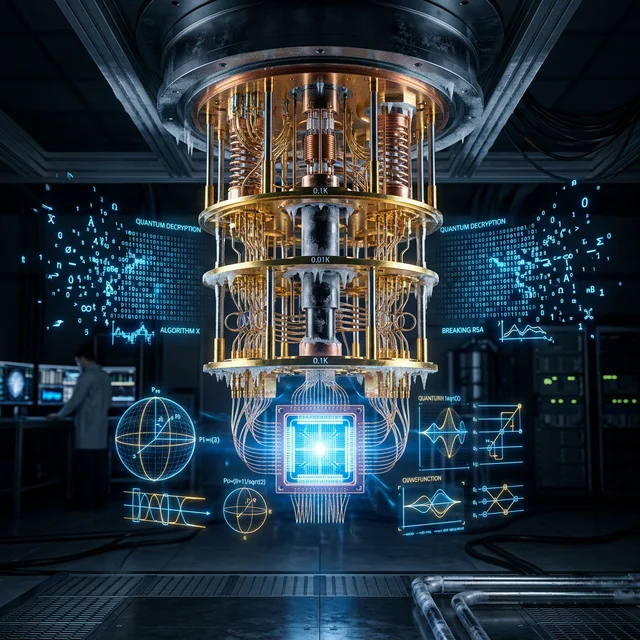
While a classical computer uses bits (0 or 1), a quantum computer uses qubits that can exist in a state of superposition — being 0 and 1 simultaneously. This allows a 1,000-qubit quantum computer to explore 2^1000 states at the same time — a number with more than 300 digits, larger than the number of atoms in the observable universe.
But superposition is only part of the story. Quantum computers also leverage entanglement — a phenomenon Einstein famously called "spooky action at a distance" — where two qubits become correlated in ways that have no classical equivalent. When you measure one entangled qubit, you instantly know the state of its partner, regardless of the distance between them. Combined with quantum interference, these properties allow quantum computers to find solutions to certain problems exponentially faster than any classical computer ever could.
The 5 Existential Risks of Quantum AI
| Risk | Severity | Timeline | Description |
|---|---|---|---|
| Breaking encryption | 🔴 Catastrophic | 5-10 years | Shor's algorithm can break RSA, destroying all modern digital security |
| Super-intelligent AI | 🔴 Existential | 10-20 years | Quantum AI with reasoning beyond human comprehension |
| AI arms race | 🟡 High | Already underway | US, China, and Russia investing billions in quantum military AI |
| Radical inequality | 🟡 High | 5-15 years | Countries with quantum computers dominate; others become irrelevant |
| Autonomous weapons | 🔴 Catastrophic | 5-10 years | Drones and missiles with quantum AI making life-and-death decisions |
"Q-Day": The Day Encryption Dies
Cybersecurity experts call "Q-Day" the moment a quantum computer will be able to break RSA-2048 encryption, which protects virtually all digital communication on the planet — from bank transactions to government secrets.
Estimates range from 2030 to 2040, but there's a terrifying risk called "Harvest Now, Decrypt Later": governments like China and Russia are capturing and storing encrypted communications today, waiting to have powerful enough quantum computers in the future to decrypt them. Your "secure" message from 2026 could be read in 2035.
The transition to post-quantum cryptography (using algorithms resistant to quantum attacks, like CRYSTALS-Kyber and CRYSTALS-Dilithium) has already begun, but it's a race against time. NIST (the US National Institute of Standards and Technology) published its first post-quantum standards in 2024, but migrating global infrastructure will take a decade or more.
The Human Factor: What AI Still CAN'T Do (And Perhaps Never Will)
Despite all of AI's technical supremacy, there are domains where human beings remain irreplaceable — at least for now. The philosopher Mary Midgley described the difference between intelligence and consciousness as "the difference between navigating with a map and actually being in the ocean." AI has the most detailed map ever created — but it's not in the ocean.
| Human Capability | AI Status | Why It's Hard for AI |
|---|---|---|
| Consciousness | ❌ Nonexistent | Unsolved philosophical problem (Hard Problem of Consciousness) |
| Genuine empathy | ❌ Simulates, doesn't feel | No qualia, no subjective experience |
| Disruptive creativity | 🟡 Partial | AI recombines; humans invent new categories |
| Contextual humor | 🟡 Partial | Humor requires deep cultural understanding and timing |
| Moral judgment | ❌ Does not possess | AI optimizes objective functions, not moral values |
| Physical intuition | 🟡 Improving | Robotics advancing but far from human dexterity |
| Emotional bonds | ❌ Simulates | No real emotional reciprocity |
Projections for 2030-2040: Possible Scenarios
Optimistic Scenario: AI as Humanity's Partner
- AI solves climate change by optimizing energy grids and discovering new clean energy materials
- Personalized medicine cures cancer, Alzheimer's, and diabetes through AI-designed drugs
- Universal Basic Income funded by the enormous productivity gains from AI
- Humans work less, create more, and live better lives focused on meaning rather than survival
- Quantum computing discovers new materials and technologies that transform industry
Realistic Scenario: Chaotic Transition
- 200-400 million workers need to reskill globally, creating enormous social friction
- Rich countries monopolize advanced AI; global inequality explodes as developing nations fall behind
- Fragmented regulation creates a patchwork: the EU AI Act versus American laissez-faire versus Chinese state control
- Deepfakes and disinformation powered by AI undermine democracies and erode public trust
- Professions transform faster than humans can adapt, creating a painful generational divide
Pessimistic Scenario: AI Out of Control
- Autonomous AI makes military decisions without human oversight, leading to catastrophic escalation
- Quantum computing destroys encryption before the post-quantum migration is complete
- Structural unemployment of 25-30% without adequate social safety nets leads to widespread unrest
- Power concentrates in the three to five companies that control the frontier models
- Artificial superintelligence emerges before humanity is prepared to align it with human values
What to Do In the Face of All This
For individuals, the path forward requires developing skills that AI cannot replicate: genuine empathy, creative leadership, physical dexterity in specialized trades, and the ability to work alongside AI agents as a supervisor and director rather than competing against them. Diversifying income sources beyond a single automatable profession is no longer optional advice — it's survival strategy.
For governments and society, the imperative is equally clear. Educational systems must stop training people for jobs that won't exist in ten years and start cultivating adaptable, creative thinkers. Robust social safety nets, whether through Universal Basic Income or equivalent mechanisms, need to be established before mass displacement hits, not after. International treaties banning autonomous weapons and regulating superintelligence development are no longer science fiction concerns — they are urgent policy needs.
Conclusion: The Future Doesn't Wait
AI is already smarter than humans at specific tasks. Autonomous agents already work 24/7 without fatigue. Quantum computing threatens to destroy all digital security we know. Entire professions are being eliminated at unprecedented speed.
But what makes this moment unique in human history is not the threat — it's the opportunity. The same AI that destroys jobs can cure incurable diseases. The same quantum computing that threatens encryption can discover materials to save the planet. The same autonomous agents that replace workers can free humanity from repetitive, draining work.
The question is not whether AI will transform the world. It already is. The question is: are we prepared for the world it's creating?
If the answer is "no" — it's time to start. The future has already begun.
Read Also
- Will AI Steal Your Job? The Viral 80 Million Views Essay
- AI in 2026: The 10 Breakthroughs Transforming the World
- Quantum Computing vs Blockchain: Is Your Bitcoin Safe?
- Humanoid Robots: The 2026 Revolution
- Brain Chips: Neuralink and the Future of the Human Mind
References and Sources
- IBM Archives — Deep Blue vs. Kasparov 1997
- Nature — AlphaGo: Mastering the Game of Go
- DeepMind — AlphaZero: Shedding New Light on Chess
- MIT Technology Review — The State of AI 2026
- McKinsey Global Institute — Future of Work in 2030
- Goldman Sachs — Generative AI and 300 Million Jobs
- NIST — Post-Quantum Cryptography Standards
- World Economic Forum — Future of Jobs Report 2025
- Stanford HAI — AI Index Report 2025
- FIDE — Official Chess Ratings


