
"Nothing that can be done on a computer is safe in the medium term." This statement by Matt Shumer, CEO of OthersideAI, amassed 80 million views in February 2026 and ignited the decade's biggest debate about the future of work. While tech companies lay off thousands, engineers describe their new roles as "AI agent supervisors." Lawyers use AI for legal research. Designers ask Midjourney to create what used to take weeks. Translators watch their clients migrate to DeepL and ChatGPT.
The future of work isn't coming. It's already here. And it's arriving faster than any forecast dared to predict.
The Essay That Scared 80 Million People
In February 2026, Matt Shumer published an essay that went viral with 80 million views. His central thesis:
"AI now does work better than humans. Nothing that can be done on a computer is safe in the medium term."
The timing was perfect: February 2026 saw a massive wave of tech layoffs, and software engineers — once the world's most valued professionals — began describing their roles as "directing AI agents."
The essay hit nerves society had been trying to ignore. It wasn't just about programmers — it was about anyone whose work involves a computer. Accountants, copywriters, designers, analysts, lawyers, even doctors in diagnostic imaging. The list of "safe" professions shrank dramatically.

The Numbers of the Professional Apocalypse
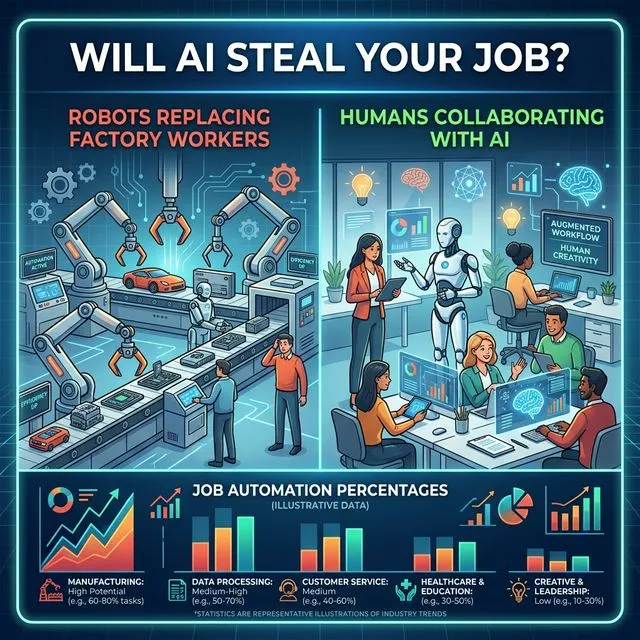
Jobs at Risk by Sector
| Sector | Automation Risk | Timeline | Global jobs at risk |
|---|---|---|---|
| Customer service | 🔴 95% | 1-2 years | 23 million |
| Translation/Writing | 🔴 90% | 1-3 years | 8 million |
| Data analysis | 🔴 85% | 2-4 years | 15 million |
| Basic programming | 🟡 70% | 2-5 years | 12 million |
| Graphic design | 🟡 65% | 3-5 years | 5 million |
| Accounting | 🟡 60% | 3-5 years | 18 million |
| Digital marketing | 🟡 55% | 3-5 years | 10 million |
| Legal (research) | 🟡 50% | 3-5 years | 4 million |
| Medicine (diagnosis) | 🟢 30% | 5-10 years | 3 million |
| Physical labor | 🟢 20% | 10+ years | Minimal |
Goldman Sachs estimated in 2023 that generative AI could affect 300 million jobs globally. In 2026, that estimate looks conservative. McKinsey Global Institute updated to 400-500 million workers needing to change roles by 2035.
What's Already Happening
Tech Mass Layoffs (2025-2026)
| Company | Layoffs | Stated Reason |
|---|---|---|
| Meta | 11,000+ | "Operational efficiency" |
| 12,000+ | "AI restructuring" | |
| Amazon | 18,000+ | "Optimization" |
| Microsoft | 10,000+ | "Strategic alignment" |
| SAP | 8,000+ | "AI transformation" |
| Various startups | 50,000+ | "AI does the work of 5 people" |
| Total estimated Tech | 260,000+ (2023-2026) | — |
Engineers Became "AI Supervisors"
The new role of the software engineer in 2026:
- ❌ Writing code from scratch
- ✅ Describing needs to AI agents
- ✅ Reviewing AI-generated code
- ✅ Directing multiple agents working in parallel
- ✅ Fixing "hallucinations" and bugs AI can't solve alone
A senior Google engineer reported anonymously: "My job is now 70% prompt engineering and 30% code review. I write maybe 100 lines of code per week — it used to be 2,000. AI does the rest."
Real-World Replacement Cases
| Company | What AI replaced | Result |
|---|---|---|
| Duolingo | 10% of translation contractors | Laid off in 2024 |
| Klarna | Customer service (700 agents) | AI does work equivalent to 700 humans |
| Chegg | Educational platform | Stock dropped 98% after ChatGPT |
| BuzzFeed | Content writing | Laid off 15% of writers |
| IBM | HR functions | Stopped hiring for 7,800 positions |
The Age of AI Agents: The Tipping Point
What changed in 2025-2026 wasn't just AI quality — it was the emergence of autonomous AI agents. Unlike chatbots that answer questions, agents:
- Plan: Receive complex objectives and create execution plans
- Execute: Open browsers, edit files, send emails, write code
- Iterate: Test their own work, identify errors, and fix them
- Coordinate: Multiple agents work together on parallel projects
This means a single developer with 5 agents can produce the output of a 10-15 person team. An analyst with research agents processes data that previously required an entire department.
AI Cost vs. Human Cost
| Task | Human Cost | AI Cost | Savings |
|---|---|---|---|
| Write an article (2000 words) | $200-600 | $1-3 | 99% |
| Legal research (10 hours) | $2,000 | $20 | 99% |
| Logo design (full process) | $1,000-5,000 | $10-50 | 99% |
| Translate document (50 pages) | $2,000 | $10 | 99.5% |
| 24/7 support (1 month) | $5,000/agent | $80 | 98.4% |
When the cost difference is 99%, no company resists the transition out of morality. It's a matter of competitive survival.
5 Types of Work AI CAN'T Replace
| Type | Why It's Safe | Examples |
|---|---|---|
| Original creative work | AI combines existing patterns; humans invent new ones | Avant-garde artists, inventors |
| Relational/empathetic work | Genuine human connection is irreplaceable | Therapists, nurses, teachers |
| Complex physical work | Robotics still limited in unstructured environments | Plumbers, electricians, surgeons |
| Ethical decision-making | AI lacks moral consciousness | Judges, religious leaders, mediators |
| Leadership | Inspiring and motivating people requires humanity | Visionary CEOs, coaches, mentors |
The "AI Isn't Creative" Fallacy
A popular argument is that "AI isn't truly creative." This is technically true — AI recombines existing patterns. But the reality is that most "creative" work in the economy doesn't require genuine creativity. Creating an Instagram post, writing ad copy, designing a corporate website layout — all of this is pattern recombination, and AI does it better, faster, and cheaper.
The creativity that remains exclusively human is disruptive creativity: inventing new categories, breaking paradigms, creating art that touches deep human emotions. That's a tiny fraction of the "creative work" in the market.
The Universal Basic Income (UBI) Debate
With hundreds of millions of jobs threatened, the Universal Basic Income debate has moved from academia to the center of global politics.
| Country | UBI Status | Proposal |
|---|---|---|
| 🇫🇮 Finland | Experiment completed (2017-2018) | €560/month — improved well-being |
| 🇪🇸 Spain | "Ingreso Mínimo Vital" active | €462-1,015/month per family |
| 🇺🇸 USA | Pilots in 30 cities | $500-1,000/month — positive results |
| 🇧🇷 Brazil | Bolsa Família expanded | R$600/month — UBI foundation |
| 🇰🇷 South Korea | Under parliamentary debate | ₩500,000/month proposal |
Sam Altman (OpenAI CEO) and Elon Musk are public UBI advocates. The logic: if AI eliminates jobs but generates unprecedented wealth, that wealth must be redistributed. Without UBI or an equivalent mechanism, the result is extreme capital concentration in companies that control AI, with mass unemployment for everyone else.
How to Protect Yourself
5-Step Strategy
- Learn to use AI — If you can't beat it, join it. Master ChatGPT, Claude, Copilot, Midjourney
- Develop skills AI lacks — Disruptive creativity, genuine empathy, inspirational leadership
- Become an "AI supervisor" — Learn prompt engineering and agent orchestration
- Invest in physical skills — Jobs requiring physical presence and manual dexterity are safer
- Diversify income — Don't depend on a single computer-based income source
The Education Paradox
The educational system trains people for jobs that are being destroyed. In 2026:
- Universities continue teaching basic programming that ChatGPT does better
- Marketing courses teach skills AI automates in minutes
- Law schools train legal researchers AI replaces for pennies
The necessary revolution in education is eliminating focus on repeatable technical skills and prioritizing critical thinking, creativity, emotional intelligence, and ambiguous problem-solving — the only competencies AI cannot replicate.
The Global AI Competition
| Country | AI Investment 2026 | Focus | Leading AI Model |
|---|---|---|---|
| USA | $200B+ | Frontier models, defense | GPT-5, Claude, Gemini |
| China | $150B+ | Sovereign AI, manufacturing | Qwen, DeepSeek |
| EU | $50B+ | Regulation, ethical AI | Mistral, AI Act |
| India | $20B+ | AI outsourcing, startups | Krutrim |
Impact on Developing Countries
AI disproportionately threatens developing nations:
- India depends on BPO (outsourcing) that AI directly replaces — 4 million jobs at risk
- Philippines is the world's largest call center hub — 1.3 million agents threatened
- Africa may lose its "industrialization window" if automated factories eliminate the cheap labor advantage
AI could create a scenario where wealth concentrates in 5-6 countries that control frontier models, while the rest of the world becomes passive technology consumers — a new form of digital colonialism.
Conclusion: Adapt or Disappear
AI won't end all jobs. But it will end every job that an algorithm can do better than a human. And that list is growing exponentially.
The 18th-century industrial revolution eliminated artisans but created factory workers. The 20th-century digital revolution eliminated typists but created programmers. The 21st-century AI revolution is eliminating programmers — and nobody knows for certain what will come in their place.
The most optimistic estimates say AI will create more jobs than it destroys. The most pessimistic say we'll have 30% structural unemployment in 15 years. The truth is probably in the middle — but the middle is already scary enough.
The question you should ask yourself isn't "Will AI steal my job?" The right question is: "What do I do that AI can't?"
If the answer is "nothing" — it's time to change. Now.


